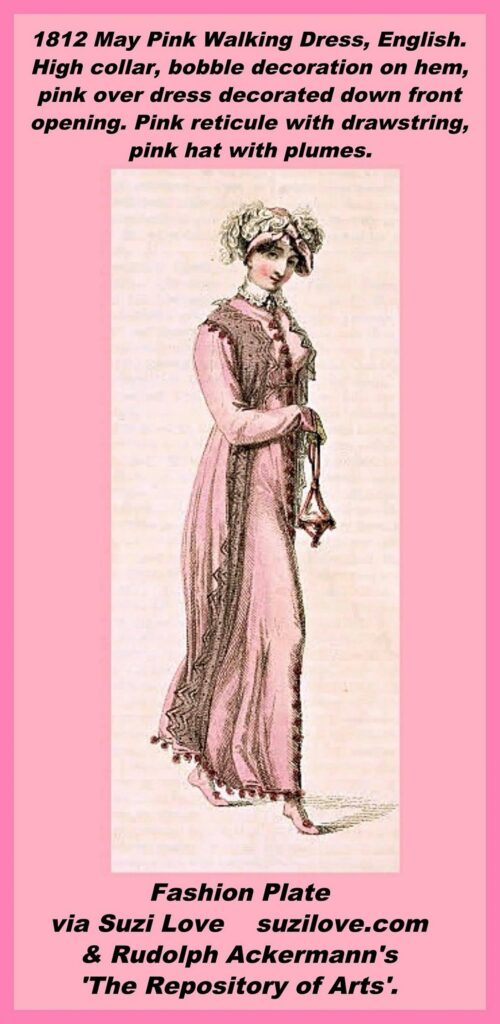
1812 May Pink Walking Dress, English. Coat is called a ‘Spencer Robe’ in the description and the fabric is sarcenet in blossom color. High collar, bobble decoration on the hem, pink sleeveless pelisse dress trimmed with a tufted Chinese silk fringe. The deep vandyke black lace is a loose Polonaise style that sits over the collar of the white muslin dress. The provincial muslin bonnet has two curled white ostrich feathers on the front. Half-boots are of pink kid, gloves are lemon or pale tan kid, and pink reticule, or ridicule or bag, has a drawstring. Fashion Plate via Rudolph Ackermann’s ‘The Repository of Arts’.
Definition Pelisse, Redingote, Or Walking Dress: Jane Austen and her contemporaries wore long coats like these to keep warm when out and about, visiting, shopping etc. The thin muslin dresses worn in the early 1800s were little protection against European winters.
Definition Reticule Or Ridicule Or Bag Or Purse: Because reticules were so popular, Jane Austen and her family and friends would have made reticules for each other for gifts and carried these small purses with them whenever they went out.
Definition Aigret, Aigrette, Egret: Plume of feathers or jeweled ornament in shape of feathers worn on head or hats. During the early 19th century., or Jane Austen’s lifetime, the favorite feathers were osprey and heron.
1812 May Pink Walking Dress With Coat in Jane Austen Style. #JaneAusten #RegencyFashion #HistoricalFashion https://books2read.com/SuziLoveFashion1810-1814
Policing in the 17th and 18th centuries – one unarmed able-bodied citizen in each parish a man was appointed or elected annually to serve for a year unpaid as parish constable.
Worked in co-operation with the local Justices in observing laws and maintaining order.
In towns, responsibility for the maintenance of order was conferred on the guilds
Later conferred on other specified groups of citizens
These supplied bodies of paid men, known as The Watch
The Watch guarded the gates and patrolled the streets at night
Huge social and economic changes and increases in town populations meant parish constables and Watch systems couldn’t cope.
In 1812, 1818 and 1822, Parliamentary committees investigated crime and policing.
Impotence of the law-enforcement machinery was a serious menace
Conditions became intolerable and led to the formation of the New Police
The Metropolitan Police
Established by an Act of Parliament in 1829 by Sir Robert Peel
Peel appointed 2 Commissioners
Appointed 895 Constables, 88 Sergeants, 20 Inspectors and 8 Superintendents.
Superseded the local Watch in the London area but the City of London was not covered.
Numbers increased
Grew to include the Greater London area (excluding the City of London)
Included parts of the Home Counties and all Royal Naval Dock Yards throughout the country.
First officer was given the warrant number ‘1’
Today the service is reaching near to a quarter million
The warrant number is unique to the officer
Different from the shoulder number which changes as the officer moves stations. Scotland Yard
Colonel Charles Rowan and Richard Mayne organized and designed the New Police
The two Commissioners occupied a private house at 4, Whitehall Place
The back opened on to a courtyard and used as a police station
This address led to the headquarters of the Metropolitan Police being known as Scotland Yard.
Sir Robert Peel, 2nd Baronet, (5 February 1788 – 2 July 1850) British Conservative statesman who served twice as Prime Minister of the United Kingdom, Chancellor of the Exchequer, and Home Secretary. Regarded as the father of modern British policing as he founded the Metropolitan Police Service.
Other Police organizations
Some older police establishments remained outside control of the Metropolitan Police Office
The Bow Street Patrols, mounted and foot, commonly called the Bow Street runners.
Police Office constables attached to the offices of, and under the control of, the Magistrates.
The Marine or River Police.
By 1839 all these establishments had been absorbed by the Metropolitan Police Force.
The City of London Police was set up in 1839 and is an independent force to this day.
1800s Early The Metropolitan Police In Jane Austen and Bridgerton Years, London. #JaneAusten #Bridgerton #BritishHistory #RegencyEra #police #London books2read.com/suziloveROver
Rates of Postage of single Letters in Pence In Great Britain in Jane Austen’s times.
From any post-office in England or Wales, to any place not exceeding 15 miles from such office – 3
For any distance above 15, and not exceeding 30 miles — 4
For any distance above 30, and not exceeding 50 miles — 5
For any distance above 50, and not exceeding 80 miles – 6
For any distance above 80, and not exceeding 12O miles — 7
For any distance above 120, and not exceeding 170 miles – 8
For any distance above 170, and not exceeding 230 miles — 9
For my distance above 230, and not exceeding 300 miles – 10
For any distance above 300, and not exceeding 400 miles – 11
For any distance above 400, and nut exceeding 500 mites – 12
1802 Picture of London Printed for R. Phillips via Google Books (PD-180)
The Twopenny Post- Office.
There are two principal offices, one in the General Post—office yard, Lombard—street and the other in Gerrard-street, Soho. There are also numerous receiving houses in both the town and country.
There are SI X collections and deliveries of letters in town daily, (Sundays excepted) and there are two dispatches from, and three deliveries at, most places in the country, within the limits of this office.
1802 Picture of London Printed for R. Phillips via Google Books (PD-180)
1802 Rates Of Postage Of Single Letters In Pence. From: 1802 Picture of London Printed for R. Phillips via Google Books (PD-180))
Rates of Postage of single Letters in Pence In Great Britain in Jane Austen’s times. #JaneAusten #RegencyEra #Postal #BritishHistory https://books2read.com/suziloveROver
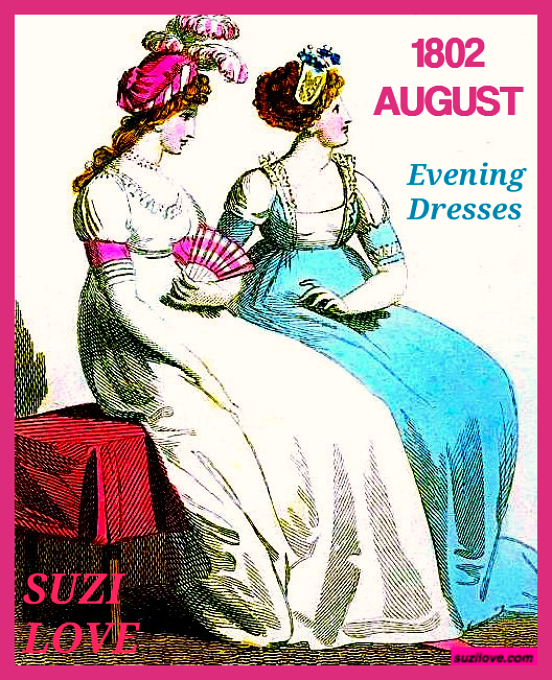
1802 August. Two Ladies in Evening Dresses in the high-waisted, or Empire line, styles worn By Jane Austen. White dress with pink trim, pink fan, and pink plumed headdress. Aqua blue dress with white bodice and a blue trimmed evening headdress.
The Empire dress which evolved in the late 1790s began as a chemise shift gathered under the breasts and at the neck. Named after the First Empire in France, by 1800 Empire dresses had a very low décolleté, or neckline and a short narrow backed bodice attached to a separate skirt. Skirts started directly under the bust and flowed into the classical relaxed wide styles of Greece and Rome.
Definition Aigret, aigrette, egret: Plume of feathers or jeweled ornament in shape of feathers worn on head or hats. During the early 19th century, or Jane Austen’s lifetime, or during the years of the Bridgerton series, the favorite feathers were osprey and heron.
1802 August. Two Ladies in Evening Dresses In the Styles Worn By Jane Austen. #RegencyFashion #HistoricalFashion #JaneAusten https://books2read.com/SuziLoveFashionWomen1801-1804
1821 December Green Promenade Dress, English. High waisted coat over white dress with ruffled collar, vertical front bows, short puffed sleeves over long straight sleeves, matching ruffled bonnet and yellow gloves. Fashion Plate via Rudolph Ackermann’s ‘The Repository of Arts’, London, U.K.
Pleasure House Ball: Brenton, Lord Mallory, attends his first courtesan’s ball in ten years to appease his concerned friends, though he’d rather stay home and read to his motherless daughter. Though mortified that Brenton unmasks her at a scandalous ball, Lady Lillian Armstrong doesn’t regret their night together. Book 3 Irresistible Aristocrats books2read.com/suzilovePHB
Excerpt
‘Brent, why are you eager for me to risk a repeat of my miserable marriage?’ Lady Lillian asked. ‘When you’ve declared that you’ll never marry again.’
‘Because you’re a woman and I’m a man.’
Lillian’s eyes narrowed. ‘That’s a very biased view, and I thought you better than that.’
Brent groaned. ‘You’re right. It’s unfair to tell you to risk more unhappiness when I won’t.’
‘Everyone knows you’re avoiding your family because they push eligible ladies towards you. They want you to remarry and give your daughter a new mother.’
‘They’ve no right to interfere in our lives, mine or my daughter’s. We’re happy as we are, the two of us.’
‘Your wife hurt you, deeply, and so you’ve refused to even speak to the women your mother thinks suitable.’
‘I speak to you.’
‘Only because I visit you and drag you away from your house to go riding. I refuse to let you retreat from the world. You’re a wonderful man with a lot to give to another woman. To another wife.’
‘You’re the only lady that I can tolerate being near for more than ten minutes.’
‘And you’re the only man I’d select for a second husband, and you’re against marriage.’ She looked towards a group of men smoking at the far end of the verandah. ‘Hence my venture into the unknown tonight. The sedate balls are full of married men or old lechers, as all the exciting men are here instead.’ She pointed towards the cluster of five or six young men. ‘Perhaps one of them might be the boost I need to restore my faith in the male gender. A virile young man who knows about pleasurable sex.’
He scowled as he watched the young men laugh and slap each other on the back. ‘Those pups are too inexperienced to give a woman pleasure. At that age, it’s all over too quickly. You need someone who will leave you limp with pleasure.’ He shook his head and seemed to collect himself.
Lillian swallowed. She didn’t doubt that Brent knew many ways to make sex exciting and unforgettable, but there was no point imagining herself with him when she knew how studiously he avoided contact with women these days. Well, except for her and his cook.
‘Not all men are cruel,’ he was saying when she paid attention to his words rather than the way his trousers stretched across his groin when he had his hands on his hips and his coat tails pulled aside. ‘Some husbands value their wives and treat them like queens.’
She sighed. ‘A nice thought, Brent, but unless you can introduce me to one of those paragons of husbands, I’m reduced to finding my excitement with one of the gentlemen here tonight.’
PHB_Lord Mallory, attends first courtesan’s ball in years to appease concerned friends. http://books2read.com/suzilovePHB
Book Hooks: ‘Why are you eager for me to risk a repeat of my miserable marriage?’ Lady Lillian asked. #RegencyRomance #HistRom #ReadARegency #EroticRomance books2read.com/suzilovePHB
1800s Early Typical Regency Gentleman Riding His Horse. Fashions In The Time Of Jane Austen.
From the finish of the 18th century until 1820, men’s fashions in European and European-influenced countries moved away from the formal wear of brocades, lace, wigs and powder to more informal and relaxed styles. Focus was on undress rather than formal dress. Typical menswear in the early 1800s included a tailcoat, a vest or waistcoat, either breeches, pants, or the newer trousers, stockings, shoes or boots, all worn with an overcoat and hat. This basic ensemble was accessorized with some form of neckcloth or cravat, gloves, walking stick, cane or riding crop, handkerchief, fobs, watch and perhaps a quizzing glass or eye glass.
1800s Early A Gentleman Riding His Horse.
In 1806, the Journal des Dames et des Modes stated, ‘The informal outfit for a young man includes a coat of similar style, snug pantaloons which are probably knitted, and a striped waistcoat.’
Skirted coats were replaced with short-fronted, or cutaway, tailcoats worn over fitted waistcoats and plain, white linen shirts. Knee breeches were gradually replaced by tight-fitting pantaloons and later trousers, decorative shoes with buckles were replaced with a variety of boot styles, and fussy and ruffled neckwear gave way to intricately tied, white linen neck cloths. A Regency Era, or early 1800s, gentleman was outfitted in more practical fabrics, such as wool, cotton and buckskin rather than the fussy brocades and silks of the late 1700s.
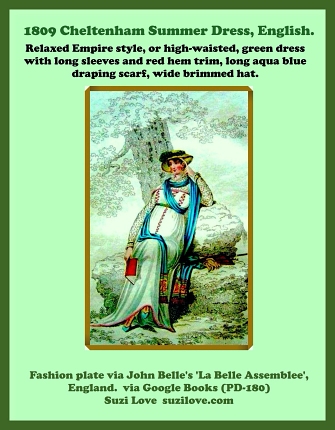
1809 Cheltenham Summer Dress, English. Relaxed Empire style high-waisted green dress with long sleeves and red hem trim, long aqua blue draping scarf, wide brimmed hat and holding a red book. Fashion Plate via John Belle’s ‘La Belle Assemblee’, London.
Seaside clothing was very popular. High-waisted dresses, usually of white muslin, were loose and flowing for the summer heat but ladies could easily add colorful accessories, such as shawls, hats, and parasols. In the early 1800s, it was fashionable to parade along the shorefront or in parks, to see and be seen. These are the sort of ensembles that Jane Austen and her family and friends would have worn at seaside towns or at sea bathing resorts.
Fashion Women 1805-1809 History Notes Book 26 What did Jane Austen and friends wear? This book looks at early 1800s fashions, which were elegant and pretty with high waists and fabrics that were almost transparent. These Empire style gowns, named after Napoleon’s first Empress, became popular throughout Europe, and were then copied around the world. Colorful outwear was added to make an ensemble more attractive and warmer. https://books2read.com/SuziLoveFashionWomen1805-1809
Fashion Women 1805-1809 History Notes Book 26 What did Jane Austen and friends wear? https://books2read.com/SuziLoveFashionWomen1805-1809
1808 ca. Jane Austen style high-waisted muslin dress with bib front, British. High stomacher front, i.e. a bib front fastened with pins, and embroidered with clusters of flowers and leaves. Embroidery satin stitch, chain stitch and French knots. Dress of muslin, embroidered in wool with a design of flowers and leaves down the sleeves and across the front of the dress. The bodice back and side fronts are lined with linen and there are linen undersleeves. The front of the bodice is made up of a panel of bias-cut muslin, which is sewn onto the skirt rather like the bib of an apron so that it can be placed in position at the neck with pins. When the pins are removed the bib front falls away to reveal linen underflaps which fasten across the bust to give support. This type of bodice construction was common during this period in this style of dress and is known as the high stomacher front.
Embroidered with clusters of flowers and leaves and embroidery is worked in satin stitch, chain stitch and French knots, the design trails down across the front of the dress and around the scalloped hemline to simulate a draped tunic-style garment slit up the side seam. Front bodice has panel of bias-cut muslin sewn onto skirt like the bib of an apron so that it can be placed in position at the neck with pins. When the pins are removed the bib front falls away to reveal linen underflaps which fasten across the bust to give support. Bib front bodice construction was common in the Regency Era, or Jane Austen’s years, in this style of dress and is known as the high stomacher front. via Victoria and Albert Museum, London, U.K.
. Fashion Women 1805-1809 History Notes Book 26 What did Jane Austen and friends wear? https://books2read.com/SuziLoveFashionWomen1805-1809
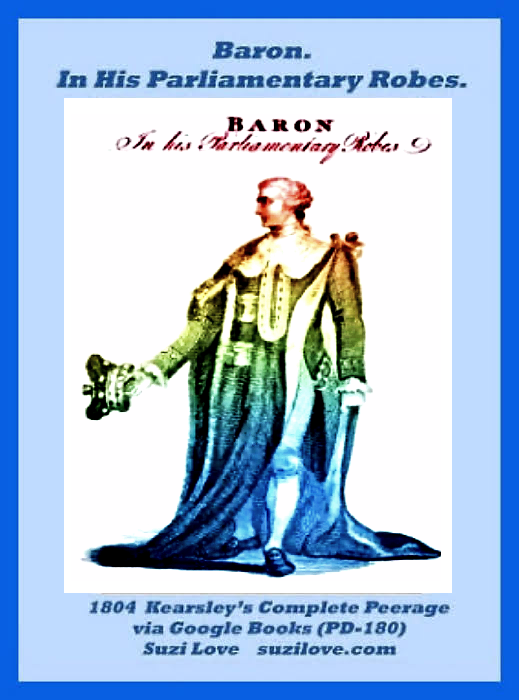
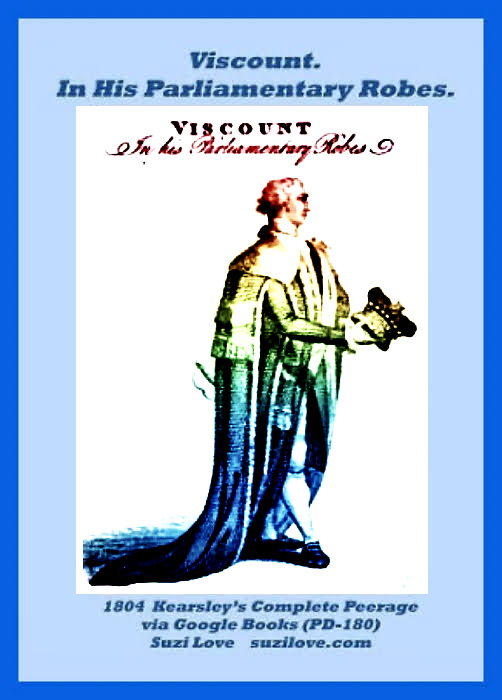
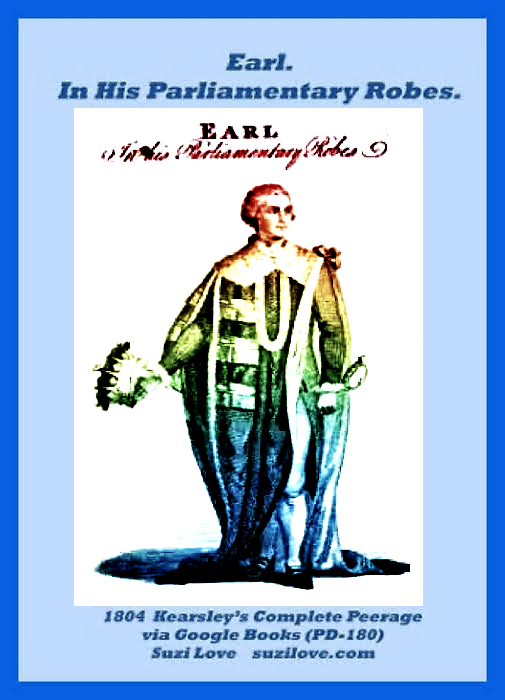
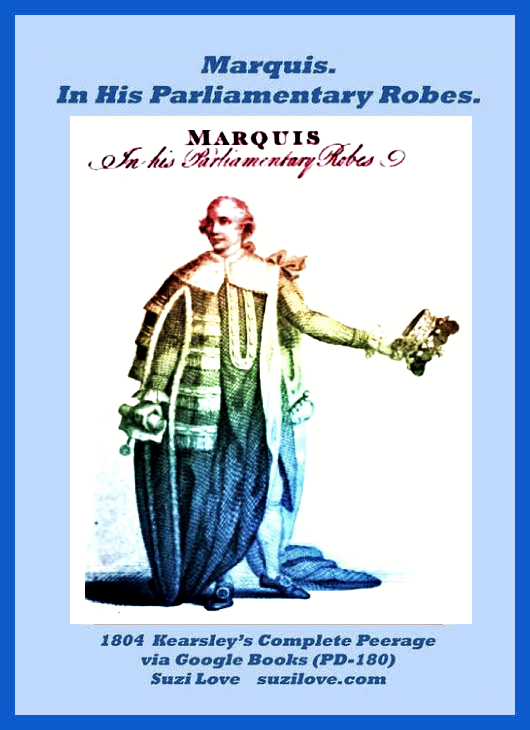
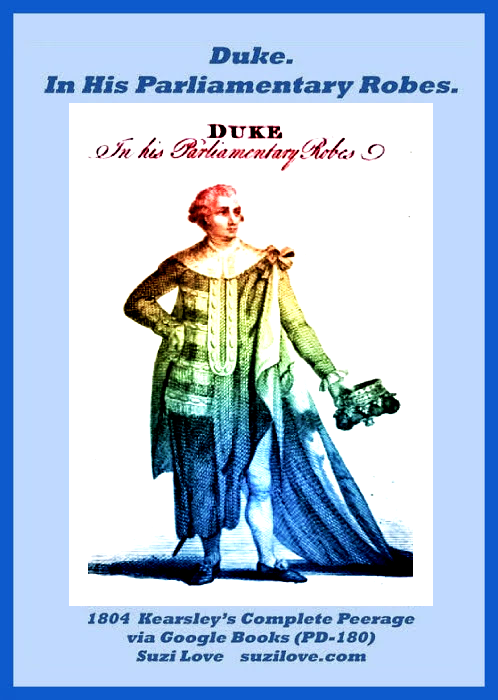
1804 Parliamentary Robes For Titled Men from the King downwards. 1804 Kearsley Complete Peerage of England, Scotland, Wales.
1804 Kearsley’s Complete Peerage. Google Books (PD-180)1804 Baron in his parliamentary robes. via Kearsley’s Complete Peerage. via Google Books (PD-200)1804 Viscount in his parliamentary robes. via Kearsley’s Complete Peerage. via Google Books (PD-200)1804 Earl in his parliamentary robes. via Kearsley’s Complete Peerage. via Google Books (PD-200)1804 Marquis in his parliamentary robes. via Kearsley’s Complete Peerage. via Google Books (PD-200)1804 Duke in his parliamentary robes. via Kearsley’s Complete Peerage. via Google Books (PD-200)RL_1_D2D_Regency Overview RetailerLinks
https://books2read.com/suziloveROver