What was fashionable for women in Jane Austen’s times? Mourning, riding, daytime, evening clothing, plus underclothing, corsets and accessories. Wars were being fought so women adopted military looks in support of soldiers. https://books2read.com/SuziLoveFashion1810-1814 History Notes Book 27 Women’s Fashions 1810-1814.
These are the types of outfits worn by Jane Austen and contemporaries in English magazines, where French fashions were obsessively copied despite the two countries being at war for many years. In Jane Austen’s years, she and her contemporaries spent a lot of time walking outdoors. People were encouraged to partake in outdoor pursuits to maintain good health. Fragile slippers were worn for balls and evening events but for walking sturdier shoes were needed, In the early 1800s, these were typically made of leather, had a very small heel, slightly rounded toes and were laced up on the top.
1827 ca. Gentleman’s Dressing Box, London. Mahogany box with brass carrying handles, lid opens to velvet and leather interior with twelve engraved silver topped bottles, all with an engraving of an oak tree. Top tray lifts out to another tray of tools.
1827 ca. Gentleman’s Dressing Box, London. Mahogany box with brass carrying handles, lid opens to velvet and leather interior with twelve engraved silver topped bottles, all with an engraving of an oak tree. Top tray lifts out to another tray. via Antique Tea Caddies, U.K. 1827 ca. Mahogany Gentleman's Dressing Box With Silver Topped Bottles, London. #Regency #Antiques #London. books2read.com/suziloveBoxesCases Share on XHN_11_D2D_Craftsmen created containers of precious metals, leather, silks, and decorated them with jewels to make exquisite and expensive items as well as practical carrying cases. books2read.com/suziloveBoxesCases
1812 June Couple In Fashionable Walking Dress, English. Lady wears a green cape and hat over a high-waisted, or Empire style, white dress with a pink parasol. Man wears a tailcoat over fawn breeches, yellow gloves, black shoes and hat and a walking stick. Fashion Plate via The Lady’s Magazine Or Entertaining Companion for the Fair Sex.
By the end of the 18th century, tailored garments for both men and women were replaced by styles made for ease and comfort, resulting in the neoclassical style of the 1780s. Inspired in part by the statuary of ancient Greece and Rome, the new fashion was epitomized by light cotton gowns falling around the body in an unstructured way, held around the high waist with a simple sash and accompanied by a soft shawl draped around exposed shoulders. This style was ideal for the Indian imports like Kashmiri shawls and Bengali muslin, as used in this embroidered gown.
1780 ca. Gold Silk Banyan, British. For at-home wear, a gentleman had a dressing gown, often with a matching waistcoat, and an undress cap or turban. “This yellow damask banyan with its bold Chinese Chippendale ā inspired pattern would have been an imposing sight on the streets or in the drawing rooms of London.” via Metropolitan Museum New York City, U.S.A. metmuseum.org Credit: Catharine Breyer Van Bomel Foundation Fund, 1978 Accession Number:1978.135.1
From the Curator: ‘For at-home wear, a gentleman had a dressing gown, often with a matching waistcoat, and an undress cap or turban.As for breeches, they were not designed especially for this casual ensemble, but rather borrowed from other suits.The dressing gown was cut like a manās loose coat and usually hung to the floor, though there were also versions that stopped below the knees. Since there were no fastenings, the wearer overlapped the dressing gown in front when he walked so that the sides did not billow out behind him.The sleeves were originally rolled back to form cuffs, but later dressing gowns display the fashionable cuff of their period.In England these dressing gowns were called “banyans” or “Indian nightgowns” because of their kimono-like form and Eastern origin. Banyans were made in a variety of fabrics, including silk brocades, damasks, and printed cottons. By the 1780s, gentlemen ventured out of doors in this comfortable and stylish costume. According to Town and Country Magazine in 1785: “Banyans are worn in every part of the town from Wapping to Westminster, and if a sword is occasionally put on it sticks out of the middle of the slit behind. This however is the fashion, the ton, and what can a man do? He must wear a banyan.”This yellow damask banyan with its bold Chinese Chippendale ā inspired pattern would have been an imposing sight on the streets or in the drawing rooms of London.’ via Metropolitan Museum New York City, U.S.A. metmuseum.org
What was fashionable for women in Jane Austen’s times? Mourning, riding, daytime, evening clothing, plus underclothing, corsets and accessories. Fashion Women 1810-1814 History Notes Book 27 This book looks at what was fashionable for women in Jane Austen’s times, or the early 1800s, or the Regency Era in Britain. Wars were being fought around the globe so women’s fashion adopted a military look in support of soldiers. Fashions, like the lifestyle, became progressively more extravagant and accessories went from colorful to over-the-top. https://books2read.com/SuziLoveFashion1810-1814
The Ladyās Magazine said of the basis of womenās fashion that was popular for the first twenty years of the 1800s, āWhite is still the prevailing color for robes. For morning dresses, linen gowns, in large diamonds or squares, are fashionable. Indian muslins, plain or embroidered, are preferred to Florence and satins. The designs of embroidery for shawls are of infinite variety. Long gloves, which reach above the elbow, are not yet laid aside. Medallions are hung around the neck from crossed chains and some of these medallions are shaped like the bags, called ridicules. These reticules are of the lozenge or hexagon shape, with a small tassel at each angle. Reticules, or ridicules, are in lozenge or hexagon shapes with a small tassel at each angle. In capotes, or hats, and ribbands, the violet and dark green prevail over jonquil. Bracelets in hair, pear-shaped ear-rings, medallions on square plates, saltiers of colored stones, are still in fashion.ā
1805 November Three English Ladies In Full Dress. White walking dress with high neck under a purple tunic and masculine style straw hat. Two in evening dresses, one white and one pink, fur stoles and plumed, or feathered, hats. via Vernon and Hood Poultry at The Ladyās Monthly Museum, London, U.K. These gorgeous dresses show the transition from the round dresses of the late 1700s to the Empire style dresses with the waistline high under the bust. Small trains were still worn in the early 1800s, but much more manageable than the larger and more elaborate trains of the late 1700s. Jane Austen and her friends would have worn dresses like this to their assemblies and evening events.
Definition Accessory: An accessory completes and complements an outfit. Two groups ā 1. Those worn e.g. bonnets, caps and hats, boots and shoes, cravats and ties, gloves, mittens and muffs, jewelry, scarves and shawls, socks and stockings. 2. Those carried e.g. bags, fans, and parasols.
Definition Full Dress: The most formal and complete ensemble, worn for day or night events, and includes the fullest range of accessories that could be added to the outfit to make the most impressive display.
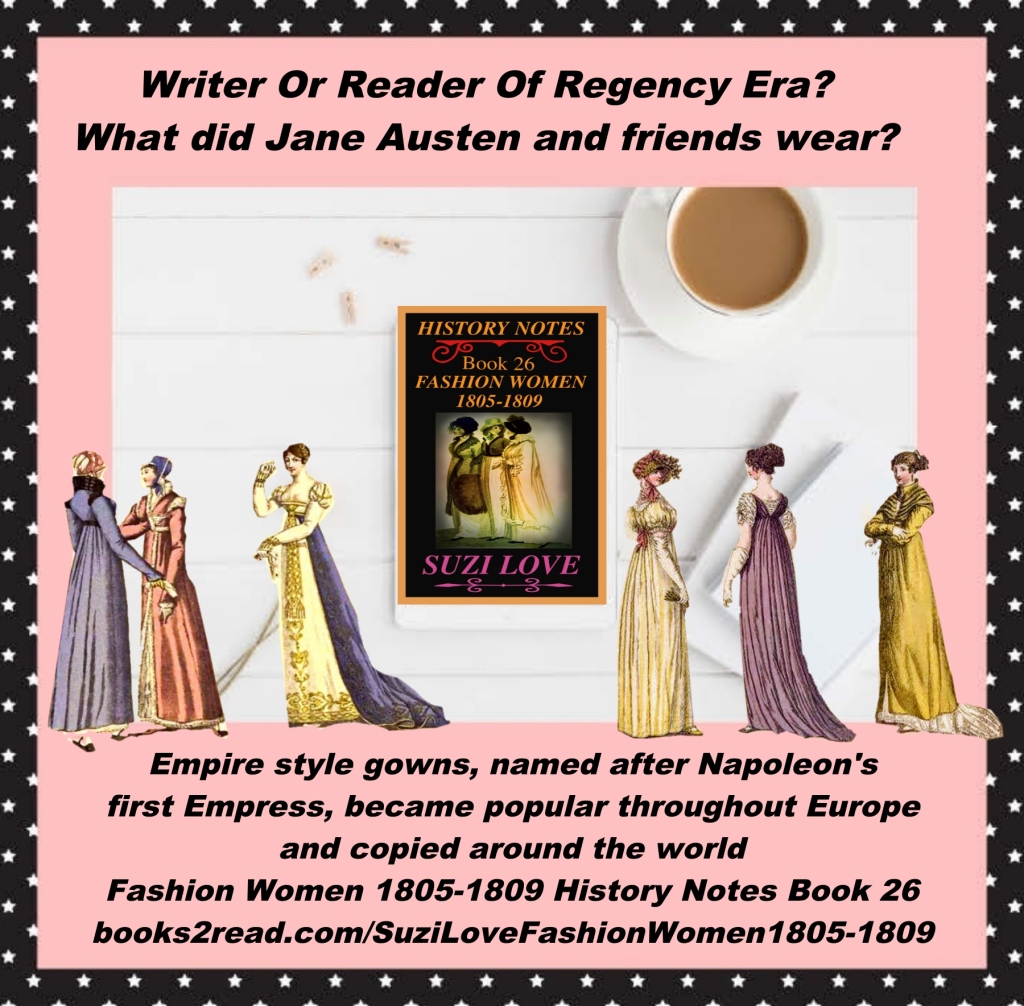
1805 November Three English Ladies In Full Dress. White walking dress with high neck under a purple tunic and masculine style straw hat. Two in evening dresses, one white and one pink, fur stoles and plumed, or feathered, hats. via Vernon and Hood Poultry at The Ladyās Monthly Museum, London, U.K.1805 November Typical Jane Austen Fashions With Accessories, English. #RegencyFashion #HistoricalFashion #JaneAusten https://books2read.com/SuziLoveFashionWomen1805-1809 Share on XFashion Women 1805-1809 History Notes Book 26
What did Jane Austen and friends wear? This book looks at early 1800s fashions, which were elegant and pretty with high waists and fabrics that were almost transparent. These Empire style gowns, named after Napoleon’s first Empress, became popular throughout Europe, and were then copied around the world. Colorful outwear was added to make an ensemble more attractive and warmer.
https://books2read.com/SuziLoveFashionWomen1805-1809
Drama and romance at the Duke Of Sherwyn’s snowbound country estate in the English countryside in December. Michael Brandon travels to introduce the woman he loves to family but is shocked when his missing brother, presumed dead for years, arrives at the country estate of the Duke Of Sherwyn where several people are stranded due to a severe snow storm. https://books2read.com/suziloveDS December Scandal, Book 3 Scandalous Siblings.
Policing in the 17th and 18th centuries – one unarmed able-bodied citizen in each parish a man was appointed or elected annually to serve for a year unpaid as parish constable.
Worked in co-operation with the local Justices in observing laws and maintaining order.
In towns, responsibility for the maintenance of order was conferred on the guilds
Later conferred on other specified groups of citizens
These supplied bodies of paid men, known as The Watch
The Watch guarded the gates and patrolled the streets at night
Huge social and economic changes and increases in town populations meant parish constables and Watch systems couldn’t cope.
In 1812, 1818 and 1822, Parliamentary committees investigated crime and policing.
Impotence of the law-enforcement machinery was a serious menace
Conditions became intolerable and led to the formation of the New Police
The Metropolitan Police
Established by an Act of Parliament in 1829 by Sir Robert Peel
Peel appointed 2 Commissioners
Appointed 895 Constables, 88 Sergeants, 20 Inspectors and 8 Superintendents.
Superseded the local Watch in the London area but the City of London was not covered.
Numbers increased
Grew to include the Greater London area (excluding the City of London)
Included parts of the Home Counties and all Royal Naval Dock Yards throughout the country.
First officer was given the warrant number ā1ā
Today the service is reaching near to a quarter million
The warrant number is unique to the officer
Different from the shoulder number which changes as the officer moves stations. Scotland Yard
Colonel Charles Rowan and Richard Mayne organized and designed the New Police
The two Commissioners occupied a private house at 4, Whitehall Place
The back opened on to a courtyard and used as a police station
This address led to the headquarters of the Metropolitan Police being known as Scotland Yard.
Sir Robert Peel, 2nd Baronet, (5 February 1788 ā 2 July 1850) BritishĀ ConservativeĀ statesman who served twice asĀ Prime Minister of the United Kingdom,Ā Chancellor of the Exchequer, andĀ Home Secretary. Regarded as the father of modernĀ British policing as he founded theĀ Metropolitan Police Service.Ā
Other Police organizations
Some older police establishments remained outside control of the Metropolitan Police Office
The Bow Street Patrols, mounted and foot, commonly called the Bow Street runners.
Police Office constables attached to the offices of, and under the control of, the Magistrates.
The Marine or River Police.
By 1839 all these establishments had been absorbed by the Metropolitan Police Force.
The City of London Police was set up in 1839 and is an independent force to this day.
1819 January Two Fashion Plates By Dean and Mundy For Mourning: Winter Carriage and Evening Dresses. High-waisted carriage dress, cuffs edged with white lace and trimmed with gray frog closures, matching plumed hat and shawl. Empire style evening dress with short sleeves and wide neckline trimmed with scallops of white lace, skirt trimmed with white rosettes, evening upswept hairstyle. Fashion Plates Published by Dean and Munday, 1819, London.
Mourning wear was worn in Britain during the regency Era, firstly for Princess Charlotte who died in England on November 6th, 1817, or then for Queen Charlotte, wife of King George III and grandmother of Princess Charlotte, who died on November 17th, 1818. All the fashion magazines featured numerous outfits in black suitable for mourning, followed by many for half mourning in colors of grey, black with touches of white, and later mauve or lavender.
Black was worn for full mourning with various other colors were worn during the months of half mourning, including grey and mauve. However, as black dresses, black tunics, and black lace shawls were popular throughout the Regency years, it is often hard to decide what was definitely made for mourning and what was simply fashionable wear.
After the death of H.R. H. Princess Charlotte on November 7th, 1817, official court mourning was ordered. ‘The ladies to wear black bombazines, plain muslin or long lawn crape hoods, shamoy shoes and gloves, and crape fans. The gentlemen to wear black cloth without buttons on the sleeves or pockets, plain muslin or long lawn cravats and weepers, shamoy shoes and gloves, crape hat bands, and black swords and buckles.’ Two months later, a change of mourning attire was ordered.
1819 January. Winter Carriage and Evening Dresses. High-waisted carriage dress, cuffs edged with white lace and trimmed with gray frog closures, matching plumed hat and shawl. Empire style evening dress with short sleeves and wide neckline trimmed with scallops of white lace, skirt trimmed with white rosettes, evening upswept hairstyle. Mourning wear for Princess Charlotte who died in England in 1817 or for another member of the Royal family. Fashion Plate Published by Dean and Munday, London. 1819 January. Winter Carriage and Evening Dresses, London, U.K. High-waisted carriage dress, trimmed with front closures, matching plumed hat. Empire style evening dress with tiny sleeves and wide neckline trimmed with white lace on sleeves, skirt trimmed with rows of frills. Fashion Plate Published by Dean and Munday, 1819, London. 1819 January Mourning Fashion Plates By Dean and Mundy London: Winter Carriage and Evening Dresses. #Regency #Mourning #Fashion https://books2read.com/SuziLoveFashionWomen1815-1819 Share on XHN_28_D2D_FashionWomen 1815-1819
1800s Typical Cold Collation Dishes served during the 1800s. These are the sort of dishes Jane Austen’s family would have eaten on a regular basis. Pigeon Pie, Raised Game Pie, Cutlets and Peas, Prawn Bouquet, Creamed Chicken, Plover’s Eggs, Lamb Cutlets, Stuffed Larks, Piped Ham, Boned Capon. From: 1860 Mrs. Isabella Beeton’s Book of Household Management.
1800s Typical Cold Collation Dishes. Pigeon Pie, Raised Game Pie, Cutlets and Peas, Prawn Bouquet, Creamed Chicken, Plover’s Eggs, Lamb Cutlets, Stuffed Larks, Piped Ham, Boned Capon. From: 1860 Mrs. Isabella Beeton’s Book of Household Management.
1800s Typical Cold Collation Dishes Served In Households Like Jane Austen’s During The Regency Era. #Food #Regency #BritishHistory #JaneAusten