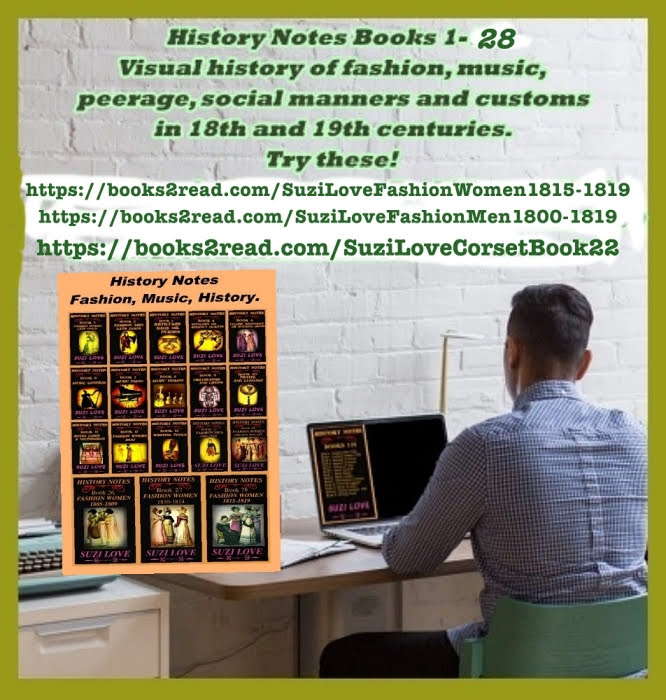
Do you need more factual and visual information for your historical fiction? History of fashion, music, peerage and customs in 18th and 19th centuries. Non-fiction series full of gorgeous pictures and engraved fashion plates. A visual history of fashion, music, peerage, social manners and customs from late 1700s to late 1800s, or 18th and 19th centuries.
I love these snippets from Captain Gronow’s Recollections 1864. Even though they were written after the Regency, they give us fun bits of information about Almack’s Assembly Rooms, the Prince Regent or later King George IV.
“Good society at the period to which I refer was, to use a familiar expression, wonderfully “select.” At the present time one can hardly conceive the importance which was attached to getting admission to Almack’s, the seventh heaven of the fashionable world. Of the three hundred officers of the Foot Guards, not more than half a dozen were honoured with vouchers of admission to this exclusive temple of the beau monde; the gates of which were guarded by lady patronesses, whose smiles or frowns consigned men and women to happiness or despair. These lady patronesses were the Ladies Castlereagh, Jersey, Cowper, and Sefton, Mrs Drummond Burrell, now Lady Willoughby, the Princess Esterhazy, and the Countess Lieven.
Almack’s: Exclusive temple of the beau monde. The gates of which were guarded by the lady patronesses,The Ladies Castlereagh, Jersey, Cowper, Sefton, Willoughby, Princess Esterhazy, and Countess Lieven.
From Captain Gronow’s Recollections 1864.
The most popular amongst these grandes dames was unquestionably Lady Cowper, now Lady Palmerston. Lady Jersey’s bearing, on the contrary, was that of a theatrical tragedy queen; and whilst attempting the sublime, she frequently made herself simply ridiculous, being inconceivably rude, and in her manner often ill-bred. Lady Sefton was kind and amiable, Madame de Lieven haughty and exclusive, Princess Esterhazy was a hon enfant, Lady Castlereagh and Mrs Burrell de tres grandes dames.
Many diplomatic arts, much finesse, and a host of intrigues, were set in motion to get an invitation to Almack’s. Very often persons whose rank and fortunes entitled them to the entree anywhere, were excluded by the cliqueism of the lady patronesses; for the female government of Almack’s was a pure despotism, and subject to all the caprices of despotic rule: it is needless to add that, like every other despotism, it was not innocent of abuses.
Almack’s
The fair ladies who ruled supreme over this little dancing and gossiping world, issued a solemn proclamation that no gentleman should appear at the assemblies without being dressed in knee-breeches, white cravat, and chapeau bras.
From Captain Gronow’s Recollections 1864.
1815 The First Quadrille at Almack’s Assembly Rooms, London. Left to Right: Marquis of Worcester, Lady Jersey, Clanronald MacDonald and Lady Worcester. “It was not until 1815 that Lady Jersey introduced from Paris the favourite quadrille, which has so long remained popular. I recollect the persons who formed the very first quadrille that was ever danced at Almack’s: they were Lady Jersey, Lady Harriett Butler, Lady Susan Ryde, and Miss Montgomery; the men being the Count St Aldegonde, Mr Montgomery, Mr Montague, and Charles Standish.” From The Reminiscences of Captain Gronow 1810-1860.RL_1_D2D_Regency Overview RetailerLinks
https://books2read.com/suziloveROver
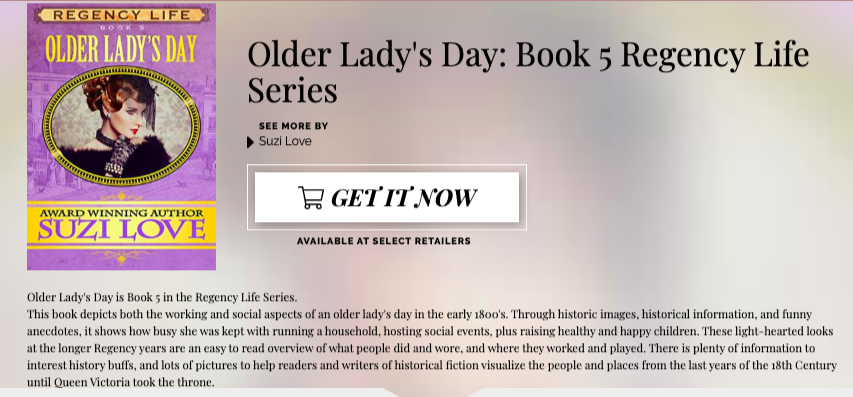
What did an older lady do in the Bridgerton family’s and Jane Austen’s times, or the early 1800s. An easy to read overview of what an older lady did, wore, and how she lived in the early 19th Century. Information for history buffs and pictures for readers and writers of historical fiction. Older Lady’s Day, Regency Life Series, Book 5, by Suzi Love. books2read.com/suziloveOLD
Through historic images, historical information, and funny anecdotes, it shows how an older lady in Jane Austen’s times fills her day, where she goes, and with whom she spends her time. This light-hearted look at the longer Regency years is an easy to read overview of what people did and wore, and where they worked and played. There is plenty of information to interest history buffs, and lots of pictures to help readers and writers of historical fiction visualize the people and places from the last years of the 18th Century until Queen Victoria took the throne.
“There was a moment when I changed from an amateur to a professional. I assumed the burden of a profession, which is to write even when you don’t want to, don’t much like what you’re writing, and aren’t writing particularly well. “Agatha Christie
“There is nothing I would not do for those who are really my friends. I have no notion of loving people by halves, it is not my nature.” Jane Austen ~ Northanger Abbey (1817) #JaneAusten #RegencyEra #Quotation
Fashion Women 1815-1819 History Notes Book 28 https://books2read.com/SuziLoveFashionWomen1815-1819
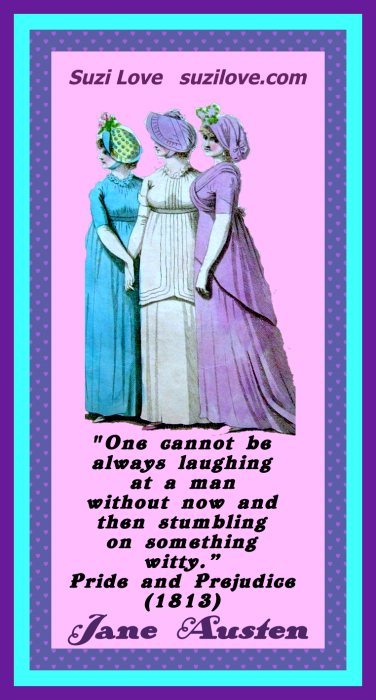
“One cannot be always laughing at a man without now and then stumbling on something witty.” Jane Austen Pride and Prejudice (1813) #JaneAusten #Quote #Regency
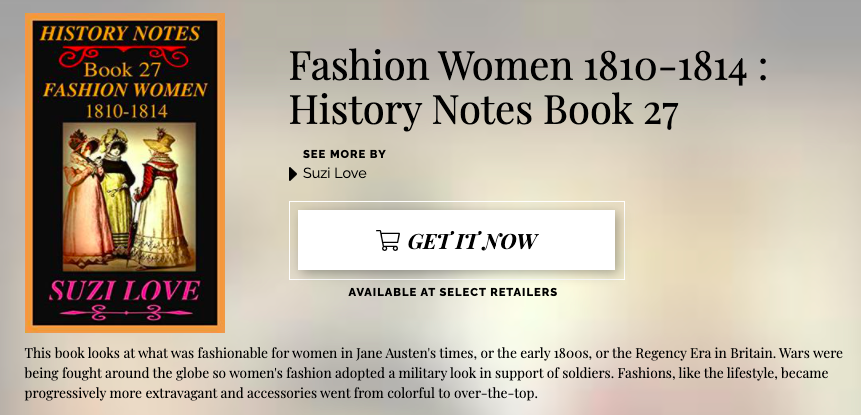
Are you a reader or writer of Regency Romance? Love Jane Austen’s books? Want to know more about the mourning, riding, underclothing and other Regency Era women’s fashions in Regency romances? What was fashionable for women in Jane Austen’s times? Mourning, riding, daytime, evening clothing, plus underclothing, corsets and accessories. This book looks at what was fashionable for women in Jane Austen’s times, or the early 1800s, or the Regency Era in Britain. Wars were being fought around the globe so women’s fashion adopted a military look in support of soldiers. Fashions, like the lifestyle, became progressively more extravagant and accessories went from colorful to over-the-top. https://books2read.com/SuziLoveFashion1810-1814