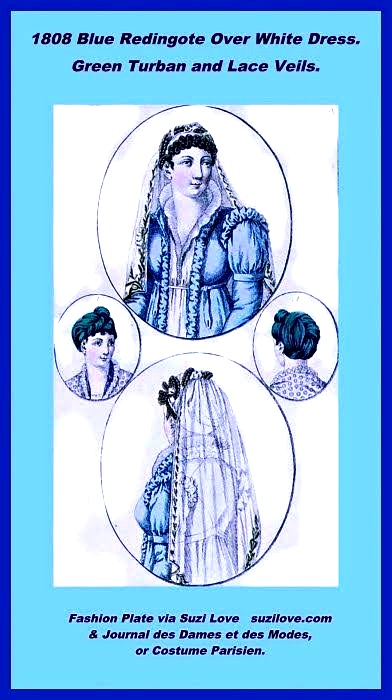
1808 Jane Austen Style Blue Redingote Over A White Dress. Green turban and lace veils. Bodice. Fashion Plate via Journal des Dames et des Modes, or Costume Parisien.
French fashions like this were copied by English magazines so these styles of hats would have been worn by Jane Austen and her contemporaries.
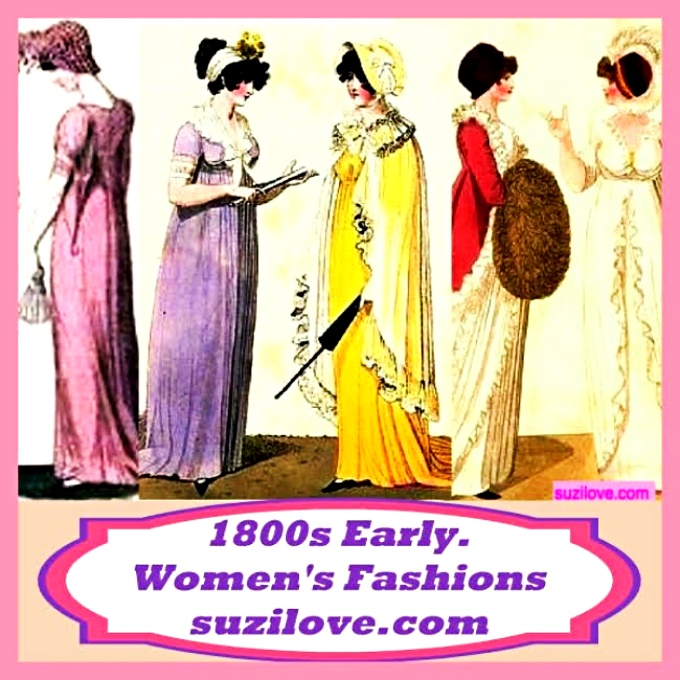
1800s Early Women’s Fashions Collage . Typical of the outfits worn by Jane Austen and her contemporaries for daytime and evening activities. An Empire style, or high-waisted white cotton dress worn under a Spencer or short jacket, a Redingote, or coat, for warmth and with pretty hats, shawls and shoes.Women’s Fashions By Suzi Love. High-waisted dresses, hats, muff, parasol, cape, reticule or bag and shoes.
Regency Era women’s fashions are elegant, pretty, and sometimes afford a gentleman a tiny glimpse of a well-turned ankle. Though to me, that sounds more like the lady has sprained her ankle rather than her ankle looking fashionably slim. High-waisted, or Empire style, white gowns defined women’s fashion during the Regency Era. ‘Empire’ is the name given to the period when Napoleon Bonaparte built his French Empire. High-waisted, loose gowns were adopted by the aristocracy as a symbol of turning away from the fussy, elaborate and expensive clothing worn in the 1700s.
Dress fabrics were thinner, sometimes almost transparent, which meant outerwear needed to be thicker and more practical. A coat, called a Redingote in France, a Pelisse in England, and a Walking Dress or Carriage Dress in Rudolph Ackermann’s fashion plates, became a necessity to keep out the chilling cold. Half cloaks, cloche or close-fitting hats, and accessories such as oversized fur muffs were very popular.
1800s Early Women’s Fashions By Suzi Love. HN_25_D2D_fashwomen1801-1804 https://books2read.com/SuziLoveFashionWomen1801-1804
1810 Couple In Walking Dress, French. Lady in a jade green Redingote, or coat, with paisley skirt, worn over a white dress with sleeves caught up, and hat tied under her chin. Man in a brown tailcoat, tight white pants that button down the sides, black hat and shoes and carrying a walking stick. Fashion Plate via Journal des Dames et des Modes, or Costume Parisien.
The sort of outfits a lady and gentleman in Jane Austen’s times would have worn while out walking, shopping, or going to visit friends.
Pelisse, or Walking Dress, or Redingote. The Fashion Dictionary description of a Redingote is (réd’ing-göt; red ing gote). Pronounced: red ing gote Woman’s long, fitted coat often cut Princess style and worn open in front to show off the dress underneath. Sometimes cut away in front. Originally made for men with several capes and trimmed with large buttons. French word developed from English words, riding coat. reefer. Single- or double-breasted, fitted, tailored, over-all coat usually made from sturdy fabric but in the British Regency Era a Pelisse was often made from a lighter fabric, such as cotton.
HN_23_D2D_Fashion Men 1800-1819 History Notes Book 23
https://books2read.com/SuziLoveFashionMen1800-1819
1815 ca. Tailcoat, Probably British. Black wool, silk cotton and wood. Double-breasted, cutaway at the front waist, notched collar, straight sleeves, pleat falling from the back waist. via Metropolitan Museum, N.Y.C., U.S.A. As Worn By the Men in the Families of Jane Austen and the Bridgertons. #Regency #JaneAusten #Fashion #BritishHistory
Tailcoat: A Regency Era, or early 1800s, gentleman was outfitted in more practical fabrics, such as wool, cotton and buckskin rather than the fussy brocades and silks of the late 1700s. The men in Jane Austen’s life would have worn a black tailcoat like this for everyday wear. https://books2read.com/SuziLoveFashionMen1800-1819
What did Jane Austen and friends wear? Early 1800s fashions were elegant and pretty with high waists and fabrics that were almost transparent. These Empire style gowns, named after Napoleon’s first Empress, became popular throughout Europe, and were then copied around the world. Colorful outwear was added to make an ensemble more attractive and warmer. History Notes Book 26 Fashion Women 1805-1809. https://books2read.com/SuziLoveFashionWomen1805-1809
The Empire waist gown defined women’s fashion during the Regency Era. ‘Empire’ is the name given in France to the period when Napoleon built his French Empire. High-waisted, loose gowns were adopted by the aristocracy as a symbol of turning away from the fussy, elaborate and expensive clothing worn in the 1700s. Jean-Jaques Rousseau advocated copying peasants and returning to a simpler life and more natural fashions. Unrestricting clothing was part of the new Democracy in France and these simpler and flowing fashions were adopted all over Europe, including Britain and despite the continual wars being fought against France during the early 1800s. Not even war stopped fashions from being copied everywhere.
1814 Gentleman’s Redingote, or Overcoat, French. Back View of coat with back pleats and metal buttons worn with high topped boots, top hat, and a cane. Fashion Plate via Journal des Dames et des Modes, or Costume Parisien.
Definition Redingote Or Coat: French word developed from English words, riding coat. Long fitted outdoor coat worn over other garments for warmth. Originally made with several capes and trimmed with large buttons. For women, the coat was often cut away in the front or left open to show off the dress underneath. French fashion plates call these coats Redingotes and they were worn by men, women, and children. English fashion plates call the coats a Pelisse, a walking dress, Promenade dress, or Carriage dress.
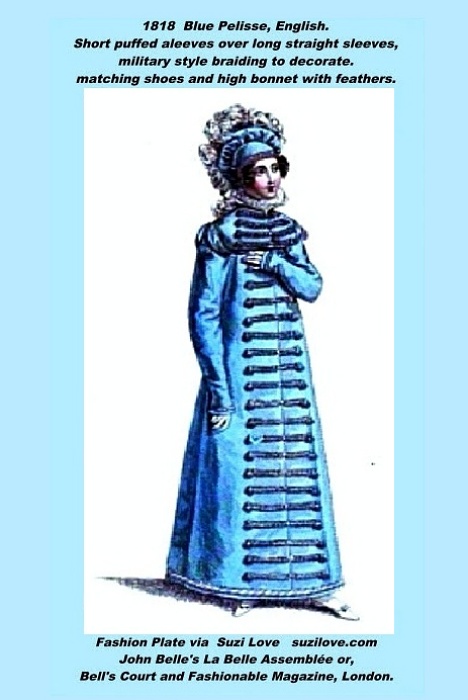
1818 Blue Pelisse, Or Coat, English. Short puffed sleeves over long straight sleeves, military style braiding to decorate. matching shoes and high bonnet with feathers. Fashion Plate John Belle’s La Belle Assemblée or, Bell’s Court and Fashionable Magazine, London. The type of outfit young Regency Era ladies would have worn if they were out shopping on Bond Street, walking in a park, or taking a carriage ride through Hyde Park.
Definition Redingote Or Pelisse Or Walking Dress Or Coat: French word developed from English words, riding coat. Long fitted outdoor coat worn over other garments for warmth. Often left open at the front to show off the dress underneath. Sometimes cut away in front. Originally made with several capes and trimmed with large buttons. French fashion plates call these coats Redingotes and they are designed for women, men and children. English fashion plates call them a Pelisse, a walking dress, Promenade dress, or Carriage dress.
1818 Blue Pelisse, Or Coat, English. Short puffed sleeves over long straight sleeves, military style braiding to decorate. matching shoes and high bonnet with feathers. Fashion Plate John Belle’s La Belle Assemblée or, Bell’s Court and Fashionable Magazine, London.
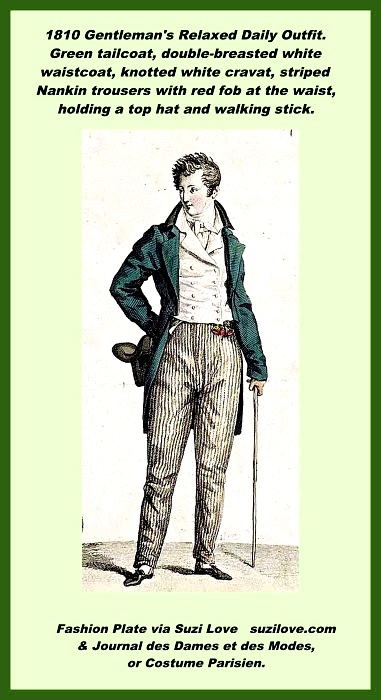
1810 Gentleman’s Relaxed Daily Outfit. Green tailcoat, double-breasted white waistcoat, knotted white cravat, striped Nankin trousers with straps under the foot and red fob at the waist, holding a top hat and a walking stick. Fashion Plate via Journal des Dames et des Modes, or Costume Parisien.
In the early 1800s, men no longer wore complicated styles and extravagant fabrics. Men’s fashion simplified and became more conservative. A well cut tailcoat, vest, pantaloons and an immaculate cravat of beautiful white linen in the style of George Bryan, or Beau, Brummell. Clothes were a status symbol and indicated a man’s social position. These clothing items were the sort worn by Jane Austen’s male family and friends.
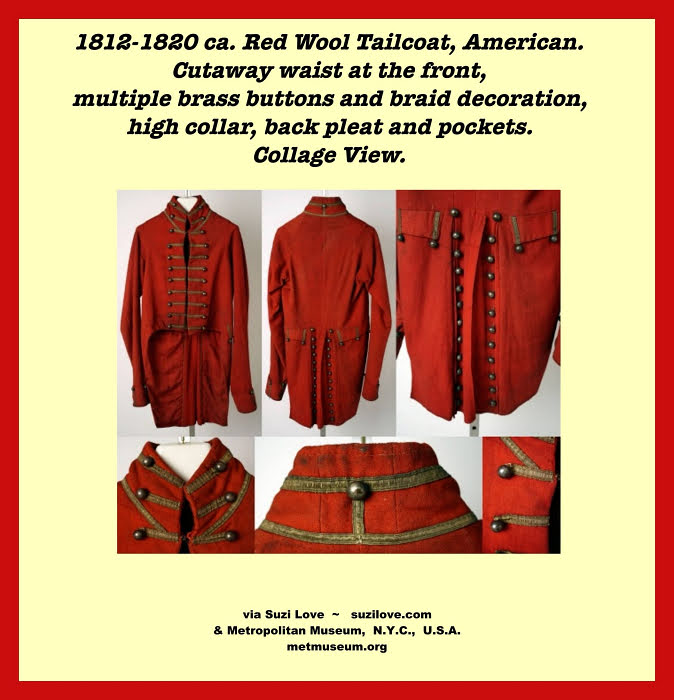
1812-1820 ca. Red Wool Tailcoat, American. Brass buttons everywhere, including on the tails and pockets. via Metropolitan Museum New York City, U.S.A. metmuseum.org
1812-1820 ca. Red Wool Tailcoat, American. Brass buttons everywhere, including on the tails and pockets. via Metropolitan Museum New York City, U.S.A. metmuseum.org1812-1820 ca. Red Wool Tailcoat, American. Brass buttons everywhere, including on the tails and pockets. via Metropolitan Museum New York City, U.S.A. metmuseum.org1812-1820 ca. Red Wool Tailcoat, American. Brass buttons everywhere, including on the tails and pockets. via Metropolitan Museum New York City, U.S.A. metmuseum.org1812-1820 ca. Red Wool Tailcoat, American. Brass buttons everywhere, including on the tails and pockets. via Metropolitan Museum New York City, U.S.A. metmuseum.org1812-1820 ca. Red Wool Tailcoat, American. Brass buttons everywhere, including on the tails and pockets. via Metropolitan Museum New York City, U.S.A. metmuseum.org1812-1820 ca. Red Wool Tailcoat, American. Brass buttons everywhere, including on the tails and pockets. via Metropolitan Museum New York City, U.S.A. metmuseum.org1812-1820 ca. Red Wool Tailcoat, American. Brass buttons everywhere, including on the tails and pockets. via Metropolitan Museum New York City, U.S.A. metmuseum.org https://books2read.com/SuziLoveFashionMen1800-1819
1813 April Carriage Dress, English. Green coat over white Empire style dress of jaconet or cambric muslin, plaited bodice, long sleeve, deep frill, with a vandyke of needle-work. Russian mantle is made of Pomona or spring green sasnet, lined with white satin, trimmed with a rich frog fringe and closed with a cord or tassel. Close-fitting cottage slouch bonnet of the same material and edged with scalloped lace, tied on the left under the chin with ribbon, and decorated with a small cluster of spring flowers. Reticule, or bag, of the sam fabric, slippers of green kid, and gloves of primrose kid. Fashion Plate via Rudolph Ackermann’s ‘The Repository of Arts’.