1818 Long Green Redingote Or Coat With Velvet Collar, French. White shirt with high collar, cravat, white trousers, black boots and a cane. Fashion Plate via Journal des Dames et des Modes, or Costume Parisien.


1818 Long Green Redingote Or Coat With Velvet Collar, French. White shirt with high collar, cravat, white trousers, black boots and a cane. Fashion Plate via Journal des Dames et des Modes, or Costume Parisien.


Early 1800s Typical Regency Couple in a Curricle. The sort of vehicle Jane Austen and her contemporaries would have driven in. Young men loved them and occasionally women drove them.


1808 ca. Jane Austen style high-waisted muslin dress with bib front, British. High stomacher front, i.e. a bib front fastened with pins, and embroidered with clusters of flowers and leaves. Embroidery satin stitch, chain stitch and French knots. Dress of muslin, embroidered in wool with a design of flowers and leaves down the sleeves and across the front of the dress. The bodice back and side fronts are lined with linen and there are linen undersleeves. The front of the bodice is made up of a panel of bias-cut muslin, which is sewn onto the skirt rather like the bib of an apron so that it can be placed in position at the neck with pins. When the pins are removed the bib front falls away to reveal linen underflaps which fasten across the bust to give support. This type of bodice construction was common during this period in this style of dress and is known as the high stomacher front.
Embroidered with clusters of flowers and leaves and embroidery is worked in satin stitch, chain stitch and French knots, the design trails down across the front of the dress and around the scalloped hemline to simulate a draped tunic-style garment slit up the side seam. Front bodice has panel of bias-cut muslin sewn onto skirt like the bib of an apron so that it can be placed in position at the neck with pins. When the pins are removed the bib front falls away to reveal linen underflaps which fasten across the bust to give support. Bib front bodice construction was common in the Regency Era, or Jane Austen’s years, in this style of dress and is known as the high stomacher front. via Victoria and Albert Museum, London, U.K.


1800’s Flat men’s shoes, presumably part of the livrée-like Römer servant’s uniform of the type worn until 1866. via historisches-museum.frankfurt.de


1816 Blue Riding Habit, French. High-waisted blue riding dress with a train, the long full skirt being necessary to cover a lady’s legs and preserve her modesty when riding side saddle. These riding habits were usually designed by men and were in two pieces, a jacket and a skirt, worn over a shirt. A military style bodice decoration, high pointed collar and a knotted pink dotted cravat worn underneath that imitate male styles, or even Dandy fashion. Sleeves are very long as was the trend in French riding habits. Yellow gloves and a masculine style beaver hat. This print was designed by Horace Vernet and engraved by Pierre Baquoy. Fashion Plate via Journal des Dames et des Modes, or Costume Parisien. Although, there are very similar riding habit fashion plates in other magazines.
The type of outfit Jane Austen and her friends would have worn if they went horse riding. https://books2read.com/SuziLoveFashionWomen1815-1819


1817 Pink Morning Walking Dress, French. High-waisted,high frilled neckline, long straight sleeves, triple layer of frills above the hem, bonnet with plumes, or feathers to decorate, and tied under the chin with pink ribbon, pink shoes and gloves. Most likely has white muslin dress with the white neck frill underneath the dress. Fashion Plate via Journal des Dames et des Modes, or Costume Parisien.
Definition Morning Walking Dress: Worn out shopping, walking in a city park or the country estate. Presentable and warm, more fashionable than Morning Dress but not overly accessorized.

1817 Bridgerton and Jane Austen Style High-Waisted Pink Morning Walking Dress, French. #RegencyFashion #JaneAusten #Bridgerton https://books2read.com/SuziLoveFashionWomen1815-1819

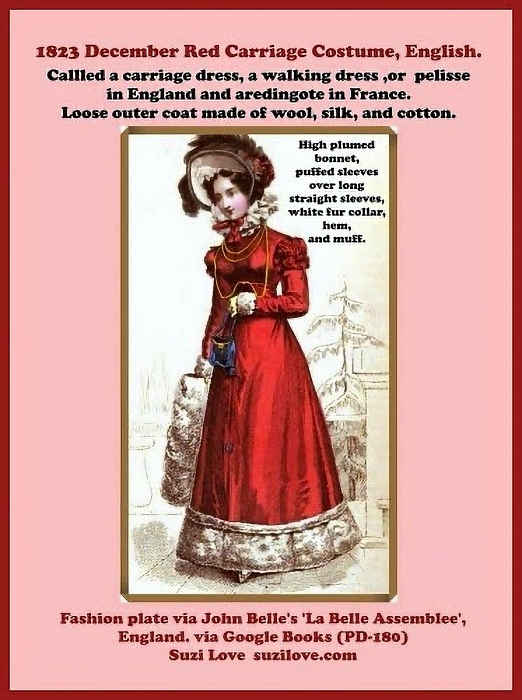
1819 Pale Blue Redingote, Pelisse or Walking Dress, French. Blue redingote with pink bow showing off gorgeous neck frills and bonnet of castor decorated with tassels. The type of outfit young Regency Era ladies would have worn if they were out shopping on Bond Street, walking in a park, or taking a carriage ride through Hyde Park. Fashion Plate via Journal des Dames et des Modes, or Costume Parisien.
Definition Redingote Or Pelisse Or Walking Dress Or Coat: French word developed from English words, riding coat. Long fitted outdoor coat worn over other garments for warmth. Often left open at the front to show off the dress underneath. Sometimes cut away in front. Originally made with several capes and trimmed with large buttons. French fashion plates call these coats Redingotes and they are designed for women, men and children. English fashion plates call them a Pelisse, a walking dress, Promenade dress, or Carriage dress.


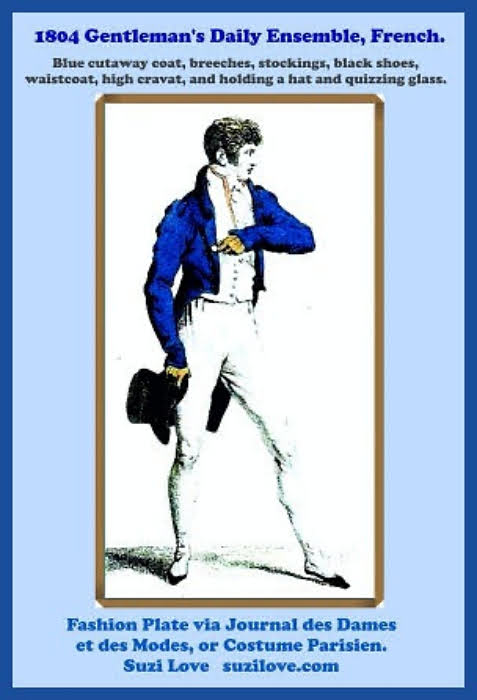
1801 Typical Gentlemen’s Fashions for the early 1800s, or Regency Era, or Jane Austen’s times. Fashion Plates via Journal des Dames et des Modes, Costume Parisien.
Typical menswear in the early 1800s included a tailcoat, a vest or waistcoat, either breeches, pants, or the newer trousers, stockings, shoes or boots, all worn with an overcoat and hat. This basic ensemble was accessorized with some form of neckcloth or cravat, gloves, a walking stick, cane or riding crop, handkerchief, fobs, a watch and perhaps a quizzing glass or eye glass.


From the finish of the 18th century until 1820, men’s fashions in European and European-influenced countries moved away from the formal wear of brocades, lace, wigs and powder to more informal and relaxed styles. Focus was on undress rather than formal dress. Typical menswear in the early 1800s included a tailcoat, a vest or waistcoat, either breeches, pants, or the newer trousers, stockings, shoes or boots, all worn with an overcoat and hat. This basic ensemble was accessorized with some form of neckcloth or cravat, gloves, walking stick, cane or riding crop, handkerchief, fobs, watch and perhaps a quizzing glass or eye glass.
Skirted coats were replaced with short-fronted, or cutaway, tailcoats worn over fitted waistcoats and plain, white linen shirts. Knee breeches were gradually replaced by tight-fitting pantaloons and later trousers, decorative shoes with buckles were replaced with a variety of boot styles, and fussy and ruffled neckwear gave way to intricately tied, white linen neck cloths. A Regency Era, or early 1800s, gentleman was outfitted in more practical fabrics, such as wool, cotton and buckskin rather than the fussy brocades and silks of the late 1700s.
1804 Men's Fashions In The Time Of Jane Austen. #Regency #Fashion #JaneAusten Share on X
This book shows how corsets changed to fit well under clothing, give maximum support and comfort. Corsets pushed up breasts and showed off the bust line beneath a square-cut and low-cut neckline as in the early 1800s, or Regency years. Jane Austen and her female and friends wore these corsets. Corsets or stays worn during the early 1800s, or Jane Austen’s lifetime. https://books2read.com/SuziLoveCorsetBook17


This book shows how body wraps, stays, and corsets were worn to create a variety of fashionable silhouettes through past centuries. Corsets flattened breasts and accentuated rounded hips or pushed up breasts and showed off the bust line depending on the fashions of the time and the desired silhouette. Includes corsets through the Georgian, Regency, Victorian and Edwardian Eras and Jane Austen’s lifetime. Overview of corsets through history, including the Georgian, Regency, Victorian and Edwardian Eras and Jane Austen’s lifetime. History Notes Book 14.
https://books2read.com/SuziLoveCorsetBook14