1809 White Court Dress, French. Long train lavishly decorated with blue flowers, long white gloves and evening hairstyle. Fashion Plate via Journal des Dames et des Modes, or Costume Parisien.
Definition Court Dress: Usually, the difference between a court dress and a ball dress was in the quality of fabrics used, how elaborate the design, and the number and quality of the accessories. Plus, in England in the early 1800s court dresses were required by Queen Charlotte to have hoops and in France and other European countries court dresses a long train, usually expensively decorated. During the Regency Era, white cotton dresses were considered suitable for many evening events, but definitely not for an evening event in a palace.
1809 White Court Dress, French.Fashion Women 1805-1809 History Notes Book 26
What did Jane Austen and friends wear? This book looks at early 1800s fashions, which were elegant and pretty with high waists and fabrics that were almost transparent. These Empire style gowns, named after Napoleon’s first Empress, became popular throughout Europe, and were then copied around the world. Colorful outwear was added to make an ensemble more attractive and warmer.
https://books2read.com/SuziLoveFashionWomen1805-1809
1815 July Walking Dress, English. Aqua blue walking dress with crossover straps at the back over a white bodice and with a cute sun hat with a scarf for decoration and with a matching shawl. Fashion Plate via The Lady’s Magazine Or Entertaining Companion for the Fair Sex.
Fashion Women 1815-1819 History Notes Book 28 What did Jane Austen wear? . D2D_HN_28_https://books2read.com/SuziLoveFashionWomen1815-1819
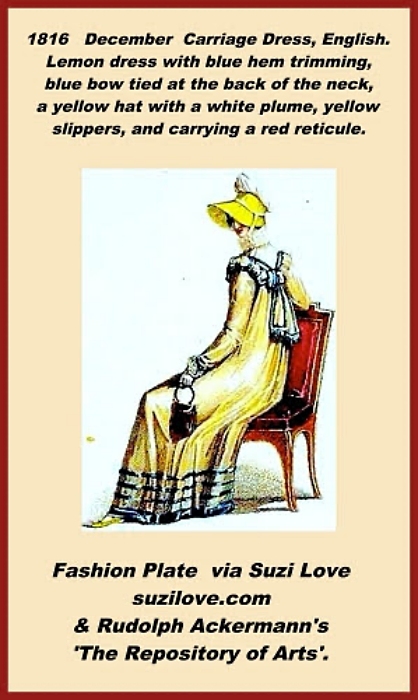
1816 December Carriage Dress, English. Fawn or lemon dress with blue silk hem trimming, blue bow tied at the back with long hanging ends, a half sleeve over a plain long sleeve, tight at the wrist and bound with blue trimming and finished with a narrow ruffle of three falls of tulle. A fichu of tulle with matching ruff. When worn as a carriage dress, the head-dress is a bonnet, the crown composed of white satin at the top and the middle and front of Leghorn. Lined with white satin and ornamented with a white satin band and strings. An indispensable India shawl, yellow slippers and carrying a black ridicule, or bag, and later called a reticule. Fashion Plate via Rudolph Ackermann’s ‘The Repository of Arts’.
Definition Fichu: Piece of lace, muslin, or other cloth worn about the neck and cleavage to preserve a lady’s modesty. From French word meaning neckerchief.
Definition Ridicule, Reticule, Indispensable, or Handbag: From the late 1700s, pockets could no longer be sewn into gowns nor could separate pockets be tied around their waists and accessed by slits in the gown and petticoats, as skirts fell from just under the bust and were full and flowing. In Jane Austen’s times, women carried small bags, known at first as ridicules and later as reticules, to keep necessary items on their person e.g. handkerchiefs, coins, vinaigrettes, calling cards, glasses etc.. For more on reticules, try my History Notes book 3 http://books2read.com/suziloveReticules
Fashion Women 1815-1819 History Notes Book 28 https://books2read.com/SuziLoveFashionWomen1815-1819
1816 June Bridal Dress, English A frock of striped French gauze over a white satin slip: the bottom of the frock is superbly trimmed with a deep flounce of Brussels lace, which is surmounted by a single tuck of byas white satin and a wreath of roses; above the wreath are two tucks of byas white satin. We refer our readers to our print for the form of the body and sleeve: it is singularly novel and tasteful, but we are forbidden either to describe it, or to mention the materials of which it is composed. The hair is dressed low at the side, and parted so as to entirely display the forehead: it is ornamented with an elegant aigrette of pearls in front, and a spring of French roses placed nearly at the back of the head. Necklace, ear-rings, and bracelets of pearl. White kid gloves, and white satin slippers. Fashion Plate via Rudolph Ackermann’s ‘The Repository of Arts’.
Fashion Women 1815-1819 History Notes Book 28 What did Jane Austen wear? . D2D_HN_28_https://books2read.com/SuziLoveFashionWomen1815-1819
1810 White Promenade Half Dress, English, In Jane Austen Style. Draped yellow shawl and yellow parasol and a fitted hat with a long lace veil. A muslin dress with long sleeves and low neck, a French scarf of yellow silk, yellow silk bonnet with lace veil, yellow Parasol with a white fringe, gloves and shoes of yellow kid. Fashion plate via John Belle’s ‘La Belle Assemblee’, England. Typical of the outdoor outfit worn by Jane Austen and her contemporaries. An Empire style, or high-waisted white dress worn with a gorgeous yellow scarf and matching yellow fringed parasol.
Dress – Half Dress: Between undress and full dress, half dress is a respectable outfit but without an excess of formal accessories. Can be worn either during the day or evening.
1810 White Promenade Half Dress, English. Draped yellow shawl and parasol, fitted hat with a long veil. Fashion plate via suzilove.com and John Belle’s ‘La Belle Assemblee’, EnglandHN_27_D2D_fashwomen1810-1814
https://books2read.com/SuziLoveFashion1810-1814
1818 September 18th Le Palais Royal de Paris, Or ‘A Peep at the French Monstrosities’. By George Cruikshank. Two English tourists, both dressed as dandies, walk arm-in-arm under the arcade of the Palais Royal, interested in the promenading courtesans. Two Frenchmen make more direct overtures to two women. Their dress is rather similar to that of the Englishmen, but the latter wear bell-shaped top-hats, while the Frenchmen have flower-pot shaped hats. An officer wearing a large cocked hat addresses a girl, and a man, said by Reid to be Irish, jovially accosts another. Some of the women are in evening-dress, others in street costume. Behind are iron railings between the supports of the roof; on one of these is the inscription ‘Caveau des Sauvages’. Published by: George Humphrey. via British Museum.
1815-1818 ca. Morning Dress, British. Typical Regency Era Day Dress. Very simple printed cotton dress with long sleeves and a very high waist. This is the typical Empire style, or high-waisted dress made of printed cotton that Jane Austen and her female friends and family would wear during a normal day. via Metropolitan Museum, N.Y.C., U.S.A. metmuseum.org
1815-1818 ca. Morning Dress, British. Front View.1815-1818 ca. Morning Dress, British. Back View. 1815-1818 ca. Typical Regency Era Printed Cotton Day Dress. #Regency #Fashion #JaneAusten
Here is an example of when English magazines copied French fashion plates.
1815 December Left: French fashion plate Ensembles French and English via Journal des Dames et des Modes. White short length ball dress with tiny bodice.
Right: English fashion plate by Rudolph Ackermann in the Repository Of arts. Blue sarsnet Pelisse, or Walking dress, or Redingote. Decorated with white lace trim on neck, vertical front, and hem. Carrying red shawl and with high plumed bonnet.
1815 December Blue Walking Dress, English. Blue twilled sarsnet pelisse, or Redingote, with ribbon bows adorning the front. Decorated with white lace trim on neck, vertical front, and a border of leaves on the hem. Slashed sleeves at shoulders and wrists plus an elaborate collar would have been time consuming to make. Carrying a red shawl and with a high bonnet with a white plume, or feather. Fashion Plate via Rudolph Ackermann’s ‘The Repository of Arts’.
1815 December Blue Walking Dress, English. Decorated with white lace trim on neck, vertical front, and hem. Carrying red shawl and with high plumed bonnet. Fashion Plate via Rudolph Ackermann’s ‘The Repository of Arts’.
Below is the French version of this pelisse but with a lady in a ball dress. Possibly another example of the English magazines ‘copying’ French designs.
1815 Ensembles French and English. White short length ball dress with tiny bodice and sleeves. Blue sarsnet Redingote, or pelisse, decorated with white lace trim and border of leaves, slashed sleeves at shoulders and wrists, elaborate collar, red shawl, high bonnet with white plume, or feather. Fashion Plate via Journal des Dames et des Modes, or Costume Parisien.
Fashion Women 1815-1819 History Notes Book 28
What did Jane Austen wear? This book looks at what was fashionable for women in the Georgian Era and at the end of the Regency Era in Britain and the reconstruction in Europe after the wars. Lifestyles were freer and fashions expressed this by becoming the focus of most women’s lives. A wardrobe full of opulent accessories was requisite. Includes mourning and riding fashion, dresses, hats, shoes, reticules or bags, underclothing, and fashion accessories.
D2D_HN_28_https://books2read.com/SuziLoveFashionWomen1815-1819
1820 August Walking and Evening Dresses, English. Walking Dress of cambric muslin with frilled hemline. Blue-purple Spencer with epaulettes of points of satin. Bonnet to match of metallic gauze and tied under her chin, yellow Limeric gloves, reticule or bag, and blue boots. Evening Dress of Urling’s lace with aqua blue leaf decoration, earl combs, pearl necklace and ear-rings, gold chain or chatelaine with a watch, white kid gloves and white silk shoes. Via Ladies’ Monthly Museum in The Mirror of Fashion, London, U.K.
Definition Limerick Gloves: Named after County Limerick in Ireland where they were first made. Often referred to as chicken skin gloves, though actually made from skins of unborn calves. Usually cream or yellow, superior quality and very thin.
Definition Ridicule, Reticule, Indispensable, or Handbag: From the late 1700s, pockets could no longer be sewn into gowns, as skirts fell from just under the bust and were full and flowing. Instead, women began carrying small bags, known at first as ridicules and later as reticules, to keep necessary items on their person e.g. handkerchiefs, coins, vinaigrettes, calling cards, glasses etc.
Definition Spencer: Short jackets cut to match the high waistlines of Empire dresses. They often copied military styling, such as braiding, shoulder decoration, buttons and loop fasteners, and wrist adornments. They were generally of complex construction, often with a diamond shaped piece in the back. Said to have originated in an accident to Lord Spencer while hunting when his coat tails were torn off and he wore it as a short jacket.
HN_4_Spencers, Or Jackets. #Regency #Georgian #Victorian #Fashion History Notes Book 4 By Suzi Love.