1814 Couple In Walking Ensembles, French. Gentleman in a brown tailcoat with a notched collar and back pockets, vest, white breeches tied under his knees, red fob at the waist, white stockings, high white shirt collar, white cravat, top hat and cane. Lady in adorable pink Redingote with capes.
1801 November 9th Playing Cards. Men and women play cards at round table. Supreme Bon Ton Plate 2. Published by S W Fores. Men and women play cards at round table. Man and woman talk to players. Woman sleeps in upright chair, two others, one with parasol and other fan, walk off arm-in-arm.Men: High-waisted coats, high collars, huge neck-cloths, with pumps or Hessian boots. Women: High-waisted dresses, short sleeves, long trains, very low necklines, short ringlets, two in caps. Via British Museum, London, UK. britishmuseum.org (PD-Art)
In Jane Austen’s times, cartoons posted in the windows of shops were one of the main ways people found news. Common people couldn’t afford newspapers so cartoonists ridiculed the people and the places with cartoons of the daily events happening in London and other cities. The ridiculous fashion trends of the late 1700s and early 1800s were easy targets for satirical cartoons as was the addiction to gambling by women and men alike.
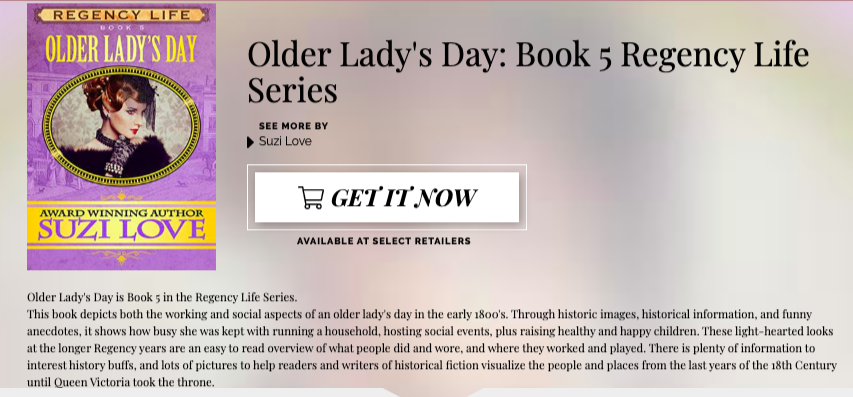
Light-Hearted look at an Older Lady’s Life In Jane Austen’s Times, or early 1800s. An easy to read overview of what an older lady did, wore, and how she lived in the early 19th Century. Information for history buffs and pictures for readers and writers of historical fiction. Older Lady’s Day, Regency Life Series, Book 5, by Suzi Love. books2read.com/suziloveOLD
The older lady’s day usually started with her toilette in her bedroom, where her maid helped her dress for the day and styled her hair. After that, she would join her family downstairs for breakfast unless she preferred a tray with either tea or hot chocolate in her bedroom as she prepared for her busy day. Her day would be made up of speaking with the housekeeper and the cook about the week’s menus, assuring that the servants were all available that day and no one was ill, and checking the list of foods needed. She would also enquire if the laundry was up to date and that they had enough good linen to make up all the beds before extended family members and guests arrived. If she was in the country and hosting a weekend house party, she would assign rooms to the guests on her lists and query that all was in readiness for their arrival.
1798 Two ladies in Jane Austen style white walking dresses. Left: Dress has gold trim, white bonnet, green Parasol. Right: Stand up collar, short puffed sleeves, brown shawl and coiled head dresses, both with necklaces. via Rijks Museum, Amsterdam, Netherlands. rijksmuseum.nl
1800s “Admiration”. By Vittorio Reggianini. Oil on canvas. This looks like a typical drawing room scene from Jane Austen’s lifetime, or the early 1800s, or the Regency Era. Via Wikimedia Commons commons.wikimedia.org
19th Century Early Jane Austen and Bridgerton Style Gold Silk Spencer With Puffed Shoulder. With V-shaped rouleaux trim to the bodice and puffed shoulder detail. via Christie’s Auction Rooms. christies.com
1800-1810 ca. Flat Silk Slippers With Ankle Ties Worn By Empress Josephine Bonaparte and As Worn By Jane Austen And friends. #Regency #Shoes #JaneAusten #France
Shoes in the early 1800s were flat or low heeled and occasionally decorated with a bow or floral embellishments and it wasn’t until the 1820s that square, rather than rounded or pointed toes became fashionable. Made of soft kid or cloth, these delicate shoes were flimsy and wore out quickly. There was often no difference between a left or right shoe, so when one slipper had a hole it was easily replaced. Slippers were often bought in multiples at a time so there were spares.
1817 White Percale Dress, French. Dress has layers of decoration above hem, black velvet Spencer, or jacket, wide brimmed straw hat trimmed in blue, neck scarf and walking shoes. Fashion Plate via Journal des Dames et des Modes, or Costume Parisien.
Definition Spencers: Short jackets worn for warmth over the high-waisted Empire style gowns said to have originated when Earl Spencer tore the tails off his coat in a hunting accident. In support of military men fighting wars everywhere, fashions for Spencers leaned towards military style embellishments, such as loops, buttons, and braids. Puffed sleeves over long straight sleeves were also very popular. Jane Austen and her friends and family wore Spencers over their high-waisted dresses.
Definition Empire Style Dress: Named after the First Empire in France. Empire dresses had a low neckline and skirts started directly under the bust and flowed into the classical relaxed wide styles of Greece and Rome. This style of dress is associated with Jane Austen and her contemporaries as a high-waisted dress was worn most days. Cotton, silk or taffeta were the popular fabrics. Only the very wealthy could afford white dress in this style as the cottons were imported from India and had to be carefully cleaned, usually by a lady’s maid.
1815 July Seaside Walking Dress. A high dress, of short walking length, made of French cambric or jaconot muslin, trimmed at the feet with treble flounces of French work, gathered into a rich bead heading, and laid upon the dress, at a suitable distance, one above the other, the body made with open fronts, worn with a full ruff of the French work, corresponding to the trimming at the feet; a long sleeve, drawn alternately across the arm, terminates with a broad wristband, worn plain over the hand. French bonnet of white satin, edged and tied under the chin with satin ribbon of celestial blue; ornamented with a rich plume of white feathers, edged to correspond. French mantle of the twilled silk en suite, richly embroidered at the ends in shaded silks, composing roses or lilies of the valley. Patent silk stockings. Slippers, or half-boots, or blue kid, or primrose colour. Gloves to correspond.
The bodies of the morning and promenade costume continue to be worn with cross or handkerchief fronts, and are generally trimmed, agreeably to the texture of the dress, with quilled tull or ribbon. The quilled ribbon is also predominant in single rows at the feet of all dresses composed of silk, bombazeen, or fancy prints. The prevailing colours are primrose, celestial blue, and evening primrose; the waist short, and the fullness of the petticoat carried to the back. Ruffs of French work are universally worn, except in full dress. The length of the petticoat continues not to exceed meeting the top of the boot and the color of the latter corresponds with the glove, mantle, and trimming of the bonnet.