1820 Gentleman’s Cream Redingote, Or Long Overcoat, French. Long pants, or trousers, buttoned at the ankles, frilled shirt, high cravat, vest, red fob hanging at his waist. via L’Observateur des Modes, French.
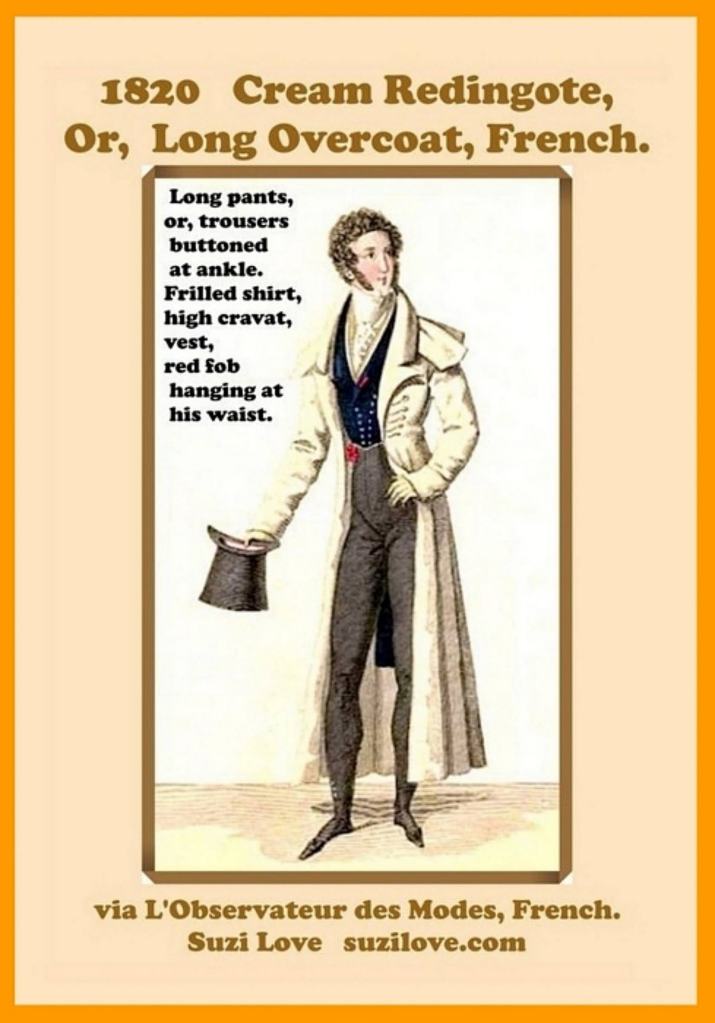

1820 Gentleman’s Cream Redingote, Or Long Overcoat, French. Long pants, or trousers, buttoned at the ankles, frilled shirt, high cravat, vest, red fob hanging at his waist. via L’Observateur des Modes, French.
1817 November Morning Dress and Evening Dress, English. Morning Dress is a round dress of Jaconot muslin with back buttons, small collar open in front to display the throat, lower part of front with bias tucks, moderately full skirt finished around bottom with small tucks and deep flounce with bright rose ribbon. Rose velvet Spenser trimmed with white satin and rose silk, finished at throat with white satin puffings. Plain long sleeves, French style Leghorn bonnet trimmed with large rows of ribbon to match Spenser and tied under the chin, stand-up lace frill around throat, swansdown muff, straw kid sandals and gloves.
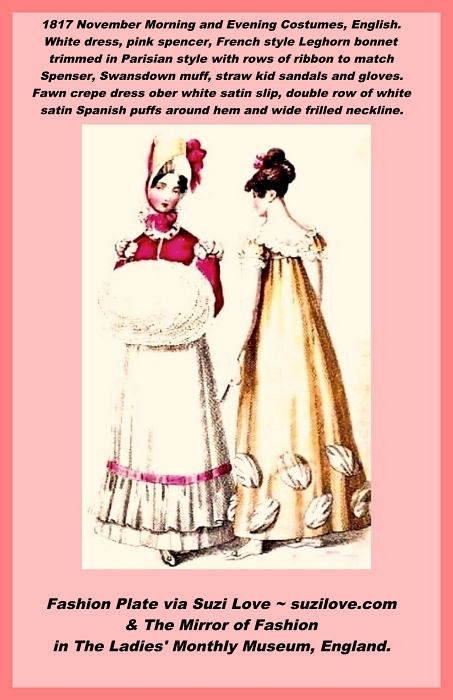
Evening dress of fawn crepe over a white satin slip, cut low around the bust, confined to waist by a narrow cestus of white satin, fastened in front by a brilliant clasp. Single fall of Mecklin lace on dress, very short full sleeve finished at bottom by a rouleau of white satin and narrow lace plait. Skirt trimmed with double row of white satin Spanish puffs, very full and in bias. Hair high, parted and curled on the forehead with garland of Provence roses. Pearl earrings and necklace, spangled crape fan, white kid gloves and white satin slippers. Fashion Plate via The Mirror of Fashion in The Ladies’ Monthly Museum, England.

1810 Les Invisibles. By James Gillray. Two men walk towards each other, each with a lady hanging to each arm, all have their faces concealed by some part of their dress, hat, or collar, or both. One man has a round hat, with a fantastically curved brim projecting downwards. The other has a huge crescent-shaped cocked hat with the peaks dipping over face and back. Via British Museum, London, UK. britishmuseum.org (PD-Art)


1810 “A Bonnet Shop” By Thomas Rowlandson.A shopkeeper with a hat in each hand converses with an elderly woman wearing a similar hat. A child holding a rattle looks up at them at left, a plump woman wearing a bonnet sits at center, and a group of young women make bonnets in the background. Many groups of hats hang overhead in the shop. Via British Museum, London, UK. britishmuseum.org (PD-Art)


1815 Blue Dress Bodice, French. Layers of frills on dress back. Hairstyle and Various Bonnets as Jane Austen would have worn. Fashion Plate via Journal des Dames et des Modes, or Costume Parisien.

1811 Green Dress French. High waist with bow under the bust, Mamaluke sleeves as “a long full sleeve partitioned into five sections, each section being drawn and seamed to fit around the arm up sleeves, white collar lining, fashionable blue bonnet tied under the chin and wearing yellow shoes. The sort of fashionable outfit worn by women in Jane Austen’s times, or 1800s, or Regency Era. Fashion Plate via Journal des Dames et des Modes, or Costume Parisien.
Mamaluke Sleeves: Long full sleeves partitioned into five sections, each section being drawn and seamed to fit around the arm up.

19th Century Silver Chatelaine. Thimble holder, vinaigrette as a trumpet, watch case, scissors and a notebook. via auction.fr
Definition
What did a chatelaine do?
What were chatelaines used for?


1820 ca. Blue Beaded Purse, French. Blue and cream beadwork, silver plated frame. via Ruby Lane Antiques rubylane.com
Definition Reticule: Bag or purse, often with a drawstring to pull closed and usually made of cloth or covered cardboard and often decorated with beading or embroidery. A reticule, or purse, or handbag, was usually carried by a woman during the Regency period to carry all their daily necessities. Earlier, women used pockets that tied at the waistline and were hidden in the folds of their skirts. Empire style, or early 1800s, high-waisted dresses made it impossible to either sewn in a pocket or to tie on a pocket. So women began carrying small, decorated bags called Reticules, or ridicules, which generally pulled close at the top with a drawstring. http://books2read.com/suziloveReticules

In the early nineteenth century, reticules started to look like future handbags as they were often made from rigid card or molded mâché or card into a variety of shapes. Early bags were circular and with a drawstring but as women wanted their reticules to look individual they could be made with two halves and a hinged metal closure or with concertina sides. Materials varied from silk, cotton and string and shapes were round, hexagonal or lozenge shapes with shell shaped bags becoming very popular during the Regency and Romantic Eras.
1800s magazines were written for well-bred women who could read, so they gave plenty of ideas for how ladies could make and embellish reticules for their own use and as pretty gifts. Needlework was highly encouraged as a pastime for a lady so bags were frequently embroidered or decorated with beading. By the 1820s, reticules became more like our modern handbags using soft leather gathered at the top or hard leather with a rigid fastener and metal chain for carrying.

1801 Dress With Train, French. English style coat and Polonaise hat to match dress. Fashion Plate via Journal des Dames et des Modes, or Costume Parisien.