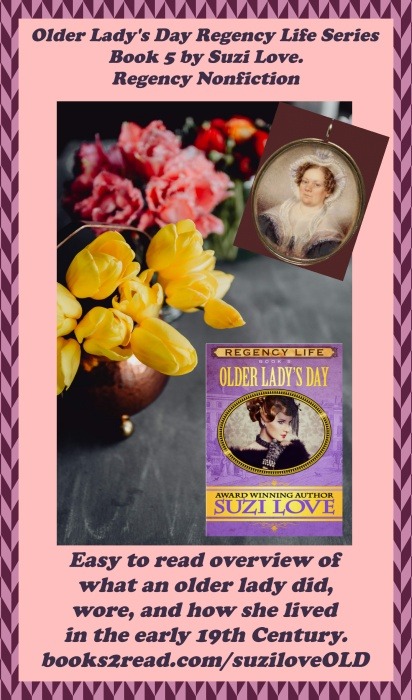
What did an older lady do and wear in the Regency Era? Information & pictures for readers and writers of early 1800s history, nonfiction and fiction. books2read.com/suziloveOLD
The older lady’s day usually started with her toilette in her bedroom, where her maid helped her dress for the day and styled her hair. After that, she would join her family downstairs for breakfast unless she preferred a tray with either tea or hot chocolate in her bedroom as she prepared for her busy day. Her day would be made up of speaking with the housekeeper and the cook about the week’s menus, assuring that the servants were all available that day and no one was ill, and checking the list of foods needed. She would also enquire if the laundry was up to date and that they had enough good linen to make up all the beds before extended family members and guests arrived. If she was in the country and hosting a weekend house party, she would assign rooms to the guests on her lists and query that all was in readiness for their arrival.
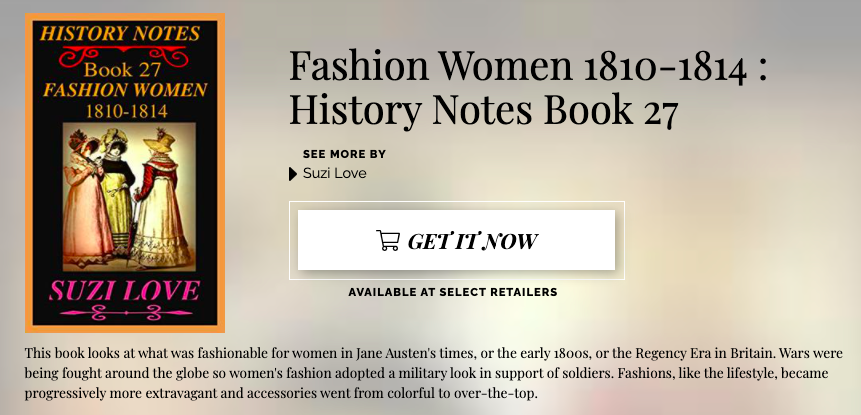
What was fashionable for women in Jane Austen’s times? Mourning, riding, daytime, evening clothing, plus underclothing, corsets and accessories. Fashion Women 1810-1814 History Notes Book 27 This book looks at what was fashionable for women in Jane Austen’s times, or the early 1800s, or the Regency Era in Britain. Wars were being fought around the globe so women’s fashion adopted a military look in support of soldiers. Fashions, like the lifestyle, became progressively more extravagant and accessories went from colorful to over-the-top. https://books2read.com/SuziLoveFashion1810-1814
The Lady’s Magazine said of the basis of women’s fashion that was popular for the first twenty years of the 1800s, ‘White is still the prevailing color for robes. For morning dresses, linen gowns, in large diamonds or squares, are fashionable. Indian muslins, plain or embroidered, are preferred to Florence and satins. The designs of embroidery for shawls are of infinite variety. Long gloves, which reach above the elbow, are not yet laid aside. Medallions are hung around the neck from crossed chains and some of these medallions are shaped like the bags, called ridicules. These reticules are of the lozenge or hexagon shape, with a small tassel at each angle. Reticules, or ridicules, are in lozenge or hexagon shapes with a small tassel at each angle. In capotes, or hats, and ribbands, the violet and dark green prevail over jonquil. Bracelets in hair, pear-shaped ear-rings, medallions on square plates, saltiers of colored stones, are still in fashion.’
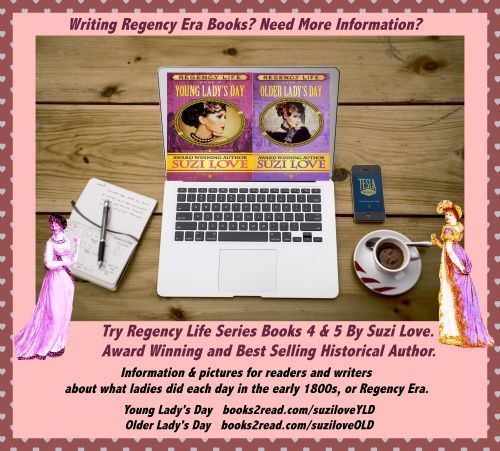
What did ladies do and wear in Jane Austen’s time, or early 1800s? #Regency #History #nonfiction Books 4 and 5 Regency Life Series. Young Lady’s Day and Older Lady’s Day in Books 4 and 5 in the Regency Life Series. These books depict the often-frivolous life and fashions of ladies in the early 1800’s, or during the lifetime of Jane Austen, but also gives a glimpse into the more serious occupations ladies may undertake. Through historic images, historical information, and funny anecdotes, they show how a lady fills her day, where she is permitted to go, and who she spends time with. These light-hearted looks at the longer Regency years are an easy to read overview of what people did and wore, and where they worked and played. There is plenty of information to interest history buffs, and lots of pictures to help readers and writers of historical fiction visualize the people and places from the last years of the 18th Century until Queen Victoria took the throne. Young Lady’s Day ~ Older Lady’s Day
1809 September Mother and Daughter Mild Mourning Dresses, English. “Our plate will be found to represent a lady and her infant in slight mourning habits: the former composed of black gossamer net, or imperial gauze, worn over a white satin slip. A half train. A round frock front, and short French sleeves, each edged with a rich Vandyke lace. A cestus, or belt, of white satin edged with gold bullion and finished in front with a rich cord and cone tassels, suspended from topaz studs. Pearl necklace and bracelets, with topaz snaps. Hair in the eastern style, with a Spartan diadem, and comb of topaz or gold. Circassian scarf of grey Spanish silk with a Tuscan border in black embroidery, tassels to correspond, confined on one shoulder with a topaz broach. Shoes of grey satin, with clasps of jet, or rosettes of black bugles. White gloves of French kid; and fan of black crape, with gold spangled devices. ‘In deep mourning, this robe should be formed of black crape, and worn over black sarsnet. The ornaments and trimmings of every description must be of bugles or jet. The shoes of queen’s silk. The scarf, black crape or imperial silk, spotted and bordered with bugles. Jet tassels and broach. The child’s dress is a simple frock of black crape muslin, tucked small, and worn over a cambric skirt. A plain net-lace tucker, and cap to match. Grey kid slippers, with black clasps.’ Fashion Plate via Rudolph Ackermann’s ‘The Repository’ of Arts.
Because many men across Europe were fighting in wars during these years, women often had a reason to dress in black. The loss of numerous family members and friends meant that black was a mainstay in any lady’s wardrobe. Black dresses, hats, capes, shoes, gloves, fans and jewelry would have been essentials, with touches of white, grey or purple being added for times of half mourning. Early publications of Rudolph Ackermann’s ‘The Repository of Arts’ had many fashion plates that included children, but the plate below with a child in ’slight’ mourning dress is very unusual. With this fashion plate is a description of how this ’slight’ mourning could be adapted for deep mourning.
Fabrics for deep mourning would be flat, rather than shiny, hats would be black with little embellishment, and jewelry would be subdued. Slight mourning allowed the white dress trimming, white gloves and these grey satin shoes.
Definition Van Dyke: V-shaped lace and trims named after a 17th Century Flemish painter, Sir Anthony Van Dyck, known for painting V-shaped lace collars and scalloped edges on sitters.
Are you a reader or writer of Regency Romance? Love Jane Austen’s books? Want to know more about the mourning, riding, underclothing and other Regency Era women’s fashions in Regency romances? What was fashionable for women in Jane Austen’s times? Mourning, riding, daytime, evening clothing, plus underclothing, corsets and accessories. This book looks at what was fashionable for women in Jane Austen’s times, or the early 1800s, or the Regency Era in Britain. Wars were being fought around the globe so women’s fashion adopted a military look in support of soldiers. Fashions, like the lifestyle, became progressively more extravagant and accessories went from colorful to over-the-top. https://books2read.com/SuziLoveFashion1810-1814
Easy to read overview of what an older lady did, wore, and how she lived in Jane Austen and Bridgerton’s time. Information for history buffs and pictures for readers and writers of historical fiction. Older Lady’s Day Regency Life Series Book 5 by Suzi Love books2read.com/suziloveOLD
1809 February Walking or Carriage Dress, English. Polanese coat, Saragossa mantle of spring green Virgnia cloth, trimmed round the edges and up the front of the coat with black velvet bindings, and edgings of gold lace. High puckered collar, confined round the throat with a gold cord and acorn tassels. Belt of black velvet, and rich gold clasp. Military cap formed of the same material, and trimmed also with black velvet and gold. Short white lace veil falling from the edge of the cap just below the chin. Half-boots of green kid or cloth, calashed and bound with black, and laced with gold cord. Fashion Plate via John Belle’s La Belle Assemblée or, Bell’s Court and Fashionable Magazine, London.
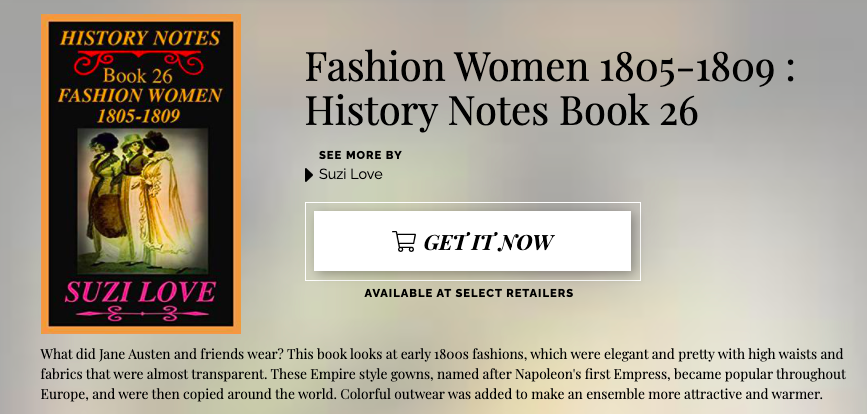
Fashion Women 1805-1809 History Notes Book 26
What did Jane Austen and friends wear? This book looks at early 1800s fashions, which were elegant and pretty with high waists and fabrics that were almost transparent. These Empire style gowns, named after Napoleon’s first Empress, became popular throughout Europe, and were then copied around the world. Colorful outwear was added to make an ensemble more attractive and warmer.
https://books2read.com/SuziLoveFashionWomen1805-1809
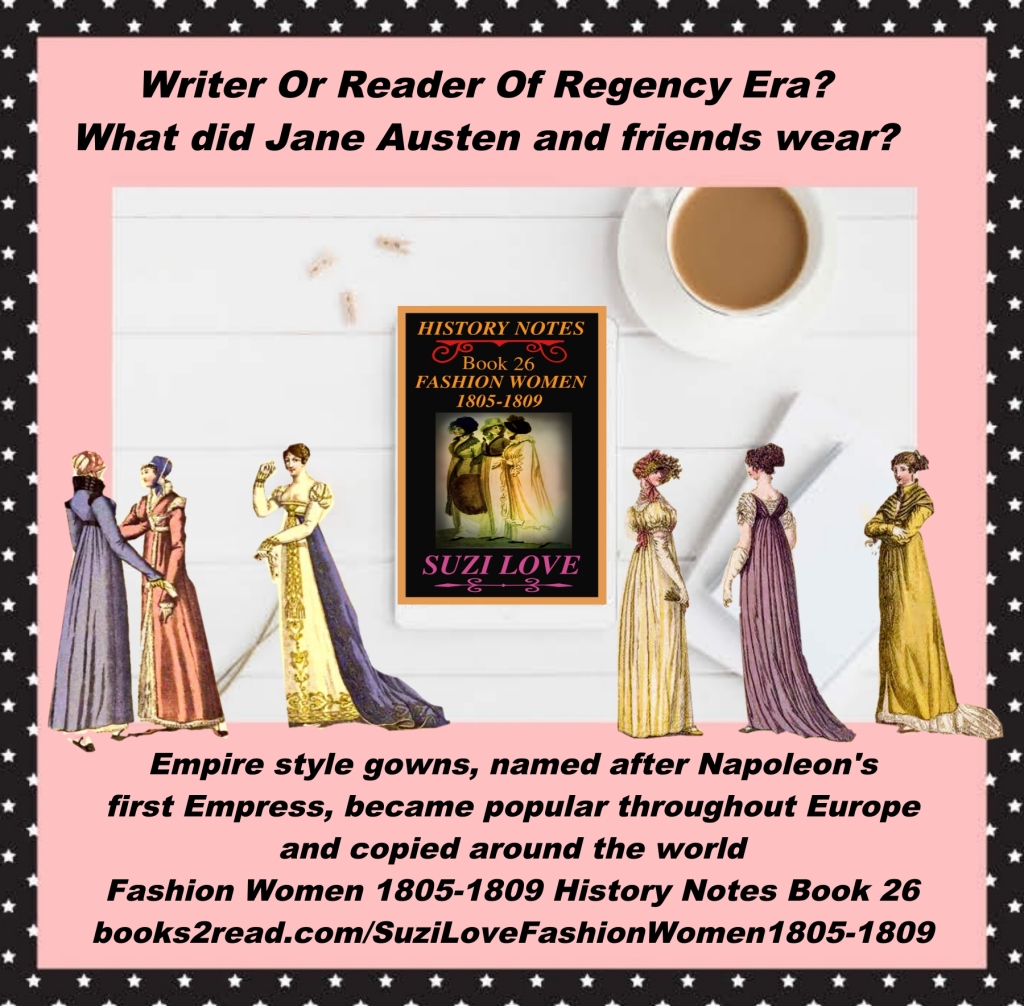
What did Jane Austen and friends wear? Early 1800s fashions were elegant and pretty with high waists and fabrics that were almost transparent. These Empire style gowns, named after Napoleon’s first Empress, became popular throughout Europe, and were then copied around the world. Colorful outwear was added to make an ensemble more attractive and warmer. History Notes Book 26 Fashion Women 1805-1809. https://books2read.com/SuziLoveFashionWomen1805-1809
What did Jane Austen and friends wear? Early 1800s fashions were elegant and pretty with high waists and fabrics that were almost transparent. These Empire style gowns, named after Napoleon’s first Empress, became popular throughout Europe, and were then copied around the world. Colorful outwear was added to make an ensemble more attractive and warmer. History Notes Book 26 Fashion Women 1805-1809. https://books2read.com/SuziLoveFashionWomen1805-1809
The Empire waist gown defined women’s fashion during the Regency Era. ‘Empire’ is the name given in France to the period when Napoleon built his French Empire. High-waisted, loose gowns were adopted by the aristocracy as a symbol of turning away from the fussy, elaborate and expensive clothing worn in the 1700s. Jean-Jaques Rousseau advocated copying peasants and returning to a simpler life and more natural fashions. Unrestricting clothing was part of the new Democracy in France and these simpler and flowing fashions were adopted all over Europe, including Britain and despite the continual wars being fought against France during the early 1800s. Not even war stopped fashions from being copied everywhere.
Fashion Women 1805-1809 History Notes Book 26
What did Jane Austen and friends wear? This book looks at early 1800s fashions, which were elegant and pretty with high waists and fabrics that were almost transparent. These Empire style gowns, named after Napoleon’s first Empress, became popular throughout Europe, and were then copied around the world. Colorful outwear was added to make an ensemble more attractive and warmer.
https://books2read.com/SuziLoveFashionWomen1805-1809HN_26_D2D_FsshionWomen1805-1809
What was fashionable for women in Jane Austen’s times? Mourning, riding, daytime, evening clothing, plus underclothing, corsets and accessories. Wars were being fought so women adopted military looks in support of soldiers. https://books2read.com/SuziLoveFashion1810-1814