1789-1790 ca. Man’s Red Riding Coat, England or France. Wool plain weave, full finish, with metallic-thread embroidery, tan breeches, black riding boots and crop. Credit: (M.2007.211.46) via Los Angeles County Museum of Art, California, USA. collections.lacma.org
1789-1790 Man’s Red Riding Coat, England or France. Wool plain weave, full finish, with metallic-thread embroidery Credit: (M.2007.211.46) via Los Angeles County Museum of Art, California, USA. collections.lacma.org suzilove.comHN_2_D2D_Fashion Men 1700s
books2read.com/suziloveFashMen1700
1800 Outfit Of A Young Man With Grey Cutaway Coat, French. Grey cutaway coat, red vest or waistcoat, high white cravat, yellow breeches with red fob at waist, yellow gloves, black boots with tassels, hat and walking stick. Fashion Plate via Journal des Dames et des Modes, or Costume Parisien.
In the early years of the 19th century, men’s fashions changed dramatically. Coats were cut higher in the front and finished in long tails at the back. Waist length square-cut waistcoats were displayed beneath tailcoats. The lining of the shoulders and upper chest of the coat was sometimes quilted to improve the fit and some dandies wore boned corsets to give them a small waist. Trousers became increasingly fashionable in the first quarter of the 19th century as men gradually adopted long trousers rather than knee breeches. At first long length pants were only worn for day and informal dress and breeches were still required for court dress, but by the 1820s trousers were accepted as evening wear.
Typical menswear in the early 1800s included a tailcoat, a vest or waistcoat, either breeches, pants, or the newer trousers, stockings, shoes or boots, all worn with an overcoat and hat. This basic ensemble was accessorized with some form of neckcloth or cravat, gloves, walking stick, cane or riding crop, handkerchief, fobs, watch and perhaps a quizzing glass or eye glass. The tan hat from the late 18th century was worn and developed into the top hat which was worn for day and formal dress throughout the 19th century. Hair was carefully styled into a windswept look or worn short and curled.
1830 ca. Quilted Buff Canvas Corset, English. Quilted canvas, wood, boning, and brass. Self lined, quilted with back stitch.
Front fastening, shoulder straps, and brass eyelets for back. The wide centre front busk may be of wood and these stays are boned from the waist through the centre of the bust gussets, with three bones at each side and on each side of the back lacing. The rest is quilted, the top is over a cord foundation, and there are gussets at the hips. Eyelets in the back and strap lacing are of brass and machine inserted. On the left of the centre busk at hip level, is a tape stretched so that it ties horizontally. The top and straps are bound with tape. Self lined, quilted in back stitch, the waist is herringboned, and the bases of the bust and hip gores are button-holed. via Victoria and Albert Museum, London, UK. collections.vam.ac.uk
19th Century Early Reticule, Or Bag, New England, England or U.S.A. Septagonal, or four sided, with embroidery and silk tassels. White satin embroidered with polychrome silks, silver threads, silver sequins. On front, in center of wreath of roses tied with blue bow, is written VALUE THE TRIFLE. On back, in similar wreath, is FRIENDSHIP. On sides are floral motifs, one of sweetpeas and the other of pansies. On all sides a border of silver threads in chain motif entwined with curling brown vine. Primarily worked in satin stitch. Thirteen silk tassels attached. White ribbon ties. via Museum of Fine Arts, Boston, U.S.A. mfa.org
Definition Reticule Or Ridicule Or Bag or Purse: Often with a drawstring to pull closed and usually made of cloth or covered cardboard and often decorated with beading or embroidery. A reticule, or purse, or handbag, was usually carried by a woman during the Regency period to carry all their daily necessities. Earlier, women used pockets that tied at the waistline and were hidden in the folds of their skirts. Empire style, or early 1800s, high-waisted dresses made it impossible to either sewn in a pocket or to tie on a pocket. So women began carrying small, decorated bags called Reticules, or ridicules, which generally pulled close at the top with a drawstring.
1800 ca. Brown Silk Trousers, French. Though these pants are French, the men in Jane Austen’s life would have worn similar trousers. Drop down front flap, or ‘fall’, buttoned waist front and back, extra fabric in the back for ease of movement and ties at calves to hold in place. via Metropolitan Museum, N.Y.C., U.S.A.
1800 ca. Brown Silk Trousers, extra fabric in the back for ease of movement. 1800 ca. Brown Silk Trousers, French. Drop down front flap, or ‘fall’, buttoned waist front and back. 1800 ca. Brown Silk Trousers, French. Drop down front flap, or ‘fall’, buttoned waist front and back. 1800 ca. Brown Silk Trousers, French. Drop down front flap, or ‘fall’, buttoned waist front and back, extra fabric in the back for ease of movement and ties at calves to hold in place. HN_23_D2D_Fashion Men 1800-1819
1801 Typical Gentleman’s Suit, French. Normal outfit worn by men in the times of Jane Austen, or the Regency Era, or the early 1800s. Blue tailcoat with brass buttons, taupe breeches tied beneath the knees, white stockings, black dress shoes, black hat, gloves and cane. Fashion Plate via Journal des Dames et des Modes, or Costume Parisien.
Typical menswear in the early 1800s included a tailcoat, a vest or waistcoat, either breeches, pants, or the newer trousers, stockings, shoes or boots, all worn with an overcoat and hat. This basic ensemble was accessorized with some form of neckcloth or cravat, gloves, a walking stick, cane or riding crop, handkerchief, fobs, a watch and perhaps a quizzing glass or eye glass.
HN_23_D2D_Fashion Men 1800-1819 History Notes Book 23
https://books2read.com/SuziLoveFashionMen1800-1819
1808 Gentleman’s Ensemble, French. Drap Redingote or coat, black hessian boots with heart shaped front, black top hat. Fashion Plate via suzilove.com and Journal des Dames et des Modes, or Costume Parisien. Typical gentleman’s outdoor ensemble as worn by men in Jane Austen’s time, or the Regency Era. https://books2read.com/SuziLoveFashionMen1800-1819
Hessian Boots: Named after German mercenaries who fought alongside British. Soft, highly polished calfskin, knee high, heart-shaped top and decorated with tassel. Boot shaped like stirrup so rider could insert feet into stirrups and be kept securely in place. Tassels were designed to wear with breeches and didn’t suit tight fitting new trousers that dandies like Beau Brummell wore in 1800s so Hessians replaced by other boots e.g. Wellington.
1808 Gentleman’s Ensemble, French. Drap Redingote or coat, black hessian boots with heart shaped front, black top hat. Fashion Plate via suzilove.com and Journal des Dames et des Modes, or Costume Parisien. https://books2read.com/SuziLoveFashionMen1800-1819
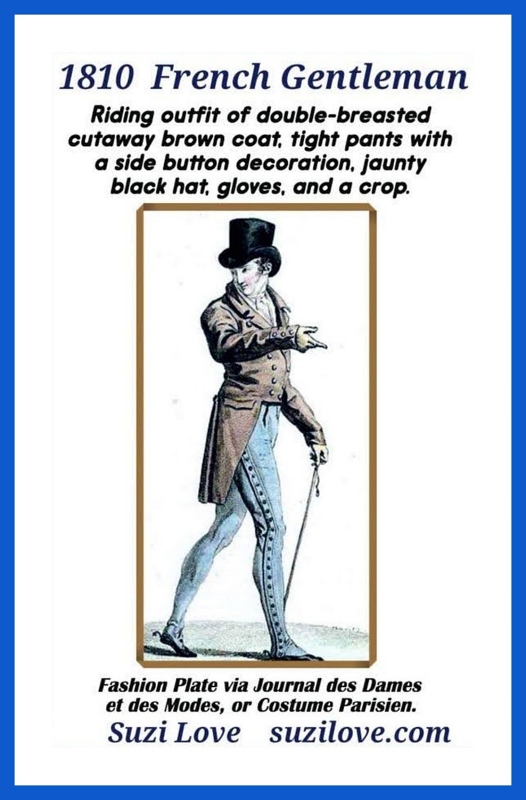
1810 French Gentleman. Riding outfit of double-breasted brown coat, tight pants with a side button decoration, jaunty black hat, gloves, and a crop. As Worn by Gentleman in the Bridgerton and Jane Austen Families. Fashion Plate via Journal des Dames et des Modes, or Costume Parisien.
Pantaloons: When tailcoats lengthened, breeches extended below the knees to accommodate the longer tails and were gradually replaced with slimmer fitting, longer pants, or pantaloons, that ended at the ankle. Pantaloons were close-fitting and sometimes buttoned all the way down the leg. To make them hug the leg tighter, knitted fabrics were used, or fabrics like nankin and kerseymere were cut on the bias.
In the early 1800s, men no longer wore complicated styles and extravagant fabrics. Men’s fashion simplified and became more conservative. A well cut tailcoat, vest, pantaloons and an immaculate cravat of beautiful white linen in the style of George Bryan, or Beau, Brummell. Clothes were a status symbol and indicated a man’s social position. These clothing items were the sort worn by Jane Austen’s male family and friends.
1810 Riding Outfit French DoubleBreastedBrownCoat Fashion Plate via Journal des Dames et des Modes, or Costume Parisien.HN_23_D2D_Fashion Men 1800-1819 History Notes Book 23
https://books2read.com/SuziLoveFashionMen1800-1819
1809 White Walking Dress, French. Green paisley shawl, green shoes and close-fitting hat. Fashion Plate via Journal des Dames et des Modes, or Costume Parisien.
These lightweight white cotton dresses were fashionable in Jane Austen’s times, but they were certainly not warm when a lady was out walking or when riding in a carriage. Numerous outer layers could be added for warmth and to brighten and personalize an outfit. These might be an overdress, pelisse or redingote, hat, shawl, gloves, or large fur muff.
Definition Paisley Shawl: Made of intricately woven and delicate wool with a teardrop motif that originated in Persia and India.
Fashion Women 1805-1809 History Notes Book 26 What did Jane Austen and friends wear? This book looks at early 1800s fashions, which were elegant and pretty with high waists and fabrics that were almost transparent. These Empire style gowns, named after Napoleon’s first Empress, became popular throughout Europe, and were then copied around the world. Colorful outwear was added to make an ensemble more attractive and warmer. https://books2read.com/SuziLoveFashionWomen1805-1809
Fashion Women 1805-1809 History Notes Book 26
What did Jane Austen and friends wear? This book looks at early 1800s fashions, which were elegant and pretty with high waists and fabrics that were almost transparent. These Empire style gowns, named after Napoleon’s first Empress, became popular throughout Europe, and were then copied around the world. Colorful outwear was added to make an ensemble more attractive and warmer.
https://books2read.com/SuziLoveFashionWomen1805-1809
“Captain, no,” Anne said, putting out her hand to prevent him from lifting the boy. “He’s a dead weight when asleep and you’ll hurt yourself.”
“Lady Melton, I may be injured, but I can still carry one small boy.”
Her hand flew to her mouth. “Oh, dear. I didn’t mean any insult, Captain.”
Damn. He’d embarrassed her when she’d only empathized with his incapacitated state. He nodded at his men, picked Daniel up and shifted him so the boy flopped over his shoulder, and walked to the door, deliberately taking small steps to hide his lop-sided gait.
“Good night,” he said to the room in general. “Find your beds and get a good night’s rest. There is a chance we’ll encounter British deserters tomorrow, so we need to be alert.”
Some of the men tried to stand but he waved them back down and looked at Anne. “Coming, Lady Melton? A fire has been lit in your room, so you and Daniel should be quite comfortable.”
She thanked him and wished the men a good night, before following Gabe up the stairs, not mentioning her son’s dead weight again and, to his relief, ignoring the ungainly way he tackled each step. When he reached the top, he sagged for a moment against the wall, and she walked past him to open the door to her chamber. He laid Daniel on the bed and said, “Thank you for allowing me to hang onto my pride in front of the men. Wouldn’t do for them to think their leader more debilitated than them, especially if we encounter trouble tomorrow.”
When Lady Melton and son join antagonistic Captain Belling and last group of wounded British soldiers evacuating Waterloo, she expects clashes with army deserters.What she doesn’t anticipate is how much she and her son will need the belligerent Captain after they reach London. #RegencyRomance #MilitaryRomance https://books2read.com/suziloveLAW