1851-1860 ca. Queen Victoria’s Ivory Silk Satin Dancing Slippers, English. Made by Richard Gundry, Gundry and Co., Soho Square, London, U.K.



1851-1860 ca. Queen Victoria’s Ivory Silk Satin Dancing Slippers, English. Made by Richard Gundry, Gundry and Co., Soho Square, London, U.K.
1816 July Opera Dress, English. Dress of white lace worn over a rich soft white satin slip. Skirt trimmed in a style of peculiar elegance, with lace festooned at regular distances, festoons edged by plain band of byas satin and finished by pearl ornaments of a very novel and pretty shape. Lace body is cut byas and richly ornamented round the bosom with pointed lace. Plain long sleeve, very full, except towards the wrist, which is nearly tight to the arm, and elegantly finished with lace. Hair ornamented with a wreath of French roses, parted in front, and simply dressed in loose curls, which fall very low on each side. Hind hair forms a tuft at the back of the head. Necklace, ear-rings, and bracelets of pearl. White satin slippers, and white kid gloves and a blush colored French silk scarf. Fashion Plate via Rudolph Ackermann’s ‘The Repository of Arts’.
Gorgeous Regency Era clothing came in a wide range of styles to suit every season and occasion. Ladies in the Bridgerton series and in Jane Austen’s times wore Empire style dresses which were usually made of light fabric and floaty in style. By the later 1810s, stripes were very popular and lace and frills were added to make the dress more individual.


19th Century Early Reticule, Or Bag, New England, England or U.S.A. Septagonal, or four sided, with embroidery and silk tassels. White satin embroidered with polychrome silks, silver threads, silver sequins. On front, in center of wreath of roses tied with blue bow, is written VALUE THE TRIFLE. On back, in similar wreath, is FRIENDSHIP. On sides are floral motifs, one of sweetpeas and the other of pansies. On all sides a border of silver threads in chain motif entwined with curling brown vine. Primarily worked in satin stitch. Thirteen silk tassels attached. White ribbon ties. via Museum of Fine Arts, Boston, U.S.A. mfa.org
Definition Reticule Or Ridicule Or Bag or Purse: Often with a drawstring to pull closed and usually made of cloth or covered cardboard and often decorated with beading or embroidery. A reticule, or purse, or handbag, was usually carried by a woman during the Regency period to carry all their daily necessities. Earlier, women used pockets that tied at the waistline and were hidden in the folds of their skirts. Empire style, or early 1800s, high-waisted dresses made it impossible to either sewn in a pocket or to tie on a pocket. So women began carrying small, decorated bags called Reticules, or ridicules, which generally pulled close at the top with a drawstring.


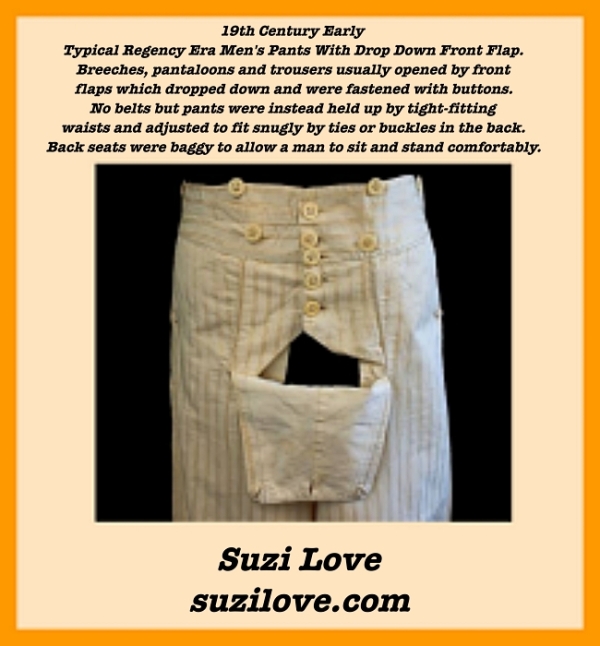
1800 ca. Brown Silk Trousers, French. Though these pants are French, the men in Jane Austen’s life would have worn similar trousers. Drop down front flap, or ‘fall’, buttoned waist front and back, extra fabric in the back for ease of movement and ties at calves to hold in place. via Metropolitan Museum, N.Y.C., U.S.A.


1820 ca. Silk Spencer, British. Made of silk and willow. Short length, long sleeves, extensive decoration on shoulders, sleeves and wrists. Military style braiding on the spencer in support of all the soldiers fighting wars across the world. The sort of jacket worn by fashionable Regency ladies over their light and flowing Empire dresses. Credit Line:Catharine Breyer Van Bomel Foundation Fund, 1987 via Metropolitan Museum New York City, U.S.A. metmuseum.org
Definition Spencer: Short jackets cut to match the high waistlines of Empire dresses. They often copied military styling, such as braiding, shoulder decoration, buttons and loop fasteners, and wrist adornments. They were generally of complex construction, often with a diamond shaped piece in the back. Said to have originated in an accident to Lord Spencer while hunting when his coat tails were torn off and he wore it as a short jacket.


1820 ca. Military Style Silk Spencer With Braiding In the Style of the Bridgertons and Jane Austen. #Bridgerton #JaneAusten #RegencyFashion #BritishHistory books2read.com/suziloveSpencers

1801 Typical Gentleman’s Suit, French. Normal outfit worn by men in the times of Jane Austen, or the Regency Era, or the early 1800s. Blue tailcoat with brass buttons, taupe breeches tied beneath the knees, white stockings, black dress shoes, black hat, gloves and cane. Fashion Plate via Journal des Dames et des Modes, or Costume Parisien.
Typical menswear in the early 1800s included a tailcoat, a vest or waistcoat, either breeches, pants, or the newer trousers, stockings, shoes or boots, all worn with an overcoat and hat. This basic ensemble was accessorized with some form of neckcloth or cravat, gloves, a walking stick, cane or riding crop, handkerchief, fobs, a watch and perhaps a quizzing glass or eye glass.

1815 Pink Dress, French. Cashmere dress with white underdress showing the sleeves, decorated hem, turban of tulle and satin, diamond pointed hem, slippers and shawl. Fashion Plate via Journal des Dames et des Modes, or Costume Parisien. https://books2read.com/SuziLoveFashionWomen1815-1819
Definition Aigret, aigrette, egret: Plume of feathers or jeweled ornament in shape of feathers worn on head or hats. During the early 19th century., or Jane Austen’s lifetime, the favorite feathers were osprey and heron.
Definition Empire Style: Named after the First Empire in France, by 1800 Empire dresses had a very low décolleté, or neckline and a short narrow backed bodice attached to a separate skirt. Skirts started directly under the bust and flowed into the classical relaxed wide styles of Greece and Rome. This style of dress is associated with Jane Austen and her contemporaries as a simple cotton high-waisted dress was worn most days and accessorized according to the importance of the occasion.

19th Century Early Typical Regency Era Men’s Pants With Drop Down Front Flap. Breeches, pantaloons and trousers usually opened by front flaps which dropped down and were fastened with buttons. No belts but pants were instead held up by tight-fitting waists and adjusted to fit snugly by ties or buckles in the back. Back seats were baggy to allow a man to sit and stand comfortably. Typical of a gentleman’s pants worn during the early 1800s, or the Regency Era, or Jane Austen’s times. They have a front flap, or fall, a back waist tie and buttons and ties to secure the breeches below the knee.
1810 ca. Pineapple Dress, French. High-waisted, Empire style dress with embroidered pineapple motifs, short wide neckline, puffed sleeves and long train. via Palais Galliera, Musée de la Mode de la Ville de Paris.


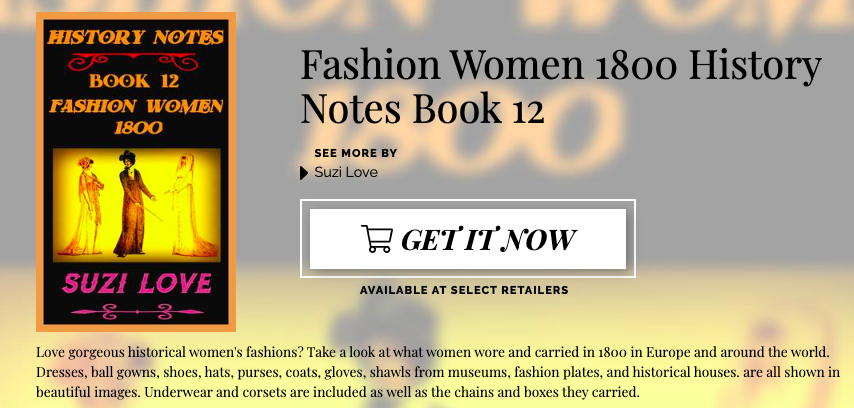
Fashion Women 1800 By Suzi Love History Notes Book 12 #Regency #Fashion Love gorgeous historical women’s fashions? Take a look at what women wore and carried in 1800 in Europe and around the world. This is the world Jane Austen lived in and the fashions she wore. books2read.com/SuziLoveFashionWomen1800