1810-1820s ca. Woman’s Green Slippers. Possibly French, worn in America. The type of shoes worn by Jane Austen and her female friends and family and by the female members of the Bridgerton family. via Museum of Fine Arts, Boston. mfa.org
Shoes in the early 1800s were flat or low heeled and occasionally decorated with a bow or floral embellishments and it wasn’t until the 1820s that square, rather than rounded, toes became fashionable. Typical Regency Era women’s footwear were shoes that had low heels, slightly rounded toes, embellished with a bow and with ribbon ties for the ankles. Made of soft kid or cloth, these delicate shoes were flimsy and wore out quickly. Slippers were often bought in multiples at a time and with no difference between left or right foot so when one slipper had a hole it was easily replaced.
1808 Gorgeous Women’s Fashion In The Times Of Jane Austen. Fashion plates from Journal des Dames et des Modes or Costume Parisien. Dresses, coats or Redingotes, Spencers in purple and red, shawls, fichu or shoulder cape, shoes, hats and headdresses, gloves, and Reticules or bags. Empire style, high-waisted dresses of lightweight cotton with softly falling, gathered, long skirt and with a train were commonly worn. In Jane Austen years, high-waisted and short sleeved dresses were the Neo-classical dresses which imitated the Greek and Roman clothing seen in sculptures. White muslin fabrics were either imported from India, or made in Europe to imitate Indian materials.
Fashion Women 1805-1809 History Notes Book 26 What did Jane Austen and friends wear? This book looks at early 1800s fashions, which were elegant and pretty with high waists and fabrics that were almost transparent. These Empire style gowns, named after Napoleon’s first Empress, became popular throughout Europe, and were then copied around the world. Colorful outwear was added to make an ensemble more attractive and warmer. https://books2read.com/SuziLoveFashionWomen1805-1809
Definition Reticule Or Ridicule Or Bag or Purse or Handbag: Often with a drawstring to pull closed and usually made of cloth or covered cardboard and often decorated with beading or embroidery. A reticule, or purse, or handbag, was usually carried by a woman during the Regency period to carry all their daily necessities. Earlier, women used pockets that tied at the waistline and were hidden in the folds of their skirts. Empire style, or early 1800s, high-waisted dresses made it impossible to either sewn in a pocket or to tie on a pocket. So women began carrying small, decorated bags called Reticules, or ridicules, which generally pulled close at the top with a drawstring.
1808 High-Waisted White Dress, French. White Fichu over the shoulders, pale blue shoes, pink striped hat.1808 White Dress With Purple Spencer, French. 1800 White Dress, French. Black ribbon criss-crossing the back bodice. 1808 White Dress With Train Under A Red Spencer, French. Pointed shawl bodice and long sleeves.1808 Negligee Or At-Home Dress, French. Orange redingote, or coat, white shawl, blue gloves and shoes.1808 Lady in a white At-Home dress and cap sitting at her dressing table, French. Fashion Women 1805-1809 History Notes Book 26
What did Jane Austen and friends wear? This book looks at early 1800s fashions, which were elegant and pretty with high waists and fabrics that were almost transparent. These Empire style gowns, named after Napoleon’s first Empress, became popular throughout Europe, and were then copied around the world. Colorful outwear was added to make an ensemble more attractive and warmer.
https://books2read.com/SuziLoveFashionWomen1805-1809
I love Pinterest for keeping thousands of historical images in some sort of order.And I love using Pinterest Boards as inspiration for my romance books.What about you? Do you use Pinterest for planning something, or just for fun?Need more hints for what to do with your boards and pins? Take a look at these fascinating articles on Pinterest. if you want even more Pinterest information and tips for becoming a power user, check out my Suzi Love Pinterest Boards
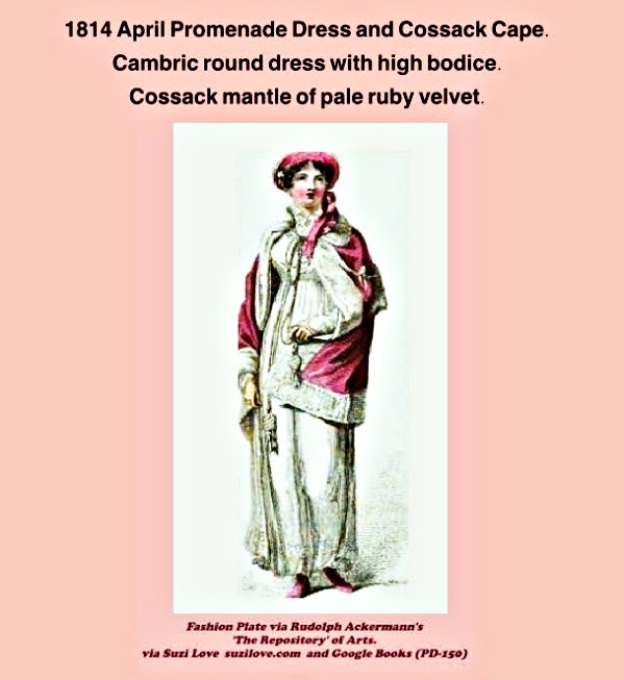
1814 April White Promenade Dress with velvet Cossack Cape . A cambric round robe, with high bodice and long sleeves, not so full as of late; embroidered stomacher front and high collar, trimmed with muslin or lace; a Tuscan border of needle work at the feet. A Cossack mantle of pale ruby or blossom velvet, lined with white sarsnet, and trimmed entirely round with a broad skin of light sable, ermine, seal or the American squirrel; a short tippet of the same; the mantle confined at the throat with a rich correspondent silk cord and tassels, very long. A mountain hat of velvet, the color of the mantle, finished round the verge with a narrow Vandyke trimming; a small flower placed in the hair beneath, on the left side. Half-boots the color of the mantle; and gloves of primrose kid or pale tan. Fashion Plate via Rudolph Ackermann’s ‘The Repository of Arts’.
Definition Van Dyke Points: V-shaped lace and trims named after a 17th Century Flemish painter, Sir Anthony Van Dyck, known for painting V-shaped lace collars and scalloped edges on sitters.
Definition Muslin: Thin fabric said to take its name from Mosul or Moosul, a large town in Turkish Asia where it was first made.
1771 September New Assembly Rooms opened on the north east of the Circus, Bath, U.K.
Bath had two assembly rooms in the lower part of the town but they weren’t large enough for the rapidly increasing population so on the 30th September, 1771, New Rooms were opened on the north east of the Circus, between Bennett and Alfred Streets. These Upper Rooms were designed by the architect, John Wood, and were in a better part of town so they became much more fashionable. They were called the New, or Upper Rooms, to distinguish them from the older Assembly Rooms in the lower part of the town.
They were a set of public rooms purpose-built for the 18th century form of entertainment called an ‘assembly’, where a large number of people came together to dance, drink tea, play cards, listen to music, or parade around the rooms and talk and flirt. The four rooms are the Ball Room, the Tea Room or Concert Room, the Octagon Room, and a Card Room. The Upper Rooms held two balls a week, a dress ball on Monday evenings and a fancy ball on Thursdays during the Bath season which was from October to early June. These balls were so popular they attracted between 800 and 1,200 guests at a time.
John Wood raised the money for the New Rooms by a “tontine” subscription, which was like a lottery. By April 1769, £14,000 was raised amongst 53 people. When a subscriber died, their shares were added to the holdings of the other subscribers, which meant that the last surviving subscriber inherited everything.
The exterior of the Upper Assembly Room looks typically Georgian, but the interior is very grand and the high ceilings gave good ventilation on crowded ball nights and windows set at a high level prevented outsiders from looking in. Two long rectangular rooms flank the entrance hall and are linked by an octagonal room at the far end to form a U-shape.
What did Jane Austen and friends wear? Early 1800s fashions were elegant and pretty with high waists and fabrics that were almost transparent. These Empire style gowns, named after Napoleon’s first Empress, became popular throughout Europe, and were then copied around the world. Colorful outwear was added to make an ensemble more attractive and warmer. History Notes Book 26 Fashion Women 1805-1809. https://books2read.com/SuziLoveFashionWomen1805-1809
The Empire waist gown defined women’s fashion during the Regency Era. ‘Empire’ is the name given in France to the period when Napoleon built his French Empire. High-waisted, loose gowns were adopted by the aristocracy as a symbol of turning away from the fussy, elaborate and expensive clothing worn in the 1700s. Jean-Jaques Rousseau advocated copying peasants and returning to a simpler life and more natural fashions. Unrestricting clothing was part of the new Democracy in France and these simpler and flowing fashions were adopted all over Europe, including Britain and despite the continual wars being fought against France during the early 1800s. Not even war stopped fashions from being copied everywhere.
Fashion Women 1805-1809 History Notes Book 26 What did Jane Austen and friends wear? This book looks at early 1800s fashions, which were elegant and pretty with high waists and fabrics that were almost transparent. These Empire style gowns, named after Napoleon’s first Empress, became popular throughout Europe, and were then copied around the world. Colorful outwear was added to make an ensemble more attractive and warmer. https://books2read.com/SuziLoveFashionWomen1805-1809HN_26_D2D_FsshionWomen1805-1809
1830-1835 ca. Canary Yellow Leather and Silk Slippers, British. Silk satin lined, kid leather and linen. via Victoria and Albert Museum, London, UK. collections.vam.ac.uk.
1830s Shoes: Producing different shoes for right and left feet started around 1830 in France. In these first attempts, little paper labels on the insoles of the shoes indicated left and right. However, the shoes were still made on straight lasts with no differentiation between the left and right foot. By the end of the 19th century, producing left and right shoes had become common as shoemakers then worked with combinations of sole and vamp cuts tailored to fit either the right or the left foot. The first steps towards the mechanisation of shoemaking were taken during the Napoleonic Wars. In 1810, engineer Marc Brunel developed a machinery that could mass-produce nailed boots for the soldiers of the British Army. But after the end of the war in 1815, manual labour became cheap, and the demand for military shoes declined. The industrialization of shoemaking began around 1830.
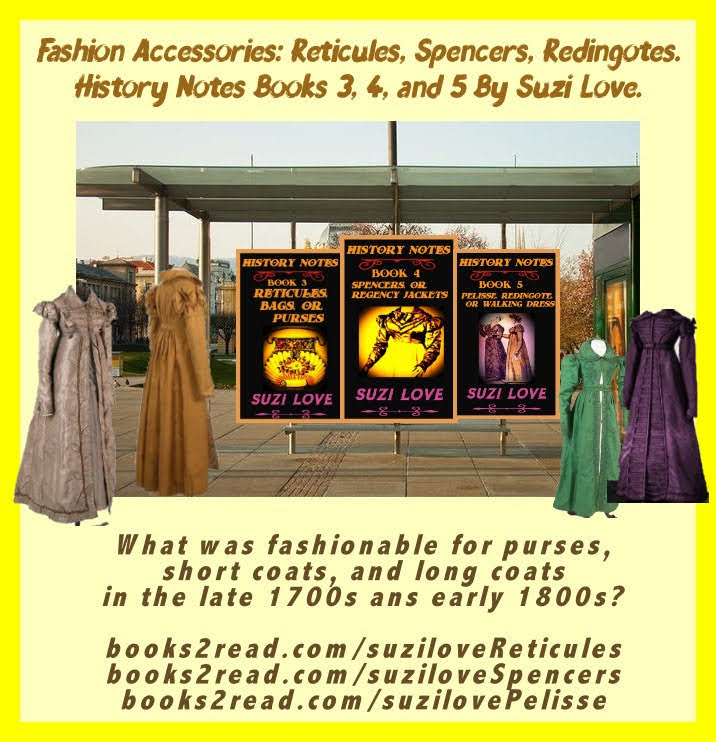
Reticule Or Bag: Purse, often with a drawstring to pull closed and usually made of cloth or covered cardboard and often decorated with beading or embroidery. Carried by a woman during the Regency period to carry all their daily necessities. in the place of pockets.
Spencer: Short jacket, cropped at the waist, worn over a dress, or gown. Delicate and regency dresses provided so little protection from the cold, so over garments were essential for warmth, modesty and good health.
Pelisse Or redingote Or Walking Dress: Coat worn over clothing of both sexes for warmth and protection from the elements.
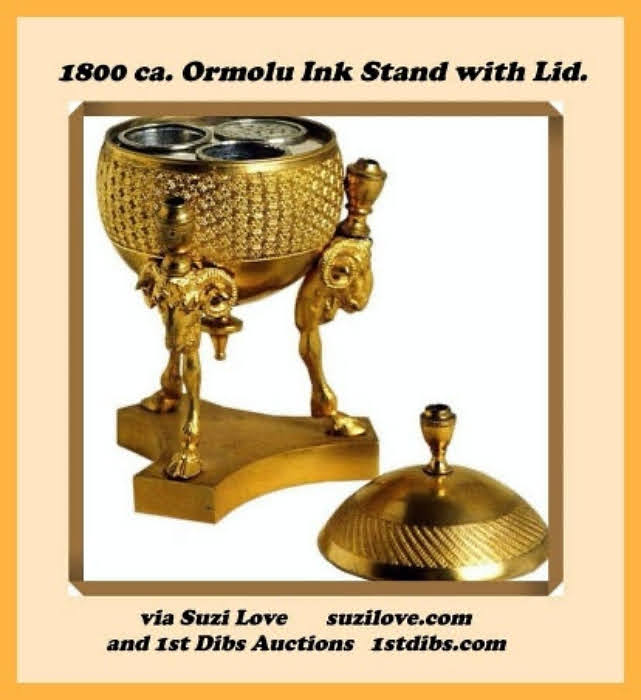
1800 ca. Ormolu Ink Stand with Lid, French. Ormolu ink stand in the shape of a globe surrounded by three rams head pen supports with animal legs and hoofs on a tripartite base. The top is removable revealing a silvered compartment with containers for sand and ink. via 1st Dibs Auctions 1stdibs.com
Definition Ormolu: Gold colored alloy of copper, zinc, and tin used in decoration and for making ornaments. Ormolu is used in mounts i.e ornaments on borders, edges, and as angle guards) for furniture, especially 18th-century furniture, and for other decorative purposes. Its gold colour may be heightened by immersion in dilute sulfuric acid or by burnishing.
HN_13_D2D_WritingTools Book 13 What did the lady of the house use to pen notes? What sat on the desk of the man of the house when managing his accounts? #History #Nonfiction #travel books2read.com/SuziLoveWritingTools