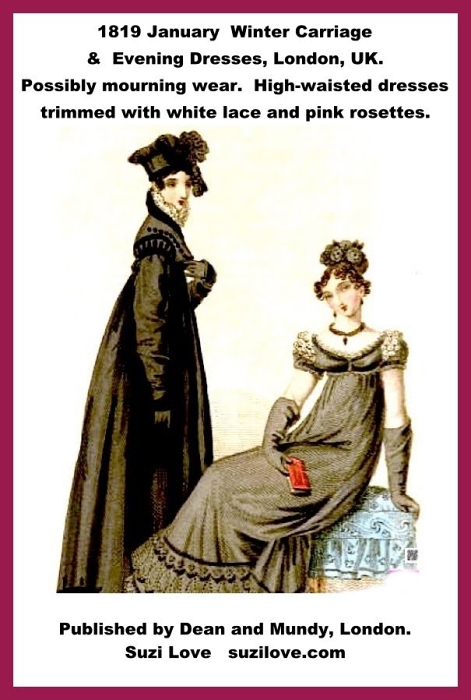
1819 January Two Fashion Plates By Dean and Mundy For Mourning: Winter Carriage and Evening Dresses. High-waisted carriage dress, cuffs edged with white lace and trimmed with gray frog closures, matching plumed hat and shawl. Empire style evening dress with short sleeves and wide neckline trimmed with scallops of white lace, skirt trimmed with white rosettes, evening upswept hairstyle. Fashion Plates Published by Dean and Munday, 1819, London.
Mourning wear was worn in Britain during the regency Era, firstly for Princess Charlotte who died in England on November 6th, 1817, or then for Queen Charlotte, wife of King George III and grandmother of Princess Charlotte, who died on November 17th, 1818. All the fashion magazines featured numerous outfits in black suitable for mourning, followed by many for half mourning in colors of grey, black with touches of white, and later mauve or lavender.
Black was worn for full mourning with various other colors were worn during the months of half mourning, including grey and mauve. However, as black dresses, black tunics, and black lace shawls were popular throughout the Regency years, it is often hard to decide what was definitely made for mourning and what was simply fashionable wear.
After the death of H.R. H. Princess Charlotte on November 7th, 1817, official court mourning was ordered. ‘The ladies to wear black bombazines, plain muslin or long lawn crape hoods, shamoy shoes and gloves, and crape fans. The gentlemen to wear black cloth without buttons on the sleeves or pockets, plain muslin or long lawn cravats and weepers, shamoy shoes and gloves, crape hat bands, and black swords and buckles.’ Two months later, a change of mourning attire was ordered.
1819 January. Winter Carriage and Evening Dresses. High-waisted carriage dress, cuffs edged with white lace and trimmed with gray frog closures, matching plumed hat and shawl. Empire style evening dress with short sleeves and wide neckline trimmed with scallops of white lace, skirt trimmed with white rosettes, evening upswept hairstyle. Mourning wear for Princess Charlotte who died in England in 1817 or for another member of the Royal family. Fashion Plate Published by Dean and Munday, London. 1819 January. Winter Carriage and Evening Dresses, London, U.K. High-waisted carriage dress, trimmed with front closures, matching plumed hat. Empire style evening dress with tiny sleeves and wide neckline trimmed with white lace on sleeves, skirt trimmed with rows of frills. Fashion Plate Published by Dean and Munday, 1819, London.
1819 January Mourning Winter Carriage and Evening Dresses in Bridgerton years. #Bridgerton #RegencyFashion #Mourning #HistoricalFashion https://books2read.com/SuziLoveFashionWomen1815-1819
1818 Long Green Redingote Or Coat With Velvet Collar, French. White shirt with high collar, cravat, white trousers, black boots and a cane. Fashion Plate via Journal des Dames et des Modes, or Costume Parisien.
Definition Redingote Or Pelisse Or Walking Dress Or Coat: French word developed from English words, riding coat. Long fitted outdoor coat worn over other garments for warmth. Originally made with several capes and trimmed with large buttons. For women, the coat was often cut away in the front or left open to show off the dress underneath. French fashion plates call these coats Redingotes and they were worn by men, women, and children. English fashion plates call the coats a Pelisse, a walking dress, Promenade dress, or Carriage dress.
1818 Gentleman’s Long Green Redingote Or Coat as Worn By the Bridgerton Men. #Bridgerton #RegencyFashion #France https://books2read.com/SuziLoveFashionMen1800-1819
This book shows how corsets changed to fit well under clothing, give maximum support and comfort. Corsets pushed up breasts and showed off the bust line beneath a square-cut and low-cut neckline as in the early 1800s, or Regency years. Jane Austen and her female and friends wore these corsets. Corsets or stays worn during the early 1800s, or Jane Austen’s lifetime. https://books2read.com/SuziLoveCorsetBook17
Are you a Reader or Writer of Regency Era Fashions? Jane Austen and Bridgerton corsets. #corsets #historicalfashion #RegencyFashion #JaneAusten #Bridgerton https://books2read.com/SuziLoveCorsetBook17
What was fashionable for women in Jane Austen’s times? Mourning, riding, daytime, evening clothing, plus underclothing, corsets and accessories. Fashion Women 1810-1814 History Notes Book 27 This book looks at what was fashionable for women in Jane Austen’s times, or the early 1800s, or the Regency Era in Britain. Wars were being fought around the globe so women’s fashion adopted a military look in support of soldiers. Fashions, like the lifestyle, became progressively more extravagant and accessories went from colorful to over-the-top. https://books2read.com/SuziLoveFashion1810-1814
The Lady’s Magazine said of the basis of women’s fashion that was popular for the first twenty years of the 1800s, ‘White is still the prevailing color for robes. For morning dresses, linen gowns, in large diamonds or squares, are fashionable. Indian muslins, plain or embroidered, are preferred to Florence and satins. The designs of embroidery for shawls are of infinite variety. Long gloves, which reach above the elbow, are not yet laid aside. Medallions are hung around the neck from crossed chains and some of these medallions are shaped like the bags, called ridicules. These reticules are of the lozenge or hexagon shape, with a small tassel at each angle. Reticules, or ridicules, are in lozenge or hexagon shapes with a small tassel at each angle. In capotes, or hats, and ribbands, the violet and dark green prevail over jonquil. Bracelets in hair, pear-shaped ear-rings, medallions on square plates, saltiers of colored stones, are still in fashion.’
These are the types of outfits worn by Jane Austen and contemporaries in English magazines, where French fashions were obsessively copied despite the two countries being at war for many years. In Jane Austen’s years, she and her contemporaries spent a lot of time walking outdoors. People were encouraged to partake in outdoor pursuits to maintain good health. Fragile slippers were worn for balls and evening events but for walking sturdier shoes were needed, In the early 1800s, these were typically made of leather, had a very small heel, slightly rounded toes and were laced up on the top.
What was fashionable in Bridgerton and Jane Austen’s times? Mourning, riding, daytime, evening fashion plus underclothing. #Bridgerton #JaneAusten #RegencyFashion https://books2read.com/SuziLoveFashion1810-1814
The type of dress worn across Europe in the early 1800s. This sort of high-waisted dress would have been worn by Jane Austen and her contemporaries in England. The Empire waist gown defined women’s fashion during the Regency Era. ‘Empire’ is the name given in France to the period when Napoleon built his French Empire. High-waisted, loose gowns were adopted by the aristocracy as a symbol of turning away from the fussy, elaborate and expensive clothing worn in the 1700s.
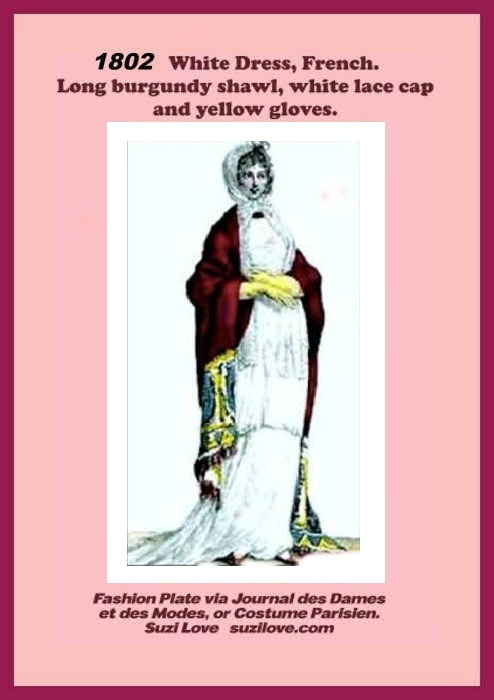
1802 White Dress, French. Long burgundy shawl, white lace cap and yellow gloves. Fashion Plate via Journal des Dames et des Modes, or Costume Parisien.
Are you a reader or writer of Regency Romance? Love Jane Austen’s books? Want to know more about the mourning, riding, underclothing and other Regency Era women’s fashions in Regency romances? What was fashionable for women in Jane Austen’s times? Mourning, riding, daytime, evening clothing, plus underclothing, corsets and accessories. This book looks at what was fashionable for women in Jane Austen’s times, or the early 1800s, or the Regency Era in Britain. Wars were being fought around the globe so women’s fashion adopted a military look in support of soldiers. Fashions, like the lifestyle, became progressively more extravagant and accessories went from colorful to over-the-top.
Love Bridgerton and Jane Austen fashions? Mourning, riding, daytime, evening fashions plus corsets and underclothing. #Bridgerton #JaneAusten #RegencyFashion https://books2read.com/SuziLoveFashion1810-1814
1808 Silver Wax Jack, Irish. By Robert Breading (active 1775–1822) Dublin. via suzilove.com and Metropolitan Museum New York City, U.S.A. metmuseum.org
How did Jane Austen seal her letters? Wax was melted by lighting the tip of a coiled wax length. This is called a wax jack. The melted wax blob was placed on the outside of a letter or document. A personal desk seal or a fob seal was pressed into the wax to identify the sender or owner of the document. Aristocrat families had their own coat of arms and others may have had their initials or their name on the seal.
How did Jane Austen seal her letters? 1808 Silver Wax Jack With Coil Of Red Wax, Irish. #JaneAusten #RegencyEra #writing #postal books2read.com/SuziLoveWritingTools
HN_13_D2D_WritingTools Book 13 What did the lady of the house use to pen notes? What sat on the desk of the man of the house when managing his accounts? #History #Nonfiction #travel books2read.com/SuziLoveWritingTools
Young Lady’s Day is Book 4 in the Regency Life Series. This book depicts the often-frivolous life and fashions of a young lady in the early 1800’s, but also gives a glimpse into the more serious occupations a young lady may undertake. Through historic images, historical information, and funny anecdotes, it shows how a young lady fills her day, where she is permitted to go, and who she is allowed spend time with. These light-hearted looks at the longer Regency years are an easy to read overview of what people did and wore, and where they worked and played. There is plenty of information to interest history buffs, and lots of pictures to help readers and writers of historical fiction visualize the people and places from the last years of the 18th Century until Queen Victoria took the throne.
Love the Bridgertons? Jane Austen fan? Early 1800’s glimpse into frivolous and serious occupations filling a young lady’s day. #Bridgerton #JaneAusten #RegencyEra #Nonfiction #AmWriting https://books2read.com/suziloveYLD
1811 White Dress, French. Worn under a white spotted tunic with yellow over dress with long sleeves. White gloves, shoes and hat with plume, or feathers, or aigrette. Fashion Plate via Journal des Dames et des Modes, or Costume Parisien. Even though this is a French fashion plate, Jane Austen and her contemporaries would have worn long coats like these to keep warm when out and about, visiting, shopping etc. The thin muslin dresses worn in the early 1800s were little protection against European winters so warmth and color was added by tunics and coats in a huge variety of styles.
Definition Aigret, aigrette, egret: Plume of feathers or jeweled ornament in shape of feathers worn on head or hats. During the early 19th century., or Jane Austen’s lifetime, the favorite feathers were osprey and heron.
1811 White Dress, French. Worn under a white spotted tunic with yellow over skirt. White gloves, shoes and hat. Fashion Plate via Journal des Dames et des Modes, or Costume Parisien.
Suzi Love Author avatar link
Suzi Love Author
1811 Jane Austen Style White Dress With Spotted Tunic And Yellow Overdress. #JaneAusten #RegencyFashion #19thcenturydress https://books2read.com/SuziLoveFashion1810-1814
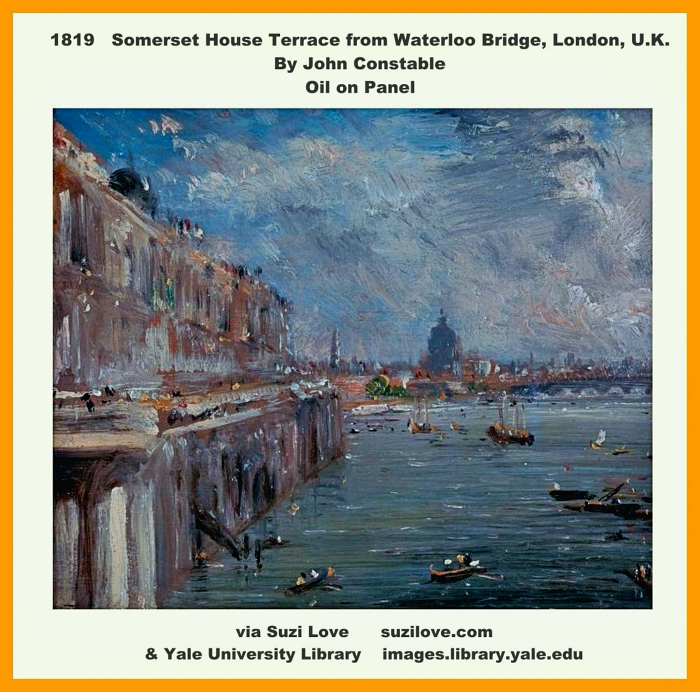
Somerset House, London, UK. London’s Best Places to Visit. Home to Royal Academy and The Great Institutions.
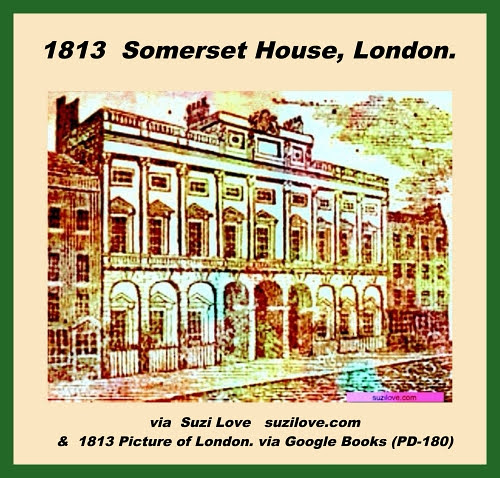
Demolition of the old house, between the Strand and the River Thames, began in 1775 and continued in stages as the new Somerset House was constructed around it. When the new building rose from the rubble, the Royal Academy, which had been one of the last occupants of the old Somerset House, became one of the first occupants of the apartments which fronted the Strand, providing tangible continuity between the old and the new.
Timeline
1547 Edward Seymour, Lord Protector and Duke of Somerset, starts building a palace for himself on the banks of the Thames
1552 Seymour is executed at the Tower of London; ownership of his palace, nearly complete, passes to the Crown
1553 Aged 20, Princess Elizabeth moves to Somerset House; she lives there until 1558, when she’s crowned Queen Elizabeth I
1603 Anne of Denmark, wife of James I of England (James VI of Scotland), moves to Somerset House, which is renamed Denmark House in her honour
1604 The Treaty of London, ending the 19-year Anglo-Spanish War, is negotiated and signed at Denmark House
1609 Anne of Denmark invites Inigo Jones and other architects to redesign and rebuild parts of the palace; work continues until her death in 1619
1625 Charles I is crowned king; his wife, Henrietta Maria of France, commissions Jones and others to undertake more construction and renovation work, including a lavish new Roman Catholic chapel completed in in 1636
1642 The English Civil War begins; soon afterwards, General Thomas Fairfax takes over the palace as the headquarters for the Parliamentary Army
1649 The Civil War ends and Charles I is executed; Parliament tries and fails to sell Denmark House, but successfully sells its contents for the then-huge sum of £118,000
1652 Inigo Jones dies at Denmark House
1660 After Charles II, her son, is crowned king at the start of the Restoration, Henrietta Maria returns to Denmark House; more new construction follows
1665 The Plague sweeps London; Henrietta Maria moves back to France, where she dies in 1669
1666 The Great Fire of London destroys much of the City of London, but stops just short of Denmark House
1685 Charles II dies and his wife, Catherine of Braganza, moves into Denmark House; Sir Christopher Wren oversees yet more construction and renovation work
1693 Catherine of Braganza leaves Denmark House, the last royal to live in the palace
early 1700s Denmark House is used as grace-and-favour apartments, offices, storage and stables
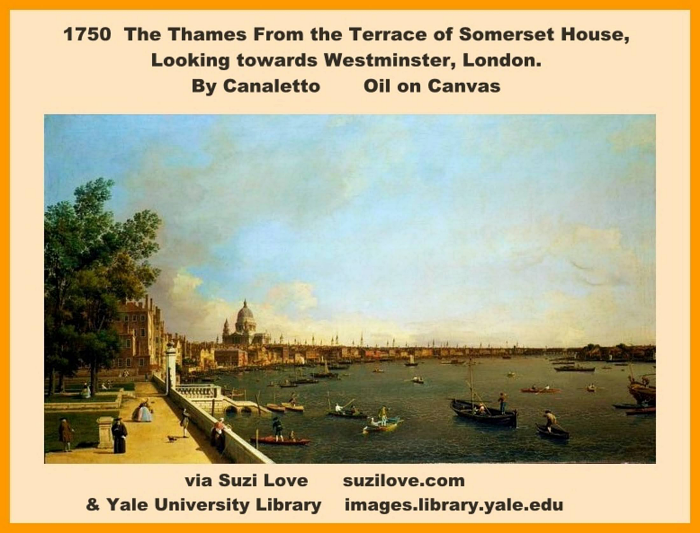
c.1750 Canaletto paints two views from the terrace
1775 After decades of neglect, the original Somerset House is demolished; architect William Chambers immediately starts work on its replacement
1779 The Royal Academy of Arts becomes the first resident of new Somerset House in what’s now known as the North Wing
1780 The Royal Society and the Society of Antiquaries take up residence in the North Wing; Somerset House hosts the first Royal Academy Exhibition
1786 The Embankment Building, known today as the South Wing, is completed; the East and West Wings are completed two years later
1789 The Navy Board completes its move to Somerset House and eventually occupies one-third of the site; the Stamp Office, responsible for taxing newspapers and other documents, joins the board in the South Wing
1795 William Chambers, then aged 72, retires; James Wyatt replaces him as the building’s architect
1801 The new Somerset House is deemed complete, its construction having cost a mammoth £462,323
1829 Sir Robert Smirke starts work on King’s College, which opens in 1831 and is finally completed in 1835
1836 The General Register Office, responsible for births, deaths and marriages, is established here
1837 One year after the final Royal Academy Exhibition at Somerset House, the academy moves to Burlington House on Piccadilly
1849 Having merged in 1834, the Stamp Office and the Board of Taxes join with the Board of Excise to form the Inland Revenue, which remains in residence for more than 150 years
1856 Seven years after James Pennethorne started work on its design, the New Wing is completed
1857 The Royal Society moves out of Somerset House to join the Royal Academy of Arts at Burlington House; the Society of Antiquaries follows 17 years later
1864 Work begins on the Victoria Embankment, designed by Sir Joseph Bazalgette; the embankment is completed in 1870
1873 The Admiralty leaves Somerset House; its offices are taken over by the Inland Revenue
1940s Near the start of World War II, the Inland Revenue temporarily moves out of Somerset House; the Ministry of Supply takes its place
1950 Sir Alfred Richardson starts a two-year project to rebuild the Navy Staircase, known today as the Nelson Stair, which had suffered terrible bomb damage in 1940
1970 After 134 years at Somerset House, the General Register Office moves out
1989 The Courtauld Institute of Art moves into the North Wing
1997 The Somerset House Trust is established to preserve and develop Somerset House for public use
2000 The River Terrace opens to the public for the first time in more than a century; the Hermitage Rooms and the Gilbert Collection both open; then, in December, Somerset House installs a temporary ice rink for the first time
2001 American band Lambchop plays the first gig in the Edmond J. Safra Fountain Court; a full programme of shows follows in 2002 and continues today as the Summer Series
2009 London Fashion Week takes place at Somerset House for the first time
2011 The HMRC (formerly the Inland Revenue) closes its offices at Somerset House
The Royal Academy of Arts
George III, described as an “enthusiastic if undiscriminating collector and patron of the arts”, provided invaluable patronage for the three learned societies. When old Somerset House was relinquished by the Crown, the King reserved to himself the right to appropriate sufficient space in the new building for the Royal Academy of Arts, the Royal Society, and the Society of Antiquaries.
The Great Exhibition Room
1808 The Exhibition Room at Somerset House.
The most important part of the building for the Royal Academy was its Exhibition Room. Situated at the top of the steep, winding staircase, it was roughly 53 x 43 feet and 32 feet high including the lantern, and was described by Joseph Baretti as, “undoubtedly at that date the finest gallery for displaying pictures so far built.” It was here that George III was given a preview of the first Royal Academy Exhibition held at his command in 1780.
Year by year, the exhibits increased. There were 547 in 1781, 1,037 in 1801, and 1,165 in 1821, so that the pictures had to be hung almost from floor to ceiling and with the frames touching one another. From 1832 onwards there was talk of the Royal Academy moving to more spacious rooms in what is now the National Gallery, which was being built at the north end of Trafalgar Square. Accordingly, the last exhibition at Somerset House was held in 1836.
When the Academy moved, the most valuable decorations were taken down and reused in their new quarters. Later they were moved to Burlington House, the Royal Academy’s present home, where the ceiling paintings by Benjamin West and Angelica Kauffmann can now be seen in the entrance hall. The Academy’s old rooms at Somerset House were occupied by the Department of Practical Art, or Government School of Design.
The Royal Society
In 1776, they discovered they were to share the building to the east of the Strand entrance with the Society of Antiquaries, and complained to William Chambers that the accommodation would be inadequate; that the library would be too small and that there would be no room for the Society’s museum.
One of the first discoveries announced to the Society in its new quarters was that of a new planet, first observed by William Herschel in 1781. He wished to call the new planet Georgium Sidus in honour of the King, but other astronomers disagreed and today we know the planet as Uranus. Fellows of the Royal Society were keen to prevent war and politics interfering with the advancement of scientific discovery.
During the Napoleonic Wars of 1796-1815, the President of the Royal Society, Sir Joseph Banks, used his influence both in England and France to ensure that explorers of the two nations were not obstructed by the conflicting armed forces, and that French scientists should continue to be elected Fellows of the Society. When Sir Humphry Davy became president in 1820, the Society became oriented more towards pure scientific enquiry, to which ends, George IV founded two Gold Medals.
After the Royal Academy left Somerset House in 1837, the Royal Society remained there until 1857 when it joined the Academy at Burlington House.
The Society of Antiquaries
In 1776, the Antiquaries heard about the proposed new building at Somerset House, they decided to apply to George III, their Patron, for rooms there. After some intense lobbying by the President, the Reverend Dr Milles, the Society’s request for accommodation was favourably considered, and the King was, “most graciously pleased to order that the Society be accommodated with apartments in the new buildings at Somerset House.”
The resident Secretary of the Society was accommodated in the attic with three rooms “with deal dadoes, and Sienna marble and Sicilian jasper chimney-pieces”. The basement was hotly contested between the Royal Society and the Antiquaries, who were eventually allowed a kitchen, cellar, two vaults, and a privy. However, the lobby, originally intended for the footman in waiting, had to accommodate the Antiquaries’ porter as the Royal Society had taken possession of the Porter’s Lodge!
In the 1850s there was a proposal to move the Royal Society and the Antiquaries from Somerset House but, when the Royal Society moved out in 1857, the Antiquaries decided to remain, taking the opportunity to secure sole use of the disputed rooms, until they joined the other two learned societies at Burlington House in 1874.
The Navy Board
When the Admiralty moved into new premises in Whitehall in 1725, it was decided that the Navy Board, over whom the Admiralty had responsibility, should move to a site much closer; from Seething Lane behind the Tower of London to new offices at Somerset House. Chambers proposed to house the Navy Board on the west side of the south wing of the new building, in the part facing the river, with the Seamen’s Waiting Hall in the centre of the building providing an imposing entrance.
The related Sick and Hurt, Navy Pay, and Victualling Offices were to occupy the range of buildings on the west side of the courtyard. By 1789 the move was completed and, for nearly a century, more than a third of Somerset House was home to the various branches of the Navy Board.
General Register Office
In 1836 the General Register Office was created to set up a comprehensive system for the registration of Births, Marriages and Deaths and appoint the first Registrar General based at Somerset House. It was not until 1970, after slightly less than a century and a half at Somerset House, that the General Register Office moved out.
Principal Probate Registry
The Inland Revenue Stamp duty on documents, including newspapers, was only one of many revenue-raising methods administered by the Stamp Office, one of the government departments which moved to the new Somerset House in 1789. In 1834 the Stamp Office united with the Affairs of Taxes and in 1849 Stamps and Taxes joined the Excise to form a new Board of Inland Revenue. The Board of Inland Revenue today still occupies the east and west wings of Somerset House.
Somerset House, London, UK. London’s Best Places To Visit in Bridgerton and Jane Austen years. #Bridgerton #JaneAusten #London #RegencyEra #BritishHistory https://books2read.com/ROver