
↓
 

Suzi Love

Making history fun, one year at a time.

Header_
  • Home
  • Newsletter
  • Pre order form
  • Shop
    • Cart
    • Checkout
    • My account
    • Refund and Returns Policy
  • Blog
  • BOOKS
    • History Events
    • Kelly’s Justice
    • Irresistible Aristocrats
    • History Notes
    • Scandalous Siblings
    • Love After Waterloo
    • Regency Life Series
  • Privacy Policy
  • EVENTS
Home » Timeline » Page 29 << 1 2 … 27 28 29 30 31 … 89 90 >>

Category Archives: Timeline

Post navigation

← Previous Post
Next Post→

Christmas: Bring In The Boar’s Head. #Christmas #holidays #customs #BritishHistory #RegencyEra

Suzi Love Posted on December 15, 2025 by Suzi LoveDecember 15, 2025

The Boar’s head At Christmas.

Christmas in the Olden Time by Walter Scott. 

Then was brought in the lusty brawn

By old blue-coated serving man;

Then the grim boar’s head frowned on high,

Crested with bays and rosemary.

Well can the green-garbed ranger tell

How, when and where the monster fell;

What dogs before his death he tore,

And all the baitings of the boar.

The wassal round, in good brown bowls,

Garnished with ribbons, blithely trowls.

There the huge sirloin reeked: hard by

Plum-porridge stood, and Christmas pye;

Nor failed old Scotland to produce,

At such high-tide, her savory goose.

Because wild boar was the most feared animal, serving it at a meal represented the victory of good over evil. During the 17th century, wild boar became extinct in Britain so a pig’s head was used instead. The head was often presented on a decorated platter with an apple in its mouth and carried in by bearers in a dramatic manner. The tradition of serving ham for Christmas lunch or dinner probably came from the idea of serving boar’s head or roasted boar joints to guests at Christmas.

To say nothing of the roast beef and plum-pudding, Christmas pies, furmity, and snap-dragons, the Yule-log and the mistletoe have not finally abdicated, while the boar’s head, decorated with rosemary or prickly holly, maintains its place at the English Christmas dinner, and is still served up in great state at the royal Christmas table. At Oxford, U.K., the boar’s head was carried in by the strongest of the guardsmen, singing a Christmas carol, and preceded by a forester, a huntsman, and a couple of pages dressed in silk and carrying the mustard which was regarded as a great luxury and  an infallible digester.

Xmas_Boar's Head
Xmas_Boar's Head
Xmas_Boar's Head

The following celebrated carol of the Boar’s Head is found in the book of  ‘Christmasse Carolles’ published in 1521 by Wynkyn de Warde: 

The boar’s head in bande bring I,     

With garlandes gay and rosemary,

I pray you all synge merely,

Qui estis in convivio.

“The bore’s head, I understande,

Is the chefe servyce in this lande.

Loke wherever it be fande,

Servite cum cantico.

“Be gladde, lordes, both more and lasse,

For this bath ordayned our stewarde,

To chere you all this Christmasse,

The bore’s head with mustarde.”

At Oxford, U.K., the boar’s head was carried in by the strongest of the guardsmen, singing a Christmas carol, and preceded by a forester, a huntsman, and a couple of pages dressed in silk and carrying the mustard which was regarded as a great luxury and  an infallible digester. A similar custom appears to have prevailed in Genoa in the times of the Dorias when a boar decorated with branches of laurel and accompanied by trumpeters was annually presented to the Doria family by the Abbot of San Antonio at Pré at midday on the 24th of December.

Christmas: Bring In The Boar's Head. #Christmas #holidays #customs #BritishHistory #RegencyEra https://books2read.com/suziloveHOCP Share on X
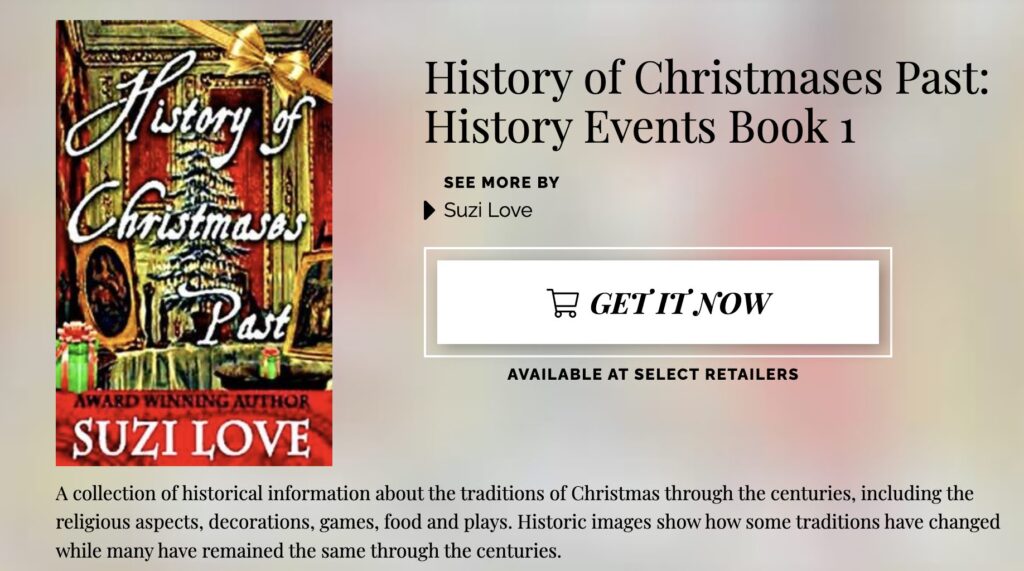
Posted in 1700s, 1800s, Christmas, Customs & Manners, England, Europe, Food and Drink, Georgian Era, Regency Era, Romantic Era, Suzi Love Images, Victorian Era | Tagged Christmas, Customs and Traditions, europe, Food, Great Britain, household, Suzi Love Images

Christmas: Mistletoe and its long history. #Christmas #Holidays #Customs #BritishHistory

Suzi Love Posted on December 14, 2025 by Suzi LoveDecember 14, 2025

Another Christmas Tradition is kisisng under the Mistletoe. So have fun this Christmas and find someone to kiss. The problem in hotter climates is to find the Mistletoe, of course. Darn!

Mistletoe was used by Druid priests 200 years before the birth of Christ in their winter celebrations. They revered the plant since it had no roots yet remained green during the cold months of winter. The ancient Celtics believed mistletoe to have magical healing powers and used it as an antidote for poison, infertility, and to ward of evil spirits. The plant was also seen as a symbol of peace, and it is said that among Romans, enemies who met under mistletoe would lay down their weapons and embrace.

Scandanavians associated the plant with Frigga, their goddess of love, and it may be from this that we derive the custom of kissing under the mistletoe. Those who kissed under the mistletoe had the promise of happiness and good luck in the following year. Mistletoe was associated with Christmas as both a decoration under which lovers kiss, as well as a protection from witches and demons. Sounds romantic, although mistletoe is actually a parasitic plant that grows on other trees or plants and comes in many varieties.  

In Britain, mistletoe was mainly found in the western and southwestern parts, so the custom wasn’t even followed in all parts of England. But where the mistletoe custom was followed, it was hung in doorways and the greenery was watched by young gentlemen in hopes of catching a pretty girl to kiss, usually on the cheek.      

Traditionally, a man was allowed to kiss a woman who was standing underneath mistletoe and bad luck would befall any woman who refused. In some places, it was the custom to pick a berry for each kiss and when all the berries were gone, no more kisses could be taken.

Xmas_Mistletoe
Xmas_Mistletoe
Xmas_Mistletoe
cropped to image, recto, unframed
Xmas_Mistletoe
Xmas_Mistletoe
Christmas: Mistletoe and its long history. #Christmas #Holidays #Customs #BritishHistory https://books2read.com/suziloveHOCP Share on X
Posted in 1700s, 1800s, Australia, Christmas, Customs & Manners, dancing, England, Europe, Georgian Era, History Of Christmases Past, household, Regency Era, Romantic Era, Suzi Love Images, U.S.A, Victorian Era | Tagged British history, Christmas, Customs and Traditions, dancing, europe, Georgian era, History Of Christmases Past, Regency Era

Spice up your holidays with these HOT Regency Romances. #christmas #holidays #ReadARegency #RegencyRomance #EroticRomance

Suzi Love Posted on December 13, 2025 by Suzi LoveDecember 13, 2025

Three stand alone HOT Regency historical romances in eBook and Paperback.

The Viscount’s Pleasure House  –  books2read.com/suziloveTVPH

Four times A Virgin –  books2read.com/suziloveFTAV

Pleasure House Ball – books2read.com/suzilovePHB

Petunia and the Pearl Diver –  https://books2read.com/suzilovePetPD

Loving Lady Katharine – https://books2read.com/suziloveLovingLadyK

Spice up your holidays with these HOT Regency Romances. #christmas #holidays #ReadARegency #RegencyRomance #EroticRomance https://books2read.com/suziloveTVPH Share on X
TVPH_D2D_RetailerBuyLink
Posted in Christmas, England, Four Times A Virgin, Irresistible Aristocrats, London, Loving Lady Katharine, Petunia and Pearl Diver, Pleasure House Ball, Regency Era, THe Viscount's Pleasure House | Tagged Christmas, England, Four Times A Virgin, Historical Mystery, Irresistible Aristocrats, London, Loving Lady Katharine, Petunia and the Pearl Diver, Pleasure House Ball, The Viscount's Pleasure House | Leave a reply

Want a HOT historical romance for the holidays? Disenchanted Viscount tutoring three naive ladies in seduction. What could go wrong? #RegencyRomance #EroticRomance #HistRom

Suzi Love Posted on December 13, 2025 by Suzi LoveDecember 13, 2025

The Viscount’s Pleasure House. Irresistible Aristocrats Book 1 By Suzi Love. Three naive country ladies coerce their way into London’s most infamous brothel and the last Sultan’s gala. Disenchanted Viscount tutoring three Regency Ladies. What could go wrong?

The Viscount’s Pleasure House allows Justin, the most notorious Viscount in London, to fund his search for his missing mother and sisters. But after three years catering to the sordid whims of the perpetually bored Upper Ten Thousand in early Victorian times, the Virile Viscount announces his retirement.

Justin plans to sell his exotically themed brothel and cease all Arabian Nights held on his estate, a desperate attempt to cleanse his blackened soul and perhaps revive his deadened sexual interest. So when Lady Chrissie Wellsby begs Justin to tutor her two friends in the amorous arts in exchange for information about his family, Justin is torn. For though he’ll do anything to discover the whereabouts of his family, including teaching three naive ladies how to act like well-schooled courtesans, he loathes being forced into this last performance as a sex God served by his harem.

Having Chrissie willingly act as his sex slave stirs the world-weary viscount into the wildest performance ever given at the Sultan’s tent, but does little to convince Chrissie that he has fallen head over heels in love with her and put his rakish ways behind him. Justin enjoys a wonderful reunion with his family but feels cheated of his chance at love until Chrissie’s friends encourage her to trust the newly reformed viscount.

Chrissie organizes one final gala at the Pleasure House, an erotic night of lovemaking for two to prove her love for Justin and show him she longs to be his wife. https://books2read.com/suziloveTVPH The Viscount’s Pleasure House. Irresistible Aristocrats Book 1 By Suzi Love.

Xmas_TVPH_Want a HOT historical romance for the holidays? Disenchanted Viscount tutoring three naive ladies in seduction. What could go wrong? #christmas #holidays  #RegencyRomance #EroticRomance #HistoricalMystery https://books2read.com/suziloveTVPH

Want a HOT historical romance for the holidays? Disenchanted Viscount tutoring three naive ladies in seduction. What could go wrong? #christmas #holidays #RegencyRomance #EroticRomance #HistoricalMystery https://books2read.com/suziloveTVPH

TVPH_D2D_RetailerBuyLink
Posted in Christmas, England, Irresistible Aristocrats, London, Regency Era, Romantic Era, Suzi Love Books, THe Viscount's Pleasure House, Victorian Era | Tagged Christmas, England, historical erotic romance, Historical Mystery, Irresistible Aristocrats, London, ReadARegency, Regency Era, Regency romance, Suzi Love Books, The Viscount's Pleasure House, Victorian Romance | Leave a reply

Want a HOT Regency Romance for the holidays? “You want me to be your mistress?” The Countess of Dorchester’s sculpted brow rose in an exaggerated show of disbelief. #christmas #holidays #EroticRomance #RegencyRomance #HistoricalMystery #ReadARegency

Suzi Love Posted on December 12, 2025 by Suzi LoveDecember 12, 2025

Want a HOT Regency Romance for the holidays? “You want me to be your mistress?” The Countess of Dorchester’s sculpted brow rose in an exaggerated show of disbelief. #christmas #holidays #RegencyRomance #HistoricalMystery #EroticHistoricalRomance books2read.com/suziloveFTAV

Continue reading →
Posted in 1800s, Christmas, England, Four Times A Virgin, Irresistible Aristocrats, London, Regency Era, Suzi Love Books | Tagged Book 2, Christmas, Erotic Romance, Four Times A Virgin, historical erotic romance, Historical Mystery, historical romance, Irresistible Aristocrats, London, mystery, ReadARegency, Regency romance, Suzi Love Books

Christmas Greenery: Holly, Ivy and Evergreen Boughs. #Christmas #Holidays #customs #Europe

Suzi Love avatarPosted on December 12, 2025 by Suzi LoveDecember 11, 2025

Christmas Greenery: Holly, Ivy and Evergreen Boughs. #Christmas #Holidays #customs #Europe https://books2read.com/suziloveHOCP

Continue reading →
Posted in Australia, Canada, Christmas, Customs & Manners, Edwardian Era, England, Europe, Georgian Era, History, household, Regency Era, Romantic Era, South Pacific, Suzi Love Images, U.S.A, Victorian Era | Tagged Christmas, Customs and Traditions, History Events, History Of Christmases Past, household

Michael Brandon travels to introduce the woman he loves to family but is shocked when his missing brother arrives. #mystery #FamilySaga #HistoricalRomance

Suzi Love Posted on December 11, 2025 by Suzi LoveDecember 11, 2025

Drama and romance at the Duke Of Sherwyn’s snowbound country estate in the English countryside in December. Michael Brandon travels to introduce the woman he loves to family but is shocked when his missing brother, presumed dead for years, arrives at the country estate of the Duke Of Sherwyn where several people are stranded due to a severe snow storm. https://books2read.com/suziloveDS December Scandal, Book 3, Scandalous Siblings Series.

Xmas_DS_https://books2read.com/suziloveDS
Michael Brandon travels to introduce the woman he loves to family but is shocked when his missing brother arrives. #mystery #FamilySaga #HistoricalRomance. https://books2read.com/suziloveDS Share on X
D2D_RetailerBuyLink_DS
https://books2read.com/suziloveDS
D2D_RetailerBuyLink_DS
Posted in December Scandal, England, Regency Era, Romantic Era, Scandalous Siblings Series, Suzi Love Books, Victorian Era | Tagged Book 3, December Scandal, Family Saga, historical romance, mystery, Scandalous Siblings Series, Suzi Love Books

Christmas: Christmas Card History #Christmas #holidays #Traditions #Customs #VictorianEra

Suzi Love Posted on December 11, 2025 by Suzi LoveDecember 11, 2025

Sending Christmas Cards.

At the end of the winter term, schoolmasters would set their pupils to work on Christmas Pieces, samplers of writing on superior paper with engraved borders, to show parents how they had progressed during the year. By about 1820, the engraved borders were enhanced with color and the children’s pieces became more decorative.

However, the custom of sending cards at Christmas was started in the United Kingdom in 1843 by Sir Henry Cole. Postage had been standardized three years earlier and Cole was a civil servant who had played a key role in initiating Uniform Penny Post. He wanted ordinary people to become more interested in the new ‘Public Post Office’. With his artist friend John Horsley, they designed the first card which was issued from a periodical, Felix Summerley’s Home Treasury, and were sold for 1 shilling each.

The card was lithographed, hand-colored, had three panels and was in a rustic frame of carved wood and ivy. The outer two panels showed people caring for the hungry and the naked. The centre panel showed a family of three generations having Christmas dinner, although the temperate classes strongly objected to the idea of a child being given a glass of wine with dinner.

Xmas_Christmas Card

New railways carried more post, and a lot faster, than a horse and carriage so the Post Office offered a Penny stamp. Cards became even more popular when they could be posted in an unsealed envelope for one halfpenny. Christmas cards became truly popular when printing improved and cards could be produced in large numbers, around 1860. By the early 1900s, the custom had spread over Europe and especially in Germany.

Early cards usually pictured Nativity scenes, but in the late Victorian times, robins and snow-scenes became popular because the postmen wore red uniforms and were nicknamed ‘Robin Postmen’. Snow-scenes were also popular because they were a reminder of the very bad winter of 1836.

Snow scenes reflected the snowy and often harsh northern hemisphere winters when opening and reading Christmas cards was an enjoyable family experience.  In 1860, Charles Goodall & Son, a British publisher of visiting cards, began mass producing cards to be used for visits during the Christmas period. These Christmas and New Year’s visiting cards were decorated with simple designs such as a twig of holly or flowers.

Sales of cards grew and designs and sizes changed. The first cards were meant to appeal to the masses and encourage them to send large numbers by post, so rather than focus on religious images, they showed sentimental or humorous images of family and children, fanciful designs of flowers, fairies, or reminders of the approach of spring. Religious themes of nativity scenes, children looking at the manger, or angels and candles remain popular to the modern day.

Cards could be shaped like bells, a fan, a crescent, a circle, or a diamond and were folding, decorated with jewels, iridescent, embossed, and carried either simple Christmas and New Year greetings or had verses and carols written in them. The next year, Mr W.C.T. Dobson produced a sketch symbolizing the ‘Spirit of Christmas’ which sold many more than the previous thousand and the novelty caught on.

Many artists became famous for their annual illustrations that became postcards and cards.  Printing technology became more advanced in the age of industrialisation and the price of card production dropped. With the introduction of the halfpenny postage rate, the Christmas card industry industry increased until in 1880 11.5 million cards were produced.

Xmas_Christmas Card
Xmas_Christmas Card
Xmas_Christmas Card
Xmas_Christmas Card
Xmas_Christmas Card
Xmas_Christmas Card
Xmas_Christmas Card
Xmas_Christmas Card
Xmas_Christmas Card
Christmas Card History #Christmas #holidays #Traditions #Customs #VictorianEra https://books2read.com/suziloveHOCP Share on X
Posted in 1800s, Australia, Canada, Christmas, Customs & Manners, England, Europe, household, Pastimes, Suzi Love Images, U.S.A, Victorian Era | Tagged British history, British Postal Museum, Christmas, Customs and Traditions, europe, History Of Christmases Past, postal, Victoria and Albert Museum, Victorian Era

Christmas: 1803 December The Bellman #Christmas #holidays #RegencyEra #Customs

Suzi Love Posted on December 11, 2025 by Suzi LoveDecember 10, 2025

Christmas Bells.

“Bells are musics laughter.” By Thomas Hood (1799-1845), British poet and humorist.

Bells hold a  long time association with Christmas. In Victorian times, carol singers used small handbells to play the tune of the carol. Sometimes there were bells without singing – Church bells are rung after sunset to signal the start of the Christmas Eve service, the first of Christmas. In England, the bellman goes round at midnight ringing his bell, and rattling off a stanza or two, for the gratuity which he confidently anticipates; while watchmen, firemen, rate-collectors, postmen, chimney-sweeps, street scavengers, the errand-boys of your baker, butcher, poultry merchant, and green-grocer, even to the hired singers in the churches all expect their Christmas-box. In Victorian times, carol singers used small hand bells to play the tune of the carol and sometimes there were bells without singing. Church bells are rung after sunset to signal the start of the Christmas Eve service, the first of Christmas.

The Bellman

The Bellman stands full face, shouting with wide-open mouth and ringing his hand-bell.

In his left hand he holds out his verses headed by a little figure of Napoleon wearing a huge tricorne and holding a gigantic sword:

 ‘This little Boney-says he’ll come At merry Christmas time,

But that I say is all a hum Or I no more will rhyme

Some say in Wooden house he’ll glide, Some say in air Balloon,

E’en those who airy schemes deride. Agree his coming soon.

Now honest people list to me, Though Income is but small, I’ll bet my Wig, to one Penney, He does not come at all.’ Hand-colored etching and aquatint.

Via British Museum

Christmas: 1803 December The Bellman #Christmas #holidays #RegencyEra #Customs books2read.com/suziloveHOCP Share on X
Posted in 1800s, Bridgerton, Christmas, Customs & Manners, England, History Of Christmases Past, Jane Austen, Music, Regency Era, Suzi Love Books, Suzi Love Images | Tagged Bridgerton, British history, Christmas, Customs and Traditions, England, History Of Christmases Past, Jane Austen, music, Regency Era, Suzi Love Books

Christmas: Candy Cane And It’s Fascinating History #Christmas #holidays #Traditions #Customs

Suzi Love Posted on December 11, 2025 by Suzi LoveDecember 10, 2025

Legend has it that during the 17th century, craftsmen created straight white sticks of candy in the shape of shepherds’ crooks at the suggestion of the choirmaster at the Cologne Cathedral in Germany. The treats were given to children to keep them quiet during ceremonies at the living creche, or Nativity scene, and the custom of passing out the crooks at such ceremonies soon spread throughout Europe.

‘The legends of the candy cane are many, including that the cane was shaped like a “J” for Jesus, the three red stripes symbolized the Holy Trinity, the hardness of the candy represented the Church’s foundation on solid rock and the peppermint flavor reflects the use of hyssop, an herb referred to in the Old Testament.’ via Encyclopedia Britannica

In celebrations of Saint Nicholas Day, candy canes are given to children as they are also said to represent the crosier of the Christian bishop, Saint Nicholas; crosiers themselves allude to the Good Shepherd, a title associated with Jesus. Some people explain the symbolism of a striped cane as white representing Christ’s purity, red the blood he shed, and the three red stripes the Holy Trinity.

In the mid 1600s, sugar roses were added but weren’t popular so plain white canes remained until red stripes were added around 1890. In 1847, a German immigrant living in Wooster, Ohio, U.S.A. looped candy canes that he brought with him from Europe over the boughs of his Christmas tree.

In 1919,  Bob McCormack of Albany, Georgia, made candy canes for family, friends and local shopkeepers. The canes were bent by hand as they came off the assembly line into the  ‘J’ shape of a shepherd’s crook, so breakage was often over 20 percent. In the 1920s, a cherubic child in a red-and-white hat sold peppermint candy cane to Albany natives in an advertisement for Bob’s candy company.  McCormack was the first manufacturer to wrap his candy in cellophane. Bobs moved to a larger facility in the 1930s so that it could expand its product lines and was one of the few candy companies to remain solvent during the Great Depression.

As the economy improved, people bought more sweet treats,  but Bobs Candy was then leveled by a tornado and, as the company had no tornado insurance, they had to rebuild on their own. By August 1940 the company was back in business and employed McCormack’s three children.

During World War II (1941-45), when sugar was rationed, coconuts were in short supply, and pecans were expensive, Bobs took advantage of a plentiful local product—the peanut—and sold peanut-butter crackers and vacuum-packed peanuts. During the 1950s, Bobs began making money with such innovations as break-proof packaging, moisture-proof candy wrappers.

In 1952, Bob McCormack’s brother-in-law, Catholic priest Gregory Keller, invented the Keller Machine which automated the process of twisting soft candy into spiral striping and then cutting them into precise lengths as candy canes.

Harding Keller invented the Keller Machine around 1950 for his brother-in-law Bob McCormack. The machine twisted and cut stick candy, allowing for the mass production of the company’s signature candy canes and other items. – Courtesy of Farley’s and Sathers Candy Company, Inc.

First, candy sticks cut to the desired length enter the machine. Each stick is bent individually, but the machine has a system of multiple grippers and rollers to continually bend the sticks, one after the other. As each stick enters the machine, it is positioned in a gripper which holds the straight portion of the cane with the part to be bent protruding out. Each gripper has on one side a curved die which the protruding end will be bent over. The candy stick is first bent to a right angle as it is moved past and put into contact with an inclined face. The patent application describes two potential versions of the mechanism which complete the bending process.

The first version of the mechanism has a chain around two sprockets on which are mounted bending rollers. Each bending roller is attached to a cam which rides along another inclined face to move the roller along the protruding surface of the cane to complete bending it around the die. In the second version, the chain and sprockets are replaced by a wheel on which the bending rollers are mounted. In modern candy cane production, the sticks are wrapped in cellophane before they are bent.

By the middle of the century, Bob’s company – originally the Famous Candy Company, then the Mills-McCormack Candy Company, and later Bobs Candies, had become one of the world’s leading candy cane producers.Bobs Candies was sold to Farley’s and Sathers in Spring 2005. Farley’s and Sathers merged with the Ferrara Candy Company which continues to make candy canes under the Bobs name.

By the middle of the century, Bob’s company – originally the Famous Candy Company, then the Mills-McCormack Candy Company, and later Bobs Candies, had become one of the world’s leading candy cane producers.

Xmas_Candy Cane
Xmas_Candy Cane
Xmas_Candy Cane
Christmas: Candy Cane And It's Fascinating History #Christmas #holidays #Traditions #Customs https://books2read.com/suziloveHOCP Share on X
Posted in 1800s, 1900s, Christmas, Customs & Manners, Edwardian Era, Food and Drink, History Of Christmases Past, Suzi Love Books, U.S.A, Victorian Era | Tagged Christmas, Customs and Traditions, Edwardian Era, Food, History Of Christmases Past, Suzi Love Images, Suzi Love Research, USA, Victorian Era

Post navigation

← Previous Post
Next Post→

SUBSCRIBE TO SUZI LOVE'S NEWSLETTER.

Recent Posts

  • “Happiness in marriage is entirely a matter of chance.” Jane Austen #PrideandPrejudice (1813) #JaneAusten #Quote #RegencyEra
  • Do You Know What A Half Parure Is? 1806 Muslin Dress With Train, Shawl and Half Parure Jewelry Set. #RegencyFashion #JaneAusten #HistoricalFashion
  • 1820-1850 ca. Chemise, Corset, Quilted Petticoat and Pocket, American. #Regency #Underclothing #RomanticEra
  • 1802 Bridgerton and Jane Austen Style Dress Bodices and Two Cute Bonnets. #Bridgertons#Regency #Hats #JaneAusten
  • Love After Waterloo: There’d been nowhere safe to hide a lady and her son at Waterloo. #HistoricalEroticRomance #MilitaryRomance #Waterloo #RegencyRomance #ReadARegency

Recent Comments

  1. Suzi Love on Book Hooks: Earl of Winchester has no time for mad scientist Lady Jamison yet when he’s with her, desire explodes. #HistoricalMystery #RomCom #VictorianRomance #RegencyRomance
  2. Suzi Love on Book Hooks: Earl of Winchester has no time for mad scientist Lady Jamison yet when he’s with her, desire explodes. #HistoricalMystery #RomCom #VictorianRomance #RegencyRomance
  3. Maggie Blackbird on Book Hooks: Earl of Winchester has no time for mad scientist Lady Jamison yet when he’s with her, desire explodes. #HistoricalMystery #RomCom #VictorianRomance #RegencyRomance
  4. Suzi Love on Book Hooks: Earl of Winchester has no time for mad scientist Lady Jamison yet when he’s with her, desire explodes. #HistoricalMystery #RomCom #VictorianRomance #RegencyRomance
  5. Jana Richards on Book Hooks: Earl of Winchester has no time for mad scientist Lady Jamison yet when he’s with her, desire explodes. #HistoricalMystery #RomCom #VictorianRomance #RegencyRomance

Login

  • Log in

Archives

  • May 2026
  • April 2026
  • March 2026
  • February 2026
  • January 2026
  • December 2025
  • November 2025
  • October 2025
  • September 2025
  • August 2025
  • July 2025
  • June 2025
  • May 2025
  • April 2025
  • March 2025
  • February 2025
  • January 2025
  • December 2024
  • November 2024
  • October 2024
  • September 2024
  • August 2024
  • July 2024
  • June 2024
  • May 2024
  • April 2024
  • March 2024
  • February 2024
  • January 2024
  • November 2023
  • October 2023
  • September 2023
  • August 2023
  • July 2023
  • June 2023
  • April 2023
  • March 2023
  • February 2023
  • June 2022
  • April 2022
  • March 2022

Categories

  • 1700s
  • 1700s Mens fashion
  • 1700s Womens Fashion
  • 1800s
  • 1800s Mens Fashions
  • 1800s women's fashion
  • 1900s
  • art
  • Australia
  • Bath
  • bedroom fashion
  • Book Hooks
  • Box Or Container
  • Bridgerton
  • Bus Trips
  • Canada
  • Carriage
  • cartoon
  • Celebrity
  • Chatelaine
  • Children
  • children
  • Christmas
  • Coat or Pelisse Or Redingote
  • Contemporary
  • Corset
  • Couple
  • Customs & Manners
  • dancing
  • December Scandal
  • Decorative Item
  • Dress Or Robe
  • Easter
  • Edwardian Era
  • Embracing Scandal
  • England
  • Ester In Images
  • Europe
  • Events
  • Fashion
  • fashion accessories
  • Food and Drink
  • Four Times A Virgin
  • France
  • furniture
  • Georgian Era
  • Georgian Fashion
  • Google Books
  • Grand Tour
  • Group
  • hats
  • History
  • History Events
  • History Notes
  • History Of Christmases Past
  • household
  • Hygiene
  • Irresistible Aristocrats
  • Jane Austen
  • Keanu Reeves
  • Kellys Justice
  • Legal
  • London
  • Love After Waterloo
  • Loving Lady Katharine
  • medical
  • military
  • money
  • mourning
  • Music
  • Outback Arrival
  • pants
  • Pastimes
  • peerage
  • People
  • Petunia and Pearl Diver
  • Places
  • Pleasure House Ball
  • postal
  • Queensland
  • Quotations
  • Regency Era
  • Regency Fashion
  • Regency Life Series
  • Reticule or Bag
  • riding
  • Romantic Era
  • Royalty
  • Russia
  • Scandalous Siblings Series
  • Scenting Scandal
  • Self Publishing
  • sewing
  • Shirt
  • shoes
  • South Pacific
  • Spencer
  • sports
  • Suit
  • Sunday Snippet
  • Suzi Love
  • Suzi Love Books
  • Suzi Love Images
  • Suzi Love Writing
  • Swain Cove
  • THe Viscount's Pleasure House
  • travel
  • U.S.A
  • underclothing
  • Vest or Waistcoat
  • Victorian Era
  • Victorian Fashion
  • weapons
  • weddings
  • Writing Tools

1800s men fashion 1800s women's fashion antiques Bridgerton British history Cartoons Corset cravat decorative Dress Or Gown England europe fashion accessories Fashion Plate France Georgian era Georgian Fashion gloves google books Hats And Hair historical romance History Notes household Jane Austen jewelry Journal des Dames et des Modes London Metropolitan Museum NYC pants Redingote Or Pelisse Or Coat Regency Era Regency Fashion Regency London Regency Men reticule or bag riding sewing shawls Shoes Suzi Love Books Suzi Love Images Tailcoat The Repository Of Arts underclothing Vest or Waistcoat

©2026 - Suzi Love - Weaver Xtreme Theme Privacy Policy
↑