1806-1809 ca. Unissued One Pound Banknote. Issued in Alton, Hampshire, UK. The type of currency used by Jane Austen and her brother when dealing with the family’s finances. Issuer Alton Bank. Unissued banknote. (obverse) Emblem with initials, floral design and crown on top at left. Text at centre. Design printed in black. via British Museum.
A pound was a lot of money for the majority of people during the Regency, so the general population didn’t trust flimsy paper banknotes. A metal coin held its value in gold or silver, whereas paper banknotes were easily lost or damaged and very easy to forge. The original banknotes were merely a piece of paper that promised payment for a set amount and were issued by individual banks. The Bank of England used these notes from its inception in 1694 and regional banks continued issuing them until the changes to the Act in 1844. By the mid 1700s, notes started to become standardized, with ten and five pound notes appearing, but as they were all hand-lettered and signed they were viewed with skepticism. Most transactions were therefore done with metal coins, with many shopkeepers routinely biting down on a coin to ensure it was legitimate.
Who loves Bridgerton and Jane Austen Women’s Fashions? Everyone? Of course we do!
During the early 1800s, dress fabrics and dresses were thin, sometimes almost transparent. These lightweight white cotton dresses were fashionable in Jane Austen’s times, but they were certainly not warm when a lady was out walking or when riding in a carriage. Numerous outer layers could be added for warmth and to brighten and personalize an outfit. These might be an overdress, pelisse or redingote, hat, shawl, gloves, or large fur muff.
A typical outdoor outfit worn by the Bridgerton family, or Jane Austen and her contemporaries, when going outside consisted of an Empire style, or high-waisted, white cotton dress worn under a Pelisse, or Redingote, or coat, for warmth and with an added layer with the pretty shawl. Hats were made to match gowns and cloaks and fashionable women spent an extraordinary amount of time coordinating complete ensembles which included reticules or bags, shoes, shawls, gloves, hats, parasols, and fans. Typical Empire style dresses had low necklines and with skirts that started directly under the bust and flowed into the classical relaxed wide styles of Greece and Rome. These were worn most days and cotton, silk or taffeta were the popular fabrics.
Definition Empire Style Dress: Named after the First Empire in France. Empire dresses had a low neckline and skirts started directly under the bust and flowed into the classical relaxed wide styles of Greece and Rome. This style of dress is associated with Jane Austen and her contemporaries as a high-waisted dress was worn most days. Cotton, silk or taffeta were the popular fabrics. Only the very wealthy could afford white dress in this style as the cottons were imported from India and had to be carefully cleaned, usually by a lady’s maid.
1816 July Opera Dress of White Lace, English. White dress with scalloped lace hem and shawl collar with lace edge, and worn under a gorgeous pink draping shawl. Skirt trimmed with lace festooned at regular distances, edged by plain band of byas satin and finished by pearl ornaments. Plain long sleeve, very full, caught at the wrists and elegantly finished with lace. Hair ornamented with a wreath of French roses, parted in front, and simply dressed in loose curls. Necklace, ear-rings, and bracelets of pearl. White satin slippers, and white kid gloves and a blush colored French silk scarf. Fashion Plate via Rudolph Ackermann’s ‘The Repository of Arts’.
Extravagant accessories of every color and style were added to the plain white dresses to show individuality and for warmth in cold European temperatures.
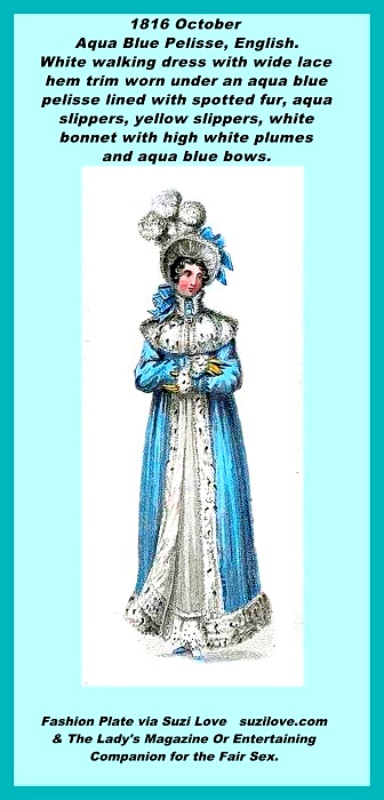
Definition Redingote Or Pelisse Or Walking Dress Or Coat: French word developed from English words, riding coat. Long fitted outdoor coat worn over other garments for warmth. Originally made with several capes and trimmed with large buttons. For women, the coat was often cut away in the front or left open to show off the dress underneath. French fashion plates call these coats Redingotes and they were worn by men, women, and children. English fashion plates call the coats a Pelisse, a walking dress, Promenade dress, or Carriage dress.
1790-1810 ca. Woman’s Black Wool Shoes. Pointed toe and low wedge heel covered in same fabric, black tape binding, leather straight or symmetrical sole, linen insole and lining. Wool satin with wool twill tape binding, plain weave linen lining, and leather sole. Place of Use: Lexington, Massachusetts, United States. Place of Manufacture: possibly Massachusetts, United States Provenance: Worn by a member of the Robbins family; inherited by Ellen A. Stone; gift to MFA, 1899. Credit Line Gift of Miss Ellen A. Stone via Museum of Fine Arts, Boston, U. S.A.
In Jane Austen’s years, she and her contemporaries spent a lot of time outdoors. Fragile slippers were worn for balls and evening events but for walking sturdier shoes were needed, In the early 1800s, these were typically made of leather and were flat or had a very small heel.
1808 Two Ladies, French. Apricot Evening Dress Or Moire Brochee, French. Patterned dress with very low cut bodice, short sleeves, long white gloves, and holding a Lorgnette, or looking glass, and a handkerchief. Grey Redingote with high waist and holding a red shawl. Fashion Plate via Journal des Dames et des Modes, or Costume Parisien.
The French magazine, Journal des Dames et des Modes, frequently made fashion plates with a single woman, two women or a woman with a man where they wear the same outfit. The two variations show innovative ideas for decorating plain white muslin dresses with a range of colorful accessories, and the early 1800s were definitely the years when accessories were the fashion highlight. Add a pair of colorful long gloves, a draped shawl or scarf, a reticule, handkerchief, fan or looking glass and the typical white dress is given individuality and personality.
Here is the companion to the above fashion plate with the single lady in her apricot dress. The lady in a grey Redingote is added.
1818 Blue Spencer Of Levantine, French. White cotton print dress with ruffled hem, high plumed bonnet and a neck scarf.
Definition Levantine: Stout silk cloth in twill weave. First made in the Levant, a large area in the Eastern Mediterranean region of Western Asia.
Definition Spencer: Short jacket, cropped at the waist, worn over a dress, or gown. These close-fitting, tight sleeved, waist length jackets were modeled on a gentleman’s riding coat, but without tails. Delicate and regency dresses provided so little protection from the cold, so over garments were essential for warmth, modesty and good health.
19th Century Leather Travel Trunk, English. #JaneAusten #RegencyEra #travel
The trunk is made of wood and covered with woven canvas. It has leather corners and straps and handles for securing and lifting. The lock plate cover is marked ‘Finnigan’s London’, 18 New Bond Street, London, UK, and there is a Maker’s Brand and a Maker’s Label. There are four removable linen trays with cloth straps and handles. The trunk measures 13 inches high, 20 inches deep, and 36 inches wide.
19th Century Leather Trunk, English. 19th Century Leather Trunk, English. 19th Century Leather Trunk, English. 19th Century Leather Trunk, English. 19th Century Leather Trunk, English. 19th Century Leather Trunk, English. 19th Century Leather Trunk, English. 19th Century Leather Trunk, English.
19th Century Leather Trunk English Wood covered with woven canvas1. 19th Century Leather Trunk, English. Wood covered with woven canvas, leather corners, and lock plate cover marked Finnigan’s London. via Live Auctioneers . liveauctioneers.com
1800s Silver and Carved Mother of Pearl Writing and Desk Set, French. Wax Seal, Dip Pen and Letter Opener in the style that Jane Austen would have used to write her novels and her letters. via Ruby Lane Antiques. rubylane.com
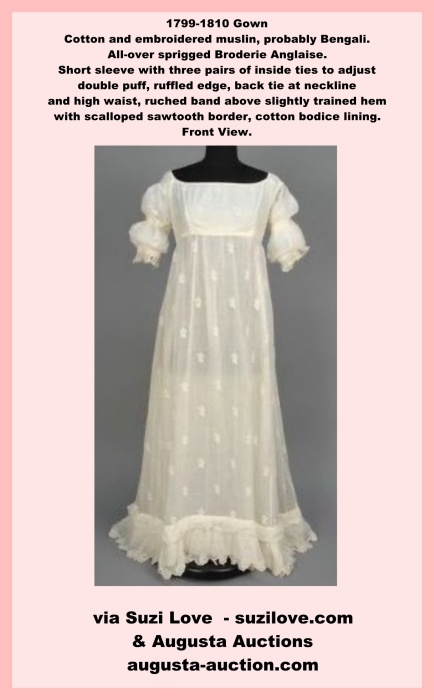
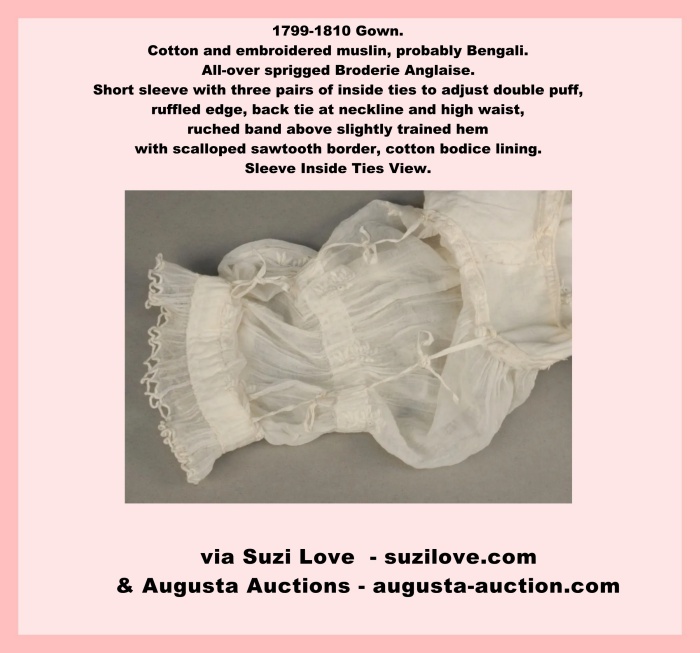
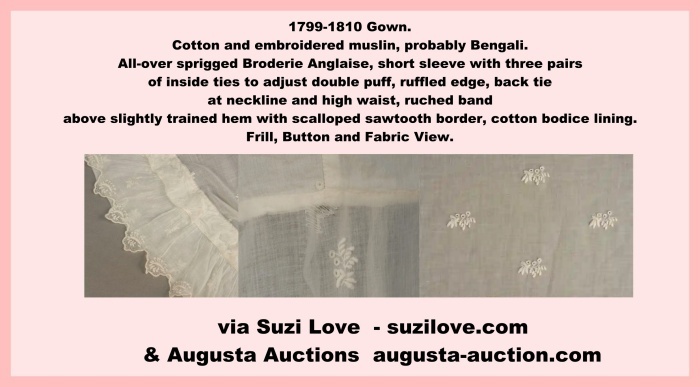
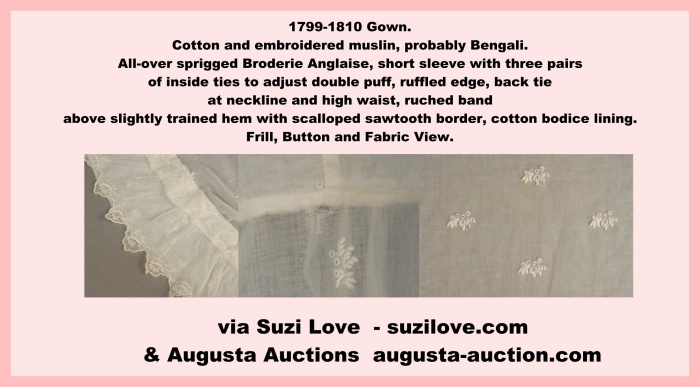
1799-1810 ca. Cotton Muslin Gown, Probably American. White cotton embroidered muslin, probably Bengal, all over sprigged broderie anglaise decoration,short sleeve with three pairs of inside ties to adjust the double-puff, ruffled edge, back tie at neckline and waist, ruched band above the slightly trained hem with scalloped sawtooth border and with cotton bodice lining. via whitakerauction.smugmug.com
These lightweight white cotton dresses were fashionable in Jane Austen’s times, but they were certainly not warm when a lady was out walking or when riding in a carriage. Numerous outer layers could be added for warmth and to brighten and personalize an outfit. These might be an overdress, pelisse or redingote, hat, shawl, gloves, or large fur muff.
The Empire dress which evolved in the late 1790s began as a chemise shift gathered under the breasts and at the neck. Named after the First Empire in France, by 1800 Empire dresses had a very low décolleté, or neckline and a short narrow backed bodice attached to a separate skirt. Skirts started directly under the bust and flowed into the classical relaxed wide styles of Greece and Rome. This style of dress is associated with Jane Austen and her contemporaries as a simple cotton high-waisted dress was worn most days and accessorized according to the importance of the occasion.
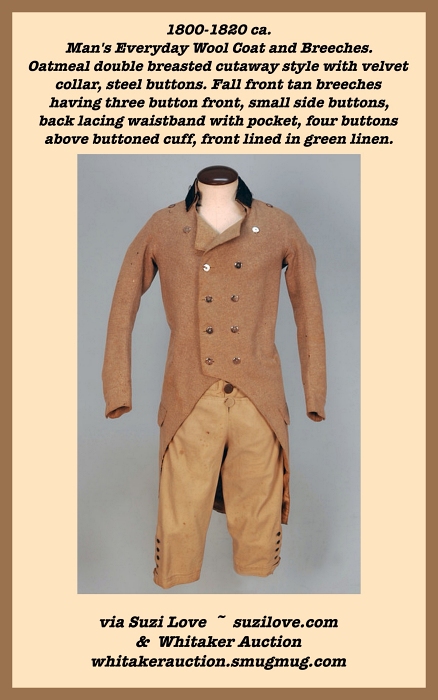
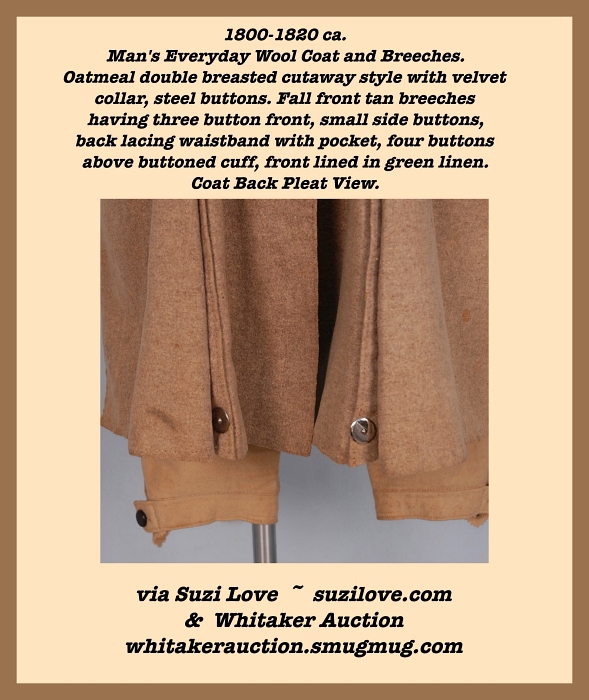
1800-1820 ca. Man’s Everyday Oatmeal Colored Wool Suit With Breeches. Can you picture Jane Austen’s male relatives and friends wearing this? Oatmeal colored double breasted cutaway style coat with velvet collar, steel buttons, rear flap pockets, back vent flanked by stitched down pleats having top and bottom button detail, glazed linen lining. Fall front tan breeches having three button front, small side buttons, back lacing waistband with pocket, four buttons above buttoned cuff, front lined in green linen. via Whitaker Auction whitakerauction.smugmug.com
1800-1815 ca. Fan of Bone and Silk, French. Jane Austen and her family and friends would have carried this style of fan when attending assemblies, musical evenings and balls. Metropolitan Museum New York City, U.S.A. metmuseum.org