1809 Pink Evening Dress Of Levantine, French. V-neck bodice, decorated hem, long gloves and Toque hat with feathers, or aigrette. Fashion Plate via Journal des Dames et des Modes, or Costume Parisien.
Definition Fabric Levantine: Stout silk cloth in twill weave. First made in the Levant, a large area in the Eastern Mediterranean region of Western Asia.
Definition Aigret, aigrette, egret: Upright plume of feathers or jeweled ornament in shape of feathers worn on head or hats. 19th century favorite feathers osprey and heron.
Fashion Women 1805-1809 History Notes Book 26 What did Jane Austen and friends wear? https://books2read.com/SuziLoveFashionWomen1805-1809
1805-1810 ca. Dress With Train as worn in the time of Jane Austen, or the early 1800s. Ivory silk, plain weave with multicolored silk embroidery in padded satin, buttonhole, and whipped running stitches and French knots running down the dress in stripes, and around the sleeves, square neckline, and train. Philamuseum.org
What did Jane Austen and friends wear? This book looks at early 1800s fashions, which were elegant and pretty with high waists and fabrics that were almost transparent. These Empire style gowns, named after Napoleon’s first Empress, became popular throughout Europe, and were then copied around the world. Colorful outwear was added to make an ensemble more attractive and warmer.
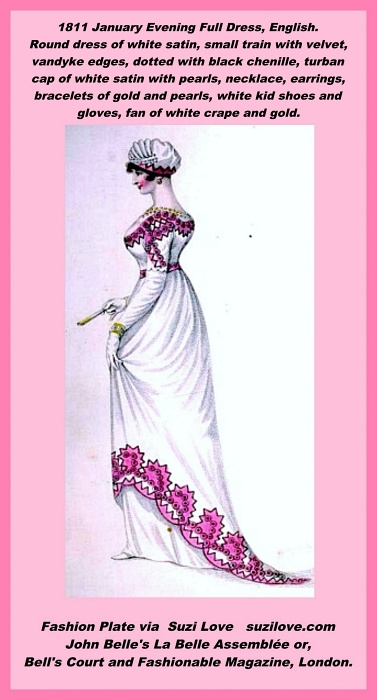
1811 January Evening Full Dress, English. Round dress of white satin, small train with pink velvet, vandyke edges, dotted with black chenille, turban cap of white satin with pearls, necklace, earrings, bracelets of gold and pearls, white kid shoes and gloves, fan of white crape and gold. Fashion Plate via John Belle’s La Belle Assemblée or, Bell’s Court and Fashionable Magazine, London.
Definition Van Dyke Points: V-shaped lace and trims named after a 17th Century Flemish painter, Sir Anthony Van Dyck, known for painting V-shaped lace collars and scalloped edges on sitters.
Definition Velvet or Velour: Silk with short, dense and smooth pile produced by pile warp raised in loops above ground weave through introduction of rods during the weaving.
1811 January Evening Full Dress, English. Round dress of white satin, small train with pink velvet, vandyke edges27_D2D_FashWomen1810-1814
1810 Three Piece Gentleman’s Purple Court Suit, French. Worn by a rich and fashionable gentleman after Napoleon Bonaparte revived court traditions when he crowned himself Emperor of France in 1804. Gentlemen were expected to wear extravagant court dress, but the working class despised these luxurious fashions and royal overspending. Wastage of France’s money spurred French peasants to rise up in revolt and create the French Revolution. via Metropolitan Museum, N.Y.C., U.S.A.metmuseum.org
1810 Front Of Three Piece Court Suit, French. 1810 Back Of Gentleman’s Court Suit, French. 1810 Front and Back Of Gentleman’s Court Suit, French. 1810 Fabric Of Gentleman’s Court Suit, French. 1810 Gentleman’s Court Suit, French. 1810 Black and White View Of Gentleman’s Court Suit, French. https://books2read.com/SuziLoveFashionMen1800-1819
1806 ca. Typical Silk and Straw Bonnet, French. Definition Bonnet: Soft form of hat with little brim at back and usually tied under the chin with ribbons. via Metropolitan Museum, N.Y.C., U.S.A. metmuseum.org
Hats were an essential item during the Regency Era for women, men and children. Nobody left their home without one, no matter what their social class. Jane Austen and her friends would have worn gorgeous bonnets or hats, tied under the chin like this.
Fashion Women 1805-1809 History Notes Book 26
What did Jane Austen and friends wear? This book looks at early 1800s fashions, which were elegant and pretty with high waists and fabrics that were almost transparent. These Empire style gowns, named after Napoleon’s first Empress, became popular throughout Europe, and were then copied around the world. Colorful outwear was added to make an ensemble more attractive and warmer.
https://books2read.com/SuziLoveFashionWomen1805-1809
An overview of women’s fashions in the first twenty years of the 19th century. What was fashionable for women in Jane Austen’s times, or the early 1800s. Wars were being fought around the globe so women’s fashion adopted a military look in support of soldiers. In Britain, the Prince Regent ruled instead of his father, King George III, so fashions, like the lifestyle, became more extravagant and accessories went from pretty to opulent. This set includes books 12, 25, 26, 27 and 28.
What was fashionable for women in Jane Austen’s times, or 1800s, or Regency Era. High-waisted dresses were extravagantly accessorized and hats, shoes, parasols and bags were added. Set includes History Notes Books 12, 25, 26, 27 and 28.
Fashion Women 1800-1819 Box Set History Notes Book 24 An overview of the first twenty years of the 19th century. These books look at what was fashionable for women in Jane Austen’s times, or the early 1800s. Wars were being fought around the globe so women’s fashion adopted a military look in support of soldiers. In Britain, the Prince Regent ruled instead of his father, King George III, so fashions, like the lifestyle, became more extravagant and accessories went from pretty to opulent. This set includes books 12, 25, 26, 27 and 28. https://books2read.com/SuziLoveFashionWomenBoxSet
1815-1825 ca. Back lacing, hand embroidered cotton sateen corset. The type of corset worn by Jane Austen and her female friends and family. Entirely hand sewn, cotton cord bones, dark cream embroidered flowers, centre front busk channel, bone eyelets and with the monogram ‘MS’ embroidered twice. via Augusta Auctions. augusta-auction.com
1815-1825 ca. Cream cotton sateen back lacing corset. Entirely hand sewn, cotton cord, boning, dark cream embroidered flowers, centre front busk and busk channel, bone eyelets, embroidered with ‘MS’ twice. via Augusta Auctions.1815-1825 ca. Cream cotton sateen back lacing corset. Entirely hand sewn, cotton cord, boning, dark cream embroidered flowers, centre front busk and busk channel, bone eyelets, embroidered with ‘MS’ twice. via Augusta Auctions.1815-1825 ca. Cream cotton sateen back lacing corset. Entirely hand sewn, cotton cord, boning, dark cream embroidered flowers, centre front busk and busk channel, bone eyelets, embroidered with ‘MS’ twice. via Augusta Auctions.1815-1825 ca. Cream cotton sateen back lacing corset. Entirely hand sewn, cotton cord, boning, dark cream embroidered flowers, centre front busk and busk channel, bone eyelets, embroidered with ‘MS’ twice. via Augusta Auctions.1815-1825 ca. Cream cotton sateen back lacing corset. Entirely hand sewn, cotton cord, boning, dark cream embroidered flowers, centre front busk and busk channel, bone eyelets, embroidered with ‘MS’ twice. via Augusta Auctions.1815-1825 ca. Cream cotton sateen back lacing corset. Entirely hand sewn, cotton cord, boning, dark cream embroidered flowers, centre front busk and busk channel, bone eyelets, embroidered with ‘MS’ twice. via Augusta Auctions.HN_17_D2D_Corset_1810-1830
1801-1818 ca. ‘Diablo, or devil on two sticks’. Lessons In The Devil Series Plate 55: Man teaching a woman how to play diabolo, or devil on two sticks. via 1801-1818 Le Bon Genre, French. Gentleman in blue tailcoat, high white shirt and cravat, pants and black shoes. Lady in white dress with high frilled neckline, long sleeves and wearing green walking boots. Hand-colored etching. Published by: Pierre La Mésangère. Via British Museum, London, UK britishmuseum.org (PD-Art)
Jane Austen and Games: In Jane Austen’s times, games were a part of daily life. Families played all sorts of games, indoors and outside, to pass the time, especially at house parties or family gatherings.
Diablo, Or Devil On Two Sticks: Double cone type of yo-yo that is twirled, spun, tossed and caught on a string attached to two hand sticks. The toy, or Diablo, is kept spinning by manipulating it back and forth along the string and by tossing into the air. Numerous tricks can be performed e.g. toss, trapeze, cat’s tail and the umbrella.
Fashion Women 1815-1819 History Notes Book 28 https://books2read.com/SuziLoveFashionWomen1815-1819
19th Century Tantalus, or Drink Holder, With Hand-Painted Glasses and Bottles, as would have been used in the homes of Jane Austen and the Bridgertons. via 1st Dibs Auctions 1stdibs.com
Tantalus: A small wooden cabinet containing drink decanters. The box has a lock and key to keep unauthorised people from drinking the contents e.g. servants and younger sons, yet still allowing the decanters of drinks to be on show. The word, Tantalus, is a reference to the unsatisfied temptations of the Greek mythological character Tantalus. Patented in the UK in 1881 by George Betjemann, a cabinet maker from the Netherlands, whose workshop was on Pentonville Road, London from the 1830s.This type of small drinks cabinet would have been used in most households during the Bridgerton family’s and Jane Austen’s times, unless the householders were teetotalers. via 1st Dibs Auctions 1stdibs.com