19th Century Early Woman’s Plain Weave Linen Chemise, Or Shift, American. Shift with scoop neck with drawstring, three-quarter length sleeves with drawstrings and lighter-weight linen ruffles. Lexington, Massachusetts, United States. Probably worn by Abigail Robbins (1759-1850) and Inherited by Ellen A. Stone; Gift to MFA, 1899. via Museum of Fine Arts, Boston, U.S.A. Type worn By the Bridgerton Ladies and Jane Austen.
Chemise Or Shift: Sleeveless, mid-calf length garment of white cotton or muslin was worn next to the skin under stays or corset. Called ‘Shift’ from early Georgian (1700-1750) until Late Georgian (1750-1790) to replace ‘Smock’. By 1800, name replaced by ‘Chemise’.
19th Century Early Type of Linen Chemise, or Shift, Worn By the Bridgerton Ladies and Jane Austen. #Bridgerton #Underclothing #JaneAusten #RegencyFashion https://books2read.com/SuziLoveFashionWomen1815-1819
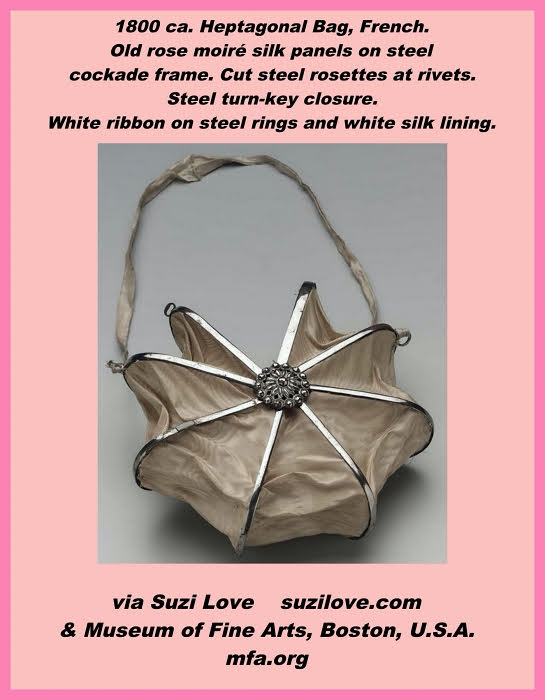
1800 ca. Heptagonal Bag, French. Old rose moiré silk panels on steel cockade frame. Cut steel rosettes at rivets. Steel turn-key closure. White ribbon on steel rings. White silk lining. Credit: The Elizabeth Day McCormick Collection via Museum of Fine Arts, Boston, U.S.A. mfa.org
Reticule Or Bag: As the silhouette of dresses became more form fitting and fabrics lighter and more transparent, pockets could no longer be hidden in the folds of skirts or underwear. Something else was needed to hold a lady’s essentials. Small purses, like men’s money pouches, were used by women to carry money for gambling, sewing necessities, and women’s daily requirements such as combs. A bag or purse, often with a drawstring to pull closed and usually made of cloth or covered cardboard and often decorated with beading or embroidery was called a reticule, or ridicule. They came in a variety of shapes, sizes, and materials. Jane Austen and her contemporaries would have purchased or hand made reticules, or bags, for each other for gifts and carried them with them whenever they went out.
1800 ca. Heptagonal Bag, French. Old rose moiré silk panels on steel cockade frame. Cut steel rosettes at rivets. Steel turn-key closure. White ribbon on steel rings. White silk lining. Credit: The Elizabeth Day McCormick Collection via Museum of Fine Arts, Boston, U.S.A. mfa.org
1800 ca. Heptagonal Bag Of Old Rose Moiré Silk Panels With A Steel Turn-Key Closure. #JaneAusten #France #Reticule books2read.com/suziloveReticules
1806 Waiting For the St. Cloud Coach, Place de la Concorde, Paris. Illustrations by Francis Courboin. via Les Modes de Paris. (PD-Art) This couple is depicted waiting for the coach, which was a passenger vehicle drawn by four horses. The woman is wearing a fashionable hat or “capote” that covers her face. Her dress maintains the empire waist and has very long sleeves that also have a ‘mancheron’ or a gathered sleeve at the shoulders. The man is wearing a ‘habit du gagé’ or a coat with tails, buttoned at the waist. His hat is a ‘haut-de-forme’ or what is commonly known in English as a top hat. He wears tight, short pants tucked into large, riding boots, as was the fashion for men. Illustrations by François Courboin from Octave Uzanne‘s Les Modes de Paris. Variations du goût et de l’esthétique de la femme, 1797-1897, L. Henry May, Paris, 1898, or from the English translation of the same work: Fashion in Paris : the various phases of feminine taste and aesthetics from 1797 to 1897, William Heinemann, London, 1898. Modes de Paris VIa Brown University Library .
Blurb: Love After Waterloo: Lady Melton and her son are forced to join antagonistic Captain Belling and the last group of wounded British soldiers evacuating Waterloo and traveling back to London. https://books2read.com/suziloveLAW
Book Hook: Lady Melton’s hand flew to her mouth. “Oh, dear. I’ve taken your bed. I’ve forced you to use a mattress on the floor.”
The Captain laughed. “Believe me, that’s far better than propping against a tree and trying to snatch an hour’s sleep before battle. Or squeezing between a sea of horses and men so you stay warm and don’t expire from frostbite.”
“How long have you been with Wellesley?”
He leaned forward and rested his arms on his knees. “Too damn long.”
“So you’re pleased to be going home?”
“Pleased? No. Resigned, yes. My friends, my fellow officers, were ordered back to Brussels. I feel guilty that I’m not with them.”
“But surely they will return home soon, now that we’ve defeated Napoleon?”
“We’ve thought the war finished several times before, and I fear this time may prove the same. Nobody can predict what the Corsican will do next.”
She squeezed his thigh. “You’re worn out, Gabe. Things will be better when you’re in London once again.”
“Will they? Too much has changed there as well. I doubt I’ll fit back into society very easily.”
“Won’t your family be pleased to have you home?”
“Perhaps, but the only important one, my uncle, died three months ago. No one cares how many thousand British men have been slaughtered, or that there will be hundreds of injured soldiers in London soon who will have no homes and no employment.”
“Some people care, Gabe.”
Book Hooks: Book Hooks: “Oh, dear. I’ve taken your bed. I’ve forced you to use a mattress on the floor.” #Waterloo #regencyromance #militaryromance #BookHook #MFRW https://books2read.com/suziloveLAW
1790-1810 ca. Linen and Metal Corset, American Or European. Front Lacing. #Corset #RegencyEra #GeorgianEra #JaneAusten. https://books2read.com/SuziLoveCorsetBook16
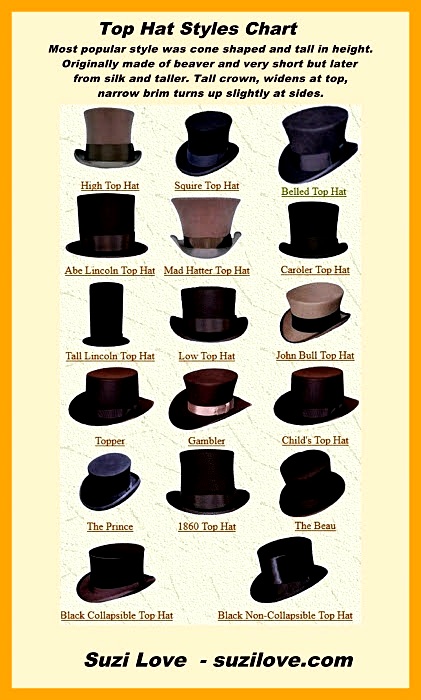
Top Hat Styles Chart during the 1800s, from the Regency Era through to the Victorian years. Most popular style was cone shaped and tall in height. Originally made of beaver and very short but later from silk and taller. Tall crown, widens at top, narrow brim turns up slightly at sides.
1800s Men’s Top Hat Styles Chart from Bridgerton and Jane Austen years. #Bridgerton #JaneAusten #RegencyFashion #Hats https://books2read.com/SuziLoveFashionMen1800-1819
1809 Blue Redingote, French. Back view of walking coat with military style trim, upstanding collar, white hat, black shoes and a handkerchief. Fashion Plate via Journal des Dames et des Modes, or Costume Parisien.
Redingotes or Pelisses were needed to cover the flimsy dresses made of lightweight fabrics of the Regency years to provide warmth and some protection from windy conditions when gowns might lift and cause modesty issues. Jane Austen and her contemporaries often walked to places and so would have needed the warmth of a Pelisse or coat in the cold British winters.
In Europe, a Redingote was a coat or robe like garment worn both indoors and out, indoors left open to reveal a dress while the outdoor version was made of heavier materials and of darker colors than the type worn indoors. The name comes from the term ‘riding coat.’
1820-1850 ca. Cotton and Beadwork Reticule Or Bag, Dutch. Couple on shore, man in boat, house and windmill behind, musicians, dancers, onlookers. Yellow metallic frame and green braided silk cord. Beadwork on cotton foundation. Polychrome design: couple on shore, man in boat, house and windmill behind (obv.); musicians, dancers, onlookers (rev.); acanthus motif at base. Yellow metallic frame with dotted design, stud closure, green braided silk cord. Ecru silk lining. via Museum of Fine Arts, Boston, U.S.A. mfa.org
Definition Reticule Or Bag or Purse: Often with a drawstring to pull closed and usually made of cloth or covered cardboard and often decorated with beading or embroidery. A reticule, or purse, or handbag, was usually carried by a woman during the Regency period to carry all their daily necessities. Earlier, women used pockets that tied at the waistline and were hidden in the folds of their skirts. Empire style, or early 1800s, high-waisted dresses made it impossible to either sewn in a pocket or to tie on a pocket. So women began carrying small, decorated bags called Reticules, or ridicules, which generally pulled close at the top with a drawstring.
1820-1850 ca. Cotton and Beadwork Reticule Or Bag, Dutch. Couple on shore, man in boat, house and windmill behind, musicians, dancers, onlookers. Yellow metallic frame and green braided silk cord. via Museum of Fine Arts, Boston, U.S.A. mfa.org
1820-1850 ca. Cotton and Beadwork Reticule Or Bag, With Couple on Shore, Dutch. #holland #sewing #Reticule #RegencyEra #RomanticEra #HistoricalFashion #Antiques http://books2read.com/suziloveReticules
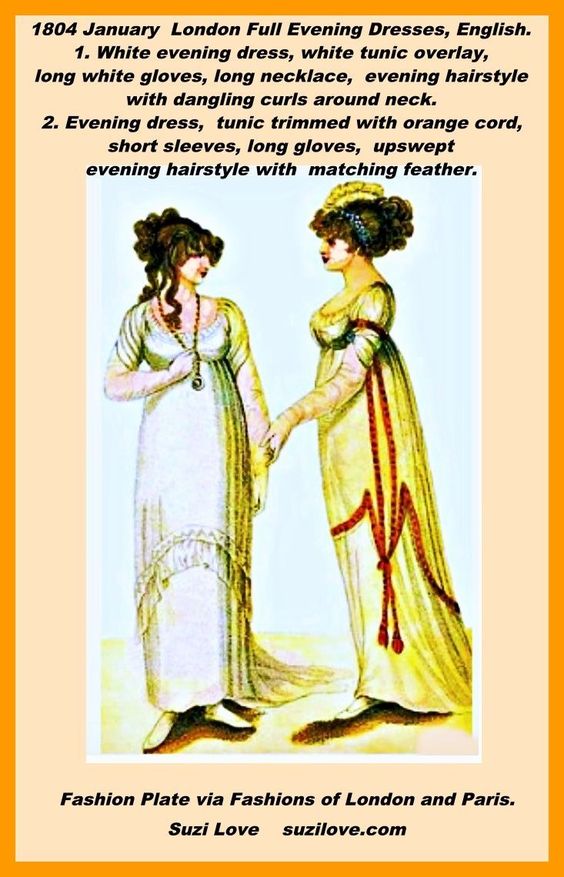
1804 January London Full Evening Dresses, English. White evening dress has a white tunic overlay and worn with long white gloves, a long necklace, and with an evening hairstyle that leaves dangling curls around her neck. Other evening dress has a tunic trimmed with orange cord, short sleeves, and worn with long gloves, and upswept evening hairstyle with a matching feather. Fashion Plate via Fashions of London and Paris. https://books2read.com/SuziLoveFashionWomen1801-1804
1804 January Two Ladies Wearing London Full Evening Dresses in Jane Austen style. #Regencyfashion #JaneAusten #historicalFashion https://books2read.com/SuziLoveFashionWomen1801-1804
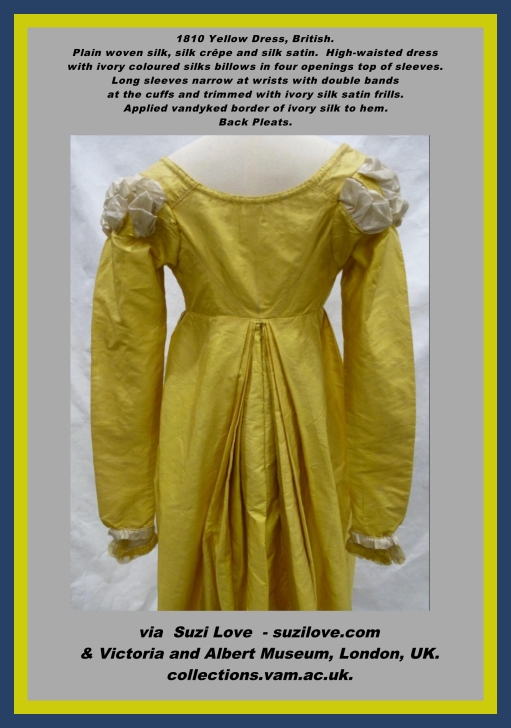
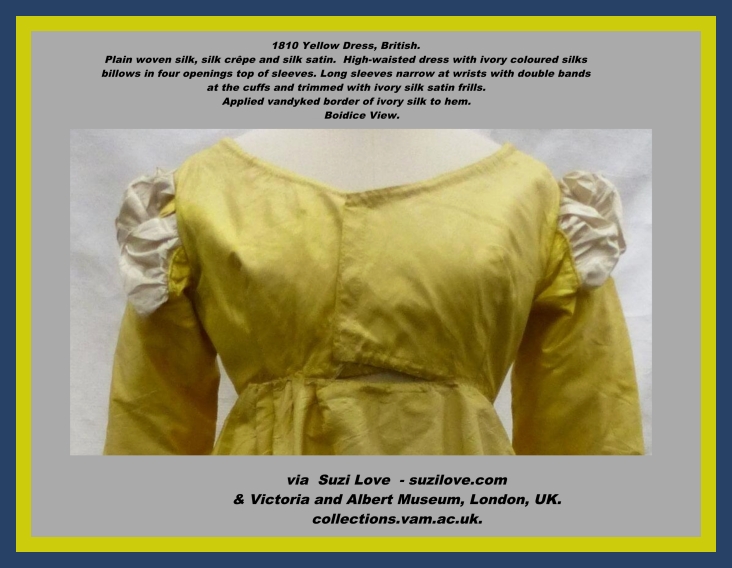
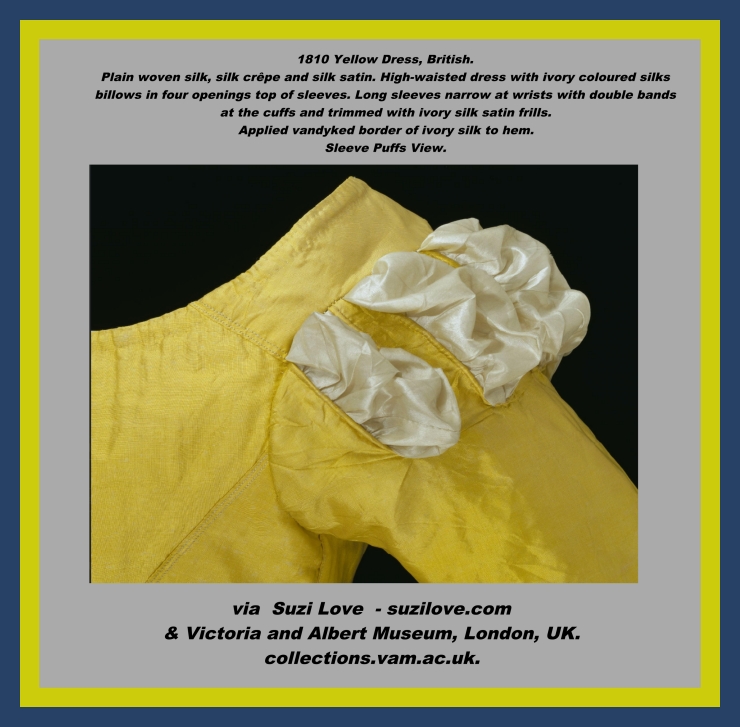
1810 Yellow Dress, British. Plain woven silk, silk crêpe and silk satin. High-waisted dress of yellow silk, ivory colored silks billow out of four openings at sleeve tops. The puffed trimmings are inspired by the fashionable slashing of garments in the Renaissance period when the top fabric was cut to reveal a colored lining or garment worn underneath. A long rectangular strip of ivory silk on inside of sleeve head and excess gathered into pudds through openings. The 19th-century version of slashing is much more controlled by cut, stitching and piped edges, rather than the raw cuts in fabric seen in the 16th century.
Long sleeves narrow at wrists with double bands at cuffs and trimmed with ivory silk satin frills, yellow silk crêpe, cream ribbon and cording. Trimming around lower hem of skirt of applied vandyked border of ivory silk. Length center back neckline to hem of train length: 158cm Front length shoulder to hem length: 139cm