Another Christmas Tradition is kisisng under the Mistletoe. So have fun this Christmas and find someone to kiss. The problem in hotter climates is to find the Mistletoe, of course. Darn!
Mistletoe was used by Druid priests 200 years before the birth of Christ in their winter celebrations. They revered the plant since it had no roots yet remained green during the cold months of winter. The ancient Celtics believed mistletoe to have magical healing powers and used it as an antidote for poison, infertility, and to ward of evil spirits. The plant was also seen as a symbol of peace, and it is said that among Romans, enemies who met under mistletoe would lay down their weapons and embrace.
Scandanavians associated the plant with Frigga, their goddess of love, and it may be from this that we derive the custom of kissing under the mistletoe. Those who kissed under the mistletoe had the promise of happiness and good luck in the following year. Mistletoe was associated with Christmas as both a decoration under which lovers kiss, as well as a protection from witches and demons. Sounds romantic, although mistletoe is actually a parasitic plant that grows on other trees or plants and comes in many varieties.
In Britain, mistletoe was mainly found in the western and southwestern parts, so the custom wasn’t even followed in all parts of England. But where the mistletoe custom was followed, it was hung in doorways and the greenery was watched by young gentlemen in hopes of catching a pretty girl to kiss, usually on the cheek.
Traditionally, a man was allowed to kiss a woman who was standing underneath mistletoe and bad luck would befall any woman who refused. In some places, it was the custom to pick a berry for each kiss and when all the berries were gone, no more kisses could be taken.
Christmas: Wassail Bowl History #Christmas #holidays #Traditions #Customs
The term wasseling refers to the jovial revelry and carousing that went on in historic England when all classes of society would gather around a common banquet-table and the wassail bowl and indulge in the most unrestrained joviality and merriment around.
Wassail Bowl: Most great houses had a wassel-bowl, or cup, frequently of massy silver. Toasts were “Drine heil,” or “Was hail,” from which the howl derives its name but were replaced around the nineteenth century by “Come, here’s to you,” or “I’ll pledge you.” Now, we toast with the simplified version of ‘Here’s to you’. As the hour of twelve approached, carol-singers would prepare and bell-ringers would place themselves at their post to usher in the morning of the Nativity with lots of rejoicing and with bands of music parading the towns.
In some parishes in the West of England, carol-singers adjourn to the church to sing in Christmas-day, a remnant probably of popery, as in Catholic countries there were frequently church-services held at this time. In the 16th century, Tusser prescribed for Christmas: good drink, a good fire in the hall, brawn, pudding, and mustard withall, capon, or turkey, cheese, apples, nuts, and jolly carols. In rich houses, a wassail cup would be filled with rich wine, sweet and spicy, and with roasted apples bobbing on the surface. In poorer houses, the cup would hold ale with nutmeg, sugar, ginger, and roasted crab apples.
How did they celebrate Christmas in Bridgerton and Jane Austen times? Historical information about the traditions of Christmas through the centuries, including the religious aspects, decorations, games, food and plays. History Of Christmases Past has lots of information and images about Christmas through the centuries, including religious aspects, decorations, games, food and plays. Historic images show how some traditions have changed while many have remained the same through the centuries. books2read.com/suziloveHOCP
Christmas: Typical Christmas Food Eaten By the Bridgerton and Jane Austen Families. #Christmas #Food #JaneAusten #Bridgerton
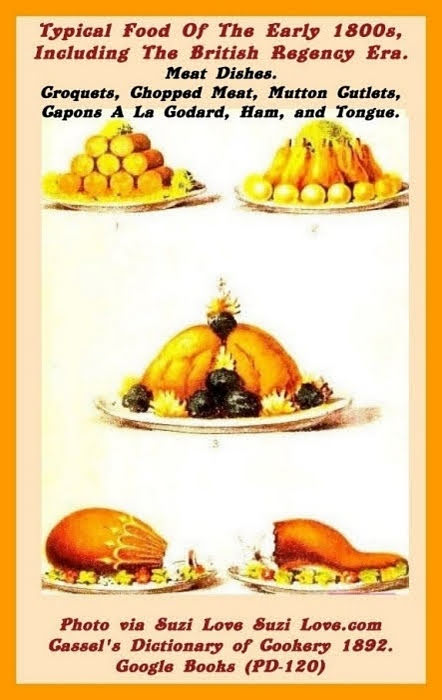
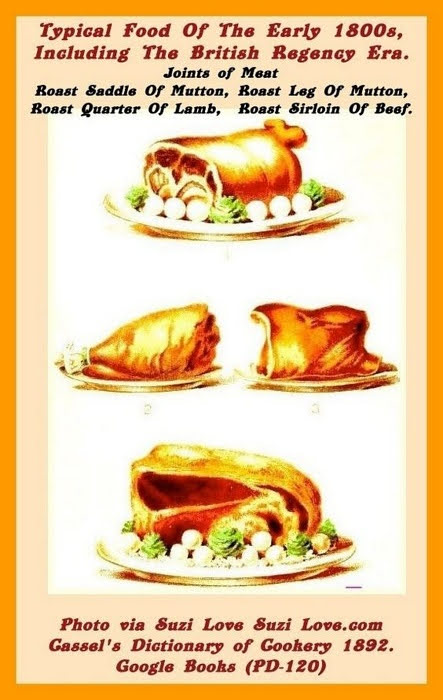
On the Christmas menu was generally mince pies and perhaps a goose or a piece of beef, depending on the family’s wealth and status. Mince pies were not made of fruit mince as we do now, but of offal or meat such as bullock’s tongue cooked with spices, orange peel, and wine and then used to fill pastry cases.
Another Christmas specialty was a Yorkshire Christmas pie which would be filled with turkey, goose, a hen, or perhaps woodcocks, partridge, or pigeons. And after the main courses, came the Plum Pudding, mixed on Stir-Up Sunday according to each family’s recipe and then boiled in a cloth.
‘The following is a valued receipt that has been handed down in a Cornish family for many generations, and the hand-writing of the receipt book will vouch for its antiquity. ‘A pound of beef-suet chopped fine; a pound of raisins do. stoned. A pound of currants cleaned dry. A pound of apples chopped fine. Two or three eggs. Allspice beat very fine, and sugar to your taste. A little salt, and as much brandy and wine as you like. An ancient Cornish custom at Christmas.” A small piece of citron in each pie is an improvement.’ From: 1833 Christmas Carols, Ancient and Modern by William Sandys.
Mince meat pies, or Christmas or Twelfth Night pies, were always part of Christmas feasts. Originally the mince pies were oblong or oval but in the 1600’s, the pies became circular, although were quite large and could weigh up to 20 lbs. In London, they could be brought out on Lord Mayor’s Day which was the 9th of November.
Timeline of Mince Pies via Minced Pie Club.
In the 13th century, crusaders returned from the Middle Eastern with recipes containing meat, fruit and spices mixed together, which helped preserve meat without having to smoke, dry or salt.
1413 King Henry served a mincemeat pie at his coronation.
1588 Good Hous-Wiues Treasurie by Edward Allde: meats were still cut up to be eaten with a spoon and combined with fruits and heavy spices. His recipe for Minst Pye had practically the same ingredients as modern mince pies.
1657 Mince Pies were banned during the reign of Oliver Cromwell, along with other Christian traditions that were classed as gluttony.
1659 Oliver Cromwell’s Puritan influence spread to the American British Colonies and many towns banned mincemeat pies at Christmas time.
When pies were reintroduced in Britain, they were a lot smaller and could be served individually to guests and were named Wayfarer pies.
1832 Bill of Fare: no less than one hundred and eleven dishes of mince pies included.
More Minced Pie Trivia
When the monarchy was restored in 1660, the law regarding Minced Pies was disregarded but apparently never repealed so Mince pies are still, supposedly, illegal.
Pastry crusts sink in the middle and are thought to resemble Jesus’ manger so sometimes a small pastry doll was put in the middle and these were called crib pies.
Pies could last up to two months in cold weather.
Recipes varied by region, but usually included beef, poultry and other meats, suet, sugar, raisins or currants, spices, orange and lemon peel, eggs, apples and brandy.
Minced-meat was only supposed to be stirred clockwise, otherwise the stirrer would have bad luck in the coming year. bring bad luck for the coming year.
Filling included cinnamon, cloves and nutmeg to represent the gifts of the Magi to the infant Jesus and the star shaped pastry on top represents the star of Bethlehem.
If you ate minced pie every day of the twelve days of Christmas you were supposed to have twelve months of happiness, especially if the pies were baked by the dozen and offered by friends.
Christmas pudding originated as a 14th century porridge called ‘frumenty’ , made of beef and mutton with raisins, currants, prunes, wines and spices. Often more like soup, it was eaten as a fasting meal in preparation for Christmas festivities. By 1595, frumenty changed into a plum pudding thickened with eggs, breadcrumbs, dried fruit and flavoured with beer and spirits. It became the customary Christmas dessert around 1650, but in 1664 the Puritans banned it as a bad custom. In 1714, King George I re-established it as part of the Christmas meal, having tasted and enjoyed Plum Pudding.
“In December, the principal household duty lies in preparing for the creature comforts of those near and dear to us, so as to meet old Christmas with a happy face, a contented mind, and a full larder; and in stoning the plums, washing the currants, cutting the citron, beating the eggs, and mixing the pudding, a housewife is not unworthily greeting the genial season of all good things.” Via 1861 Beeton’s Book of Household Management.
The Sunday closest to St. Andrew’s Day was Stirring-up Sunday, and the day to prepare the family’s Christmas pudding. The eldest member of the household or a visitor would give the first stir and charms were stirred into the pudding. A ring meant a coming marriage, a button was bachelorhood, a thimble meant spinsterhood, and a sixpence was good luck. Puddings were steamed in a pudding bag and stored in a cool place until Christmas Day.
Angels – Heralds for the news of the birth of a baby in a manger.
Bells – Bells have rung out for all important events for centuries, plus lost sheep are found by the sound of the bell.
Candy Cane – Symbolizes the crook of the shepherds who visited Christ. Red represents the blood that was spilled and white is for purity. The peppermint oil that flavors is known for its strong healing properties.
Cards – Produced in Britain in 1843 to be sent with love to family and friends around the world by the new Postal services.
Carols – Poems and stories of worship made into songs.
Carolers – Groups of people who strolled the streets singing Christmas songs
Feasting – To celebrate the joy of the baby’s arrival on the 25th December.
Gift Giving – The Wise Men bowed before the baby and gave him gold, frankincense and myrrh.
Gold – Decorating using the color of one of the gifts of the wise men.
Green – Decorating using the color of evergreens which show everlasting love.
Holly – Represents Eternal Life and the crown of thorns worn by Jesus.
Mistletoe: In the 18th Century, men kissed a woman who stood under mistletoe to show love, friendship and goodwill. If a woman was un-kissed, she would (supposedly) never marry.
Nativity: The birth of Jesus Christ
Poinsettia – Red flowers used in countries such as Mexico to symbolize Christmas time.
Stockings – Hung by children to receive gifts
Twelve Days of Christmas: Twelve days between the birth of Christ on December 25 and the coming of the Magi on January 6, the Epiphany.
Tree – Evergreen tree symbolizes eternal life and love
Wreath – Made of evergreens to symbolize never ending love
From Harper’s Bazaar:- ‘Advent is the herald of Christmas. In Protestant as well as Catholic countries, choristers and school-boys during the “holy-nights” go from house to house singing songs or Christmas carols to usher in the auspicious day. In the south of Germany, they accompany the singing by knocking at the doors with a little hammer, or throwing pease, beans, or lentils at the windows. Hence the origin of the name of “knocking nights.”
In Bohemia, Styria, Carniola, and other German provinces, people group together and perform Christmas plays during Advent, with simple plots about the story of the Savior’s birth, his persecution by Herod, and the flight of the Holy Family into Egypt. The players usually consist of the Christ-child, St. Nicholas or St. Peter, St. Joseph and the Virgin, Herod, the varlet Ruprecht, several angels, together with shepherds and other less conspicuous personages.
The devil is the merriest character because he capers about through the village and furiously blows his horn, frightening or bantering with, the old and young, despite portraying the humble rôle of a messenger. A handsome youth of the strictest morals is usually selected to represent the Virgin Mary. The rehearsal is usually accompanied by a certain rhythmical movement, the players going four steps to and fro, so that a meter or foot corresponds to every step, and on the fourth, which includes the rhyme, the performer turns quickly around. The holy personages sing instead of rehearsing their parts, but accompany their singing with the same rhythmical movement.
On the first Sunday in Advent the play is inaugurated by a solemn procession, headed by the master singer bearing a gigantic star, followed by the others drawing a large fir-tree ornamented with ribbons and apples; and thus they go singing to the large hall where the play is to be performed. On arriving at the door they form a half circle, and sing the star-song; then, after saluting sun, moon, and stars, the emperor, the government, and the master singer, in the name of all the “herbs and roots that grow in the earth,” they enter the hall, and the performance begins.
The prologue and epilogue are sung by an angel. As the whole stage apparatus often consists of only a straw-bottomed chair and a wooden stool, every change of scene is indicated by a procession of the whole company singing an appropriate song; after which only those who take part in the next act remain standing, while the remainder go off singing.
These dramatic representations are often very simple, or only fragmentary, consisting, it may be, of a troop of boys and girls disguised as shepherds and shepherdesses, who go about singing shepherd songs, thus announcing the approaching advent of our Savior. At other times, they are performed from house to house and are associated with the distribution of Christmas presents.
In such cases, they are made the occasion of a solemn inquest into the conduct of the children, and constitute in Germany — which appears to be at once the paradise and purgatory of Christmas-loving juveniles — a potential auxiliary of pedagogic and parental discipline.
The archangel Gabriel, it may be, first appears upon the scene, and thus announces his advent: “May God give you a happy good-evening! I am his messenger, sent from angel-land. My name is Gabriel. In my hands I bear the scepter which the Son of God has given me. On my head I wear the crown with which the Son of God has crowned me.”
Thereupon the Christ-child, wearing a gilded paper crown, and carrying a basket full of apples and nuts, enters, singing the song commencing,
“Down from the high heaven I come,”
and greets the company with a similar salutation.
In the course of his song he informs the children that the object of his coming is to learn whether they have been good and obedient, and if they “pray and spin diligently.”
If so, they are to be rewarded with gifts from his golden chariot which stands at the door; if not, their backs are to be belabored with rods. St. Peter or St. Nicholas, as the case may be, is then called in to furnish a faithful account of the children’s deportment.
If it be St. Nicholas, he enters with a long staff or crozier in his hand, and a bishop’s miter of gilt paper upon his head. His report is not usually a flattering one. On their way from school the children loiter in the streets, they tear their books, neglect their tasks, and forget to say their prayers; and as a penance for all this evil-doing, he recommends a liberal application of the rod. The Christ-child interposes, almost supplicating,
“Ah, Nicholas, forbear.
Spare the little child.
Spare the young blood!”
The two then join with the angel in singing a song, when St. Peter is summoned, who promptly enters, jingling his keys. The saint, who rather plumes himself on his high office of heavenly janitor, carries matters with a high hand.
He examines the children’s copy-books, it may be, bids them kneel down and pray, and then, by virtue of his high prerogative, pronounces sentence upon the unfortunate delinquents, and calls upon the black Ruprecht, who stands waiting outside the door, to execute his orders.
“Ruperus, Ruperus, enter!
The children will not be obedient.”
The frightful bugbear, dressed in fur, and covered with chains, with blackened face and fiery eyes, and a long red tongue protruding out of his month, stumbles over the threshold, brandishing an enormous birch, and as he falls headlong into the room, roars out to the children, “Can you pray?” Whereupon they fall upon their knees and repeat their prayers at the top of their voices.
The five heavenly visitors, standing in a half circle, then sing another song or two descriptive of the heavenly joys, or freighted with wholesome advice to both children and parents. The latter give them in return a few farthings, while the Christ-child scatters apples and nuts here and there upon the floor for the further edification of the children, and then Christ-child, St. Nicholas, St. Peter, the archangel Gabriel, and devil exeunt.
St. Nicholas, as all the world knows, is the patron of children, with whom he is the most popular saint in the calendar. Bishop of Myra, in Lycia, in the time of Constantine the Great, if we are to credit the Roman breviary, he supplied three destitute maidens with dowries by secretly leaving a marriage-portion for each at their window. Hence the popular fiction that he is the purveyor of presents to children on Christmas-eve.
He usually makes his appearance as an old man with a venerable beard, and dressed as a bishop, either riding a white horse or an ass, and carrying a large basket on his arm, and a bundle of rods in his hand. In some parts of Bohemia he appear dressed up in a sheet instead of a surplice, with a crushed pillow on his head instead of a miter.
On his calling out, “Wilt thou pray?” all the children fall upon their knees, whereupon he lets fall some fruit upon the floor and disappears. In this manner he goes from house to house, sometimes ringing a bell to announce his arrival, visits the nurseries, inquiries into the conduct of the children, praises or admonishes them, as the case may be, distributing sweetmeats or rods accordingly.
St. Nicholas is the Santa Claus of Holland, and the Samiklaus of Switzerland, and the Sönner Klâs of Helgoland. In the Vorarlberg he is known as Zemmikias, who threatens to put naughty children into his hay-sack; in Nether Austria as Niklo, or Niglo, who is followed by a masked servant called Krampus. In the Tyrol he goes by the name of the “Holy Man,” and shares the patronage of his office with St. Lucy, who distributes gifts among the girls, as he among the boys. Sometimes he is accompanied by the Christ-child. In many parts of Switzerland, Germany, and the Netherlands St. Nicholas still distributes his presents on St. Nicholas’s Eve — the 5th of December — instead of on Christmas-eve.
In the Netherlands and adjoining provinces he is especially popular, and is perhaps the only saint who has maintained his full credit, even among the Protestants. For days previous to his expected advent busy housewives have been secretly conspiring with the bakers in gilding nuts, cakes, and gingerbread, and torturing pastry, prepared with flour, sugar, honey, spices, and sweetmeats, into the most fantastical forms, from which the good saint may from time to time replenish his supplies.
As to the children, St. Nicholas or Sünder Klaas is the burden of their prayers, the staple of their dreams, and the inspiration of their songs. As they importune him to let fall from the chimney-top some pretty gift into their little aprons, they go on singing with childish fervor,
“Sünder Klaas da gode Bloot!
Breng’ mi Nööt un Zuckerbrod,
Nicht to veel un nich to minn
Smiet in mine Schörten in!”
In Belgium, on the eve of the good bishop’s aerial voyage in his pastoral visitation of his bishopric of chimney-tops, the children polish their shoes, and after filling them with hay, oats, or carrots for the saint’s white horse, they put them on a table, or set them in the fireplace. The room is then carefully closed and the door locked. Next morning it is opened in the presence of the assembled household, when, mirabile dictu! the furniture is found to be turned topsy-turvy, while the little shoes, instead of horse’s forage, are filled with sweetmeats and toys for the good children, and with rods for the bad ones. In some places wooden or China shoes, stockings, baskets, cups and saucers, and even bundles of hay, are placed in the chimney, or by the side of the bed, or in a corner of the room, as the favorite receptacles of St. Nicholas’s presents.
In the Western world, where Christmas is characterized by the exchange of gifts among friends and family members, some of the gifts are attributed to a character called Santa Claus. He is also known as Father Christmas, Saint Nicholas, St. Nikolaus, Sinterklaas, Kris Kringle, Joulupukki, Weihnachtsmann, Saint Basil and Father Frost.
Father Christmas, who predates Santa Claus, was first recorded in the 15th century and then associated with holiday merrymaking and drunkenness. Today’s version of Santa Claus was created by the German-American cartoonist Thomas Nast (1840-1902), who drew a new image of the character annually, beginning in 1863.
By the 1880s, Nast’s Santa had become the one now know and in the 1920s, this image was used in most advertising. In Victorian Britain, his image was remade to match that of Santa and France’s Père Noël (Papa Noël) evolved the same way and eventually began using the same Santa image.
Our modern Christmas tree tradition probably began in Germany in the 18th century, though some argue that Martin Luther began the tradition in the 16th century. An evergreen fir tree was used to celebrate winter festivals (pagan and Christian) for thousands of years. Nobody is really sure when Fir trees were first used as Christmas trees but it probably began 1000 years ago in Northern Europe. Many early Christmas Trees seem to have been hung upside down from the ceiling using chains.
The English phrase “Christmas tree”, first recorded in 1835, came from the German words Tannenbaum (fir tree) or Weinachtenbaum (Christmas tree). The Christmas tree is often explained as a Christianization of pagan tradition and ritual surrounding the Winter Solstice, which included the use of evergreen boughs, and an adaptation of pagan tree worship. At first, a figure of the Baby Jesus was put on the top of the tree. Over time it changed to an angel or fairy that told the shepherds about Jesus, or a star like the Wisemen saw.
Christian tradition associates the holly tree with the crown of thorns, and says that its leaves were white until stained red by the blood of Christ. Along with a Christmas tree, the interior of homes were decorated with plants, garlands, and evergreen foliage and in Victorian times, Christmas trees were decorated with candles to represent stars.
The early Germans conceived of the world as a great tree whose roots were hidden deep under the earth, but whose top, flourishing in the midst of Walhalla, the old German paradise, nourished the she-goat upon whose milk fallen heroes restored themselves. Yggdnafil was the name of this tree, and its memory was still green long after Christianity had been introduced into Germany, when much of its symbolic character was transferred to the Christmas-tree. At first fitted up during the Twelve Nights in honor of Berchta, the goddess of spring, it was subsequently transferred to the birthday of Christ, who, as the God-man, is become the “resurrection and the life.”
Queen Victoria saw a Christmas tree as a girl in 1832. The little princess wrote excitedly in her diary that her Aunt Sophia had set up two “trees hung with lights and sugar ornaments. All the presents being placed around the tree.” In 1841, Prince Albert, Queen Victoria’s German husband, arranged for a fir tree to be brought from Germany and decorated. By 1850, Victoria and Albert had Christmas trees erected in the British Royal Palaces and their children started the tradition of gathering around the tree.
‘The Christmas-tree is doubtless of German origin. Though in its present form it is comparatively of recent date, yet its pagan prototype enjoyed a very high antiquity.’ From 1873 Harper’s Bazaar, America.
A print of the royal family gathered about the Christmas tree at Windsor Castle appeared in the Illustrated London News in 1848, then in Godey’s Lady’s Book in 1850, and was reprinted again ten years later. The six-foot fir sits on a table, each tier laden with a dozen or more lighted wax tapers. An angel with outstretched arms poses at the top. Gilt gingerbread ornaments and tiny baskets filled with sweets hang by ribbons from the branches. Clustered around the base of the tree are dolls and soldiers and toys.
Christmas trees did exist in America before Queen Victoria made them famous, but mainly only amongst migrant groups from Europe. The writer of an 1825 article in The Saturday Evening Post mentions seeing trees in the windows of many houses in Philadelphia, a city with a large German population. He wrote, Their “green boughs laden with fruit, richer than the golden apples of the Hesperides, or the sparkling diamonds that clustered on the branches in the wonderful cave of Aladdin.” Gilded apples and nuts hung from the branches as did marzipan ornaments, sugar cakes, miniature mince pies, spicy cookies cut from molds in the shape of stars, birds, fish, butterflies, and flowers. A woman visiting German friends in Boston in 1832 wrote about their unusual tree hung with gilded eggshell cups filled with candies.
Not until the mid-nineteenth century did Christmas trees start spreading to homes with no known German connection. But once Queen Victoria approved of the custom of a Christmas tree, the practice spread throughout England and America and, to a lesser extent, to other parts of the world, through magazine pictures and articles. Upper-class Victorian Englishmen loved to imitate the royal family, and other nations copied the custom. Late in the century, larger floor-to-ceiling trees replaced the tabletop size.