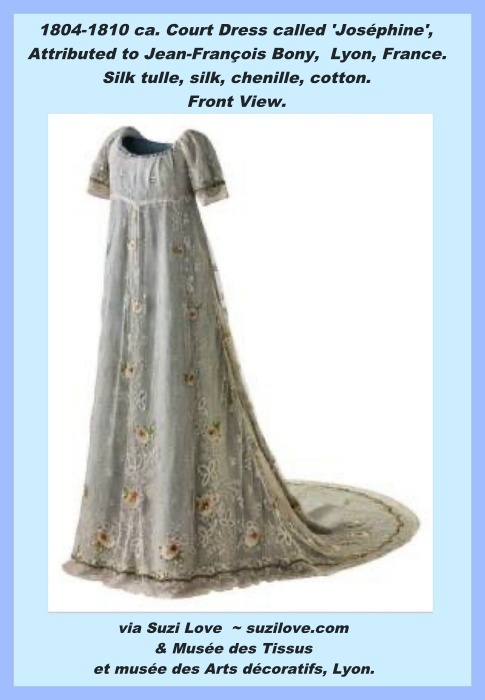
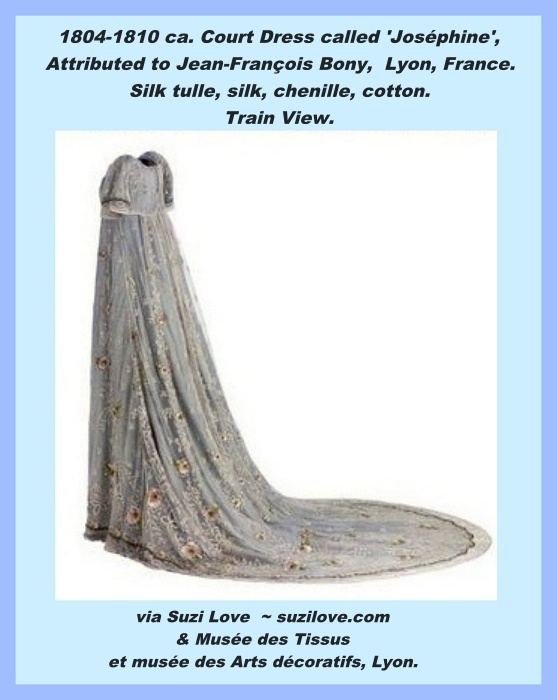
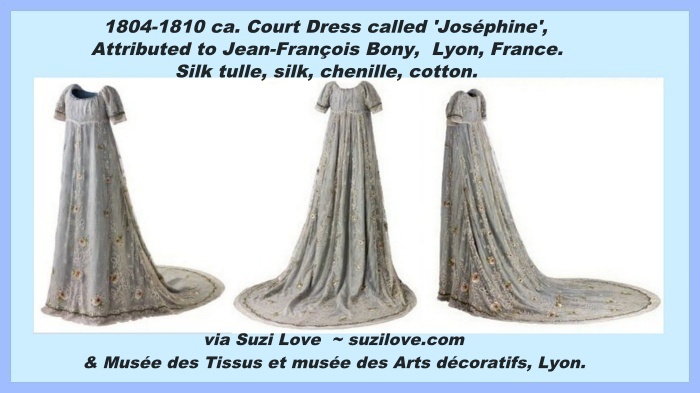
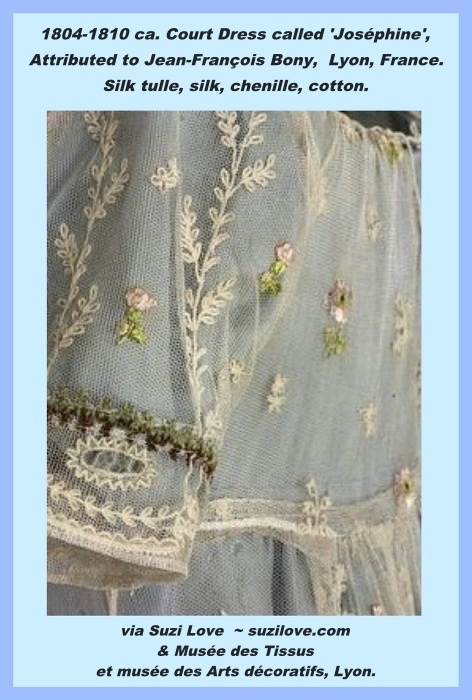
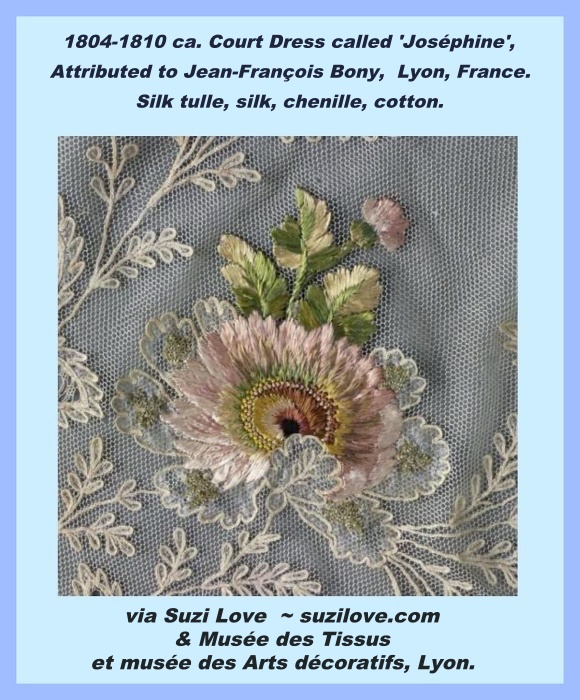
1804-1810 ca. Empire style, or high-waisted, French Court Dress called ‘Joséphine’, Attributed to embroiderer Jean-François Bony, Lyon, France. Silk tulle, silk, chenille, and cotton. via Musée des Tissus et musée des Arts décoratifs, Lyon. via Musée des Tissus et musée des Arts décoratifs, Lyon.
Definition Empire Style: Named after the First Empire in France, by 1800 Empire dresses had a very low décolleté, or neckline and a short narrow backed bodice attached to a separate skirt. Skirts started directly under the bust and flowed into the classical relaxed wide styles of Greece and Rome. This style of dress is associated with Jane Austen and her contemporaries as a simple cotton high-waisted dress was worn most days and accessorized according to the importance of the occasion.
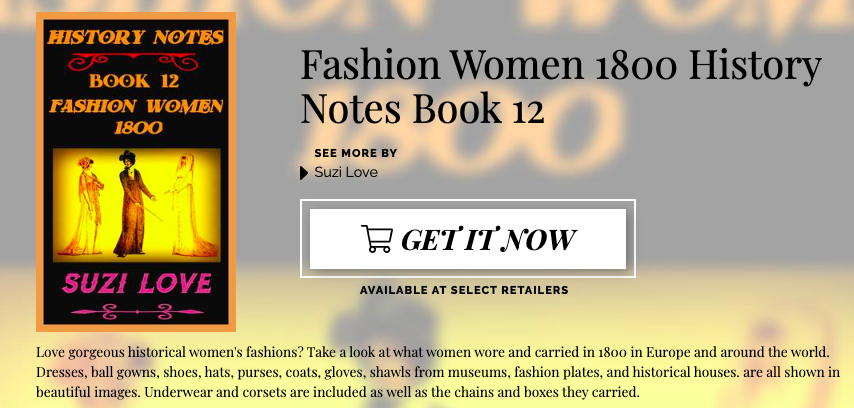
Fashion Women 1805-1809 History Notes Book 26 What did Jane Austen and friends wear? https://books2read.com/SuziLoveFashionWomen1805-1809
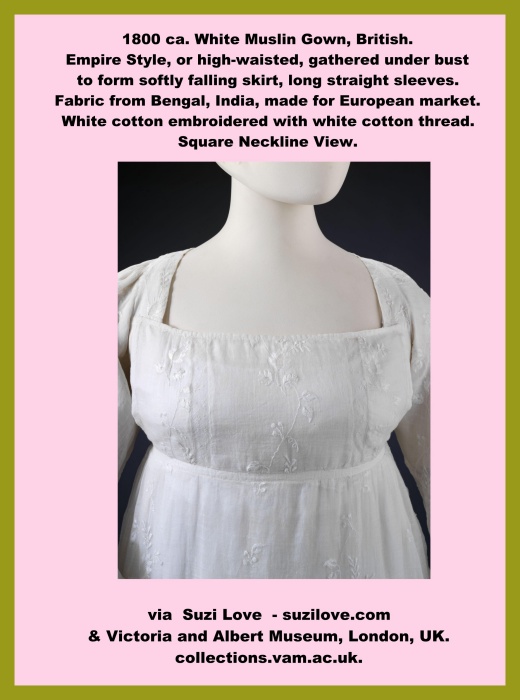
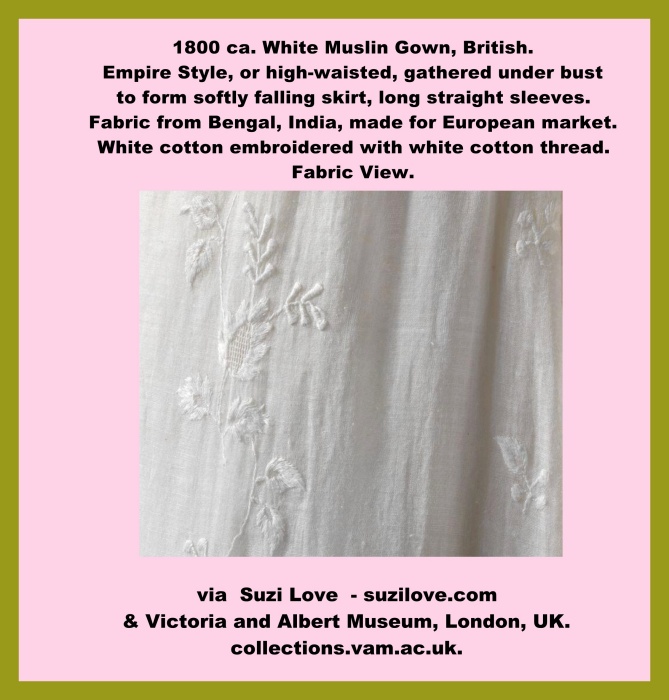
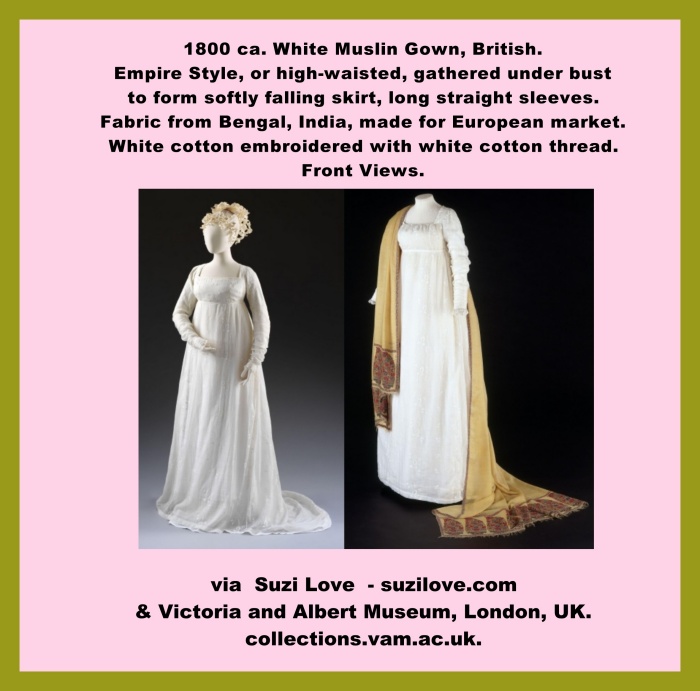
1800 ca. White Muslin Gown, British. Empire Style, or high-waisted, gathered under bust to form softly falling skirt, long straight sleeves. Fabric from Bengal, India, made for European market. White cotton embroidered with white cotton thread. via Victoria and Albert Museum, London, UK. collections.vam.ac.uk.
About 1800 Women’s dress changed dramatically after 1785. The rich fabrics and complicated, formal shapes of the late 18th century gave way to simple, light fabrics that draped easily. These new gowns achieved something of the effect of the simple tunics shown on classical Greek and Roman statues and vases, Muslin embroidered with cotton thread Fabric made in India, gown made in England Given by Miss Frances Vickers Museum no. 444-1888 (2013) Victoria and Albert Museum, London.
By the end of the 18th century, rigidly tailored garments for both men and women were replaced by styles made for ease and comfort, resulting in the neoclassical style of the 1780s. Inspired in part by the statuary of ancient Greece and Rome, the new fashion was epitomised by light cotton gowns falling around the body in an unstructured way, held around the high waist with a simple sash and accompanied by a soft shawl draped around exposed shoulders. This style was ideal for the Indian imports like Kashmiri shawls and Bengali muslin, as used in this embroidered gown. Championed by such influential figures as Emma Hamilton in England and Madame Récamier in France, the so-called ‘Empire’ style catapulted Indian muslin into the forefront of fashion.
Definition Empire Style Dress: Named after the First Empire in France. Empire dresses had a low neckline and skirts started directly under the bust and flowed into the classical relaxed wide styles of Greece and Rome. This style of dress is associated with Jane Austen and her contemporaries as a high-waisted dress was worn most days. Cotton, silk or taffeta were the popular fabrics. Only the very wealthy could afford white dress in this style as the cottons were imported from India and had to be carefully cleaned, usually by a lady’s maid.
1785–1800 ca. Cotton Breeches, American or European. Man’s cotton breeches, drop down, or fall, front opening, button fastening at the waist, extra material in the back allows more movement for riding etc., and buttons secure the leg openings so they can be fitted to wear with boots for riding. via Metropolitan Museum, NYC, U.S.A. These are the sort of pants that the men Jane Austen knew would have worn for riding or in the country.
1820 Ball Gown of Embroidered Net, British. Silk satin and silk net embroidered with metal and trimmed with silk blonde bobbin lace, hand sewn. Short-sleeved ball gown comprising of an underdress of silk satin and an overdress of machine-made silk net embroidered with metal and trimmed with blonde bobbin lace. The dress has a low oval neckline, puffed short sleeves, a wedge shaped front bodice panel, and a medium high waist. The skirt has a central front panel, wedge shaped panels and the centre back panels are tightly gathered at the waist.
From the Museum Curator: ‘Women saved their most elaborate dresses for special occasions such as balls. Lavish gowns embellished with gold thread or sparkling beads glittered in the artificial light of the dancing room. Thin, gauzy materials created a soft dreamy look. These light materials also prevented the wearer from getting too hot while dancing in stuffy, overcrowded spaces’. Victoria and Albert Museum, London, UK
Fashion Women 1815-1819 History Notes Book 28 https://books2read.com/SuziLoveFashionWomen1815-1819
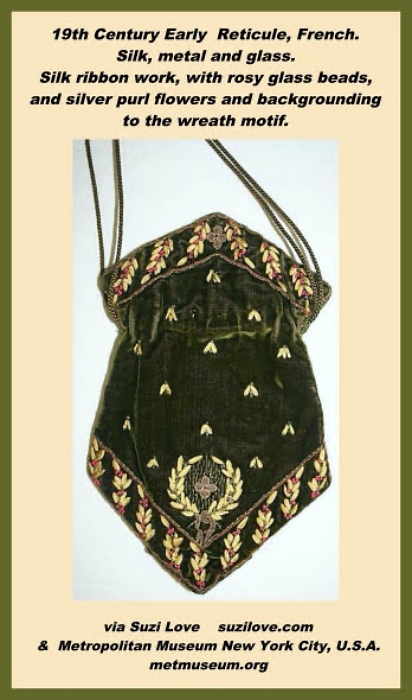
19th cent. Early. Reticule, or Bag, of silk, metal and glass, French, as carried in Jane Austen’s times. Silk ribbon work, with rosy glass beads, and silver purl flowers and backgrounding to the wreath motif. via Metropolitan Museum, N.Y.C., U.S.A. metmuseum.org
Definition Reticule: Bag or purse, often with a drawstring to pull closed and usually made of cloth or covered cardboard and often decorated with beading or embroidery. A reticule, or purse, or handbag, was usually carried by a woman during the Regency period to carry all their daily necessities. Earlier, women used pockets that tied at the waistline and were hidden in the folds of their skirts. Empire style, or early 1800s, high-waisted dresses made it impossible to either sewn in a pocket or to tie on a pocket. So women began carrying small, decorated bags called Reticules, or ridicules, which generally pulled close at the top with a drawstring.
19th Century. Early. Reticule. Silk, metal and glass. French. Silk ribbon work, with rosy glass beads, and silver purl flowers and backgrounding to the wreath motif. via Metropolitan Museum New York City, U.S.A. metmuseum.orgHN _3_D2D_RetailerBuyLink_HN_3
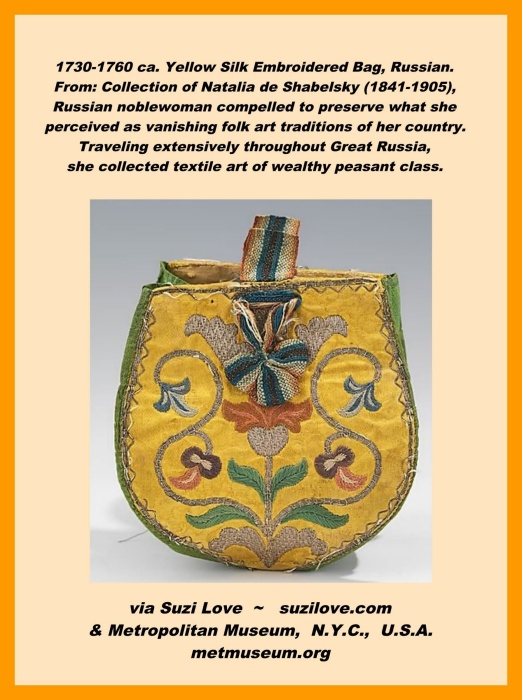
1730-1760 ca. Yellow Silk Embroidered Bag, Russian. From: Collection of Natalia de Shabelsky (1841-1905), Russian noblewoman preserving vanishing folk art traditions of her country. Traveling extensively throughout Great Russia, she collected textile art of wealthy peasant class. via Metropolitan Museum, NYC.
18th Century bags, or purses, were usually designed to hang from the waist or wrist to carry essential daily items on the person rather than making the long walk back through a castle or grand house to fetch things like coins, personal seals, toiletries or medicines.
1805 Pink Redingote, French. Also called a Pelisse, a Walking Dress, or a Carriage Costume, in England. High-waisted, short puffed sleeves over long straight sleeves with elaborate embroidery to decorate, and close-fitting gold hat tied under her chin. Fashion Plate via Journal des Dames et des Modes, or Costume Parisien. Jane Austen and her contemporaries would have worn long coats like this one to keep warm when out and about, visiting, shopping etc. The thin muslin dresses worn in the early 1800s were little protection against European winters, so coats of some sort were added, plus colorful accessories like this shawl and the hat to add color and another layer of warmth.
Definition Redingote Or Coat Or Pelisse: Long fitted outdoor coat worn over other garments for warmth. French word developed from English words, riding coat. French fashion plates call these coats Redingotes and they are designed for women, men and children. English fashion plates call them a Pelisse, a walking dress, Promenade dress, or Carriage dress.
1817-1820 ca. Spencer, English. Green silk, brown satin puffs, silk cord on deep V collar and sleeves. With the rise of fashionable waistlines in women’s dresses after around 1800, women’s outerwear followed suit. This jacket with very short bodice and long sleeves was known as a Spencer and was named after the male coat made famous by the Earl Spencer. The jacket is said to have originated in an accident to Lord Spencer in hunting when his coat tails were torn off and a cropped jacket was invented. via Museum of London, UK. museumoflondon.org.uk. books2read.com/suziloveSpencers. Jane Austen and her contemporaries often walked to places and so would have needed the warmth of a Spencer over her dress in the cold British winters.
Definition Spencer: Short jacket, cropped at the waist, worn over a dress, or gown. These close-fitting, tight sleeved, waist length jackets were modeled on a gentleman’s riding coat, but without tails. Delicate and regency dresses provided so little protection from the cold, so over garments were essential for warmth, modesty and good health.
1817-1820 ca. Spencer, English. With the rise of fashionable waistlines in women’s dresses after around 1800, women’s outerwear followed suit. This jacket with very short bodice and long sleeves was known as a spencer. via Museum Of London. HN_4_Spencers Or Regency Jackets.
books2read.com/suziloveSpencers
1816. June Blue Merino wool riding dress with high waist and embroidered and ornamented round the bust and cuffs and fastens on the back of the shoulder. Double ruff of fine Vandyke lace is separated from shirt collar by a Chinese silk handkerchief of blue and white. Small round hat made of fine beaver or moss silk, the half boots are of blue kid with Limerick gloves worked and seamed with blue and she is carrying a riding whip. These riding habits were usually designed by men and were in two pieces, a jacket and a skirt, worn over a shirt but this is in one piece and the full skirt falls from directly under the bust. Fashion Plate via John Belle’s La Belle Assemblée or, Bell’s Court and Fashionable Magazine, London. https://books2read.com/SuziLoveFashionWomen1815-1819
Typical of the riding costumes worn by Jane Austen’s female contemporaries. The style is still in the Empire fashion of a high-waist with the full skirt falling from just under the bust and with a frill and small decorations on the wrists and shoulders to make it look unique.
Fashion Women 1815-1819 History Notes Book 28 What did Jane Austen wear? . D2D_HN_28_https://books2read.com/SuziLoveFashionWomen1815-1819
1820 Brown Evening Dress Of Figured Silk Muslin With Brown Gauze Trim. An evening dress of tobacco coloured figured silk muslin, warp float, small sprig repeat design. Shallow, round neckline, short puffed sleeves, high, empire-style waistline and long tubular skirt. Bodice has narrow cream lace trim above a band of self fabric edged with cream silk braid and brown silk taffeta piping. Bodice front has brown silk gauze joined on at side seams with 3 van dyke points down sides of centre front. Edges of points bound with silk taffeta and trimmed with ball buttons covered in brown silk floss.
Centre front panel has brown silk cord lacing through 17 handworked eyelets bordered by 2 v-shaped strips of same silk taffeta rouleaus. Self fabric waistband is trimmed with cream braid and piping, with two van dyke points either side of centre back. Bodice laced at back from neck to waistband while gauze overlay from front forms a band tucked over the waist, which extends over skirt to form a narrow peplym, also van dyke pointed and bound with taffeta. Two self fabric epaulettes attached at sleeve seams and trimmed with brown silk passmenterie tassel, at shoulder and with same braid and piping. Short sleeves overlaid with brown silk gauze ruched between rouleaux bands stitched to lining. Cuff bands piped and braided and cut into 8 van dyke points above overlay. Points are trimmed with braid, piping and silk covered ball buttons. Skirt of dress falls to the ground, trained at back, and flounce of satin striped silk gauze falling from corded seam. Bodice lined with cream cotton. Via Powerhouse Museum, Sydney, Australia. collection.maas.museum.
Passementerie: Art of making elaborate trimmings or edgings (in French, passements) of applied braid, gold or silver cord, embroidery, colored silk, or beads for clothing or furnishings.Styles of passementerie include the tassel, fringes, ornamental cords, galloons, pompons, rosettes, and gimps, as well as other forms. Tassels, pompons, and rosettes are point ornaments, and the others are linear ornaments.
Fashion Women 1815-1819 History Notes Book 28 https://books2read.com/SuziLoveFashionWomen1815-1819