1817 Evening Mourning Dress, English. Black short length dress, layers of feathers on the skirt, long lace headdress falling from an upswept hairstyle and black shoes. Fashion Plate via John Belle’s La Belle Assemblée or, Bell’s Court and Fashionable Magazine, London.
Mourning – Full Or Deep Mourning: Entire ensemble and accessories must be black. Shiny fabrics were not allowed so bombazine became the fabric of choice for many. Hats had veils added and jet was the preferred jewelry.
Mourning – Half or Slight Mourning: allowed touches of grey and white to be added to full, or deep, mourning ensembles. Some lustre, or shine, was allowed in fabrics and accessories. After a time, mauve or deep purple could also be worn.
1817 Evening Mourning Dress, English. Black short length dress, layers of feathers on the skirt, long lace headdress falling from an upswept hairstyle and black shoes. Fashion Plate via John Belle’s La Belle Assemblée or, Bell’s Court and Fashionable Magazine, London.HN_28_D2D_FashionWomen 1815-1819
1817 November Cambric Muslin Walking Dress, English. As would have been worn by Jane Austen and her female contemporaries when out walking. Row of pointed work forms a narrow pelerine, high on the bosom, and ends in a point in front. The skirt has a deep muslin flounce beneath a row of soft muslin bouffone. Brown Spencer of gros de Naples has figured buttons which are intermixed with an elegant trimming. Sleeves ends are like the hem with a double row of buttons and trimming. The newly fashionable epaulette is edged and finished with buttons on the shoulder. Autumnal bonnet has a large front, low crown, and ties under the chin with a large bow. Swansdown muff, lilac sandals and pale lemon kid gloves finish the ensemble. ‘We have been favored this month with both our dresses by a lady, one of our subscribers, who purchased them, we understand, at Mrs. Bell’s in St. James’s Street.’ Fashion Plate via Rudolph Ackermann’s ‘The Repository of Arts’.
1817 November. Walking Dress, English. Brown Spencer over a white Empire style, high-waisted, walking dress with frilled hem, large white muff, brown bonnet with ruffles and ribbon to match. Fashion Plate via Rudolph Ackermann’s ‘The Repository of Art Fashion Women 1815-1819 History Notes Book 28 https://books2read.com/SuziLoveFashionWomen1815-1819
1810-1820s ca. Woman’s Green Slippers. Possibly French, worn in America. The type of shoes worn by Jane Austen and her female friends and family and by the female members of the Bridgerton family. via Museum of Fine Arts, Boston. mfa.org
Shoes in the early 1800s were flat or low heeled and occasionally decorated with a bow or floral embellishments and it wasn’t until the 1820s that square, rather than rounded, toes became fashionable. Typical Regency Era women’s footwear were shoes that had low heels, slightly rounded toes, embellished with a bow and with ribbon ties for the ankles. Made of soft kid or cloth, these delicate shoes were flimsy and wore out quickly. Slippers were often bought in multiples at a time and with no difference between left or right foot so when one slipper had a hole it was easily replaced.
1810-1820s ca. Woman’s Green Slippers. Possibly French, worn in America. via suzilove.com and Museum of Fine Arts, Boston. mfa.orgHN_27_D2D_fashwomen1810-1814
https://books2read.com/SuziLoveFashion1810-1814
1787 St. George’s Church, Hanover Square, London, U.K. By T. Malton. A favorite place to be married for the Regency aristocracy during Bridgerton and Jane Austen times, but also a haunt of pickpockets.
From the Edinburgh Annual Register 1810: Complaints have been made of numerous robberies, by daring gangs of pickpockets in the daytime, in the public streets, also at churches, chapels, and meetings, particularly at St. George’s church, Hanover-square. The Countess of Aylesford, and several other ladies of distinction, having been robbed there, mentioned the circumstances to Townsend, the officer. The Countess of Aylesford said, she had no doubt but she was robbed by a short fat woman. Townsend went to the church and observed Mary Blakeman, alias Hills, a well-known female pickpocket, genteelly dressed in a black velvet pelisse and a cottage straw bonnet. When he called her outside, no stolen property was found on her person, despite him knowing her to be a thief for 25 years.
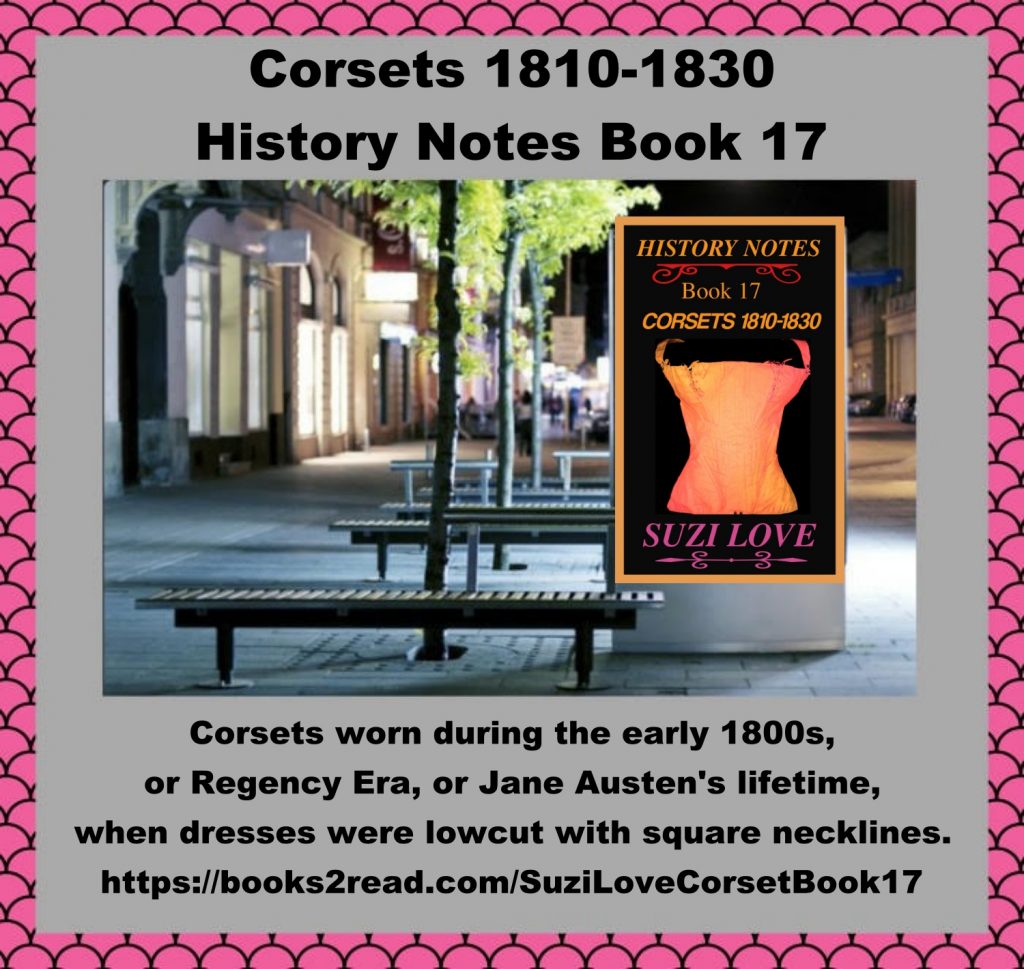
This book shows how corsets changed to fit well under clothing, give maximum support and comfort. Corsets pushed up breasts and showed off the bust line beneath a square-cut and low-cut neckline as in the early 1800s, or Regency years. Jane Austen and her female and friends wore these corsets. Corsets or stays worn during the early 1800s, or Jane Austen’s lifetime. https://books2read.com/SuziLoveCorsetBook17
The main purpose of corsets was to support and shape the breasts. Though they still slimmed the midriff, this was not the prime purpose of a corset between 1810 and 1830. The waistlines of dresses were lowering to below the bust line but nearer to the true waist, so corsets were longer and were given added shaping by stitching and cording and by shaping the breasts with pleated or gathered cups.
1817 June Morning Dress as worn in Bridgerton and Jane Austen’s times in England. A round dress composed of jaconet muslin; the bottom of the skirt is trimmed with an intermixture of tucks and embroidery. The body is perfectly novel, it is a three-quarter height, and displays the whole of the throat and a little of the neck: it is composed of the same material as the dress, and is formed to the shape, in a manner at once singular and becoming, by bands of letting-in lace; it is also profusely ornamented with lace, which is set on very full. Long full sleeve, the fullness confined by a tasteful cuff, which is finished by a lace ruffle. Head-dress the Marlborough cap, composed of white lace, ornamented with full-blown roses and blush colored satin ribbon. For the form of this elegant cap, which is perfectly in the English style, we refer our readers to our print. The hair is parted in front so as to display a little of the forehead, and curled lightly over the temples. Necklace and ear-rings white cornelian mixed with gold. White kid slippers and gloves. We are indebted to the elegant taste of Mrs. Marchant of 40, Gerrard-street, Soho, for both our dresses this month. Fashion Plate via Rudolph Ackermann’s ‘The Repository of Arts’.
Definition Morning or At-Home Dress: Loose and comfortable dress and soft lace cap to be worn at home for reading, painting, sewing or for walking in the garden. To be seen by family, servants and close friends. Not accessorized enough to be out in the wider public, although the pretty pink roses and trim on the cap suggest this outfit may have been worn for receiving visitors at home.
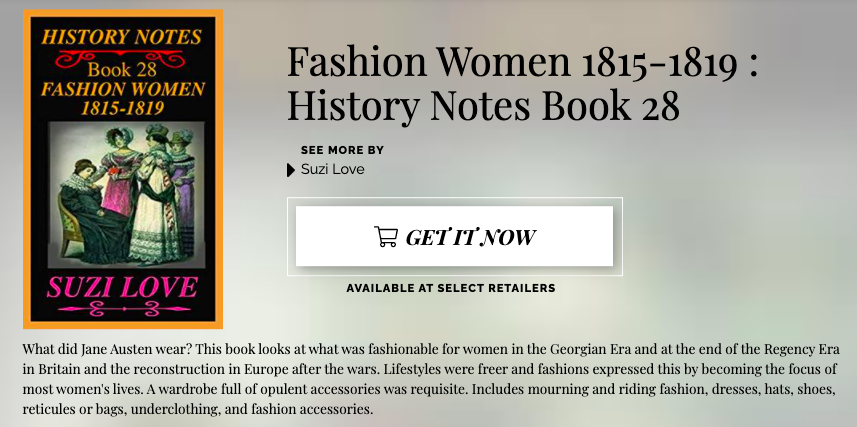
1817 February Pelisse, or Redingote, English. Carriage dress of white poplin with a deep blond flounce. Blue levantine pelisse or walking dress, or Redingote in France, edged with floss silk, blonde lace neck ruff, ermine ruff and a pink shawl. Fashion Plate via John Belle’s La Belle Assemblée or, Bell’s Court and Fashionable Magazine, London. Fashion Women 1815-1819 History Notes Book 28 What did Jane Austen wear? . D2D_HN_28_https://books2read.com/SuziLoveFashionWomen1815-1819
1814 Gentleman’s Morning Outfit, French. Green double-breasted cutaway tailcoat, cream trousers, high collared shirt, unusual black cravat, heeled black boots with small spurs, fob at his waist, black top hat with decoration. Fashion Plate via Journal des Dames et des Modes, or Costume Parisien.
1814 Gentleman’s Morning Outfit, French. Green double-breasted cutaway tailcoat, cream trousers, high collared shirt, unusual black cravat, heeled black boots, fob at his waist, black top hat with decoration. Fashion Plate via Journal des Dames et des Modes, or Costume Parisien.
What was fashionable outdoor wear for the Bridgerton ladis, Jane Austen, and their contemporaries? Reticules, Spencers, and Pelisses, or Walking Dresses, Or Redingotes. History Notes Books 3, 4, and 5 By Suzi Love.
What was fashionable for purses in past centuries? Call them what you like: purses, bags, handbags, reticules, ridicules, clutches, or pocket replacements. They all did the same job and they changed greatly with the prevailing fashions of time. books2read.com/suziloveReticules
What was fashionable in women’s jackets in the Regency Era? Call them what you like: Spencers, short jackets, or Regency jackets. They provided modesty and warmth and they changed greatly with the prevailing fashions of the time. Take a look at the jackets being worn by women in the early 1800s. books2read.com/suziloveSpencers
What sort of coats did women wear during the Regency years? them what you like: Coat, Pelisse, Redingote, Walking Dress, Promenade Dress. Take a look at what was being worn by women, men, and children. books2read.com/suzilovePelisse
HN_3-4-5_Fashion-accessories-reticules-spencers-redingotes.-regency-fashion-history-.-history-notes_books2read.comsuzilovespHN_4_Spencers, Or Jackets. #Regency #Georgian #Victorian #Fashion History Notes Book 4 By Suzi Love.
Lover of Bridgerton and Jane Austen fashions? What was fashionable for their outer wear? Different names in different countries: Pelisse, Redingote, Or Walking Dress. #Regency #Fashion #History http://books2read.com/suzilovePelisse
The Pelisse or Redingote was essentially a coat or robe like garment worn both indoors and out. Worn indoors open to reveal a dress, the outdoor version was made of heavier materials and of darker colors than the type worn indoors. The name comes from the term ‘riding coat.’ In the Georgian Era, Redingotes were worn by men, women and children when outdoors and especially as part of a riding costume by both sexes.
In England, the Pelisse was the main sort of fashionable outerwear, or coat, for women in the Regency Era, or Jane Austen’s times. Though this sort of coat was popular from the late 1700s until around 1850. In the early 1800s, this sort of Empire style coat reached the hip or knee but around 1810 the Pelisse lengthened to become a full length coat. Around 1812, the Pelisse often had a broad, cape-like collar with fur trim and thanks to the Napoleonic Wars and an avid interest in all things military, a Pelisse took on a military look with epaulettes and braiding very popular.
While the terms Redingote and Pelisse are often used interchangeably, Pelisse and Walking Dress and Carriage Costume were the names used in English Fashion Plates, whereas French Fashion Plates refer to the longer style of coats as a Redingote and the shorter shoulder capes worn by military men as a Pelisse.
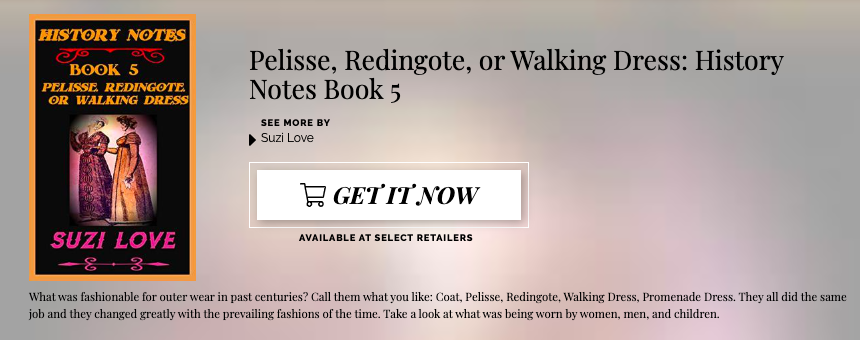
Pelisse, Redingote, Or Walking Dress. History Notes Book 5 By Suzi Love. What was fashionable for outer wear in past centuries? Call them what you like: Coat, Pelisse, Redingote, Walking Dress, Promenade Dress. Take a look at what was being worn by women, men, and children. books2read.com/suzilovePelisseD2D_RetailerBuyLink_HN_5_books2read.com/suzilovePelisse
1808 Richard Trevithick’s Steam Circus, Bloomsbury, London, U.K. Site where Trevithick ran his locomotive ‘Catch Me Who Can’. Trevithick wanted to prove that traveling by train was faster than on horseback. Locomotive ran at top speed of 19 km per hour and people paid a shilling to sit in an attached car and be pulled around. Via Wikimedia Commons commons.wikimedia.org (PD-ART) This was the start of the railway expansions across England in Jane Austen’s time.
1808 Richard Trevithick’s Steam Circus, Bloomsbury, London, U.K. Site where Trevithick ran his locomotive ‘Catch Me Who Can’. Trevithick wanted to prove that traveling by train was faster than on horseback. Locomotive ran at top speed of 19 km per hour and people paid a shilling to sit in an attached car and be pulled around. Via Wikimedia Commons commons.wikimedia.org (PD-ART)
D2D_RetailerBuyLink_HN_10.books2read.com/SuziLoveTravel