1810 Three Piece Gentleman’s Purple Court Suit, French. Worn by a rich and fashionable gentleman after Napoleon Bonaparte revived court traditions when he crowned himself Emperor of France in 1804. Gentlemen were expected to wear extravagant court dress, but the working class despised these luxurious fashions and royal overspending. Wastage of France’s money spurred French peasants to rise up in revolt and create the French Revolution. via Metropolitan Museum, N.Y.C., U.S.A.metmuseum.org
1810 Front Of Three Piece Court Suit, French. 1810 Back Of Gentleman’s Court Suit, French. 1810 Front and Back Of Gentleman’s Court Suit, French. 1810 Fabric Of Gentleman’s Court Suit, French. 1810 Gentleman’s Court Suit, French. 1810 Black and White View Of Gentleman’s Court Suit, French. https://books2read.com/SuziLoveFashionMen1800-1819
19th Century Early Women’s Cotton Caps. Worn as morning caps, night caps, or under other hats. With lappets, hanging ties, or tails, which were also called ‘follow me lads’, or ‘flirtation ribbons’. via Museum of Fine Arts, Boston, U.S.A. mfa.org. via Museum of Fine Arts, Boston, U.S.A. mfa.org
Definition Caps: Worn as morning caps, night caps, or under other hats. Jane Austen and her family and female friends would have worn caps like these, sometimes during the morning at home, to bed to keep their long hair from becoming knotted, or under a bonnet to hold a hairstyle in place. Caps sometimes had hanging ties, or tails, were also called ‘follow me lads’, or ‘flirtation ribbons’.
Definition Lappets: Two long strips of material, often lace, hanging from top of head down back or over shoulders. Sometimes extensions of a headdress and a requirement for court dress.
19th Century Early Women’s Cotton Caps. Worn as morning caps, night caps, or under other hats. Hanging ties, or tails, also called ‘follow me lads’, or ‘flirtation ribbon’s. via Museum of Fine Arts, Boston, U.S.A. mfa.org
1860 ca. Gilt Chatelaine With Etui. Hanging chatelaine with seven carbochons, gilt tools inside etui, or small container, of scissors, bodkin, knife, stiletto, pencil case, combination tweezers and ear spoon and ivory aid memoire, or notepad. via Needle’s Work Antiques. needleworkantiques.com
Definition Chatelaine: The word Chatelaine is French and means the keeper of the keys. Chatelaine” derives from the Latin word for castle. In Medieval times, the chatelaine was in charge of the day-to-day running of the castle. Women in charge of households dangled long chains from their waists to keep essentials within easy reach e.g. keys, notebook and pen, watch, sewing items, vinaigrette or perfume, or magnifying glass. Early chatelaine were simple essentials. Later chatelaine were decorative and expensive.books2read.com/SuziLoveChatelaines
D2D_RetailerBuyLink_HN_9. Chatelaines and Chains History Notes Book 9 By Suzi Love. #regency Women in charge of houses wore long chains holding important household items around their waist e.g. keys, pen, notebook, sewing. books2read.com/SuziLoveChatelaines
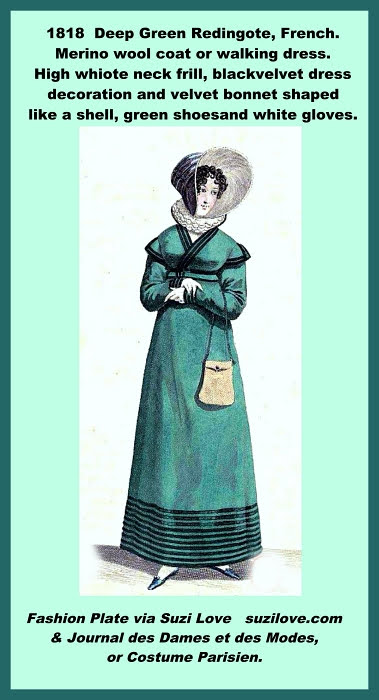
1818 Deep Green Redingote, French. Merino wool coat or walking dress. High white neck frill, black velvet dress decoration and velvet bonnet shaped like a shell, green shoes and white gloves. Fashion Plate via Journal des Dames et des Modes, or Costume Parisien. The type of outfit young Regency Era ladies, such as Jane Austen and her family and the Bridgerton women would have worn if they were out shopping on Bond Street, walking in a park, or taking a carriage ride through Hyde Park.
Definition Redingote Or Pelisse Or Walking Dress Or Coat: French word developed from English words, riding coat. Long fitted outdoor coat worn over other garments for warmth. Often left open at the front to show off the dress underneath. Sometimes cut away in front. Originally made with several capes and trimmed with large buttons. French fashion plates call these coats Redingotes and they are designed for women, men and children. English fashion plates call them a Pelisse, a walking dress, Promenade dress, or Carriage dress.
1816 August Back view of a lady in Evening Dress, English. White, high-waisted, dress with short bodice, long sleeves, frilled hem plus decoration above the frill, high plumed headdress, and reading music sheets. “A gown of white soft satin, cut low all round the back and bosom.The skirt gored, and a good deal of fullness thrown behind. The body, which is disposed in small plaits, displays the shape, as our readers perceive by print, to very great advantage; it is trimmed round bosom with a wreath of small white net roses, with a little tuft of pearl in the heart of each. Long loose sleeve, composed of white lace, and finished a la Parisienne with a rich double frill at the wrists.
The skirt is ornamented, in an exquisitely tasteful style, with a broad flounce of rich blond, surmounted by a wreath of roses and deep scallops of white net, the points of which are finished by bows of white satin ribbon. The effect of this trimming is uncommonly beautiful. Hair, cropped and curled full in the back of the neck, and dressed light, and much parted on the forehead: it is ornamented With a superb white ostrich-plume, at the base of which is an aigrette of diamonds. Neck-lace, ear. rings, and bracelets also of diamond. White satin slippers, and white kid gloves. We have to thank the condescension of a lady of much celebrity in the fashionable world, to whom we are indebted for a sight of the very elegant and tasteful dress from which our present print is designed.” Fashion Plate via Rudolph Ackermann’s ‘The Repository of Arts’.
Fashion Women 1815-1819 History Notes Book 28 https://books2read.com/SuziLoveFashionWomen1815-1819
1819 White Percale Dress, French. Deep hem of bubbly muslin, matching Percale Spencer or jacket, pink parasol and flowered straw hat. Spencer has short puffed sleeves over long straight sleeves and military style trimmings. Fashion Plate via Journal des Dames et des Modes, or Costume Parisien. Even though this a French fashion plate, this is typical of the outdoor outfit worn by Jane Austen and her contemporaries when going outside. An Empire style, or high-waisted white cotton dress worn under a Spencer, or jacket, for warmth and with a parasol to protect fair complexions from the sun.
Description Spencer: Short jackets worn for warmth over the high-waisted Empire style gowns that were popular after the French Revolution, where there was a shift away from opulence and decadence to simpler fashion. This jacket with very short bodice and long sleeves was known as a Spencer and was named after the male coat made famous by the Earl Spencer and said to have originated in accident to Lord Spencer in hunting when coat tails torn off and a cropped jacket was invented. The dresses in the early 1800s therefore became looser, lighter, and flowing and women became cold due to their very low cut and short bodices. Short fitted jackets that went easily over the dresses and provided extra modesty and some warmth. As Europe and many other parts of the world were deep in wars in the late 1700s and early 1800s, men in uniform were found everywhere. In support of these military men, fashions leaned towards military style shoulder paddings, shoulder embellishments, loops, buttons, and braids.
Definition Percale or Perkale: From the Persian word pargalah. Fine cotton fabric, or cambric muslin of good quality, originally from India, generally bleached, printed and finished without gloss. Contains more dressing than ordinary muslin, but without the glossy finish of cambric and is printed in fancy patterns on white and colored grounds. In May 1816, Percale was commented on in Rudolph Ackermann’ Repository Of Arts, “Perkale, as they call cambric muslin, is now almost the only thing worn in the morning costume: you must not, however, fancy that this proceeds from a wish to encourage English manufacture, but partly from a love for novelty, and partly because it is less expensive than cambric, and equally fashionable.”
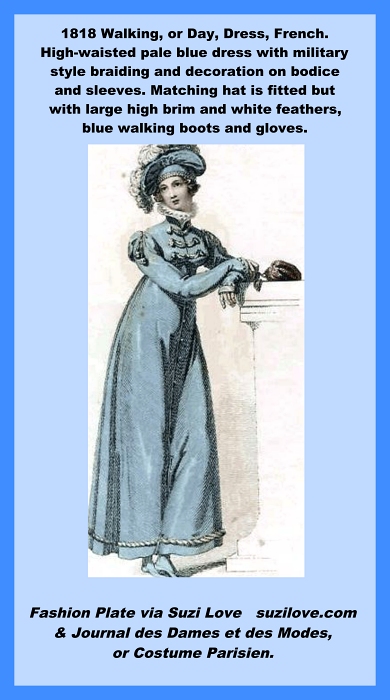
1818 Military style Redingote, or Coat,or Walking dress, French. High-waisted pale blue outdoors coat with military style braiding and decoration on bodice and sleeves. Matching hat is fitted to her head but with a large high brim and white feathers, or plume, blue walking boots and gloves. The type of outfit young Regency Era ladies would have worn if they were out shopping on Bond Street, walking in a park, or taking a carriage ride through Hyde Park. Fashion Plate via Journal des Dames et des Modes, or Costume Parisien. .
Definition Redingote Or Pelisse Or Walking Dress Or Coat: French word developed from English words, riding coat. Long fitted outdoor coat worn over other garments for warmth. Often left open at the front to show off the dress underneath. Sometimes cut away in front. Originally made with several capes and trimmed with large buttons. French fashion plates call these coats Redingotes and they are designed for women, men and children. English fashion plates call them a Pelisse, a walking dress, Promenade dress, or Carriage dress.
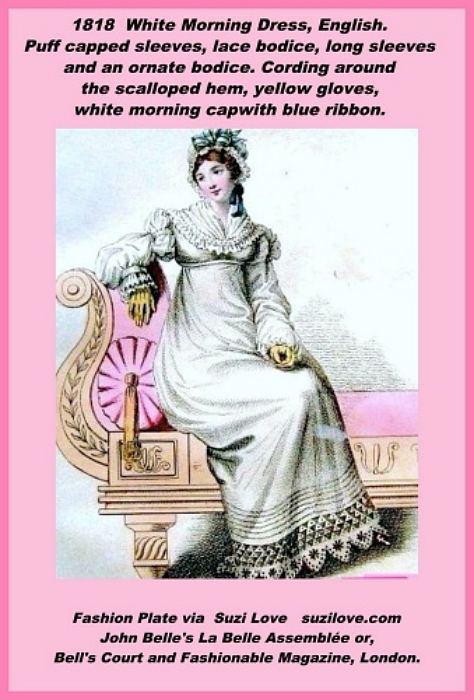
1818 Empire style, or high-waisted white morning dress, English. Puffed capped sleeves, lace shawl like neckline, ornate bodice cording around a scalloped hem, small white hat with blue flowers, and yellow gloves. Fashion Plate via John Belle’s ‘La Belle Assemblee’, London.
Definition Morning or At-Home Dress: Worn at home for reading, painting, sewing or for walking locally or while residing in the country. To be seen by family and close friends.
Definition Empire Style Dress: High-waisted white gown defined women’s fashion during the Regency Era. ‘Empire’ is the name given to the period when Napoleon Bonaparte built his French Empire. High-waisted, loose gowns were adopted by the aristocracy as a symbol of turning away from the fussy, elaborate and expensive clothing worn in the 1700s.
Definition Morning Cap Or Cornette: Muslin or other lightweight material, worn to cover hair during at-home pursuits such as reading, playing music, or sketching, tied under chin and sometimes worn under a bonnet.
1800-1805 ca. Pink Silk Bonnet, French. Similar to hats worn in England by Jane Austen and friends. Silk net, silk satin ribbon, and silk flowers. via Museum of Fine Arts, Boston, U.S.A. mfa.org
1809 June Evening Full Dress, English. Lemon dress with white underskirt, short sleeves, braid decorated bodice, zig-zag hem, long white gloves, plumed headdress, full Parure of necklace, bracelet and earrings, evening slippers and a fan. Fashion Plate via John Belle’s La Belle Assemblée or, Bell’s Court and Fashionable Magazine, London.
Definition Full Evening Dress – Ball, dinner, evening and opera gowns but with every possible accessory added to make the most impressive display possible, such as adding a Grand Parure, or full jewelry set and including headpieces as with the feathered headdress above.
Fashion Women 1805-1809 History Notes Book 26 What did Jane Austen and friends wear? https://books2read.com/SuziLoveFashionWomen1805-1809