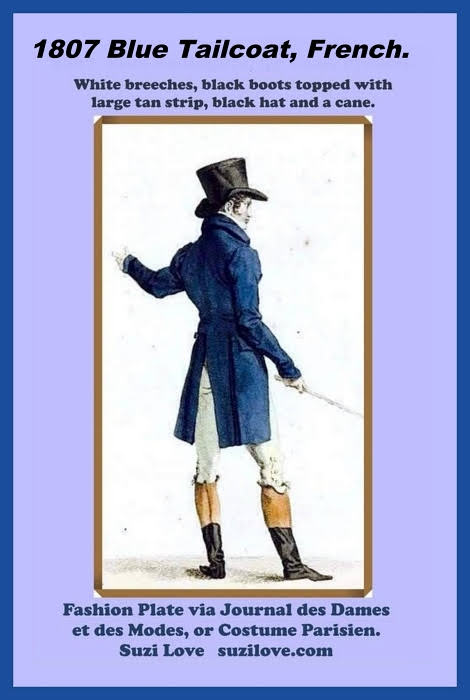
1807 Gentleman’s Blue Tailcoat, French. White breeches, black boots topped with large tan strip, black hat and a cane. Plate via Journal des Dames et des Modes, or Costume Parisien.
French fashions and Georgian and Regency Era fashions from Great Britain were copied around the world. This is what men wore in the times of Jane Austen for city and country life.
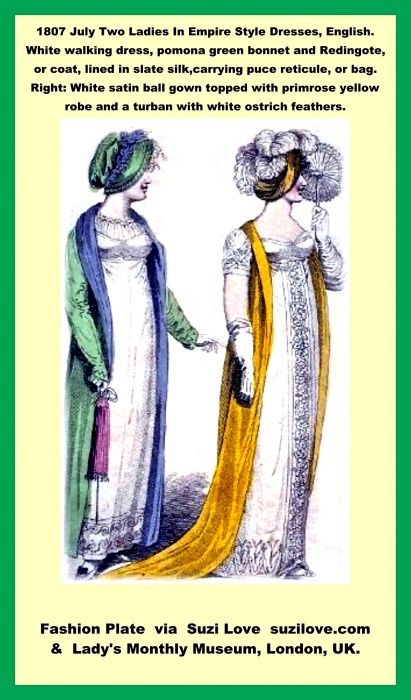
1807 July Two Ladies In Empire Style Dresses, English. White walking dress, Pomona green bonnet and Redingote, or coat, lined in slate silk, carrying puce reticule, or bag. Right: White satin ball gown topped with primrose yellow robe and a turban with white ostrich feathers. Fashion Plate via Lady’s Monthly Museum, London, UK.
Gorgeous Regency Era clothing came in a wide range of styles to suit every season and occasion. Ladies in Jane Austen’s times wore Empire style dresses which were usually of light fabric and floaty in style so accessories were essential to keep women warm.
Definition Reticule Or Ridicule Or Bag or Purse: Often with a drawstring to pull closed and usually made of cloth or covered cardboard and often decorated with beading or embroidery. A reticule, or purse, or handbag, was usually carried by a woman during the Regency period to carry all their daily necessities. Earlier, women used pockets that tied at the waistline and were hidden in the folds of their skirts. Empire style, or early 1800s, high-waisted dresses made it impossible to either sewn in a pocket or to tie on a pocket. So women began carrying small, decorated bags called Reticules, or ridicules, which generally pulled close at the top with a drawstring.
Definition Aigret, aigrette, egret: Plume of feathers or jeweled ornament in shape of feathers worn on head or hats. During the early 19th century., or Jane Austen’s lifetime, the favorite feathers were osprey and heron.
Redingote, or Pelisse, or Walking Dress, or Promenade Dress: Going by many names, this is a coat copied from men’s overcoats but worn by both men and women. Generally, opens down the front, worn for warmth over a dress or coat and breeches, and has a military look with front vertical buttoning or decoration.
1815 Long Blue Overcoat with brown fur trim, white trousers, scarf, top hat and a cane. Fashion Plate via Journal des Dames et des Modes, or Costume Parisien. I can picture Jane Austen’s male friends and family and the Bridgerton men wearing this gorgeous coat when out walking or driving in the park.
1815 Long Blue Overcoat with brown fur trim, white trousers, scarf, top hat and a cane. Fashion Plate via Journal des Dames et des Modes, or Costume Parisien. https://books2read.com/SuziLoveFashionMen1800-1819
1815 June 15th ‘Behold at Brook’s Club, London. By George Cruikshank. Sir Thomas Stepney standing under the porch of Brooks’s Club in St. James’s Street, London. Double door with glass panels is behind him. Right hand in his breeches pocket, round hat with low crown, double-breasted tail-coat, double-breasted waistcoat, small stock, knee-breeches, and striped stockings with pumps. Via British Museum, London, UK. britishmuseum.org (PD-Art)
Caricatures were pasted to the windows of newspapers and shops in the Era of Jane Austen and the Bridgertons.
1800s Early Women’s Half Boots, British, as worn by Jane Austen and her family and the Bridgerton ladies. Walking was encouraged for women so lace-up half-boots became a popular replacement for flimsy slippers for outdoor wear. Made of nankeen, a durable, yellow-colored, natural cotton from China or from colored leather. via Victoria and Albert Museum, London, UK. collections.vam.ac.uk
In Bridgerton and Jane Austen years, people were encouraged to partake in outdoor pursuits to maintain good health so walking became a daily pastime. Fragile slippers were worn for balls and evening events but for walking sturdier shoes were needed, In the early 1800s, these were typically made of leather, had a very small heel, slightly rounded toes and were laced up on the top.
1820 ca. Groups of Dandies fashionably dressed. Hand Colored etching. Published By J. Le Petit, Dublin, U.K. Via British Museum, London, UK. britishmuseum.org (PD-Art)
A dandy is a man who places a lot of importance on his appearance, on having refined language living his life in a leisurely manner. A dandy didn’t have to be an aristocrat. He could also be a middle class man or a self-made man of wealth who could afford to place all his emphasis on his clothing and his leisure time.
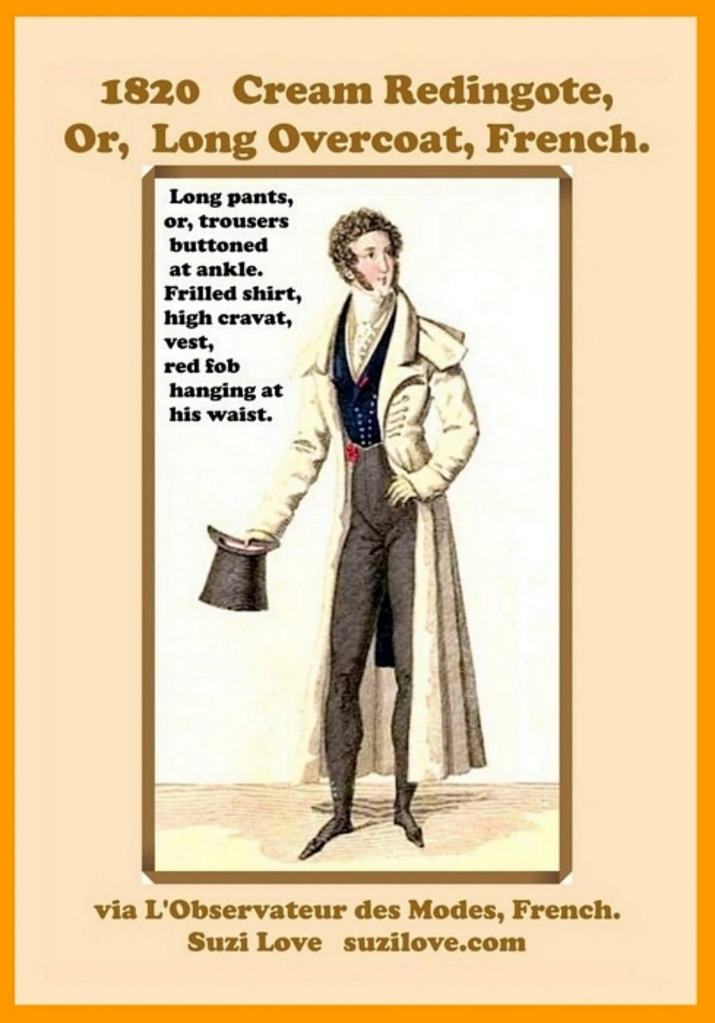
1820 Gentleman’s Cream Redingote, Or Long Overcoat, French. Long pants, or trousers, buttoned at the ankles, frilled shirt, high cravat, vest, red fob hanging at his waist. via L’Observateur des Modes, French.
1811 Walking Dress, French. High-waisted lavender Redingote over a white dress, paisley shawl, white gloves, slippers, and a ruched, or gathered fabric, hat to match the high ruched neck frill. Fashion Plate via Journal des Dames et des Modes, or Costume Parisien.
1810-1829 ca. Green Silk Street Shoes, Probably British. As Worn by Jane Austen and her contemporaries and the Bridgerton family. Heavier sole than ordinary day shoes, although the silk fabric meant they were only worn for easy promenades. Rounded toe means prior to 1830, when toes became square. Strong colors in shoes complimented fashionable colorful garments of the time. via Metropolitan Museum, NYC, U.S.A. metmuseum.org
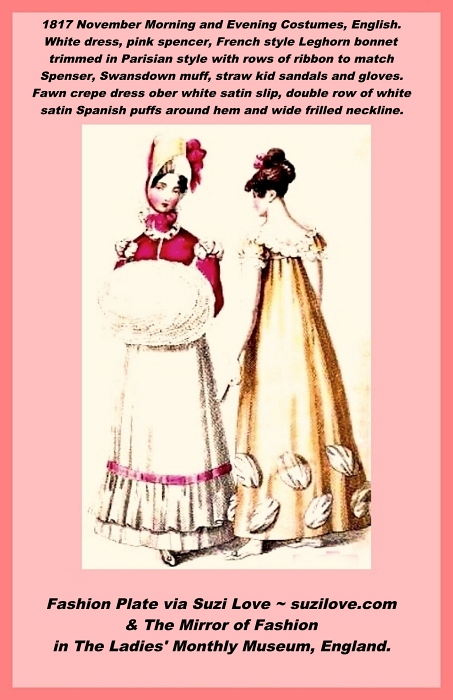
1817 November Morning Dress and Evening Dress, English. Morning Dress is a round dress of Jaconot muslin with back buttons, small collar open in front to display the throat, lower part of front with bias tucks, moderately full skirt finished around bottom with small tucks and deep flounce with bright rose ribbon. Rose velvet Spenser trimmed with white satin and rose silk, finished at throat with white satin puffings. Plain long sleeves, French style Leghorn bonnet trimmed with large rows of ribbon to match Spenser and tied under the chin, stand-up lace frill around throat, swansdown muff, straw kid sandals and gloves.
Evening dress of fawn crepe over a white satin slip, cut low around the bust, confined to waist by a narrow cestus of white satin, fastened in front by a brilliant clasp. Single fall of Mecklin lace on dress, very short full sleeve finished at bottom by a rouleau of white satin and narrow lace plait. Skirt trimmed with double row of white satin Spanish puffs, very full and in bias. Hair high, parted and curled on the forehead with garland of Provence roses. Pearl earrings and necklace, spangled crape fan, white kid gloves and white satin slippers. Fashion Plate via The Mirror of Fashion in The Ladies’ Monthly Museum, England.
Fashion Women 1815-1819 History Notes Book 28 https://books2read.com/SuziLoveFashionWomen1815-1819