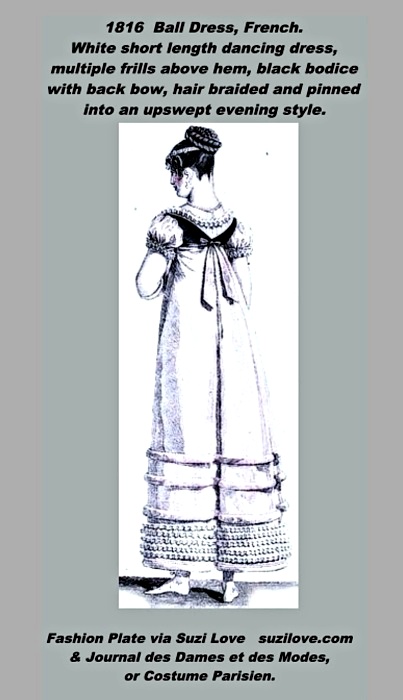
1816 Ball Dress, French, as worn by the Bridgertons and Jane Austen. White short length dancing dress, multiple frills above hem, black bodice with a back bow, hair braided and pinned into an upswept evening style. Fashion Plate via Journal des Dames et des Modes, or Costume Parisien.
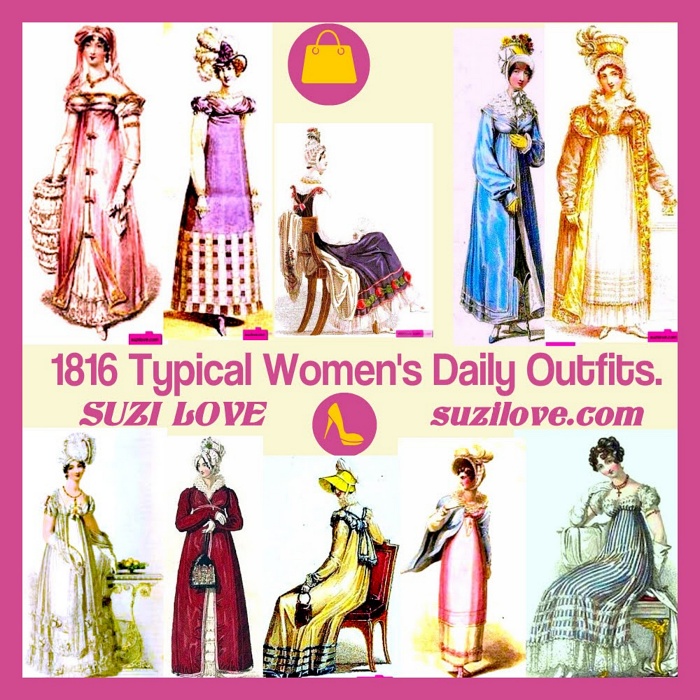
Women’s clothing came in the late 1810s came in a wide range of styles to suit every season and occasion. When attending assemblies or balls, ladies in Jane Austen’s times women wore Empire style dresses which were usually of light fabric and floaty in style and often of a shorter length suitable for dancing.
1819 Pale Blue Redingote, Pelisse or Walking Dress, French. Blue redingote with pink bow showing off gorgeous neck frills and bonnet of castor decorated with tassels. The type of outfit young Regency Era ladies would have worn if they were out shopping on Bond Street, walking in a park, or taking a carriage ride through Hyde Park. Fashion Plate via Journal des Dames et des Modes, or Costume Parisien.
Definition Redingote Or Pelisse Or Walking Dress Or Coat: French word developed from English words, riding coat. Long fitted outdoor coat worn over other garments for warmth. Often left open at the front to show off the dress underneath. Sometimes cut away in front. Originally made with several capes and trimmed with large buttons. French fashion plates call these coats Redingotes and they are designed for women, men and children. English fashion plates call them a Pelisse, a walking dress, Promenade dress, or Carriage dress.
1807 White High-Waisted Dress, French. Black zig-zag edging and decoration, lemon draping shawl, long gloves, orange Fichu, yellow slippers, pink bonnet. Fashion Plate via Journal des Dames et des Modes, or Costume Parisien.
Definition Empire Style Dress: High-waisted white gown defined women’s fashion during the Regency Era. ‘Empire’ is the name given to the period when Napoleon Bonaparte built his French Empire. High-waisted, loose gowns were adopted by the aristocracy as a symbol of turning away from the fussy, elaborate and expensive clothing worn in the 1700s.
1807 White High-Waisted Dress in Jane Austen Style With Black Zig-Zag Edging. #RegencyFashion #JaneAusten #HistoricalFashionhttps://books2read.com/SuziLoveFashionWomen1805-1809
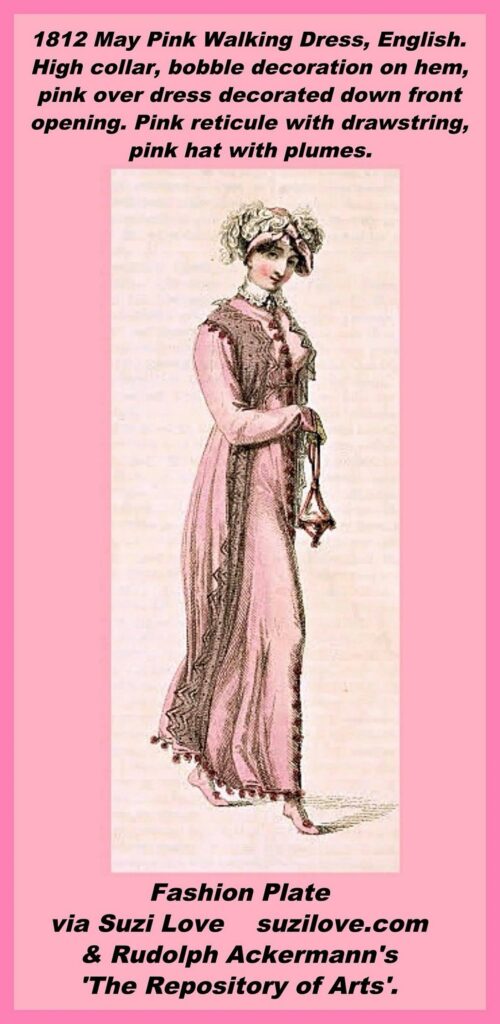
1812 May Pink Walking Dress, English. Coat is called a ‘Spencer Robe’ in the description and the fabric is sarcenet in blossom color. High collar, bobble decoration on the hem, pink sleeveless pelisse dress trimmed with a tufted Chinese silk fringe. The deep vandyke black lace is a loose Polonaise style that sits over the collar of the white muslin dress. The provincial muslin bonnet has two curled white ostrich feathers on the front. Half-boots are of pink kid, gloves are lemon or pale tan kid, and pink reticule, or ridicule or bag, has a drawstring. Fashion Plate via Rudolph Ackermann’s ‘The Repository of Arts’.
Definition Pelisse, Redingote, Or Walking Dress: Jane Austen and her contemporaries wore long coats like these to keep warm when out and about, visiting, shopping etc. The thin muslin dresses worn in the early 1800s were little protection against European winters.
Definition Reticule Or Ridicule Or Bag Or Purse: Because reticules were so popular, Jane Austen and her family and friends would have made reticules for each other for gifts and carried these small purses with them whenever they went out.
Definition Aigret, Aigrette, Egret: Plume of feathers or jeweled ornament in shape of feathers worn on head or hats. During the early 19th century., or Jane Austen’s lifetime, the favorite feathers were osprey and heron.
1812 May Pink Walking Dress With Coat in Jane Austen Style. #JaneAusten #RegencyFashion #HistoricalFashion https://books2read.com/SuziLoveFashion1810-1814
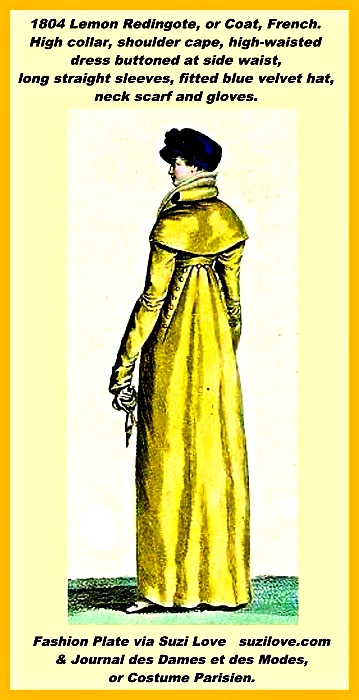
1804 Lemon Redingote, or Coat, French. High collar, wide shawl collar or shoulder cape, high-waisted dress buttoned at side waist, long straight sleeves, fitted blue velvet hat, neck scarf and gloves. Fashion Plate via Journal des Dames et des Modes, or Costume Parisien.
Definition Redingote Or Pelisse Or Walking Dress Or Coat: French word developed from English words, riding coat. Long fitted outdoor coat worn over other garments for warmth. Originally made with several capes and trimmed with large buttons. For women, the coat was often cut away in the front or left open to show off the dress underneath. French fashion plates call these coats Redingotes and they were worn by men, women, and children. English fashion plates call the coats a Pelisse, a walking dress, Promenade dress, or Carriage dress.
Definition Shawl Collar: Wide turned down collar used on both women’s and men’s coats.
1804 Lemon Redingote, Or Coat, Or Pelisse, With Shoulder Cape, French. #RegencyFashion #JaneAusten #HistoricalFashion https://books2read.com/SuziLoveFashionWomen1801-1804
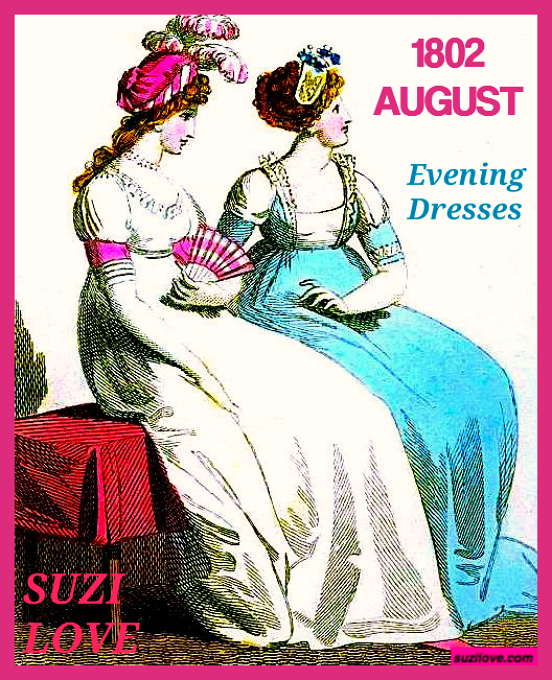
1802 August. Two Ladies in Evening Dresses in the high-waisted, or Empire line, styles worn By Jane Austen. White dress with pink trim, pink fan, and pink plumed headdress. Aqua blue dress with white bodice and a blue trimmed evening headdress.
The Empire dress which evolved in the late 1790s began as a chemise shift gathered under the breasts and at the neck. Named after the First Empire in France, by 1800 Empire dresses had a very low décolleté, or neckline and a short narrow backed bodice attached to a separate skirt. Skirts started directly under the bust and flowed into the classical relaxed wide styles of Greece and Rome.
Definition Aigret, aigrette, egret: Plume of feathers or jeweled ornament in shape of feathers worn on head or hats. During the early 19th century, or Jane Austen’s lifetime, or during the years of the Bridgerton series, the favorite feathers were osprey and heron.
1802 August. Two Ladies in Evening Dresses In the Styles Worn By Jane Austen. #RegencyFashion #HistoricalFashion #JaneAusten https://books2read.com/SuziLoveFashionWomen1801-1804
1821 December Green Promenade Dress, English. High waisted coat over white dress with ruffled collar, vertical front bows, short puffed sleeves over long straight sleeves, matching ruffled bonnet and yellow gloves. Fashion Plate via Rudolph Ackermann’s ‘The Repository of Arts’, London, U.K.
1800s Early Typical Regency Gentleman Riding His Horse. Fashions In The Time Of Jane Austen.
From the finish of the 18th century until 1820, men’s fashions in European and European-influenced countries moved away from the formal wear of brocades, lace, wigs and powder to more informal and relaxed styles. Focus was on undress rather than formal dress. Typical menswear in the early 1800s included a tailcoat, a vest or waistcoat, either breeches, pants, or the newer trousers, stockings, shoes or boots, all worn with an overcoat and hat. This basic ensemble was accessorized with some form of neckcloth or cravat, gloves, walking stick, cane or riding crop, handkerchief, fobs, watch and perhaps a quizzing glass or eye glass.
1800s Early A Gentleman Riding His Horse.
In 1806, the Journal des Dames et des Modes stated, ‘The informal outfit for a young man includes a coat of similar style, snug pantaloons which are probably knitted, and a striped waistcoat.’
Skirted coats were replaced with short-fronted, or cutaway, tailcoats worn over fitted waistcoats and plain, white linen shirts. Knee breeches were gradually replaced by tight-fitting pantaloons and later trousers, decorative shoes with buckles were replaced with a variety of boot styles, and fussy and ruffled neckwear gave way to intricately tied, white linen neck cloths. A Regency Era, or early 1800s, gentleman was outfitted in more practical fabrics, such as wool, cotton and buckskin rather than the fussy brocades and silks of the late 1700s.
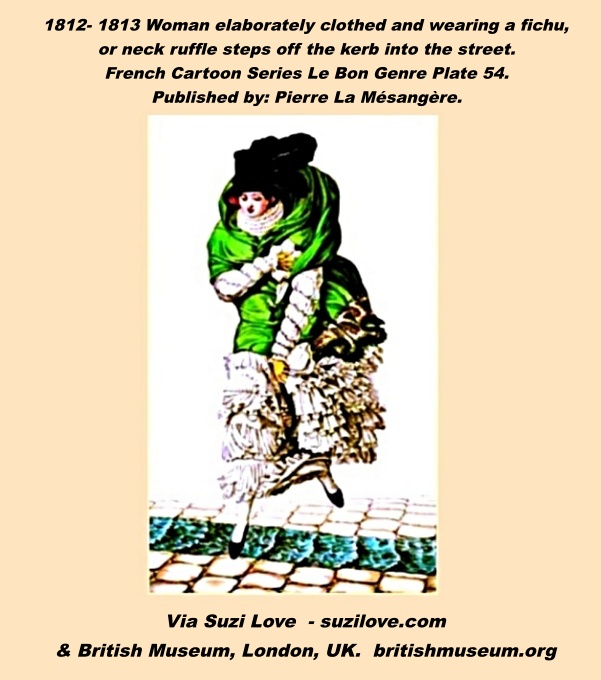
1812 -1813 Woman elaborately clothed and wearing a fichu, or neck ruffle, steps off the kerb into the street. She holds up her dress before stepping over the dirty Parisian gutter. French Cartoon Series Le Bon Genre Plate 54. Published by: Pierre La Mésangère. https://books2read.com/SuziLoveFashion1810-1814
Le Bon Genre, or Good Taste, series pokes fun at the absurdities of the fashion styles adopted by high society.
Plate 54: Manches en Spirale. Profusion de Garnitures. Mouchoir servant de porte-clef.
Manches en Spirale: Spiral Sleeves. Spiraling or puffy sleeves of the late Empire period looked like three-scoop ice cream cones.
Profusion de Garnitures: Profusion of Trimmings.
Ridicules the excessive use of ruffles, bows, and lace on a garment.
Mouchoir servant de porte-Clef: Handkerchief used as a Keyring. Women made a fashion statement by carrying richly decorated handkerchiefs that doubled as makeshift keyrings.
Definition Fichu: Triangular piece of lace, muslin, or other cloth worn about the neck and cleavage to fill in a low bodice or neckline and preserve a lady’s modesty. From the French ‘thrown over’.
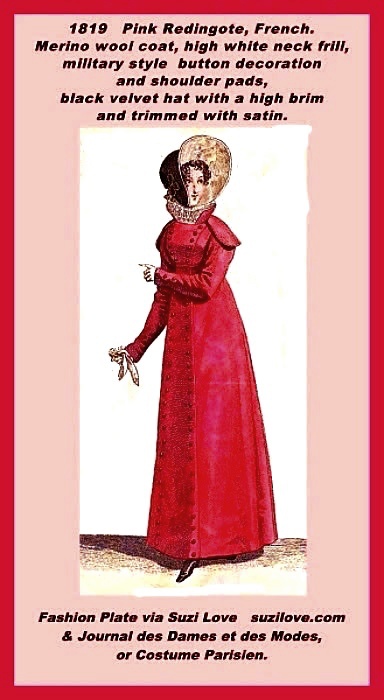
1819 Pink Merino Wool Redingote, French. Merino wool coat over a white dress with a high lace collar, military style buttons decoration and shoulder pads, matched with a black velour, or velvet, hat with a high front brim and lined with white satin. Military style shoulder pads and front buttons. It was fashionable at the time to wear military inspired clothing to show support of all the fighting men involved in the Napoleonic and other wars. The type of outfit young Regency Era ladies would have worn if they were out shopping on Bond Street, walking in a park, or taking a carriage ride through Hyde Park. Fashion Plate via Journal des Dames et des Modes, or Costume Parisien. Fashion Plate via Journal des Dames et des Modes, or Costume Parisien.
Definition Redingote Or Pelisse Or Walking Dress Or Coat: French word developed from English words, riding coat. Long fitted outdoor coat worn over other garments, especially light-weight muslin dresses, for warmth. Often left open at the front to show off the dress underneath. Sometimes cut away in front. Originally made with several capes and trimmed with large buttons. French fashion plates call these coats Redingotes and they are designed for women, men and children. English fashion plates call them a Pelisse, a walking dress, Promenade dress, or Carriage dress.
1819 January Red Redingote, French. Also called a Pelisse or Walking Dress in England. Merino wool coat over a white dress with a high lace collar, matched with a black velour, or velvet, hat lined with white satin. Fashion Plate via suzilove.com and Journal des Dames et des Modes, or Costume Parisien.
1819 Bridgerton or Jane Austen Style Pink Merino Wool Redingote, Or Coat, With Military Styling. #Bridgerton #JaneAusten #RegencyFashion #FashionPlate #French https://books2read.com/SuziLoveFashionWomen1815-1819