1816 June Bridal Dress, English A frock of striped French gauze over a white satin slip: the bottom of the frock is superbly trimmed with a deep flounce of Brussels lace, which is surmounted by a single tuck of byas white satin and a wreath of roses; above the wreath are two tucks of byas white satin. We refer our readers to our print for the form of the body and sleeve: it is singularly novel and tasteful, but we are forbidden either to describe it, or to mention the materials of which it is composed. The hair is dressed low at the side, and parted so as to entirely display the forehead: it is ornamented with an elegant aigrette of pearls in front, and a spring of French roses placed nearly at the back of the head. Necklace, ear-rings, and bracelets of pearl. White kid gloves, and white satin slippers. Fashion Plate via Rudolph Ackermann’s ‘The Repository of Arts’.
1810 White Promenade Half Dress, English, In Jane Austen Style. Draped yellow shawl and yellow parasol and a fitted hat with a long lace veil. A muslin dress with long sleeves and low neck, a French scarf of yellow silk, yellow silk bonnet with lace veil, yellow Parasol with a white fringe, gloves and shoes of yellow kid. Fashion plate via John Belle’s ‘La Belle Assemblee’, England. Typical of the outdoor outfit worn by Jane Austen and her contemporaries. An Empire style, or high-waisted white dress worn with a gorgeous yellow scarf and matching yellow fringed parasol.
Dress – Half Dress: Between undress and full dress, half dress is a respectable outfit but without an excess of formal accessories. Can be worn either during the day or evening.
Here is an example of when English magazines copied French fashion plates.
1815 December Left: French fashion plate Ensembles French and English via Journal des Dames et des Modes. White short length ball dress with tiny bodice.
Right: English fashion plate by Rudolph Ackermann in the Repository Of arts. Blue sarsnet Pelisse, or Walking dress, or Redingote. Decorated with white lace trim on neck, vertical front, and hem. Carrying red shawl and with high plumed bonnet.
1815 December Blue Walking Dress, English. Blue twilled sarsnet pelisse, or Redingote, with ribbon bows adorning the front. Decorated with white lace trim on neck, vertical front, and a border of leaves on the hem. Slashed sleeves at shoulders and wrists plus an elaborate collar would have been time consuming to make. Carrying a red shawl and with a high bonnet with a white plume, or feather. Fashion Plate via Rudolph Ackermann’s ‘The Repository of Arts’.
1815 December Blue Walking Dress, English. Decorated with white lace trim on neck, vertical front, and hem. Carrying red shawl and with high plumed bonnet. Fashion Plate via Rudolph Ackermann’s ‘The Repository of Arts’.
Below is the French version of this pelisse but with a lady in a ball dress. Possibly another example of the English magazines ‘copying’ French designs.
1815 Ensembles French and English. White short length ball dress with tiny bodice and sleeves. Blue sarsnet Redingote, or pelisse, decorated with white lace trim and border of leaves, slashed sleeves at shoulders and wrists, elaborate collar, red shawl, high bonnet with white plume, or feather. Fashion Plate via Journal des Dames et des Modes, or Costume Parisien.
1807 January Couple In Morning Walking Ensembles, English. Lady in white dress with lemon pelisse or coat, fitted hat and interesting reticule, or bag. Gentleman in long black tailcoat over yellow breeches, high black boots with wide tan tops, yellow gloves, cane and top hat. via Le Beau Monde, or Literary and Fashionable Magazine, London, U.K.
These are the types of outfits worn by Jane Austen and contemporaries in England and shown in their English magazines.The same designs had probably already been seen in France, because English publishers obsessively copied French fashions despite the two countries being at war for many years. https://books2read.com/SuziLoveFashionWomen1805-1809
1809 May Walking Dress, English. Dress of white Scotia washing silk. Bishop’s mantle of sage or olive green striped and plain silks, made entirely without seams, border of the same color. Spanish hat to match the mantle turned up in front and decorated with artificial flowers. Shoes of sage or olive green match. Design by Mrs. James, New Bridge Street, Blackfriars. Fashion Plate via Rudolph Ackermann’s ‘The Repository’ of Arts.
General Observations for 1809 fashions from The Repository Of Arts: Spanish hats with feathers were worn all winter but are now worn as walking hats and the feathers have been replaced with flowers. Light silk mantles of all colors are being much worn. Scotia silk is now in great request for dresses and colors vary according to individual taste but silver-grey is the most elegant and fashionable. The attempt to introduce long waists failed. Full dress is the present standard.
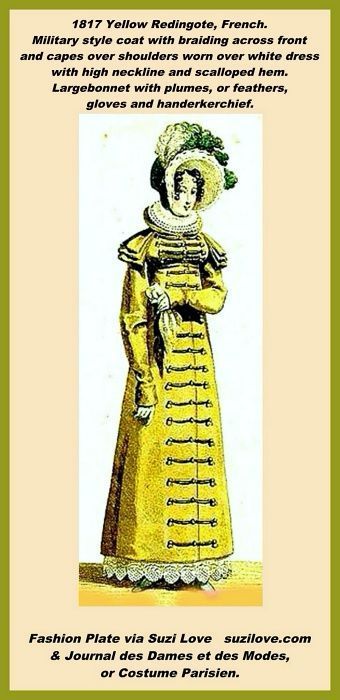
1817 Yellow Redingote, or Pelisse, or Walking Dress, French. Yellow military style pelisse with braiding across the front and capes across the shoulders and worn over a white dress with a high neckline and a scalloped hem. Large and high bonnet with plume, or feathers, and green flowers, gloves and a handkerchief. Although this is a French fashion plate, similar styles were worn everywhere and Jane Austen would have worn a Pelisse like this before her death on the 18th July, 1817. Fashion Plate via Journal des Dames et des Modes, or Costume Parisien.
The ongoing years of wars followed by the victories of Wellington’s armies brought the military into fashion in England and there was a rush of fashion articles named after him e.g. Wellington hat, Wellington bonnet, Wellington jacket and Wellington Boot. In other European countries, military headwear was copied from military helmets and hats and frogging and epaulettes added a further patriotic touch to women’s clothing. And as always, fashions were copied and spread around the world, despite the battles being fought.
Definition Redingote Or Coat Or Pelisse: Long fitted outdoor coat worn over other garments for warmth. French word developed from English words, riding coat. French fashion plates call these coats a Redingote and English plates call them a Pelisse, Or Walking Dress, or Carriage Costume.
1817 October. White Promenade Dress, English. High dress of jaconet muslin richly embroidered around the hem, body composed entirely of work, Long sleeve, finished down the arm in front by bouillons of lace. Charlotte Spencer of blue satin, tight fitting and short waist, wide sleeve ornamented at wrist and shoulder, elegant trimming and disposed in so tasteful manner to give the appearance of perfect novelty. Bonnet, a la Ninon, of the same material, cut in small squares, edged with white satin, turned over at the ends, very large front displays the front hair which is braided across the forehead, edged with puffed gauze, disposed in points, and confined by a narrow fold of white satin, sprig of acacia on left side and finished by white satin strings. French ruff and ruffles of rich lace. Blue or white kid shoes and gloves.
We have again to acknowledge our obligations to Miss M’Donald of 29, Great Russel Street, Bedford Square, for our dresses this month. Fashion Plate via Rudolph Ackermann’s ‘The Repository of Arts’.
1801 Young Man’s Daily Outfit, French. Blue cutaway coat with extra high collar, brown knee breeches, chin high white cravat, an all-over curly hairstyle and a round-hat with a wide brim and a low crown which is flat on the top. The hats only decoration is a narrow ribbon and buckle. Fashion Plate via Journal des Dames et des Modes, or Costume Parisien. https://books2read.com/SuziLoveFashionMen1800-1819
I love when the same fashion plate is repeated with two ladies or a lady and a gentleman. 1808 Ladies In High Waisted Dresses, French. Green dress with short sleeves, white frill back bow and white lace headdress. White dress with short puffed sleeves, paisley shawl and red coral necklace. Fashion Plate via Journal des Dames et des Modes, or Costume Parisien. https://books2read.com/SuziLoveFashionWomen1805-1809. Gorgeous Regency Era clothing came in a wide range of styles to suit every season and occasion. Ladies in Jane Austen’s times wore Empire style dresses which were usually of light fabric and floaty in style so accessories were essential to keep women warm.
What was fashionable for outer wear in past centuries? Different names in different countries: Pelisse, Redingote, Coat, Or Walking Dress. The Bridgertons and Jane Austen and her contemporaries wore long coats like these to keep warm when out and about, visiting, shopping etc. The thin muslin dresses worn in the early 1800s were little protection against European winters. http://books2read.com/suzilovePelisse