19th Century Early Jane Austen and Bridgerton Style Gold Silk Spencer With Puffed Shoulder. With V-shaped rouleaux trim to the bodice and puffed shoulder detail. via Christie’s Auction Rooms. christies.com



19th Century Early Jane Austen and Bridgerton Style Gold Silk Spencer With Puffed Shoulder. With V-shaped rouleaux trim to the bodice and puffed shoulder detail. via Christie’s Auction Rooms. christies.com
1817 White Percale Dress, French. Dress has layers of decoration above hem, black velvet Spencer, or jacket, wide brimmed straw hat trimmed in blue, neck scarf and walking shoes. Fashion Plate via Journal des Dames et des Modes, or Costume Parisien.
Definition Spencers: Short jackets worn for warmth over the high-waisted Empire style gowns said to have originated when Earl Spencer tore the tails off his coat in a hunting accident. In support of military men fighting wars everywhere, fashions for Spencers leaned towards military style embellishments, such as loops, buttons, and braids. Puffed sleeves over long straight sleeves were also very popular. Jane Austen and her friends and family wore Spencers over their high-waisted dresses.
Definition Empire Style Dress: Named after the First Empire in France. Empire dresses had a low neckline and skirts started directly under the bust and flowed into the classical relaxed wide styles of Greece and Rome. This style of dress is associated with Jane Austen and her contemporaries as a high-waisted dress was worn most days. Cotton, silk or taffeta were the popular fabrics. Only the very wealthy could afford white dress in this style as the cottons were imported from India and had to be carefully cleaned, usually by a lady’s maid.


1820 August Walking and Evening Dresses, English. Walking Dress of cambric muslin with frilled hemline. Blue-purple Spencer with epaulettes of points of satin. Bonnet to match of metallic gauze and tied under her chin, yellow Limeric gloves, reticule or bag, and blue boots. Evening Dress of Urling’s lace with aqua blue leaf decoration, earl combs, pearl necklace and ear-rings, gold chain or chatelaine with a watch, white kid gloves and white silk shoes. Via Ladies’ Monthly Museum in The Mirror of Fashion, London, U.K.
Definition Limerick Gloves: Named after County Limerick in Ireland where they were first made. Often referred to as chicken skin gloves, though actually made from skins of unborn calves. Usually cream or yellow, superior quality and very thin.
Definition Ridicule, Reticule, Indispensable, or Handbag: From the late 1700s, pockets could no longer be sewn into gowns, as skirts fell from just under the bust and were full and flowing. Instead, women began carrying small bags, known at first as ridicules and later as reticules, to keep necessary items on their person e.g. handkerchiefs, coins, vinaigrettes, calling cards, glasses etc.
Definition Spencer: Short jackets cut to match the high waistlines of Empire dresses. They often copied military styling, such as braiding, shoulder decoration, buttons and loop fasteners, and wrist adornments. They were generally of complex construction, often with a diamond shaped piece in the back. Said to have originated in an accident to Lord Spencer while hunting when his coat tails were torn off and he wore it as a short jacket.


1817 October. White Promenade Dress, English. High dress of jaconet muslin richly embroidered around the hem, body composed entirely of work, Long sleeve, finished down the arm in front by bouillons of lace. Charlotte Spencer of blue satin, tight fitting and short waist, wide sleeve ornamented at wrist and shoulder, elegant trimming and disposed in so tasteful manner to give the appearance of perfect novelty. Bonnet, a la Ninon, of the same material, cut in small squares, edged with white satin, turned over at the ends, very large front displays the front hair which is braided across the forehead, edged with puffed gauze, disposed in points, and confined by a narrow fold of white satin, sprig of acacia on left side and finished by white satin strings. French ruff and ruffles of rich lace. Blue or white kid shoes and gloves.
We have again to acknowledge our obligations to Miss M’Donald of 29, Great Russel Street, Bedford Square, for our dresses this month. Fashion Plate via Rudolph Ackermann’s ‘The Repository of Arts’.


What did Jane Austen and friends wear? Early 1800s fashions were elegant and pretty with high waists and fabrics that were almost transparent. These Empire style gowns, named after Napoleon’s first Empress, became popular throughout Europe, and were then copied around the world. Colorful outwear was added to make an ensemble more attractive and warmer. History Notes Book 26 Fashion Women 1805-1809.
https://books2read.com/SuziLoveFashionWomen1805-1809
The Empire waist gown defined women’s fashion during the Regency Era. ‘Empire’ is the name given in France to the period when Napoleon built his French Empire. High-waisted, loose gowns were adopted by the aristocracy as a symbol of turning away from the fussy, elaborate and expensive clothing worn in the 1700s. Jean-Jaques Rousseau advocated copying peasants and returning to a simpler life and more natural fashions. Unrestricting clothing was part of the new Democracy in France and these simpler and flowing fashions were adopted all over Europe, including Britain and despite the continual wars being fought against France during the early 1800s. Not even war stopped fashions from being copied everywhere.


1817-1820 ca. Spencer, English. Green silk, brown satin puffs, silk cord on deep V collar and sleeves. With the rise of fashionable waistlines in women’s dresses after around 1800, women’s outerwear followed suit. This jacket with very short bodice and long sleeves was known as a Spencer and was named after the male coat made famous by the Earl Spencer. The jacket is said to have originated in an accident to Lord Spencer in hunting when his coat tails were torn off and a cropped jacket was invented. via Museum of London, UK. museumoflondon.org.uk. books2read.com/suziloveSpencers. Jane Austen and her contemporaries often walked to places and so would have needed the warmth of a Spencer over her dress in the cold British winters.
Definition Spencer: Short jacket, cropped at the waist, worn over a dress, or gown. These close-fitting, tight sleeved, waist length jackets were modeled on a gentleman’s riding coat, but without tails. Delicate and regency dresses provided so little protection from the cold, so over garments were essential for warmth, modesty and good health.


What did Jane Austen and friends wear? Early 1800s fashions were elegant and pretty with high waists and fabrics that were almost transparent. These Empire style gowns, named after Napoleon’s first Empress, became popular throughout Europe, and were then copied around the world. Colorful outwear was added to make an ensemble more attractive and warmer. History Notes Book 26 Fashion Women 1805-1809.
https://books2read.com/SuziLoveFashionWomen1805-1809
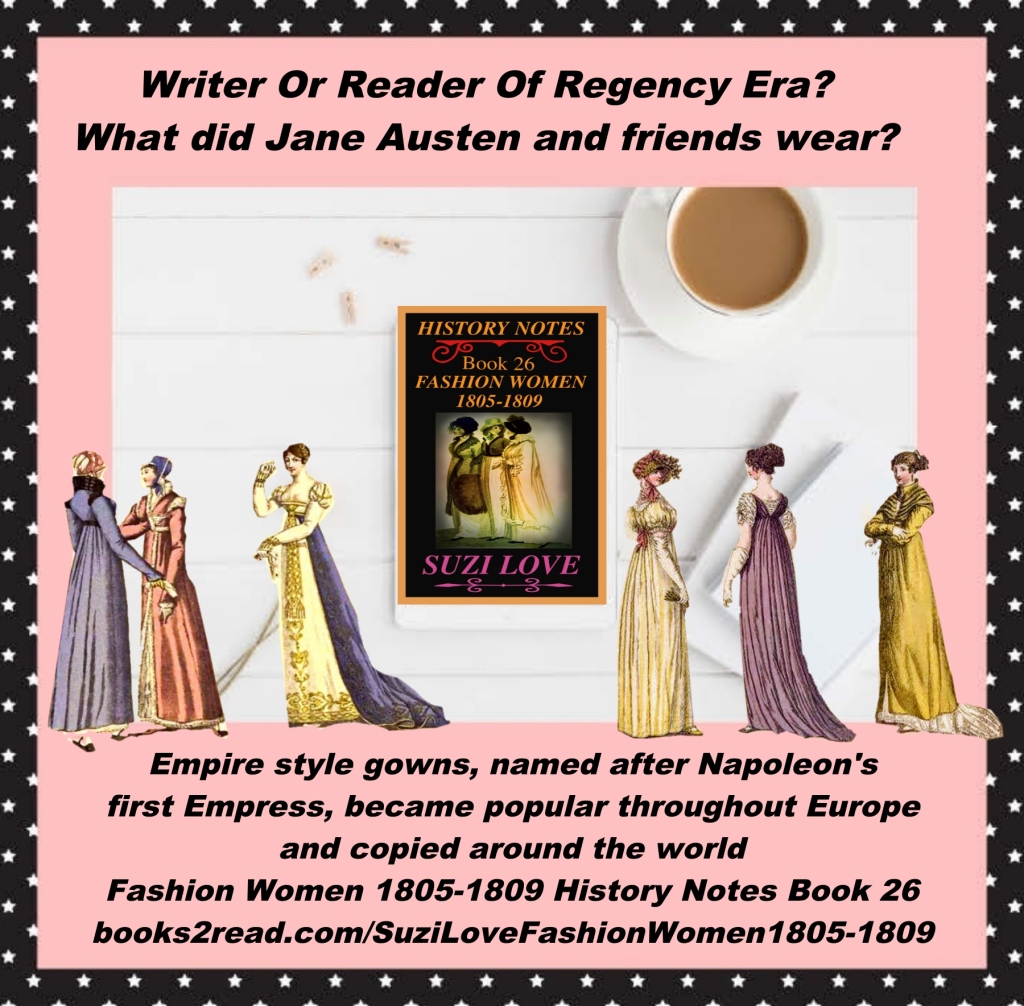
What did Jane Austen and friends wear? Early 1800s fashions were elegant and pretty with high waists and fabrics that were almost transparent. These Empire style gowns, named after Napoleon’s first Empress, became popular throughout Europe, and were then copied around the world. Colorful outwear was added to make an ensemble more attractive and warmer. History Notes Book 26 Fashion Women 1805-1809.
https://books2read.com/SuziLoveFashionWomen1805-1809
The Empire waist gown defined women’s fashion during the Regency Era. ‘Empire’ is the name given in France to the period when Napoleon built his French Empire. High-waisted, loose gowns were adopted by the aristocracy as a symbol of turning away from the fussy, elaborate and expensive clothing worn in the 1700s. Jean-Jaques Rousseau advocated copying peasants and returning to a simpler life and more natural fashions. Unrestricting clothing was part of the new Democracy in France and these simpler and flowing fashions were adopted all over Europe, including Britain and despite the continual wars being fought against France during the early 1800s. Not even war stopped fashions from being copied everywhere.
