1771 Tattersall’s Horse Training School, London, U.K. via Yale Center for British Art, Paul Mellon Collection.
Tattersall’s was founded in 1766 by Richard Tattersall (1724–1795), the Duke Of Kingston’s stud groom in premises near Hyde Park Corner, London. Two Subscription rooms were designated for members of the Jockey Club and became a meeting place for sporting and betting men. ‘Old Tatt’ conducted sales for the Duke of Kingston’s stud in 1774 and the Prince of Wales, or Prinny, in 1786. The prince often visited Richard Tattersall who was succeeded by his son, Edmund Tattersall (1758–1810), who extended the business to France.
1771 Tattersall’s Horse Training School, London, U.K.. Yale Center for British Art, Paul Mellon CollectionHN_2_D2D_Fashion Men 1700s
books2read.com/suziloveFashMen1700
ance”As the Duke of Sherwyn, you’ve entree into the best houses and social events.”
After a scowl towards the ceiling, he muttered, “Thanks to my stepmother, I’m forced into it. But what does my recent social popularity have to do with your current predicament?”
“In daylight, with other ladies, I can stroll about the streets. Visit shops, sometimes slip unnoticed into the twice-weekly stock auctions at the Hall of Commerce in Threadneedle Street. And I’ve already searched the desks of many of the mere misters and lesser peers of the lower orders of the consortium, as their houses aren’t guarded like fortresses.”
“Do you mean to say you entered these men’s homes and rifled their papers?”
“Well yes, but–”
“Are you mad?”
“I risked little, because those sort of houses cannot afford a footman guarding every passageway. Especially not on occasions such as those I attended, where every footman is needed to fetch drinks for belligerent guests. Slipping into those libraries was child’s play.” She sighed. “What I cannot do is visit the homes of the highest ranking peers to scour their correspondence for any that bears the special seal of the consortium. Nor secure enough privacy to copy any incriminating letters I may find. Someone always hovers, and watches, at those type of houses.”
He paced before her like a restless panther, an angry scowl pulling his face taut. His fine looks had always turned heads, but this brooding beast carried a lethal combination of strength and menacing masculinity. She shivered. His newly acquired arrogance of bearing enhanced, rather than detracted from, his magnetism, although this time, she knew to avoid his magnetic pull.
“You intend searching the houses of every peer in the city who is making money from stock shares?”
“No, no, not all of them. We’ve done a lot of research–”
“We?”
“My family have become quite adept at research. We’ve narrowed our search to gentlemen known to invest in railway expansions in a large way. Our final list is of those we consider to be involved in the inner, and most secret, tier of the syndicate. It contains eighteen names, the majority of whom are high-ranking peers.
“Bloody hell, Becca.” He ground the expletive out through clenched teeth. “You’re out of your depth. I’ve been involved in similar commercial groups. They’ll stop at nothing for the sake of money.”
“Nevertheless, we need certain details you may overhear at clubs about certain gentlemen having sudden windfalls. Or things gleaned at certain balls and soirees.
“Unbelievable.” Both hands went up in the air. “That’s certainly as clear as muddy water.”
“Clear or not, I’m asking you to trust me. To help me.”
She held out both hands, palms up, and hoped he wouldn’t notice their tremors. “With your assistance, I can verify more names. Collect proof of each one’s involvement and hand it over to Scotland Yard. Time is of the essence, as we’ve now less than two weeks.”
She watched him absorb, assess, decide. In under a minute, he guided her to his desk and seated her before it.
“Make a start. List the names of every man you suspect to be a member.” He placed writing materials before her. “Then list those you consider inner tier, and include their ranking.”
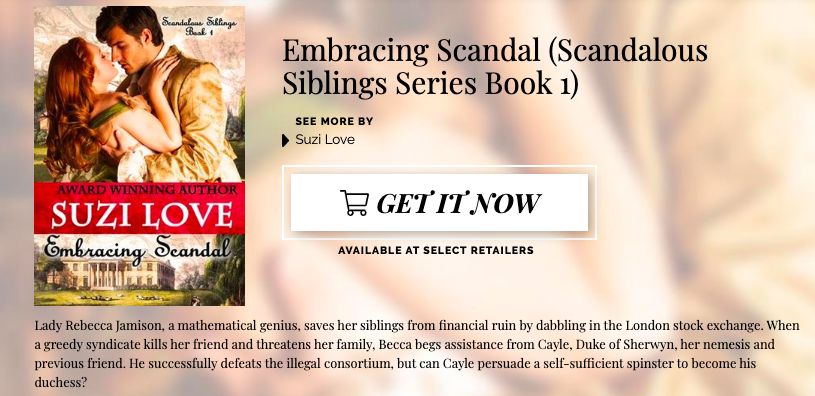
Lady Jamison saves family from financial ruin by railway investing but when her friend is murdered, Becca begs assistance from new Duke of Sherwyn. https://books2read.com/suziloveES
ES_ Embracing Scandal Book 1 Scandalous Siblings Series D2D_ES_ https://books2read.com/suziloveES
1800s Early Tattersall’s Horse Auctions, London, U.K.. Top sporting venue for Regency Life in London. ‘A mixture of persons of nearly all ranks’. By Pierce Egan. Via Wikimedia Commons (PD-ART)
In Jane Austen’s and Bridgerton times, or the Regency Era, horse riding was a vital mode of transport and Tattersall’s was the best place to buy and sell horses. Tattersall’s was established in 1773 near Hyde Park Corner for the sale by auction of horses, carriages, hounds and harnesses. Sales during the winter months were every Monday and Thursday, and on Mondays only during the spring and summer. On the mornings when there was no sale, Tattersall’s was a meeting place for fashionable sporting gentlemen.
Pierce Egan’s Description of Tattersall’s
A masquerade could scarcely exhibit more motley groups than the attendants of this place of fashionable resort. There were Peers, Baronets, Members of Parliament, Turf gentlemen and Turf-servants, Jockies, Grooms, Horse-dealers, Gamblers, &c. There you might see the oldest and some of the best blood in England, disguised like coachmen.
From: 1820 Sporting Anecdotes by Pierce Egan via Google Books (PD-150)
Richard, Earl of Winchester, groaned. Heaven save him, for lust had addled his wits. Contrarily, if he’d read similar thoughts on the face of any drooling young pup, he’d have leapt across the pews and planted him a facer. Embarrassed himself, and Lady Laura Jamison, with his possessiveness. The gossips would squeal with delight to see him break his own rules and behave like an obsessed suitor.
Far better that onlookers saw the relationship between him and Laura as sparring siblings because, in private, his indifference was becoming harder and harder to maintain. More so, when Laura studied him surreptitiously, or so she thought, and compared him to other men. When she recorded his suitability as her mate as part of her quest to ensure the survival of the human species. Blast the woman and her speculating eyes, because no matter how sexually innocent her assessments of his anatomy might be, his body leapt to readiness faster than any seasoned street walker lifted her skirts.
And damn his randy thoughts for creating so many pictures of them cavorting in his bed. In that arena, if nowhere else, he was certain their passionate natures would prove a perfect match. He clenched his fist at the thought of giving up something else. The intelligent and strong children their couplings would produce. Because if he had Laura’s body under him once, he’d be old and wizened before he tired of her.
Love revealed at a courtesan’s ball. Brenton, Lord Mallory, attends his first courtesan’s ball in ten years to appease his concerned friends, though he’d rather stay home and read to his motherless daughters. Though mortified that Brenton unmasks her at a scandalous ball, Lady Lillian Armstrong doesn’t regret their night together. But will the object of her girlish adoration still treat her as his best friend’s little sister, or will he now see her as a mature and willing woman? books2read.com/suzilovePHB
The finger prodded her chest again. Gently yet insistently. But his voice softened. “And I, the man, and the duke, choose you. You, Lady Rebecca. Do you think I can’t decide for myself, for my family, for you and me, what’s best?”
“But that’s what I’ve always done. It’s always been up to me to work out the best plan for everyone and then make it happen.” “In the past, that’s what happened.”
“But even now, it’s up to me to keep everyone safe. You said yourself that neither my family, nor the society, could go on without my making these types of decisions. I’m always the one with the clear head. In time, you’ll see that I’m right to walk away from you when this is finished.”
“No, no. This isn’t finished by a long shot, sweetheart. There has to be some consolation in my life for taking on control of Julia and my brothers, for assuming the family titles and topping up our coffers.”
“I know how hard you’re working to succeed. But it’ll never work if you have someone like me in your life.” “I don’t want someone like you, Becca. I want you.” This time his kiss was tinged with desperation. “Answer me one thing.” Her eyes widened. “Do you love me, minx? Do I still hold your heart?”
“Stop! It’s unfair to ask me that. Leave, please, just leave.” Turning away, Becca wished him gone before he glimpsed the fat tears collecting in her eyes. It was crucial that she remain strong. Even if it broke her heart to do so.As he reached the door, Becca heard Cayle mutter, “I will have you, Rebecca Jamison. I will not stop until I find a way.” She didn’t know whether it made her happy, or if it simply terrified her.
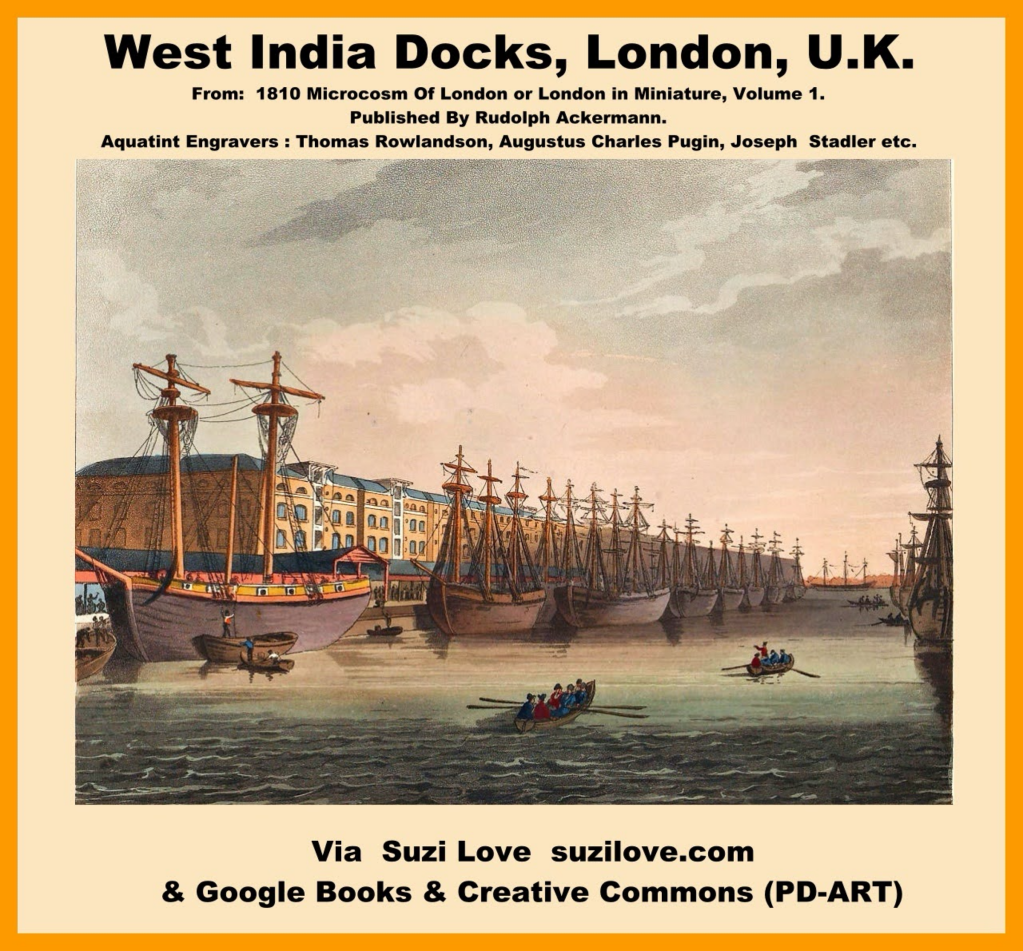
1810 January 1st. West India Docks, London. By Thomas Rowlandson and Augustus Charles Pugin. Printed in 1810 By Rudolph Ackermann in Microcosm Of London, or London In Miniature. Volume 1. Aquatint showing warehouses at quayside and several West Indiamen moored alongside. Warehouses held thousands of tons of cargo, including sugar, rum, molasses, coffee, spices and hardwood. Docks were constructed by powerful group of businessmen led by Robert Milligan, wealthy merchant and ship-owner outraged at losses suffered due to theft and delay at riverside wharves. via National Maritime Museum, Greenwich, London, U.K. ~ collections.rmg.co.uk
West India Docks, London, U.K. From: 1810 Microcosm of London or London in Miniature Published By Rudolph Ackermann. Via Google Books & Creative Commons (PD-ART)RL_1_D2D_Regency Overview RetailerLinks
https://books2read.com/suziloveROver
East and West India Docks London’s Historic Places
The East India Docks was a group of docks in Blackwall, east London, north-east of the Isle of Dogs. In 1607, the East India Company decided to build its own ships and leased a yard in Deptford. In 1614 the East India Company ordered William Burrell to begin work on a bigger yard for repair, construction and loading of out-going ships. The site selected was at Blackwall, which was further down river and had deeper water, allowing laden ships to moor closer to the dock. During the early 17th century, the site was enlarged repeatedly. Later in the 17th century, the East India Company reverted to its practice of hiring vessels, although many owners who chartered their vessel to the East India Company had them built at Deptford and Blackwall.
Before 1800, the Thames river was overcrowded with ships. They carried cargoes of tea, china and cloth in their lower parts along with casks of water, salted meat, beer, wine and rum for their crews. Brandy, wine, and tobacco were also shipped and stored in the warehouses. In 1800, the London Dock Company was formed and the planned docks in Wapping went ahead in 1801. The first was the West India Dock. In 1806, the East India Company opened their own docks to the north-east of the West India Docks after deciding that the Brunswick Dock at Blackwall, where ships were fitted out, was unsuitable for storing cargo.
The Brunswick Dock, which had originally been connected directly to the Thames to the south, became the Export Dock. To the north the company built a larger 18-acre (7.3 ha) Import Dock. Both were connected to the Thames via an eastern entrance basin. The number of ships discharged in the docks rose from 354 in 1804, to 598 in 1808, and to 641 in 1810. In 1808, the warehouses were full, as blockades prevented the re-export of goods. The dock company calculated that the almost total prevention of theft made possible by the building of the docks was saving West India merchants almost £400,000, and the Exchequer about £150,000 each year. During the 1840s and early 1850s, shipping and tonnage handled at the East and West India docks increased so much that dividends of 5 and 6 per cent were paid.
The East India Docks didn’t have many warehouses because cargoes were taken straight to their warehouses in the City. So instead of building warehouses, the company built private toll roads like Commercial Road and East India Dock Road to carry traffic to and from the docks.
The company made large profits on tea, spices, indigo, silk and Persian carpets. The tea trade alone was worth £30m a year. Spice merchants and pepper grinders set up around the dock to process goods. Although the East India docks were smaller than the West India Docks, they handled up to 250 ships at one time and East Indiamen of 1000 tons but larger ships and steam power reduced the importance of the dock.
The West India Docks were a series of three docks, quaysides, and warehouses built to import goods from, and export goods and occasionally passengers to the British West Indies. In 1802, the first dock opened on the Isle Of Dogs. When they closed for commerce in 1980, the Canary Wharf development was built around the wet docks by narrowing some of their broadest tracts.
The docks were constructed in two phases. The two northern docks were constructed between 1800 and 1802 for the West India Dock Company and were the first commercial wet docks in London. For 21 years, all vessels in the West India trade using the Port Of London had to use the West India docks by a clause in the act of Parliament that had enabled their construction.
In 1838 the East and West India companies merged. The southern dock, the South West India Dock, later known as South Dock, was constructed in the 1860s and in 1909 the Port Of London Authority took over the West India Docks,
The docks played a key role in the Second World War as a location for constructing the floating Mulberry harbours used by the Allies to support the D-Day landings in France. Following the Second World War, in which all the docks were badly damaged, the East India Docks were confined to occasional Channel Islands traffic and to the maintenance of dredger equipment.
The docks were the first London docks to close, in 1967. Today the docks have been mostly filled in. Only the entrance basin remains, as a wildlife refuge and an attractive local amenity. The area is predominantly residential with several major developments around it.
“Two nights ago,” Lady Rebecca Jamison said, “the woman we engaged at the Women’s Betterment Society to tally the Stock Exchange ledgers — our friend — was murdered. The killer was still inside Peggy’s house when I arrived. Her slayer stopped at the back door and stared directly at me, memorizing my features.”
Her pronouncement was flat-voiced, deadly calm.
“Thankfully, his immediate concern was escaping with our two accounting books. But when the cache identifies me as the woman who saw their lackey’s face, I am certain they will send him to dispose of me as well. They are peers, titled and wealthy, and cannot risk being exposed as members of an illegal group. If we cannot stop these men, brutes who employ cold-blooded assassins to do their dirty work, I will certainly be the next to die.”
The Duke of Sherwyn’s chilled blood turned to ice.
1808 Christie’s Auction Room, London, U.K. From: Microcosm of London By Rudolph Ackermann. The Microcosm of London was published in three volumes between 1808 and 1810 and was coordinated by German born printseller, Rudolph Ackermann, from his Repository of Arts at 101 The Strand, London, U.K. and included numerous contributors. Visitors to London in Jane Austen’s time would go to all the important buildings. https://books2read.com/suziloveROver