1825-1835 ca. Cotton Corset, Possibly American. Waist shaping at the almost natural waistline, flared hips, cording, widely spaced shoulder straps with front ties. Via Winterthur Museum Collection museumcollection.winterthur.org.
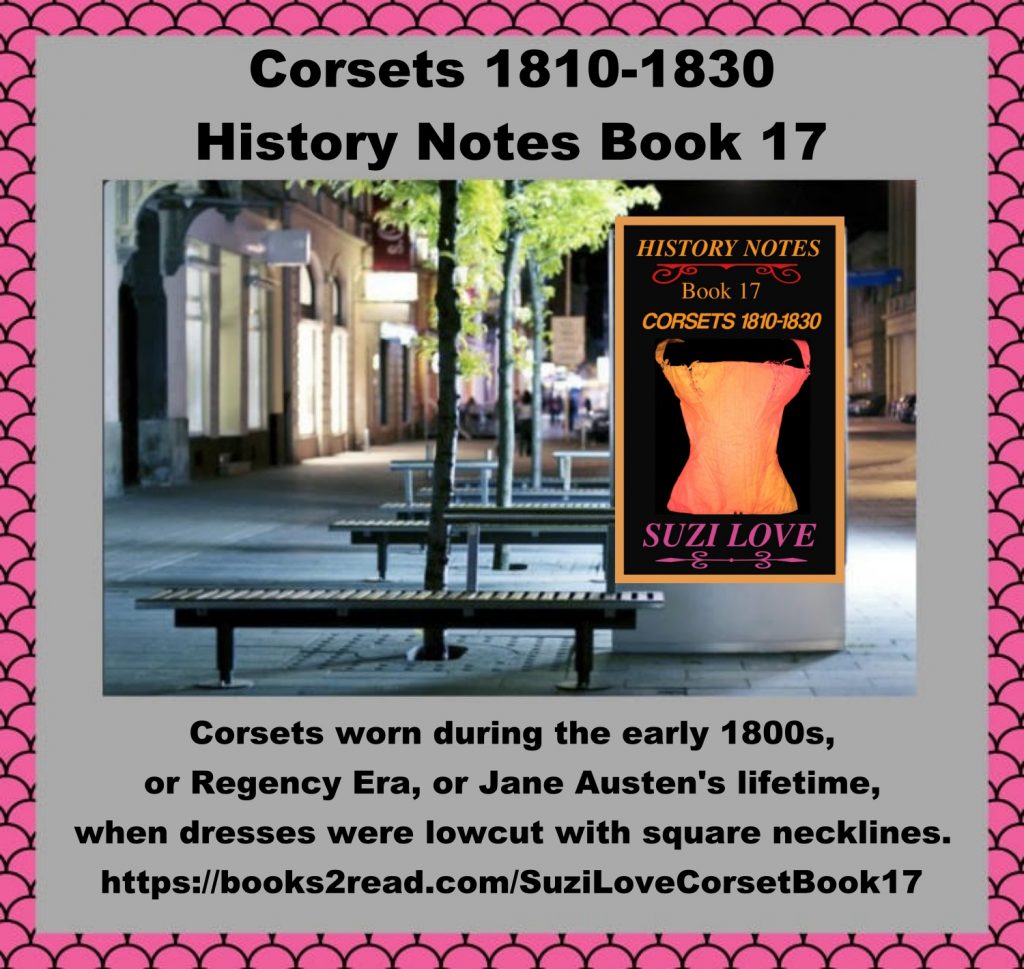
Corsets 1810-1830 History Notes Book 17: For Readers or Writers of historical fiction, the corsets worn during the Regency Era, or Jane Austen’s lifetime, or the Bridgerton years when dresses were lowcut with square necklines. https://books2read.com/SuziLoveCorsetBook17
1825-1835 ca. Cotton Corset, Possibly American. Waist shaping at the almost natural waistline, flared hips, cording, widely spaced shoulder straps with front ties. 1825-1835 ca. Cotton Corset, Possibly American. Waist shaping at the almost natural waistline, flared hips, cording, widely spaced shoulder straps with front ties. 1825-1835 ca. Cotton Corset, Possibly American. Waist shaping at the almost natural waistline, flared hips, cording, widely spaced shoulder straps with front ties.
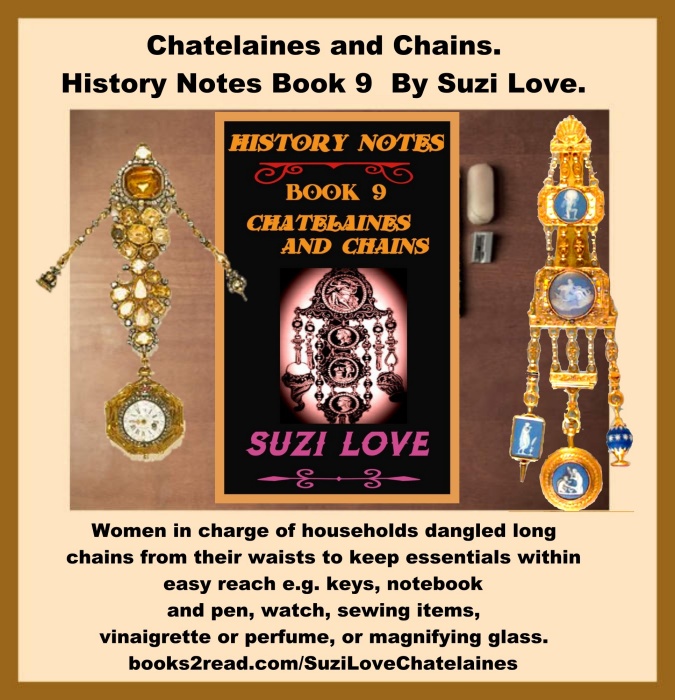
Chatelaines and Chains History Notes Book 9 By Suzi Love. What do you know about Chatelaines and Chains worn in Jane Austen’s and Bridgerton times? Women in charge of households carried important items with them. History Notes Book 9 Chatelaines and Chains. books2read.com/SuziLoveChatelaines
Personal Necessities, keys, or chatelaines was a set of useful items hung from waist by decorative chain. Chatelaines and Chains. History Notes Book 9 By Suzi Love. Women in charge of households dangled long chains from their waists to keep essentials within easy reach e.g. keys, notebook and pen, watch, sewing items, vinaigrette or perfume, or magnifying glass. Early chatelaine were simple essentials. Later chatelaine were decorative and expensive. http://books2read.com/SuziLoveChatelaines
Definition Chatelaine: The word Chatelaine is French and means the keeper of the keys. Chatelaine” derives from the Latin word for castle. In Medieval times, the chatelaine was in charge of the day-to-day running of the castle. Women in charge of households dangled long chains from their waists to keep essentials within easy reach e.g. keys, notebook and pen, watch, sewing items, vinaigrette or perfume, or magnifying glass. Early chatelaine were simple essentials. Later chatelaine were decorative and expensive.books2read.com/SuziLoveChatelaines
What did a chatelaine do? Most important task was keeper of the keys. Also ordered supplies, did bookkeeping, supervised servants, taught castle children, and organized guests.
By 1700’s, a metal jeweled ornament hung from pockets, attached to belts, or by hooks into skirt waistbands
During 1800’s, women wore large collections of tools hung from chains
Young girls sewed and did needlework and needed to carry sewing notions eg scissors, thimbles
Worn by women of all classes, from workers to nobility
Varied depending on class and finances.
Made of silver, brass, steel, leather, or fabric
During 19th century, fashionable dresses often had no waist and nowhere to hang chatelaines
Chatelaines became decorative brooches
Often given as a wedding present from a husband to bride
Later became fashion accessories
HN_9 Chatelaines and Chains History Notes Book 9 books2read.com:SuziLoveChatelainesD2D_RetailerBuyLink_HN_9. Chatelaines and Chains History Notes Book 9 books2read.com/SuziLoveChatelaines
This book shows how corsets changed to fit well under clothing, give maximum support and comfort. Corsets pushed up breasts and showed off the bust line beneath a square-cut and low-cut neckline as in the early 1800s, or Regency years. Jane Austen and her female and friends wore these corsets. Corsets or stays worn during the early 1800s, or Jane Austen’s lifetime. https://books2read.com/SuziLoveCorsetBook17
The main purpose of corsets was to support and shape the breasts. Though they still slimmed the midriff, this was not the prime purpose of a corset between 1810 and 1830. The waistlines of dresses were lowering to below the bust line but nearer to the true waist, so corsets were longer and were given added shaping by stitching and cording and by shaping the breasts with pleated or gathered cups.
1820-1835 ca. Woman’s Underwear Combination, English. This style of underwear was worn during the Jabe Austen and Bridgerton years. Petticoat: 1820-1829 ca. Cotton with double row of piping round hem. Frontless with looped shoulder pieces. Corset: 1835: Cotton reinforced with whalebone and cording, hand-sewn. Shift Or Chemise:1830s Worn under corset. Drawers: Sheer clinging fabrics needed drawers underneath for modesty. via Victoria and Albert Museum, London, UK. collections.vam.ac.uk.
Fashion Women 1815-1819 History Notes Book 28 https://books2read.com/SuziLoveFashionWomen1815-1819
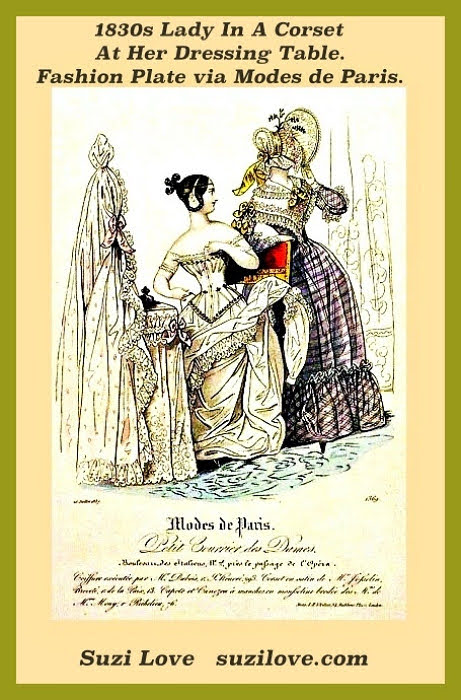
1830s Lady In A Corset At Her Dressing Table. Fashion Plate via Modes de Paris.
Romantic Era women’s corsets supported plus fitted well to give a fashionable silhouette. Becoming a fashion item, rather than simply hidden underclothing. https://books2read.com/SuziLoveCorsetBook18
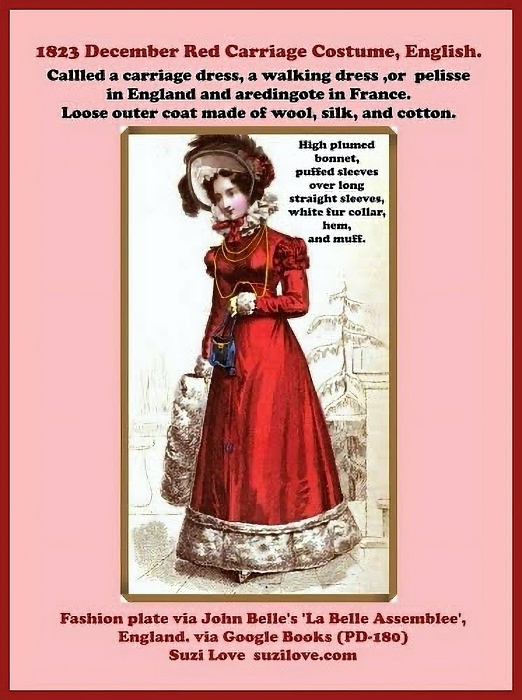
1823 December Red Carriage Costume, English. Gorgeous red dress with waistline a couple of inches below the bust, puffed short sleeves over long straight sleeves, wide white fur hem trim to match the white fur muff, white ruffle at the neck. High bonnet with a feather tied under the chin with a red bow. Fashion plate via John Belle’s ‘La Belle Assemblee’, England.
Definition Redingote Or Pelisse Or Walking Dress Or Carriage Dress Or Coat: French word developed from English words, riding coat. Long fitted outdoor coat worn over other garments for warmth. Often left open at the front to show off the dress underneath. Sometimes cut away in front. Originally made with several capes and trimmed with large buttons. French fashion plates call these coats Redingotes and they are designed for women, men and children. English fashion plates call them a Pelisse, a walking dress, Promenade dress, or Carriage dress. books2read.com/suzilovePelisse
1825 Brown stays with center front busk, back lacing, hip shaping, breast gussets, widely spaced straps, cotton embroidered in ivory silks with hearts. via Kerry Taylor Auctions. kerrytaylorauctions.com https://books2read.com/SuziLoveCorsetBook17
The main purpose of corsets was to support and shape the breasts. Though they still slimmed the midriff, this was not the prime purpose of a corset in the 1820s. The waistline of dresses had lowered to below the bust line and nearer to the true waist so corsets were longer and were given added shaping by stitching and cording and by shaping the breasts with pleated or gathered cups.
History Notes Book 18 Corsets 1830-1850This book shows how corsets changed to both provide support and also fit well under clothing to give a fashionable silhouette. Corsets started being a fashion item, rather than simply underclothing to be hidden. Romantic Era women’s fashionable corsets. Corsets worn from 1830-1850, or the Romantic Era of fashion. https://books2read.com/SuziLoveCorsetBook18
Information or drawings on corsets through both the Regency and Romantic Eras is difficult as underwear wasn’t shown in British publications for modesty sake, and only occasionally seen in French magazines. Therefore, most of our knowledge about corsets from the Regency and Romantic Eras is through actual garments, especially those donated to museums. Surviving corsets show that shorter corsets weren’t as common and corsets were generally of a longer length. Many of these corsets were still front fastening, plus many were laced at both the front and the back so our aristocratic fictional heroines could indeed dress and undress themselves without the assistance of a maid.
Corset makers became more skilled and cut garments much better, so the body was controlled and shaped by the cut and grain of the fabric. They developed long corded corsets to suit the classical gowns of the period. A wooden busk was created to help keep the undergarment garment lay flat and to lift and separate the breasts. Busks stopped women from bending at the waist, which encouraged good posture.
1830-1850 Romantic Era Corsets Provided Support and Gave Fashionable Silhouette. History Notes Book 18 #Corsets #RomanticEra #HistoricalFashion https://books2read.com/SuziLoveCorsetBook18
1823 Couple In Evening Costumes, French. Short length dancing dress of white gauze, short sleeves, pink ribbon trim, flowers, parure, or jewelry set, dancing shoes and hair in a bandeau. Man in half dress of black tailcoat, yellow vest, short length white trousers, high white cravat, blue fob, and curled hair style. via Modes Francaises L’Indiscreet, France.
From the finish of the 18th century until 1820, men’s fashions in European and European-influenced countries moved away from the formal wear of brocades, lace, wigs and powder to more informal and relaxed styles. Focus was on undress rather than formal dress. Typical menswear in the early 1800s included a tailcoat, a vest or waistcoat, either breeches, pants, or the newer trousers, stockings, shoes or boots, all worn with an overcoat and hat. This basic ensemble was accessorized with some form of neckcloth or cravat, gloves, walking stick, cane or riding crop, handkerchief, fobs, watch and perhaps a quizzing glass or eye glass.
Skirted coats were replaced with short-fronted, or cutaway, tailcoats worn over fitted waistcoats and plain, white linen shirts. Knee breeches were gradually replaced by tight-fitting pantaloons and later trousers, decorative shoes with buckles were replaced with a variety of boot styles, and fussy and ruffled neckwear gave way to intricately tied, white linen neck cloths. A Regency Era, or early 1800s, gentleman was outfitted in more practical fabrics, such as wool, cotton and buckskin rather than the fussy brocades and silks of the late 1700s.