↓
 

Suzi Love

Making history fun, one year at a time.

Header_
  • Home
  • Newsletter
  • Pre order form
  • Shop
    • Cart
    • Checkout
    • My account
    • Refund and Returns Policy
  • Blog
  • BOOKS
    • History Events
    • Kelly’s Justice
    • Outback Arrival
    • Irresistible Aristocrats
    • History Notes
    • Scandalous Siblings
    • Love After Waterloo
    • Regency Life Series
  • Privacy Policy
  • EVENTS
Home » Victoria and Albert Museum 1 2 3 4 5 >>

Tag Archives: Victoria and Albert Museum

Post navigation

← Previous Post

1700-1800 ca. Women’s Pockets With Waist Ties as worn in Jane Austen’s years. #Georgianera #Regencyera #JaneAusten #Underclothing

Suzi Love Posted on September 5, 2026 by Suzi LoveSeptember 9, 2026

From 1700 until the early 1800s, pockets with waist ties were worn by women to keep essential items on their person. Generally of linen or some other cotton fabric, they were often quilted, or embroidered and gifted or handed down to others. In the 18th century, women’s pockets were not sewn into their gowns. Instead they were attached to a tape and tied around the waist as separate garments. Worn under the hoops and petticoats, they were accessed through openings in the gown and petticoat seams. By the early 1800s, round gowns were both flowing and almost transparent so pockets could no longer be worn under dresses, so ridicules, or bags, or reticules were carried instead. Jane Austen and her female friends and family would have worn pockets under their out layers.

From the Curator Victoria and Albert Museum, London: Quilting was a popular form of decoration for a variety of garments including pockets. However, hand-quilting was a time-consuming method of decoration. The increased demand for quilted petticoats, waistcoats and pockets led to the invention of woven quilting.

1700-1725 ca. Pair of Linen Twill Women’s Pockets With Crewel Embroidery and Waist Ties, British. Embroidered in yellow, green and pink worsted thread with chain and stem stitches, design of flower pot with flowering plant, bound with green worsted tape and sewn to linen tape tie. Designs are similar but not identical, suggesting both hand-drawn and possibly work of an amateur. Pockets may have been handed down to another person who found them too small as each pocket has been extended at top by 4 cms. via Victoria and Albert Museum, London, UK.
collections.vam.ac.uk.

1700-1725 ca. Pair of Linen Twill Women's Pockets With Crewel Embroidery and Waist Ties, British. Embroidered in yellow, green and pink worsted thread with chain and stem stitches, design of flower pot with flowering plant, bound with green worsted tape and sewn to linen tape tie. Designs are similar but not identical, suggesting both hand-drawn and possibly work of an amateur. Pockets may have been handed down to another person who found them too small as each pocket has been extended at top by 4 cms. via Victoria and Albert Museum, London, UK. collections.vam.ac.uk.
by 4 cms. via Victoria and Albert Museum, London, UK. collections.vam.ac.uk.

1750-1800 ca. Woman’s Pocket With Waist Ties, New England, America. Linen plain weave, cotton plain weave, wool embroidery. Dimensions 39.5 cm x 27.5 cm. Polychrome crewels on cotton and linen, vine with buds, flowers and leaves and initials M.W. in center. In 18th century, women’s pockets were tied around waist with tape as separate garments, worn under hoops and petticoats, accessed through openings in gown and petticoat seams. via Museum of Fine Arts, Boston, U.S.A. mfa.org

1750-1800 ca. Woman's Pocket With Waist Ties, New England, America. Linen plain weave, cotton plain weave, wool embroidery. Dimensions 39.5 cm x 27.5 cm. Polychrome crewels on cotton and linen, vine with buds, flowers and leaves and initials M.W. in center. In 18th century, women’s pockets were tied around waist with tape as separate garments, worn under hoops and petticoats, accessed through openings in gown and petticoat seams. via Museum of Fine Arts, Boston, U.S.A. mfa.org
1750-1800 ca. Woman’s 1750-1800 ca. Woman’s Pocket With Waist Ties, New England, America. Linen plain weave, cotton plain weave, seams. via Museum of Fine Arts, Boston, U.S.A. mfa.org
HN_1_D2D_Fashion Women 1700s
books2read.com/suziloveFashWomen1700s
HN_1 Fashion Women Late 1700s History Notes Book 1 by Suzi Love. What was fashionable for women in the late 1700s? Extravagant colors and fabrics and outrageous styles were all seen in these flamboyant fashions. books2read.com/suziloveFashWomen1700s
Posted in 1700s, 1700s Womens Fashion, 1800s, 1800s women's fashion, Australia, Canada, England, Europe, fashion accessories, Georgian Era, Georgian Fashion, Jane Austen, Regency Era, Regency Fashion, Suzi Love Images, U.S.A | Tagged 1700s Women's Fashion, 1800s women's fashion, fashion accessories, Georgian Fashion, Jane Austen, Museum Of Fine Arts, Regency Fashion, underclothing, Victoria and Albert Museum
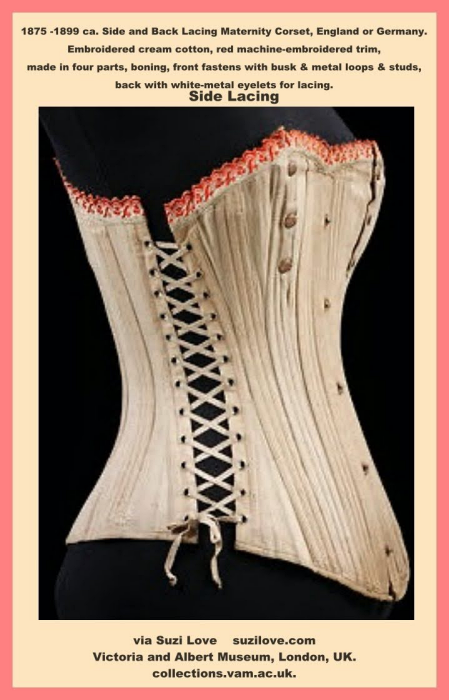
1875-1899 ca. Side Lacing Maternity Corset, Possibly England Or Germany. via collections.vam.ac.uk

1875-1899 ca. Side Lacing Maternity Corset, Possibly England Or Germany. #VictorianEra #History #Corset

Suzi Love Posted on August 29, 2026 by Suzi LoveAugust 13, 2026

1875-1899 ca. Side Lacing Maternity Corset, Possibly England Or Germany. Embroidered cotton with metal and boning, possibly used as a maternity corset. This corset is made of cream cotton with red machine-embroidered trim and trimmed with a scallop edged tape. The corset is made in four parts and fastens at the front with a busk and with five white metal loops and studs. At the back are seventeen sets of white metal bound eyelets for threading through a lace. At each side, there are twelves sets of metal bound eyelets to fasten with elasticated laces. There is a vertical opening at the bust which fastens with three bronze gilt press studs, clamped into the fabric, and a diamond pattern impressed on the head which shows on the face of the fabric. On the reverse of the stud is a mark. 

The corsets reach from the bust to the middle of the hip descending to a point at about the middle of the belly in the centre front. They are machine-stitched and seem lightly boned, encased and sewn to the face of the fabric. Bound at the top and bottom with grey tape. The breast gussets and side lacing suggest this is a maternity corset. Corsets designed for pregnancy and nursing were advertised throughout the 19th century. This maternity corset is a typical example. It is constructed like a fashionable corset, with boning and a central busk. It has side laces, to enable the wearer to adjust the corset to her changing figure. The cups can be opened for breastfeeding by releasing the press studs.  via Victoria and Albert Museum, London, UK.

1875-1899 ca. Side Lacing Maternity Corset, Possibly England Or Germany. via collections.vam.ac.uk
1875-1899 ca. Side Lacing Maternity Corset, Possibly England Or Germany. SideView. via collections.vam.ac.uk
1875-1899 ca. Side Lacing Maternity Corset, Possibly England Or Germany. #corset #maternity #victorianfashion https://books2read.com/SuziLoveCorsetBook19
Post On X
HN_19_D2D_Corsets 1850-1880
HN_19_D2D_Corsets 1850-1880 https://books2read.com/SuziLoveCorsetBook19
Posted in 1800s, 1800s women's fashion, Corset, England, Europe, Suzi Love Images, underclothing, Victorian Era, Victorian Fashion | Tagged 1800s women's fashion, Corset, europe, Germany, underclothing, Victoria and Albert Museum, Victorian fashion
guitar_1780 ca. English Guitar, Lisbon, Portugal. Made by Jaco Vieira da Silva Pine back, sides and soundboards, with pine and wood purfling (bordering); brass openwork rose, framed with mother-of-pearl. The English guitar was a fashionable instrument from about 1750, considered easy to play and tuned in C major, although the player would use a capo, much like a modern folk-guitarist, in order to change the key. The tuning pegs were often small metallic pins that could be turned with a watch-key, to keep the strings in tune longer. This instrument was made in Portugal, a country with strong trading links with England, and its peg box is decorated with a paper ‘cameo’ in imitation of a jasper ware medallion, a motif made popular by Josiah Wedgwood (1730-1795) from about 1770. Victoria and Albert Museum, London, U.K.

1780 ca. English Guitar, Lisbon Made by Jaco Vieira da Silva. #Music #Guitar #Portugal #GeorgianEra

Suzi Love Posted on August 27, 2026 by Suzi LoveAugust 22, 2026

1780 ca. English Guitar, Lisbon Made by Jaco Vieira da Silva. Pine back, sides and soundboards, with pine and wood purfling or bordering, brass openwork rose, framed with mother-of-pearl. The English guitar was a fashionable instrument from about 1750, considered easy to play and tuned in C major, although the player would use a capo, much like a modern folk-guitarist, in order to change the key. The tuning pegs were often small metallic pins that could be turned with a watch-key, to keep the strings in tune longer. This instrument was made in Portugal, a country with strong trading links with England, and its peg box is decorated with a paper ‘cameo’ in imitation of a jasper ware medallion, a motif made popular by Josiah Wedgwood (1730-1795) from about 1770. Victoria and Albert Museum, London, U.K.  History Notes Book 6 Music General https://www.suzilove.com/wp-admin/books2read.com/suziloveMusicGeneral \

1780 ca. English Guitar, Lisbon, Portugal. Made by Jaco Vieira da Silva Pine back, sides and soundboards, with pine and wood purfling (bordering); brass openwork rose, framed with mother-of-pearl. The English guitar was a fashionable instrument from about 1750, considered easy to play and tuned in C major, although the player would use a capo, much like a modern folk-guitarist, in order to change the key. The tuning pegs were often small metallic pins that could be turned with a watch-key, to keep the strings in tune longer. This instrument was made in Portugal, a country with strong trading links with England, and its peg box is decorated with a paper ‘cameo’ in imitation of a jasper ware medallion, a motif made popular by Josiah Wedgwood (1730-1795) from about 1770. Victoria and Albert Museum, London, U.K.
.
1780 ca. English Guitar, Lisbon, Portugal. Made by Jaco Vieira da Silva Pine back, sides and soundboards, with pine and wood purfling (bordering); brass openwork rose, framed with mother-of-pearl. The English guitar was a fashionable instrument from about 1750, considered easy to play and tuned in C major, although the player would use a capo, much like a modern folk-guitarist, in order to change the key. The tuning pegs were often small metallic pins that could be turned with a watch-key, to keep the strings in tune longer. This instrument was made in Portugal, a country with strong trading links with England, and its peg box is decorated with a paper ‘cameo’ in imitation of a jasper ware medallion, a motif made popular by Josiah Wedgwood (1730-1795) from about 1770. Victoria and Albert Museum, London, U.K.
HN_6_D2D_Music General_ books2read.com/suziloveMusicGeneral

Posted in 1700s, Decorative Item, Europe, Georgian Era, History, Music, Pastimes, Suzi Love Images | Tagged 1700s Or Georgian Era, europe, Georgian era, guitar, music, Victoria and Albert Museum
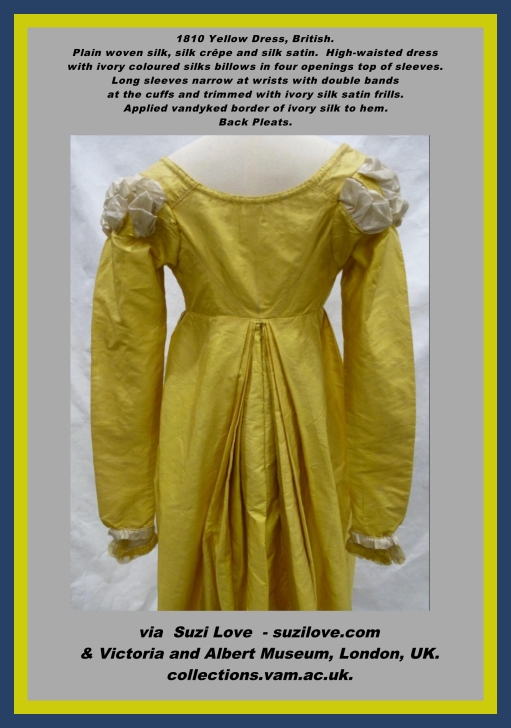
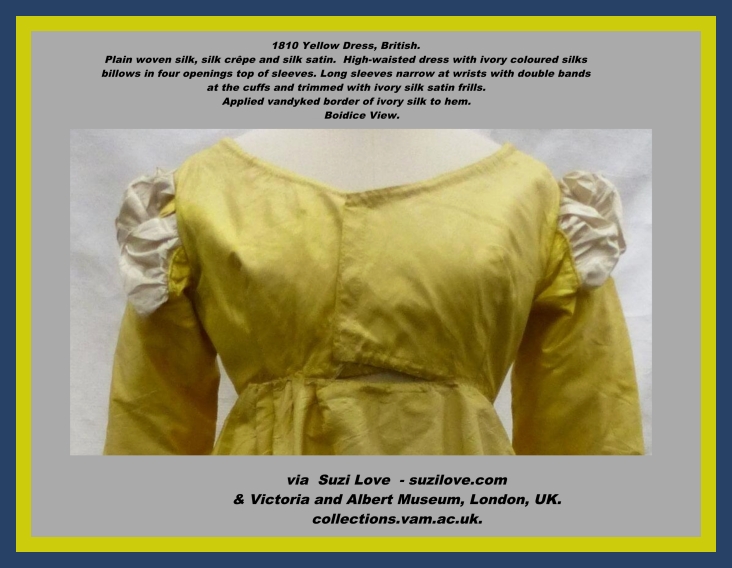
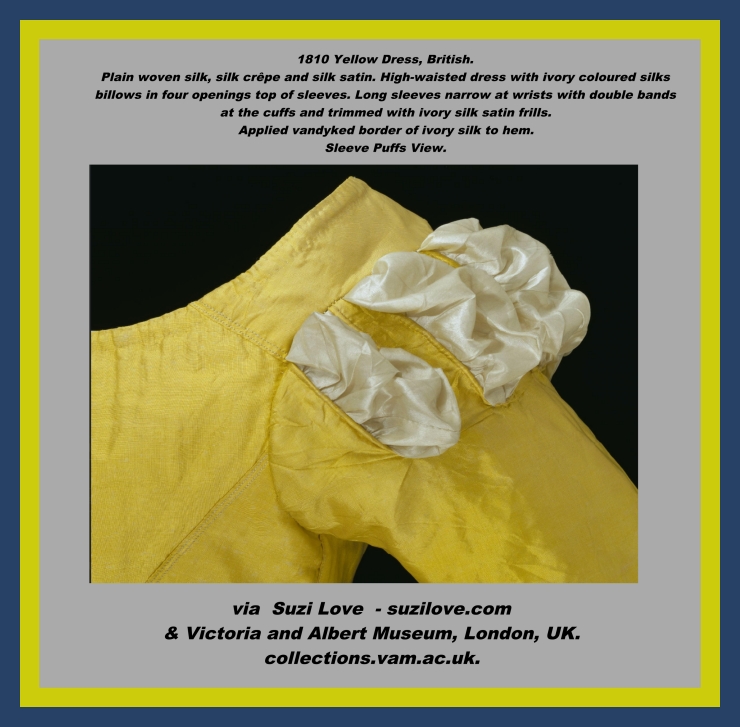
1810 Yellow Dress, British. Plain woven silk, silk crêpe and silk satin. High-waisted dress of yellow silk, ivory colored silks billow out of four openings at sleeve tops, long rectangular strip of ivory silk on inside of sleeve head and excess gathered into pudds through openings. Long sleeves narrow at wrists with double bands at cuffs and trimmed with ivory silk satin frills, yellow silk crêpe, cream ribbon and cording. Trimming around lower hem of skirt of applied vandyked border of ivory silk.

1810 Yellow Silk Dress With Ivory Puffs on Top Of Sleeves in Jane Austen style. #RegencyFashion #JaneAusten #BritishHistory

Suzi Love Posted on August 22, 2026 by Suzi LoveAugust 22, 2026

1810 Yellow Dress, British. Plain woven silk, silk crêpe and silk satin. High-waisted dress of yellow silk, ivory colored silks billow out of four openings at sleeve tops. The puffed trimmings are inspired by the fashionable slashing of garments in the Renaissance period when the top fabric was cut to reveal a colored lining or garment worn underneath. A long rectangular strip of ivory silk on inside of sleeve head and excess gathered into pudds through openings.  The 19th-century version of slashing is much more controlled by cut, stitching and piped edges, rather than the raw cuts in fabric seen in the 16th century.

Long sleeves narrow at wrists with double bands at cuffs and trimmed with ivory silk satin frills, yellow silk crêpe, cream ribbon and cording. Trimming around lower hem of skirt of applied vandyked border of ivory silk. Length center back neckline to hem of train length: 158cm Front length shoulder to hem length: 139cm

 via Victoria and Albert Museum, London, UK. collections.vam.ac.uk.

1810 Yellow Dress, British. Plain woven silk, silk crêpe and silk satin. High-waisted dress of yellow silk, ivory colored silks billow out of four openings at sleeve tops, long rectangular strip of ivory silk on inside of sleeve head and excess gathered into pudds through openings. Long sleeves narrow at wrists with double bands at cuffs and trimmed with ivory silk satin frills, yellow silk crêpe, cream ribbon and cording. Trimming around lower hem of skirt of applied vandyked border of ivory silk. via Victoria and Albert Museum, London, UK. collections.vam.ac.uk.
1810 Yellow Silk Dress British_Plain woven silk, silk crêpe and silk satin. High-waisted dress with shoulder decoration and contrasting hem trim
1810_YellowSilkDressBritish_Plain wovensilk, silk crêpe and silk satin. High-waisted dress with shoulder decoration and contrasting hem trim_HemView_vam.ac.uk
HN_27_D2D_fashwomen1810-1814
https://books2read.com/SuziLoveFashion1810-1814
HN_27_D2D_fashwomen1810-1814 https://books2read.com/SuziLoveFashion1810-1814
Posted in 1800s, 1800s women's fashion, Dress Or Robe, Jane Austen, London, Regency Era, Regency Fashion, sewing | Tagged 1800s women's fashion, Dress Or Gown, fabric, Jane Austen, Regency Fashion, sewing, Victoria and Albert Museum

Are you a Reader or Writer of Regency Era Fashions? Jane Austen and Bridgerton corsets. #corsets #historicalfashion #RegencyFashion #JaneAusten #Bridgerton

Suzi Love Posted on August 7, 2026 by Suzi LoveAugust 7, 2026

This book shows how corsets changed to fit well under clothing,  give maximum support and comfort. Corsets pushed up breasts and showed off the bust line beneath a square-cut and low-cut neckline as in the early 1800s, or Regency years. Jane Austen and her female and friends wore these corsets. Corsets or stays worn during the early 1800s, or Jane Austen’s lifetime. https://books2read.com/SuziLoveCorsetBook17

HN_17_Corsets 1810-1830 History Notes Book 17 This book shows how corsets changed to fit well under clothing, give maximum support and comfort. Corsets pushed up breasts and showed off the bust line beneath a square-cut and low-cut neckline as in the early 1800s, or Regency years. Jane Austen and her female and friends wore these corsets. Corsets or stays worn during the early 1800s, or Jane Austen's lifetime. https://books2read.com/SuziLoveCorsetBook17
Are you a Reader or Writer of Regency Era Fashions? Jane Austen and Bridgerton corsets. #corsets #historicalfashion #RegencyFashion #JaneAusten #Bridgerton https://books2read.com/SuziLoveCorsetBook17
Post On X
HN_17_D2D_Corset_1810-1830
https://books2read.com/SuziLoveCorsetBook17
HN_17_D2D_Corset_1810-1830

Posted in 1800s, 1800s women's fashion, Australia, Bridgerton, Canada, Corset, England, Europe, Google Books, History Notes, Jane Austen, Regency Era, Regency Fashion, Suzi Love Books, Suzi Love Images, U.S.A, underclothing | Tagged 1800s women's fashion, Book 17, Bridgerton, British history, Corset, europe, Fashion Plate, History Notes, Jane Austen, Metropolitan Museum NYC, Museum Of Fine Arts, Regency Fashion, Suzi Love Books, underclothing, USA, Victoria and Albert Museum

1600 Pair of Backless Chopines, or Shoes, made of Pine-wood and Leather, British. #Shoes #FashionHistory #BritishHistory

Suzi Love Posted on July 13, 2026 by Suzi LoveJuly 8, 2026

1600 Pair of Backless Chopines. Pine-wood covered with punched kid leather. via Victoria and Albert Museum, London, UK. collections.vam.ac.uk.

Definition Chopine: Women’s platform shoes worn in the 15th, 16th, and 17th centuries. Used as a patten, clog, or evershoe to protect shoes and dresses from mud and street soil. Worn in Venice by courtesans and patrician women from 1400-1700.

These chopines are made of pine-wood. The wood is covered in kid leather with punched decoration and figured silk underlay. This pair are fairly modest. More extreme versions were over 50 cms high. Chopines were based on the shoes worn at Turkish baths. They were first worn by Venetian prostitutes and fashionable Venetian aristocrats then adopted them. The chopine was originally a form of overshoe, which is why it has no back. Later versions could be worn as either overshoes or on their own.

1600 Pair of Backless Chopines. Pine-wood covered with punched kid leather. via Victoria and Albert Museum, London, UK. collections.vam.ac.uk.
Suzi Love Book Bub https://www.bookbub.com/profile/suzi-love
Posted in Customs & Manners, England, History, shoes, Suzi Love Images | Tagged British history, fashion accessories, History, Shoes, Victoria and Albert Museum

1808 ca. Jane Austen style High-Waisted Muslin Dress With Bib Front, British. #JaneAusten #Regencyfashion #historicalFashion

Suzi Love Posted on July 11, 2026 by Suzi LoveJuly 9, 2026

1808 ca. Jane Austen style high-waisted muslin dress with bib front, British. High stomacher front, i.e. a bib front fastened with pins, and embroidered with clusters of flowers and leaves. Embroidery satin stitch, chain stitch and French knots. Dress of muslin, embroidered in wool with a design of flowers and leaves down the sleeves and across the front of the dress. The bodice back and side fronts are lined with linen and there are linen undersleeves. The front of the bodice is made up of a panel of bias-cut muslin, which is sewn onto the skirt rather like the bib of an apron so that it can be placed in position at the neck with pins. When the pins are removed the bib front falls away to reveal linen underflaps which fasten across the bust to give support. This type of bodice construction was common during this period in this style of dress and is known as the high stomacher front.

Embroidered with clusters of flowers and leaves and embroidery is worked in satin stitch, chain stitch and French knots, the design trails down across the front of the dress and around the scalloped hemline to simulate a draped tunic-style garment slit up the side seam. Front bodice has panel of bias-cut muslin sewn onto skirt like the bib of an apron so that it can be placed in position at the neck with pins. When the pins are removed the bib front falls away to reveal linen underflaps which fasten across the bust to give support. Bib front bodice construction was common in the Regency Era, or Jane Austen’s years, in this style of dress and is known as the high stomacher front. via Victoria and Albert Museum, London, U.K.

1808 ca. High-Waisted Muslin Dress, British. High stomacher, or bib front, fastened with pins, and embroidered with wool in clusters of flowers and leaves. Embroidery satin stitch, chain stitch and French knots, and design goes down across the front and around a scalloped hemline to simulate a draped tunic-style garment slit up the side seam. https://books2read.com/SuziLoveFashionWomen1805-1809
.
HN_26_D2D Fashion Women 1805-1809
https://books2read.com/SuziLoveFashionWomen1805-1809
Fashion Women 1805-1809 History Notes Book 26 What did Jane Austen and friends wear? https://books2read.com/SuziLoveFashionWomen1805-1809
Posted in 1800s, 1800s women's fashion, Dress Or Robe, England, Jane Austen, London, Regency Era, Regency Fashion, Suzi Love Images | Tagged 1800s women's fashion, Dress Or Gown, Jane Austen, Regency Fashion, sewing, Victoria and Albert Museum

1812-1814 ca. White Muslin Peignoir Or Dressing Gown. #RegencyFashion #JaneAusten #HistoricalFashion

Suzi Love Posted on July 3, 2026 by Suzi LoveJune 27, 2026

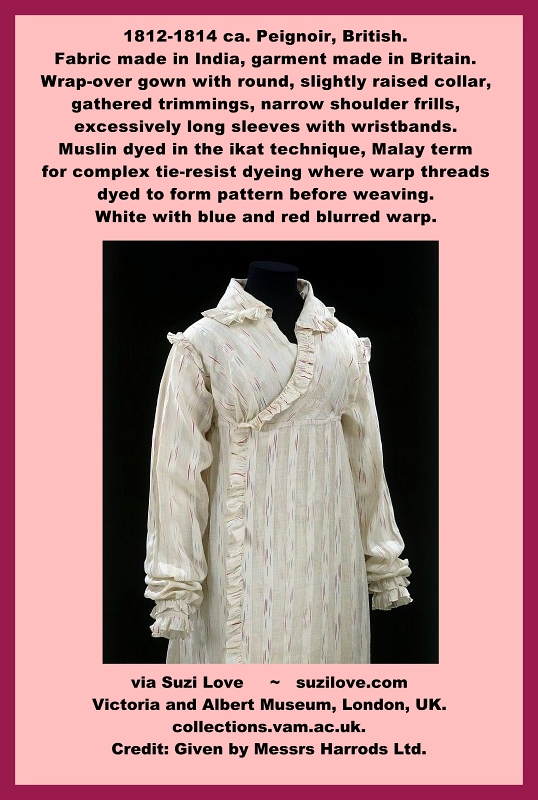
1812-1814 Ca. White Muslin Peignoir Or Dressing Gown, British. The sort of robe Jane Austen would have worn. Fabric made in India, Garment made in Britain. Wrap-over gown with round, slightly raised collar, gathered trimmings, narrow shoulder frills, excessively long sleeves with wristbands. Muslin dyed in the ikat technique, Malay term for complex tie-resist dyeing where warp threads dyed to form pattern before weaving. White with blue and red blurred warp.

via Victoria & Albert Museum, London, UK. collections.vam.ac.uk Credit: Given by Messrs Harrods Ltd.

1812-1814 Ca. White Muslin Peignoir Or Dressing Gown. Fabric made in India, Garment made in Britain. Wrap-over gown with round, slightly raised collar, gathered trimmings, narrow shoulder frills, excessively long sleeves with wristbands. Muslin dyed in the ikat technique, Malay term for complex tie-resist dyeing.
HN_27_D2D_fashwomen1810-1814
https://books2read.com/SuziLoveFashion1810-1814
HN_27_D2D_fashwomen1810-1814 https://books2read.com/SuziLoveFashion1810-1814
Posted in 1800s, 1800s women's fashion, bedroom fashion, England, Regency Era, Regency Fashion, sewing, Suzi Love Images | Tagged 1800s women's fashion, bedroom fashion, British history, Jane Austen, Regency Fashion, sewing, Victoria and Albert Museum

1780 Red Wool Stays, Or Corset, and Panniers, British. #Georgian #Corset #Underclothing

Suzi Love Posted on June 26, 2026 by Suzi LoveJune 26, 2026

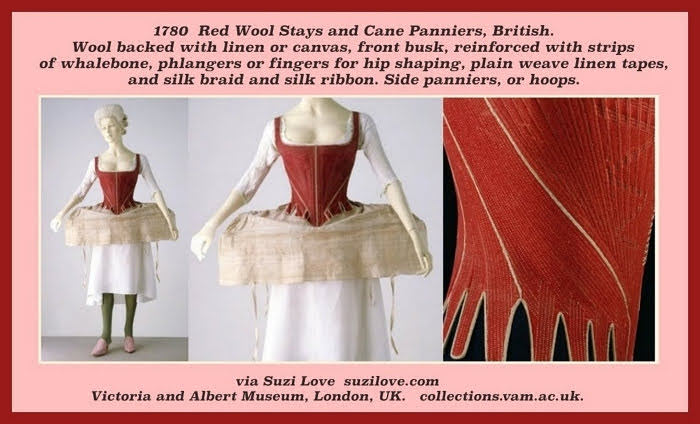
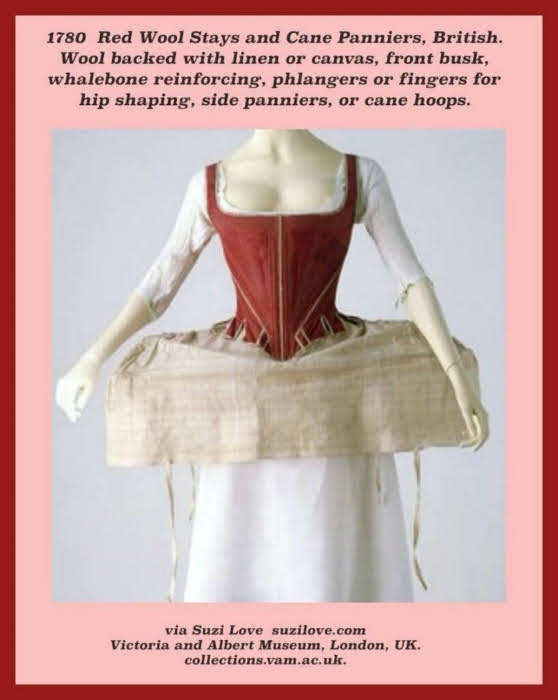
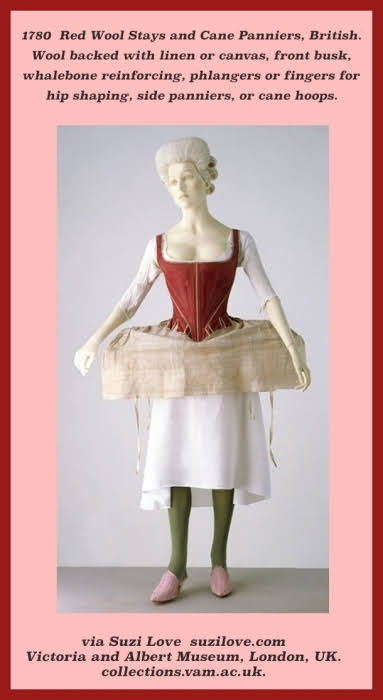
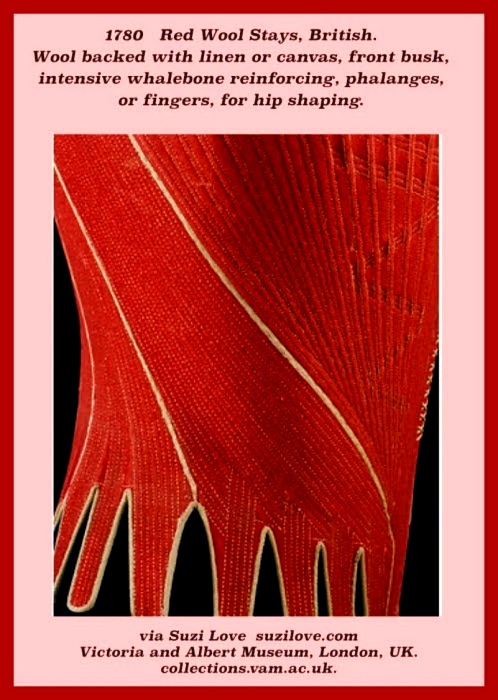
1780 Red Wool Stays, or corset, and Panniers, British. Wool backed with linen or canvas, stitched with linen thread reinforced with strips of whalebone, lined with glazed linen, bound with linen twill tape, fastened with plain weave linen tapes and decorated with silk braid and silk ribbon. Phalanges, or fingers, spread over the hips to give support. Side panniers, or hoops, are made of cane. via Victoria and Albert Museum, London, U.K.

via Victoria and Albert Museum, London, UK. collections.vam.ac.uk. Credit: Given by the family of the late Mrs Jane Robinson. Museum number:T.192-1929

Back-lacing stays with a high narrow back with a wide curving decolletage and V-point in front, about 5 cm below the waistline. Decorative white lacing and white silk braids on centre front which is wide at the top and narrow at the bottom. Below the waist there are 19 tabs, or phalanges, or fingers. Laced through 13 eyelets at back. Compartments for the strips of whalebone are 4 – 5 mm wide, running vertically and diagonally. Centre busk of whalebone about 2 cm wide. Shoulder straps have an eyelet and extend from the front and fasten with tape at each shoulder back.

Stays were an essential item of underwear for women during the 18th century. By the 1780s, the fashionable torso consisted of an inverted cone shape. Achieving smoothness of profile and firmness of contour were the primary function of 18th-century stays, rather than emphasising the bust or constricting the waist. Although custom-made and very intricately designed, stays were usually very plain. On these stays a simple silk ribbon and linen tape serve as decoration and functional finishings.

The narrow rows of very fine, even hand stitching form the compartments into which thin strips of whalebone were inserted. Although the stays appear very rigid, whalebone was quite flexible. It had the added advantage of softening with the heat of the wearer’s body, allowing the stays to mold to her shape. When worn, the shaped and boned tabs at the lower edge would splay over the wearer’s hips, giving further fullness to the petticoat tied at the waist over the stays.

1780 Red Wool Stays, or corset, and Panniers, British. Wool backed with linen or canvas, stitched with linen thread reinforced with strips of whalebone, lined with glazed linen, bound with linen twill tape, fastened with plain weave linen tapes and decorated with silk braid and silk ribbon. Phalanges, or fingers, spread over the hips to give support. Side panniers, or hoops, are made of cane. via Victoria and Albert Museum, London, U.K.
HN_15_D2D_Corsets 1700-1790

Posted in 1700s, 1700s Womens Fashion, Corset, England, Georgian Era, Georgian Fashion, Suzi Love Images, underclothing | Tagged 1700s Or Georgian Era, 1700s Women's Fashion, Corset, Georgian Fashion, underclothing, Victoria and Albert Museum

1800-1817 ca. Professional Man’s Black Wool Suit As Worn in Times Of the Bridgerton Family and Jane Austen. #Bridgerton #JaneAusten #RegencyFashion #RegencyEra

Suzi Love Posted on June 26, 2026 by Suzi LoveJune 14, 2026

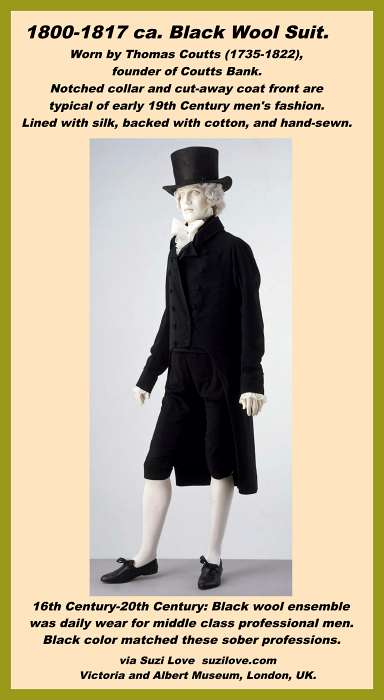
1800-1817 ca. Black Wool Suit, British. An ensemble made from black wool has been the uniform of the middle-class professional – doctor, lawyer, clergyman, academic, merchant, businessmen – since the late 16th century. This tradition continued through the 19th century and well into the 20th. The sombre color of this suit befits the sober profession of its wearer, Thomas Coutts (1735-1822), the founder of Coutts Bank. The notched collar and cut-away front of the coat reflect early-19th-century fashions. via Victoria and Albert Museum, London, UK. collections.vam.ac.uk. https://books2read.com/SuziLoveFashionMen1800-1819

This is the sort of suit that professional men in Jane Austen’s times would have worn, doctors, lawyers and clergymen. https://books2read.com/SuziLoveFashionMen1800-1819

1800-1817 ca. Black Wool Suit, British. An ensemble made from black wool has been the uniform of the middle-class professional – doctor, lawyer, clergyman, academic, merchant, businessmen - since the late 16th century. This tradition continued through the 19th century and well into the 20th. The sombre color of this suit befits the sober profession of its wearer, Thomas Coutts (1735-1822), the founder of Coutts Bank. The notched collar and cut-away front of the coat reflect early-19th-century fashions. via Victoria and Albert Museum, London, UK. collections.vam.ac.uk.
HN_23_D2D_Fashion Men 1800-1819
https://books2read.com/SuziLoveFashionMen1800-1819
Posted in 1800s, 1800s Mens Fashions, Coat or Pelisse Or Redingote, England, fashion accessories, hats, Jane Austen, London, medical, money, pants, Regency Era, Regency Fashion, shoes, Suit, Suzi Love Images, Vest or Waistcoat | Tagged 1800s men fashion, cravat, fashion accessories, Hats And Hair, Jane Austen, pants, Regency Fashion, Shoes, stockings, Victoria and Albert Museum

Post navigation

← Previous Post

SUBSCRIBE TO SUZI LOVE'S NEWSLETTER.

Recent Posts

  • Lover of the Bridgertons and Jane Austen? Mourning and riding fashion,underclothing and corsets. #Bridgerton #JaneAusten #RegencyFashion
  • Book Hooks: Petunia and the Pearl Diver. Petunia planted her feet and stifled her desire to run. #Regencyromance #historicalromance #London #mfrw
  • Writing Regency Era Stories? Lover of the Bridgertons and Jane Austen? Mourning, riding, daytime, evening fashions plus underclothing. #bridgerton #JaneAusten #suzilovebooks #regencyfashion
  • 1814 Gentleman’s dark green coat, top hat and high boots in Jane Austen and Bridergton style. #bridgerton #janeausten #RegencyFashion
  • 1700-1800 ca. Women’s Pockets With Waist Ties as worn in Jane Austen’s years. #Georgianera #Regencyera #JaneAusten #Underclothing

Recent Comments

  1. James DiBenedetto on Book Hooks: Petunia and the Pearl Diver. Petunia planted her feet and stifled her desire to run. #Regencyromance #historicalromance #London #mfrw
  2. Suzi Love on Book Hooks: Petunia and the Pearl Diver. Petunia pointed the whip at the pearl diver a second time. #Regencyromance #historicalromance #London #mfrw
  3. Suzi Love on Book Hooks: Petunia and the Pearl Diver. Petunia pointed the whip at the pearl diver a second time. #Regencyromance #historicalromance #London #mfrw
  4. Suzi Love on Book Hooks: Petunia and the Pearl Diver. Petunia pointed the whip at the pearl diver a second time. #Regencyromance #historicalromance #London #mfrw
  5. Suzi Love on Book Hooks: Petunia and the Pearl Diver. Petunia pointed the whip at the pearl diver a second time. #Regencyromance #historicalromance #London #mfrw

Login

  • Log in

Archives

  • September 2026
  • August 2026
  • July 2026
  • June 2026
  • May 2026
  • April 2026
  • March 2026
  • February 2026
  • January 2026
  • December 2025
  • November 2025
  • October 2025
  • September 2025
  • August 2025
  • July 2025
  • June 2025
  • May 2025
  • April 2025
  • March 2025
  • February 2025
  • January 2025
  • December 2024
  • November 2024
  • October 2024
  • September 2024
  • August 2024
  • July 2024
  • June 2024
  • May 2024
  • April 2024
  • March 2024
  • February 2024
  • January 2024
  • November 2023
  • October 2023
  • September 2023
  • August 2023
  • July 2023
  • April 2023
  • March 2023
  • June 2022
  • April 2022

Categories

  • 1700s
  • 1700s Mens fashion
  • 1700s Womens Fashion
  • 1800s
  • 1800s Mens Fashions
  • 1800s women's fashion
  • 1900s
  • art
  • Australia
  • Bath
  • bedroom fashion
  • Book Hooks
  • Box Or Container
  • Bridgerton
  • Bus Trips
  • Canada
  • Carriage
  • cartoon
  • Celebrity
  • Chatelaine
  • children
  • Children
  • Christmas
  • Coat or Pelisse Or Redingote
  • Contemporary
  • Corset
  • Couple
  • Customs & Manners
  • dancing
  • December Scandal
  • Decorative Item
  • Dress Or Robe
  • Easter
  • Edwardian Era
  • Embracing Scandal
  • England
  • Ester In Images
  • Europe
  • Events
  • Fashion
  • fashion accessories
  • Food and Drink
  • Four Times A Virgin
  • France
  • furniture
  • Georgian Era
  • Georgian Fashion
  • Google Books
  • Grand Tour
  • Group
  • hats
  • History
  • History Events
  • History Notes
  • History Of Christmases Past
  • household
  • Hygiene
  • Irresistible Aristocrats
  • Jane Austen
  • Keanu Reeves
  • Kellys Justice
  • Legal
  • London
  • Love After Waterloo
  • Loving Lady Katharine
  • medical
  • military
  • money
  • mourning
  • Music
  • Outback Arrival
  • pants
  • Pastimes
  • peerage
  • People
  • Petunia and Pearl Diver
  • Places
  • Pleasure House Ball
  • postal
  • Queensland
  • Quotations
  • Regency Era
  • Regency Fashion
  • Regency Life Series
  • Reticule or Bag
  • riding
  • Romantic Era
  • Royalty
  • Russia
  • Scandalous Siblings Series
  • Scenting Scandal
  • Self Publishing
  • sewing
  • Shirt
  • shoes
  • Shopping
  • South Pacific
  • Spencer
  • sports
  • Suit
  • Sunday Snippet
  • Suzi Love
  • Suzi Love Books
  • Suzi Love Images
  • Suzi Love Writing
  • Swain Cove
  • THe Viscount's Pleasure House
  • travel
  • U.S.A
  • underclothing
  • Vest or Waistcoat
  • Victorian Era
  • Victorian Fashion
  • weapons
  • weddings
  • Writing Tools

1800s men fashion 1800s women's fashion antiques Bridgerton British history Cartoons Corset cravat decorative Dress Or Gown England europe fashion accessories Fashion Plate France Georgian era Georgian Fashion gloves google books Hats And Hair historical romance History Notes household Jane Austen jewelry Journal des Dames et des Modes London Metropolitan Museum NYC pants Redingote Or Pelisse Or Coat Regency Era Regency Fashion Regency London reticule or bag riding Romantic Era sewing shawls Shoes Suzi Love Books Suzi Love Images Tailcoat The Repository Of Arts underclothing Vest or Waistcoat

©2026 - Suzi Love - Weaver Xtreme Theme Privacy Policy
↑