1800 ca. Fawn Cotton Bodiced Petticoat With Front Lacing, English. via National Trust Collections, UK. nationaltrustcollections.org.uk
Because dresses were so light and airy as to be almost see-through, petticoats were needed to protect a woman’s modesty. If a glimpse of an ankle was supposed to turn a man’s head, imagine what would happen if he saw an entire lady’s exposed leg.
Did Jane Austen wear this type of petticoat under her dress? Probably. This wide necked, small shoulder straps and Empire, or high-waisted, undergarment would have provided some warmth plus protect the modesty of Regency Era women. This would be worn under the high-waisted, wide necked, small bodiced type of thin, or even almost transparent, dresses of the early 1800s.
1750-1770 ca. Back Lacing Linen Corset, European. Made of linen, lining of natural linen, chamois leather to strengthen, straps of linen, stiffening of whalebone. Corset: deep point, hip flaps, lacing at the back, Netherlands.
Description: Quilted linen corset with vertical tunnels and with ribs. Whalebone stiffening, point on front, hip flaps, front shoulder straps of fabric plus long narrow linen strips to tie. Lined and has chamois leather at armpits, front point and waist. Linen corset with a deep thickened point at the front, hip flaps, and lacing at the back. Fully quilted with vertical tunnels, with ribs. Thickened tip at the front is slightly triangular. Above for round shape due to wide horizontal rib. Flares from the waist into hip phlangers, or fingers. Lacing eyelets and criss-crossed lacing at the back. Front shoulder straps are of the fabric with very long linen straps with narrower linen strap, total 110 cm, and two horizontal linen loops on top of the backs. There is a narrow linen strip on all seams and along all edges. Armpits and the front point are reinforced with chamois leather and chamois leather is at the waist with straps attached. Via Mode Museum Province of Antwerp
Corsets 1700-1790 History Notes Book 15 This book shows how body wraps, stomachers and stays were worn during the 1700s. They created a variety of fashionable silhouettes to suit the elaborate fashions worn for court and daily life during the 18th Century. Wearing the correct underclothing was essential for keeping garments in place and giving the best fashion display.
1740–1760 ca. Silk and Cotton Petticoat. via Suzi Love ~ suzilove.com & Metropolitan Museum, N.Y.C., U.S.A. metmuseum.org
HN_1 Fashion Women Late 1700s History Notes Book 1 by Suzi Love.
What was fashionable for women in the late 1700s? Extravagant colors and fabrics and outrageous styles were all seen in these flamboyant fashions.
books2read.com/suziloveFashWomen1700s
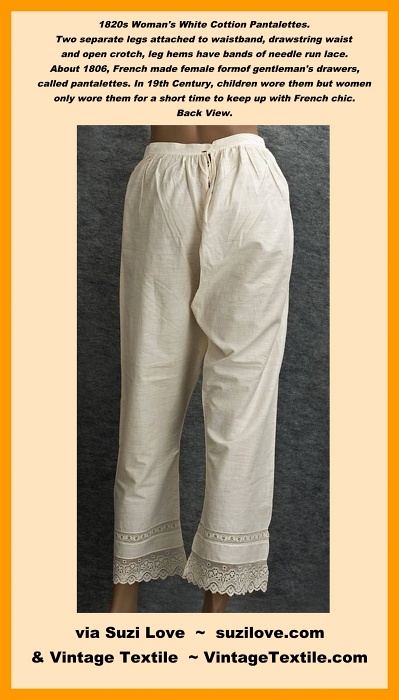
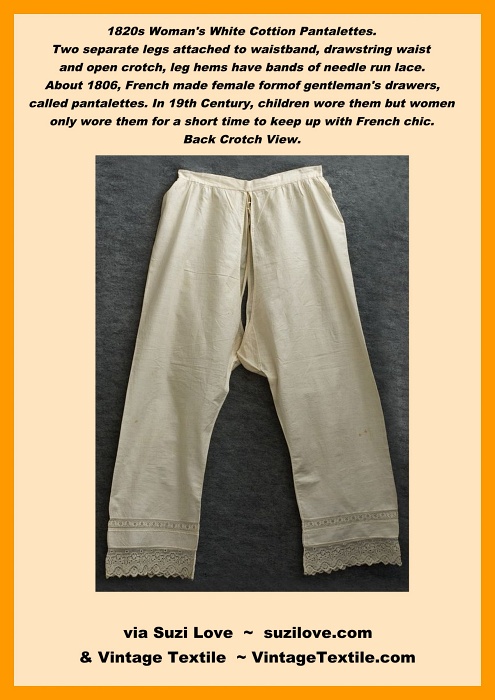
1820s Woman’s White Cotton and Lace Trimmed Pantalettes with Two Separate Legs. About 1806, French made female form of gentleman’s drawers, pantalettes. During the 19th Century, children wore them but women only wore them for a short time to keep up with French chic. The predecessor of women’s panties appeared about 1806 in the form of drawers like those worn by gentleman. Always the leader in forward chic, the French quickly came up with the female version—pantalettes. While the style persisted throughout the 19th century for children, pantalettes for adult women were only a passing fad. The pantalettes consist of two separate legs attached to a drawstring waistband, leaving the crotch open. The legs are bordered at the bottom with bands of needle run lace. The pantalettes are completely hand stitched and close in back with one mother-of-pearl button. The open edges of the crotch are finished with corded piping. via vintagetextile.com
1820-1840 ca. Hand-Embroidered Wedding Corset, Connecticut, USA. Ivory cotton covered with hand embroidery, including love birds on hearts, front pocket for busk, eyelets for back lacing. Trapunto (to embroider) cording decorates and shapes corset. The back closure has ivory eyelets for the lacing. The center-front has a pocket panel for inserting a busk. Trapunto (to embroider) shapes the corset by outlining the design with two or more rows of running stitches and then padding from the underside which gives a raised effect.The technique was always considered very elegant. Trapunto first appeared in 14th century Sicily and was widely adopted for clothing in Tudor England, and then brought to America by the new settlers. In addition to the cording, the corset is totally covered with hand-embroidered flowers and there are two embroidered love birds on hearts at the center-front. Above the birds is a section of trapunto work. via Vintage Textiles
1830 ca. Quilted Buff Canvas Corset, English. Quilted canvas, wood, boning, and brass. Self lined, quilted with back stitch.
Front fastening, shoulder straps, and brass eyelets for back. The wide centre front busk may be of wood and these stays are boned from the waist through the centre of the bust gussets, with three bones at each side and on each side of the back lacing. The rest is quilted, the top is over a cord foundation, and there are gussets at the hips. Eyelets in the back and strap lacing are of brass and machine inserted. On the left of the centre busk at hip level, is a tape stretched so that it ties horizontally. The top and straps are bound with tape. Self lined, quilted in back stitch, the waist is herringboned, and the bases of the bust and hip gores are button-holed. via Victoria and Albert Museum, London, UK. collections.vam.ac.uk
In Jane Austen’s years of the early nineteenth century, women often wore light-weight dresses under which was worn a range of underclothing to stop gowns appearing transparent and sticking to a lady’s body. To preserve modesty, underclothing included a chemise next to the skin, then a corset, and then petticoats to give shape to a dress and to keep it away from her body.
What did Jane Austen and friends wear? Early 1800s fashions were elegant and pretty with high waists and fabrics that were almost transparent. These Empire style gowns, named after Napoleon’s first Empress, became popular throughout Europe, and were then copied around the world. Colorful outwear was added to make an ensemble more attractive and warmer. History Notes Book 26 Fashion Women 1805-1809. https://books2read.com/SuziLoveFashionWomen1805-1809
The Empire waist gown defined women’s fashion during the Regency Era. ‘Empire’ is the name given in France to the period when Napoleon built his French Empire. High-waisted, loose gowns were adopted by the aristocracy as a symbol of turning away from the fussy, elaborate and expensive clothing worn in the 1700s. Jean-Jaques Rousseau advocated copying peasants and returning to a simpler life and more natural fashions. Unrestricting clothing was part of the new Democracy in France and these simpler and flowing fashions were adopted all over Europe, including Britain and despite the continual wars being fought against France during the early 1800s. Not even war stopped fashions from being copied everywhere.
Fashion Women 1805-1809 History Notes Book 26
What did Jane Austen and friends wear? This book looks at early 1800s fashions, which were elegant and pretty with high waists and fabrics that were almost transparent. These Empire style gowns, named after Napoleon’s first Empress, became popular throughout Europe, and were then copied around the world. Colorful outwear was added to make an ensemble more attractive and warmer.
https://books2read.com/SuziLoveFashionWomen1805-1809HN_26_D2D_FsshionWomen1805-1809
1780 Stays and Panier, or Hoop Petticoat, England. via suzilove.com and Los Angeles County Museum of Art, California, USA. Stays: Brown linen twill and baleen. Panier: Woman’s hoop petticoat, or pannier, of linen plain weave and cane 1750-1780. via Los Angeles County Museum of Art, California, USA. collections.lacma.org
1780 Stays and Panier, or Hoop Petticoat, England. via suzilove.com and Los Angeles County Museum of Art, California, USA. collections.lacma.org
1807 Healthful Dipping. Lady in her white linen chemise, or shift, preparing to take a dip in the spa waters. Scenes of Spa life. By F. Eginton, New Bath Guide. ‘How the ladies did giggle and set up their clacks, All the while an old lady was rubbing their backs.’ From Anstey’s ‘The New Bath Guide’. In Jane Austen’s novels, the resorts of Brighton, Scarborough, Cromer, Lyme and the fictional Sandy ton or Sanditon all get mentions. Women bathed in the sea, via bathing machines pulled down to the water’s edge, or promenaded along beautiful walkways, such as in Cheltenham, near Bat in Britain. Visiting seaside resorts became very popular during the Regency years. Le Beau Monde, or fashionable society, went to spa and beach towns to ‘take the waters’ or to holiday in a fashionable town. To see and be seen. Ladies dressed in light muslin gowns but added colorful accessories to make outfits more interesting.
Chemise Or Shift: Sleeveless, mid-calf length garment of white cotton or muslin was worn next to the skin under stays or corset. Called ‘Shift’ from early Georgian (1700-1750) until Late Georgian (1750-1790) to replace ‘Smock’. By 1800, name replaced by ‘Chemise’.
1807 Healthful Dipping.
Lady in her white linen chemise, or shift, preparing to take a dip in the spa waters.
Scenes of Spa life. By F. Eginton.
New Bath Guide.
How the ladies did giggle and set up their clacks, All the while an old lady was rubbing their backs.
From Anstey’s ‘The New Bath Guide’.
Suzi Love – suzilove.com Fashion Women 1805-1809 History Notes Book 26 What did Jane Austen and friends wear? https://books2read.com/SuziLoveFashionWomen1805-1809