1815 Man’s Cutaway Coat, American. Blue patterned linen, double breasted cutaway coat with a V-cut collar. via The Metropolitan Museum metmuseum.org




1815 Man’s Cutaway Coat, American. Blue patterned linen, double breasted cutaway coat with a V-cut collar. via The Metropolitan Museum metmuseum.org
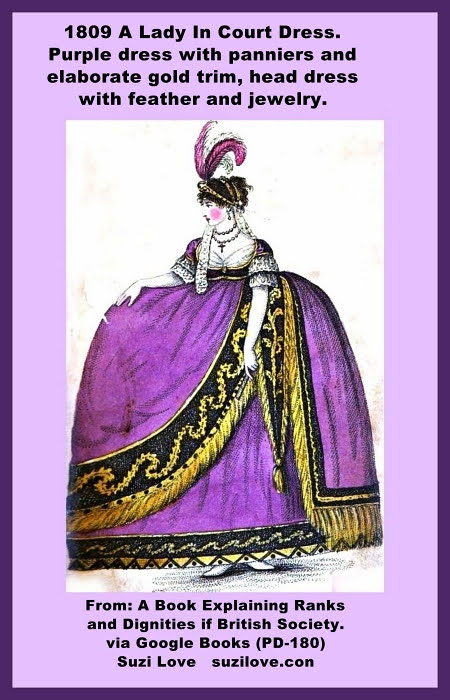
1809 A Lady In Court Dress. From: 1809 A Book Explaining Ranks and Dignities in British Society. via Google Books (PD-180)
Definition Court Dress: Usually, the difference between a court dress and a ball dress was in the quality of fabrics used, how elaborate the design, and the number and quality of the accessories. Plus, in England in the early 1800s court dresses were required by Queen Charlotte to have hoops and in France and other European countries court dresses a long train, usually expensively decorated. During the Regency Era, white cotton dresses were considered suitable for many evening events, but definitely not for an evening event in a palace.
Fashion Women 1805-1809 History Notes Book 26 What did Jane Austen and friends wear? This book looks at early 1800s fashions, which were elegant and pretty with high waists and fabrics that were almost transparent. These Empire style gowns, named after Napoleon’s first Empress, became popular throughout Europe, and were then copied around the world. Colorful outwear was added to make an ensemble more attractive and warmer.
1800 ca. Tan Corduroy Breeches. Drop down front flap, or ‘fall’, with two buttons, three silver metal buttons at the waistband, watch pocket, corner pockets with buttons, pieced back with waist tie, saggy back with extra fabric to allow for easier movement when riding or sitting, four buttons and silk ties at knee. via Whitaker Auction whitakerauction.smugmug.com. Typical of a gentleman’s breeches worn during the early 1800s, or the Regency Era, or Jane Austen’s times. They have a front flap, or fall, which unbuttons and drops down and a back waist tie to adjust the waist size and there are buttons and ties to secure the breeches below the knee. https://books2read.com/SuziLoveFashionMen1800-1819


1809 White Walking Dress, French. Green cashmere shawl, green shoes and close-fitting hat. This is a fashionable ensemble as would have been worn by Jane Austen and her family and friends. Walking dress such as this would have been worn when out shopping, walking in a park or the country estate. This sort of outfit needed to be presentable and warm, but not overly accessorized. Fashion Plate via Journal des Dames et des Modes, or Costume Parisien.


19th Century Early Brown Trousers, American. Button waist, drop down front flap, or fall, and extra fabric in the back for easy movement. via Metropolitan Museum New York City, U.S.A. metmuseum.org https://books2read.com/SuziLoveFashionMen1800-1819


1785–1800 ca. Cotton Breeches, American or European. Man’s cotton breeches, drop down, or fall, front opening, button fastening at the waist, extra material in the back allows more movement for riding etc., and buttons secure the leg openings so they can be fitted to wear with boots for riding. via Metropolitan Museum, NYC, U.S.A. These are the sort of pants that the men Jane Austen knew would have worn for riding or in the country.

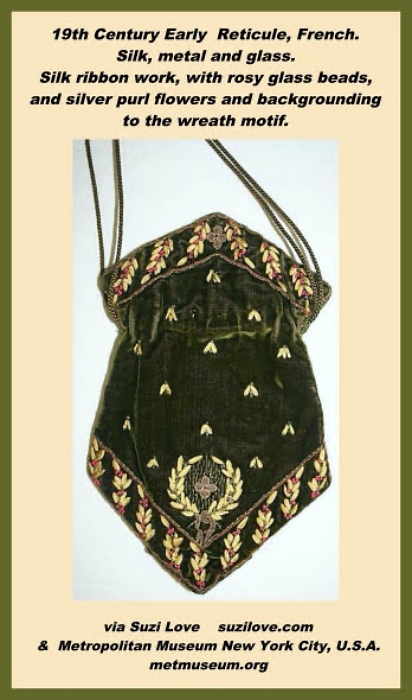
19th cent. Early. Reticule, or Bag, of silk, metal and glass, French, as carried in Jane Austen’s times. Silk ribbon work, with rosy glass beads, and silver purl flowers and backgrounding to the wreath motif. via Metropolitan Museum, N.Y.C., U.S.A. metmuseum.org
Definition Reticule: Bag or purse, often with a drawstring to pull closed and usually made of cloth or covered cardboard and often decorated with beading or embroidery. A reticule, or purse, or handbag, was usually carried by a woman during the Regency period to carry all their daily necessities. Earlier, women used pockets that tied at the waistline and were hidden in the folds of their skirts. Empire style, or early 1800s, high-waisted dresses made it impossible to either sewn in a pocket or to tie on a pocket. So women began carrying small, decorated bags called Reticules, or ridicules, which generally pulled close at the top with a drawstring.

1800 ca. Tan Corduroy Breeches. Drop down front flap, or ‘fall’, with two buttons, three silver metal buttons at the waistband, watch pocket, corner pockets with buttons, pieced back with waist tie, saggy back with extra fabric to allow for easier movement when riding or sitting, four buttons and silk ties at knee. via Whitaker Auction whitakerauction.smugmug.com. https://books2read.com/SuziLoveFashionMen1800-1819.
Typical of a gentleman’s breeches worn during the early 1800s, or the Regency Era, or Jane Austen’s times. They have a front flap, or fall, which unbuttons and drops down and a back waist tie to adjust the waist size and there are buttons and ties to secure the breeches below the knee.
1815 French Couple. Lady in evening dress with scooped neckline on low-cut pink bodice, floral headpiece and long white gloves. Gentleman in brown tailcoat and stirrup trousers, vest, and casual necktie. Fashion Plate via Journal des Dames et des Modes, or Costume Parisien.
The sort of fashionable outfits and items worn or carried by Jane Austen and her contemporaries when out in public. Ladies outfits for evening were accessorized with gloves, headdresses and jewelry and often dresses were of this shorter length for dancing. Gentlemen were always heavily accessorized as well with the essential of gloves, coats, waistcoats and neatly tied cravats. For more about the fashions of 1815, take a look at History Notes Books 23 and 28 men’s and women’s regency Era fashions.
Fashion Women 1815-1819 History Notes Book 28 What did Jane Austen wear? What was fashionable for women at the end of the Regency Era in Britain and the reconstruction in Europe after the wars. Book 28 for 1815-1819 in History Notes Includes fashions for mourning, riding, dresses, hats, shoes, reticules or bags, underclothing, accessories.
Fashion Men 1800-1819 History Notes Book 23 What was fashionable for men in early 1800s, or Jane Austen’s time, or Regency Era? Suits, hats, shoes, underclothing, fashion accessories, military and bedroom fashions. French fashions and Georgian and Regency Era fashions from Great Britain were copied around the world.


1805 Regency Group of Ladies and Gentlemen dressed as Jan Austen and her family and friends would have dressed. Ladies in dresses, bonnets, shawls, gloves, and carrying a reticule, or bag, and a parasol. Gentlemen in tailcoats, overcoats, trousers, vests, cravats, hats, boots and shoes and carrying walking sticks. via Men And Women In Costumes, 1804-1829.
The Miriam and Ira D. Wallach Division, The New York Public Library, U.S.A.
