1851-1860 ca. Queen Victoria’s Ivory Silk Satin Dancing Slippers, English. Made by Richard Gundry, Gundry and Co., Soho Square, London, U.K.


1851-1860 ca. Queen Victoria’s Ivory Silk Satin Dancing Slippers, English. Made by Richard Gundry, Gundry and Co., Soho Square, London, U.K.


1800-1850 ca. Reticule, Or Bag. Brown bag with monogram and drawstring, British. The Bridgerton family and Jane Austen and their female contemporaries would have sewn, gifted and used a bag similar to this. via Snowshill Manor, National Trust, U.K. nationaltrustimages.org.uk
Definition Reticule: Bag or purse, often with a drawstring to pull closed and usually made of cloth or covered cardboard and often decorated with beading or embroidery. A reticule, or purse, or handbag, was usually carried by a woman during the Regency period to carry all their daily necessities. Earlier, women used pockets that tied at the waistline and were hidden in the folds of their skirts. Empire style, or early 1800s, high-waisted dresses made it impossible to either sewn in a pocket or to tie on a pocket. So women began carrying small, decorated bags called Reticules, or ridicules, which generally pulled close at the top with a drawstring.


When Corsets Saved Lives.
During the Victorian Era, the tight lacing of corsets became known for damaging women’s bodies. However, the whalebone used to stiffen corsets was also a protector of the chest and rib area.
1833 Morning Post: HATTON-GARDEN. ATTEMPTED MURDER. George Bailey, a youth about seventeen, was charged with having attempted to murder Mary Prendergast, a young woman, by stabbing her with a large knife. It appeared in evidence that on Thursday morning, last, about five o’clock, the Prisoner, who sells fish in a basket near Portpool-lane, Leather-lane, Holborn, was standing before his basket when the Prosecutrix asked him the price of his fish. He told her, and she refused to purchase, but laughed at him and jeered him.. . . . In the course of the evening the Prosecutrix was passing by, when the Prisoner rushed upon her with a knife which he uses to cut up the fish and, while in a great passion, he pluinged the knife several times at her heart, and the last thrust the point of the knife dug into her clothes, and would have entered her body had it not been that the bone of her stays prevented it …
1837 The Standard: MARLBOROUGH-STREET. – AN UNNATURAL SON – Alfred Grant, a lad about nineteen years of age, of sullen aspect, was brought before Mr. Dyer, charged with having attempted to stab his own mother . . . James Grant, the brother of the prisoner, about sixteen years of age, said the prisoner came home to Grafton-street, Soho, on Monday afternoon, and some words having ensued between him and his mother, he seized a knife and made a stab at her. Fortunately the bone of his mother’s stays turned the point of the knife …
1841 The Morning Post: Catherine Connor, the person alluded to by the last witness, and who is in a state of pregnancy, deposed that she kept a fruit stall opposite to the Phoenix public-house and that on seeing the young man so savagely treated, she made use of the expersions just named, when Hill called her a ——–, and kicked at her violently. Fortunately for her, she received two of the worse kicks aimed at her on the bone of her stays, otherwise they would, she had no doubt, have proved most serious to her from the situation she was then in.
When Corsets Saved Lives. #historicalfashion #underclothing #Victorian #Corset https://books2read.com/SuziLoveCorsetBook22 Share on X
1850 ca. Beaded Crochet Reticule, or Coin Purse. #VictorianFashion #HistoricalFashion #Reticule. http://books2read.com/suziloveReticules
Continue reading →1845-1865 ca. Cream Silk Evening Slippers, British. Cream evening shoes with ankle ties and lace trim. Trim is unusual because mid 19th Century ladies’ shoes were often plain as only toes showed beneath fashionable long skirts. Designed By Hobbs, famous London shoemaker, and with a label attached to lining with a regal crest to show maker’s royal patronage. via Metropolitan Museum, NYC, U.S.A. metmuseum.org


What was fashionable outdoor wear for Jane Austen and contemporaries? Reticules, Spencers, and Pelisses, or Walking Dresses, Or Redingotes. History Notes Books 3, 4, and 5 By Suzi Love.
What sort of coats did women wear during the Regency years? them what you like: Coat, Pelisse, Redingote, Walking Dress, Promenade Dress. Take a look at what was being worn by women, men, and children. books2read.com/suzilovePelisse


1831-1850 ca. Reticule, English. Round bag of crimson silk with embroidery and a drawstring. via Museum Of London.


This book shows how body wraps, stays, and corsets were worn to create a variety of fashionable silhouettes through past centuries. Corsets flattened breasts and accentuated rounded hips or pushed up breasts and showed off the bust line depending on the fashions of the time and the desired silhouette. Includes corsets through the Georgian, Regency, Victorian and Edwardian Eras and Jane Austen’s lifetime. Overview of corsets through history, including the Georgian, Regency, Victorian and Edwardian Eras and Jane Austen’s lifetime. History Notes Book 14.
https://books2read.com/SuziLoveCorsetBook14


Top Hat Styles Chart during the 1800s, from the Regency Era through to the Victorian years. Most popular style was cone shaped and tall in height. Originally made of beaver and very short but later from silk and taller. Tall crown, widens at top, narrow brim turns up slightly at sides.

From the finish of the 18th century until 1820, men’s fashions in European and European-influenced countries moved away from the formal wear of brocades, lace, wigs and powder to more informal and relaxed styles. Focus was on undress rather than formal dress. Typical menswear in the early 1800s included a tailcoat, a vest or waistcoat, either breeches, pants, or the newer trousers, stockings, shoes or boots, all worn with an overcoat and hat. This basic ensemble was accessorized with some form of neckcloth or cravat, gloves, walking stick, cane or riding crop, handkerchief, fobs, watch and perhaps a quizzing glass or eye glass.
Skirted coats were replaced with short-fronted, or cutaway, tailcoats worn over fitted waistcoats and plain, white linen shirts. Knee breeches were gradually replaced by tight-fitting pantaloons and later trousers, decorative shoes with buckles were replaced with a variety of boot styles, and fussy and ruffled neckwear gave way to intricately tied, white linen neck cloths. A Regency Era, or early 1800s, gentleman was outfitted in more practical fabrics, such as wool, cotton and buckskin rather than the fussy brocades and silks of the late 1700s.
1804 Men's Fashions In The Time Of Jane Austen. #Regency #Fashion #JaneAusten Share on X
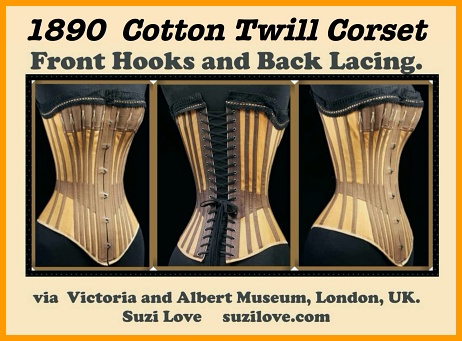
1875-1899 ca. Side Lacing Maternity Corset, Possibly England Or Germany. Embroidered cotton with metal and boning, possibly used as a maternity corset. This corset is made of cream cotton with red machine-embroidered trim and trimmed with a scallop edged tape. The corset is made in four parts and fastens at the front with a busk and with five white metal loops and studs. At the back are seventeen sets of white metal bound eyelets for threading through a lace. At each side, there are twelves sets of metal bound eyelets to fasten with elasticated laces. There is a vertical opening at the bust which fastens with three bronze gilt press studs, clamped into the fabric, and a diamond pattern impressed on the head which shows on the face of the fabric. On the reverse of the stud is a mark.
The corsets reach from the bust to the middle of the hip descending to a point at about the middle of the belly in the centre front. They are machine-stitched and seem lightly boned, encased and sewn to the face of the fabric. Bound at the top and bottom with grey tape. The breast gussets and side lacing suggest this is a maternity corset. Corsets designed for pregnancy and nursing were advertised throughout the 19th century. This maternity corset is a typical example. It is constructed like a fashionable corset, with boning and a central busk. It has side laces, to enable the wearer to adjust the corset to her changing figure. The cups can be opened for breastfeeding by releasing the press studs. via Victoria and Albert Museum, London, UK.