↓
 

Suzi Love

Making history fun, one year at a time.

Header_
  • Home
  • Newsletter
  • Pre order form
  • Shop
    • Cart
    • Checkout
    • My account
    • Refund and Returns Policy
  • Blog
  • BOOKS
    • History Events
    • Kelly’s Justice
    • Outback Arrival
    • Irresistible Aristocrats
    • History Notes
    • Scandalous Siblings
    • Love After Waterloo
    • Regency Life Series
  • Privacy Policy
  • EVENTS
Home » Victoria and Albert Museum 1 2 3 4 5 >>

Tag Archives: Victoria and Albert Museum

Post navigation

← Previous Post
corset_1770-1790 ca. Collage View. Pink Silk Damask Stays, Or Corset, English. via Victoria and Albert Museum, London, UK. collections.vam.ac.uk.

1770-1790 ca. Pink Silk Damask Stays, Or Corset, English. #GeorgianFashion #Corset #BritishHistory

Suzi Love Posted on November 1, 2026 by Suzi LoveNovember 1, 2026

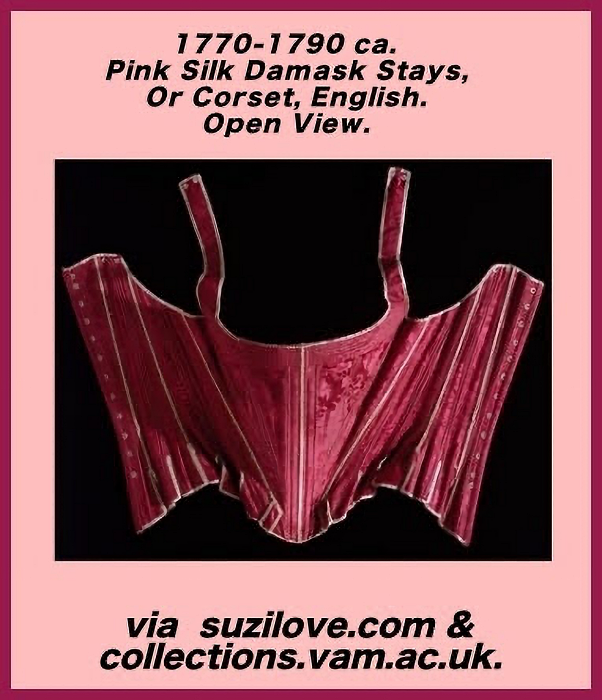
1770-1790 ca. Stays, or Corset, English. Pink silk damask, lined with linen, reinforced with whalebone, fingers spread over hips. via Victoria and Albert Museum, London, UK. collections.vam.ac.uk. https://books2read.com/SuziLoveCorsetBook15

corset_1770-1790 ca. Front View. Pink Silk Damask Stays, Or Corset, English. via Victoria and Albert Museum, London, UK. collections.vam.ac.uk.
1770-1790 ca. Front View. Pink Silk Damask Stays, Or Corset, English. via Victoria and Albert Museum, London, UK. collections.vam.ac.uk.
corset_1770-1790 ca. Back View. Pink Silk Damask Stays, Or Corset, English. via Victoria and Albert Museum, London, UK. collections.vam.ac.uk.
1770-1790 ca. Back View. Pink Silk Damask Stays, Or Corset, English. via Victoria and Albert Museum, London, UK. collections.vam.ac.uk.
corset_1770-1790 ca. Open View. Pink Silk Damask Stays, Or Corset, English. via Victoria and Albert Museum, London, UK. collections.vam.ac.uk.
1770-1790 ca. Open View. Pink Silk Damask Stays, Or Corset, English. via Victoria and Albert Museum, London, UK. collections.vam.ac.uk.
1770-1790 Pink Silk Damask Stays, Or Corset, English. #Georgian #Corset #BritishHistory
HN_15_D2D_Corsets 1700-1790
https://books2read.com/SuziLoveCorsetBook15
HN_15_D2D_Corsets 1700-1790 https://books2read.com/SuziLoveCorsetBook15
Posted in 1700s, 1700s Womens Fashion, Corset, England, Georgian Era, Georgian Fashion, Jane Austen, Suzi Love Images, underclothing | Tagged 1700s Women's Fashion, British history, Corset, Georgian Fashion, Jane Austen, Suzi Love Images, Suzi Love Research, underclothing, Victoria and Albert Museum

1700s Late Pair of Pattens, Or Strap On Undershoes, As Used On Rainy Days in Jane Austen and Bridgerton Times. #Bridgerton #JaneAusten #Shoes #BritishHistory #History

Suzi Love Posted on October 30, 2026 by Suzi LoveOctober 19, 2026

1700s Late Pair of Pattens, English. Iron supports underneath leather and wood. via Victoria and Albert Museum, London, UK. collections.vam.ac.uk.

Definition Pattens: Under shoes that strapped onto shoes and worn outdoors and to lift shoes and dresses out the mud. People in Jane Austen’s lifetime would have used these to protect the hems of dresses and legs of men’s pants, plus protect delicate shoes.

Fashion Women Late 1700s History Notes Book 1.
What was fashionable for women in the late 1700s? Extravagant colors and fabrics and outrageous styles were all seen in these flamboyant fashions. Take a look at their dresses, suits, hats, shoes and bedroom fashions. books2read.com/suziloveFashWomen1700s

1700s Late Pair of Pattens, English. Iron supports underneath leather and wood. Pattens: Under shoes that strapped onto shoes and worn outdoors and to lift shoes and dresses out the mud. via Victoria and Albert Museum, London, UK. collections.vam.ac.uk.
HN_1_D2D_Fashion Women 1700s
books2read.com/suziloveFashWomen1700s
HN_1 Fashion Women Late 1700s History Notes Book 1 by Suzi Love. What was fashionable for women in the late 1700s? Extravagant colors and fabrics and outrageous styles were all seen in these flamboyant fashions. books2read.com/suziloveFashWomen1700s
Posted in 1700s, 1700s Mens fashion, 1700s Womens Fashion, Bridgerton, Customs & Manners, England, fashion accessories, Georgian Era, Georgian Fashion, History, Jane Austen, shoes, Suzi Love Images | Tagged 1700s Mens Fashion, 1700s Or Georgian Era, 1700s Women's Fashion, Bridgerton, British history, Georgian era, Georgian Fashion, Jane Austen, Shoes, Victoria and Albert Museum
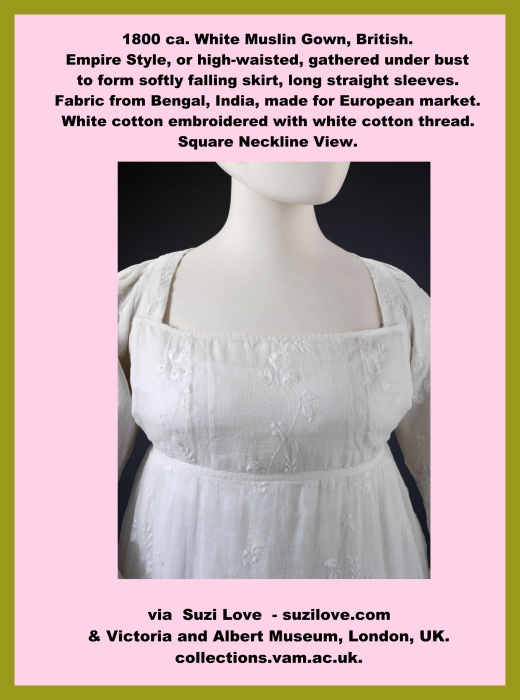
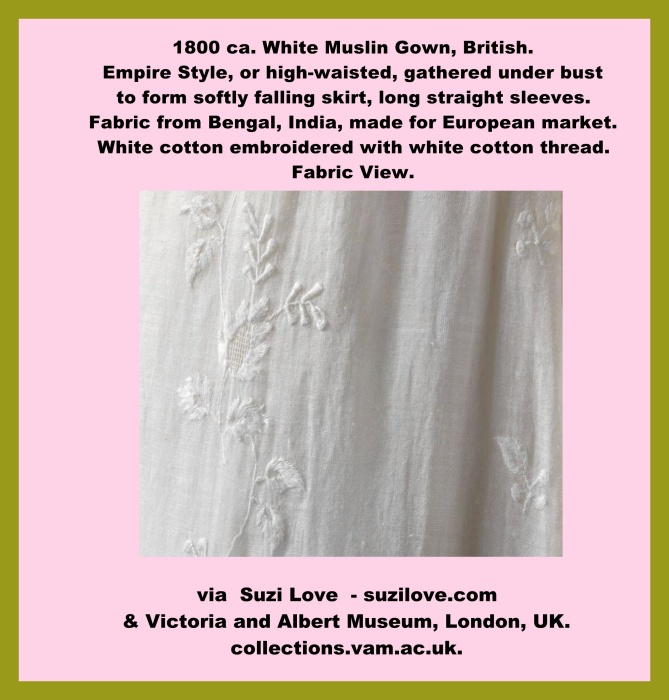
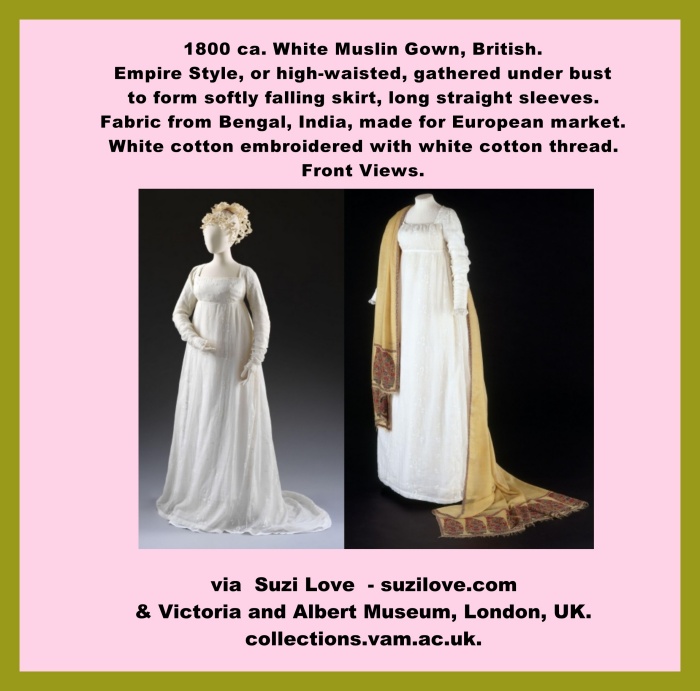
1800 ca. White Muslin Gown, British. Empire Style, or high-waisted, gathered under bust to form softly falling skirt, long straight sleeves. Fabric from Bengal, India, made for European market. White cotton embroidered with white cotton thread. via Victoria and Albert Museum, London, UK. collections.vam.ac.uk.

1800 Embroidered White On White Muslin Robe in Jane Austen Style. #JaneAusten #RegencyFashion #HistoricalFashion

Suzi Love Posted on October 20, 2026 by Suzi LoveOctober 3, 2026

1800 ca. White Muslin Gown, British. Empire Style, or high-waisted, gathered under bust to form softly falling skirt, long straight sleeves. Fabric from Bengal, India, made for European market. White cotton embroidered with white cotton thread.
via Victoria and Albert Museum, London, UK. collections.vam.ac.uk.

About 1800 Women’s dress changed dramatically after 1785. The rich fabrics and complicated, formal shapes of the late 18th century gave way to simple, light fabrics that draped easily. These new gowns achieved something of the effect of the simple tunics shown on classical Greek and Roman statues and vases, Muslin embroidered with cotton thread Fabric made in India, gown made in England Given by Miss Frances Vickers Museum no. 444-1888 (2013) Victoria and Albert Museum, London.

By the end of the 18th century, rigidly tailored garments for both men and women were replaced by styles made for ease and comfort, resulting in the neoclassical style of the 1780s. Inspired in part by the statuary of ancient Greece and Rome, the new fashion was epitomised by light cotton gowns falling around the body in an unstructured way, held around the high waist with a simple sash and accompanied by a soft shawl draped around exposed shoulders. This style was ideal for the Indian imports like Kashmiri shawls and Bengali muslin, as used in this embroidered gown. Championed by such influential figures as Emma Hamilton in England and Madame Récamier in France, the so-called ‘Empire’ style catapulted Indian muslin into the forefront of fashion.

Definition Empire Style Dress:  Named after the First Empire in France. Empire dresses had a low neckline and skirts started directly under the bust and flowed into the classical relaxed wide styles of Greece and Rome. This style of dress is associated with Jane Austen and her contemporaries as a high-waisted dress was worn most days. Cotton, silk or taffeta were the popular fabrics. Only the very wealthy could afford white dress in this style as the cottons were imported from India and had to be carefully cleaned, usually by a lady’s maid.

1800 ca. White Muslin Gown, British. Empire Style, or high-waisted, gathered under bust to form softly falling skirt, long straight sleeves. Fabric from Bengal, India, made for European market. White cotton embroidered with white cotton thread. via Victoria and Albert Museum, London, UK. collections.vam.ac.uk.
HN_12_D2D Retailer Buy Link
books2read.com/SuziLoveFashionWomen1800
HN_12 D2D_RetailerBuyLink_HN_12 books2read.com/SuziLoveFashionWomen1800
Posted in 1800s, 1800s women's fashion, Dress Or Robe, England, Jane Austen, Regency Era, Regency Fashion, sewing, Suzi Love Images | Tagged 1800s women's fashion, Dress Or Gown, fabrics, Jane Austen, Regency Fashion, sewing, Victoria and Albert Museum

1660-1700 ca. Green Velvet Gaming Purse, Probably French. #Europe #games #Antiques #purse

Suzi Love Posted on October 19, 2026 by Suzi LoveOctober 13, 2026

1660-1700 ca.  Green Velvet Gaming Purse, Probably French. Trimmed with Copper-Gilt Thread, probably French. This purse was designed especially for gaming, or gambling, and would have held money, or counters, and is of a different design to other 17th-century purses. The base is a flat circle and the sides are gathered on a drawstring to stop money or gaming counters from spilling out, and to hide how much a gambler had in the purse. The bag’s plain look was probably a deliberate move to fool other gamblers into thinking the owner had little money.The purse is quite plain, with no embroidery and only a twist of copper gilt thread, gilt being a cheap substitute for gold or silver thread.

Playing and betting on card games was a socially acceptable pastime for the wealthy in the late 17th century. Along with dancing, riding and the theatre, it was an amusement for those classes that did not have to work. A gentleman or lady who did not participate in games such as ‘Quadrille’ and ‘Basset’ would have been considered ‘low-bred and hardly fit for conversation’ according to ‘The Compleat Gamester’, published in 1674.  Victoria and Albert Museum, London, UK.
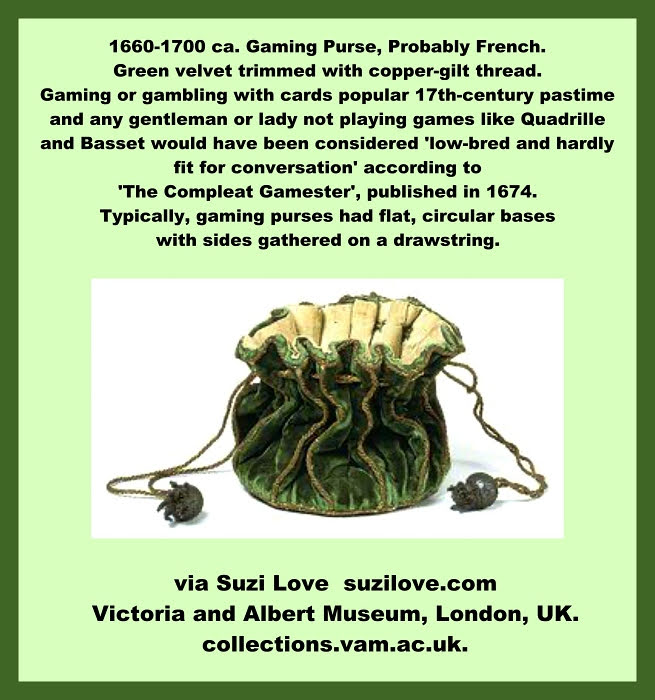
1660-1700-ca. Gaming Purse, probably French. Green velvet trimmed with copper gilt thread. Gaming or gambling with cards popular as a 17th Century Pastime and any gentleman or lady.
HN_3_PelisseRedingoteWalkingDress_universal http://books2read.com/suziloveReticules
D2D_RetailerBuyLink_HN_3 http://books2read.com/suziloveReticules
Posted in Europe, France, Pastimes, Reticule or Bag, Suzi Love Images | Tagged 1600s, France, games, pastimes, reticule or bag, Suzi Love Images, Victoria and Albert Museum
1820 8. Collage Ball Gown of Embroidered Net, British. Puffed short sleeves, underdress of silk satin, overdress of machine-made silk net embroidered with metal and trimmed with blonde bobbin lace. Low oval neckline, wedge shaped front bodice panel and medium high waist, or, not quite Empire line. collections.vam.ac.uk

1820 Short Sleeved Ball Gown of Embroidered Silk Net, British. #RegencyFashion #Historicalfashion #sewing

Suzi Love Posted on October 19, 2026 by Suzi LoveSeptember 29, 2026

1820 Ball Gown of Embroidered Net, British. Silk satin and silk net embroidered with metal and trimmed with silk blonde bobbin lace, hand sewn.  Short-sleeved ball gown comprising of an underdress of silk satin and an overdress of machine-made silk net embroidered with metal and trimmed with blonde bobbin lace. The dress has a low  oval neckline, puffed short sleeves, a wedge shaped front bodice panel,  and a medium high waist. The skirt has a central front panel, wedge shaped panels and the centre back panels are tightly gathered at the waist.

From the Museum Curator: ‘Women saved their most elaborate dresses for special occasions such as balls. Lavish gowns embellished with gold thread or sparkling beads glittered in the artificial light of the dancing room. Thin, gauzy materials created a soft dreamy look. These light materials also prevented the wearer from getting too hot while dancing in stuffy, overcrowded spaces’. Victoria and Albert Museum, London, UK

1820 1. Front Hem Ball Gown of Embroidered Net, British. Puffed short sleeves, underdress of silk satin, overdress of machine-made silk net embroidered with metal and trimmed with blonde bobbin lace. Low oval neckline, wedge shaped front bodice panel and medium high waist, or, not quite Empire line. collections.vam.ac.uk
1820 2. Back Ball Gown of Embroidered Net, British. Puffed short sleeves, underdress of silk satin, overdress of machine-made silk net embroidered with metal and trimmed with blonde bobbin lace. Low oval neckline, wedge shaped front bodice panel and medium high waist, or, not quite Empire line. collections.vam.ac.uk
1820 3. Side Ball Gown of Embroidered Net, British. Puffed short sleeves, underdress of silk satin, overdress of machine-made silk net embroidered with metal and trimmed with blonde bobbin lace. Low oval neckline, wedge shaped front bodice panel and medium high waist, or, not quite Empire line. collections.vam.ac.uk
1820 4. Bodice Ball Gown of Embroidered Net, British. Puffed short sleeves, underdress of silk satin, overdress of machine-made silk net embroidered with metal and trimmed with blonde bobbin lace. Low oval neckline, wedge shaped front bodice panel and medium high waist, or, not quite Empire line. collections.vam.ac.uk
1820 7. Sleeve. Ball Gown of Embroidered Net, British. Puffed short sleeves, underdress of silk satin, overdress of machine-made silk net embroidered with metal and trimmed with blonde bobbin lace. Low oval neckline, wedge shaped front bodice panel and medium high waist, or, not quite Empire line. collections.vam.ac.uk
1820 5. Hem Ball Gown of Embroidered Net, British. Puffed short sleeves, underdress of silk satin, overdress of machine-made silk net embroidered with metal and trimmed with blonde bobbin lace. Low oval neckline, wedge shaped front bodice panel and medium high waist, or, not quite Empire line. collections.vam.ac.uk
HN_28_D2D_Fashion Women 1815-1819
https://books2read.com/SuziLoveFashionWomen1815-1819
Fashion Women 1815-1819 History Notes Book 28 https://books2read.com/SuziLoveFashionWomen1815-1819
Posted in 1800s, 1800s women's fashion, Dress Or Robe, England, London, Regency Era, Regency Fashion, sewing, Suzi Love Images | Tagged 1800s women's fashion, Dress Or Gown, fabrics, Regency Fashion, sewing, Suzi Love Images, Victoria and Albert Museum | Leave a reply

1830-1835 ca. Canary Yellow Leather and Silk Slippers, British. #RomanticEra #Shoes #Fashion

Suzi Love Posted on October 11, 2026 by Suzi LoveOctober 5, 2026

1830-1835 ca. Canary Yellow Leather and Silk Slippers, British. Silk satin lined, kid leather and linen. via Victoria and Albert Museum, London, UK. collections.vam.ac.uk.

1830s Shoes: Producing different shoes for right and left feet started around 1830 in France. In these first attempts, little paper labels on the insoles of the shoes indicated left and right. However, the shoes were still made on straight lasts with no differentiation between the left and right foot. By the end of the 19th century, producing left and right shoes had become common as shoemakers then worked with combinations of sole and vamp cuts tailored to fit either the right or the left foot. The first steps towards the mechanisation of shoemaking were taken during the Napoleonic Wars. In 1810, engineer Marc Brunel developed a machinery that could mass-produce nailed boots for the soldiers of the British Army. But after the end of the war in 1815, manual labour became cheap, and the demand for military shoes declined. The industrialization of shoemaking began around 1830.

1830-1835 ca. Canary Yellow Silk Slippers, British. Silk satin lined, kid leather and linen. via Victoria and Albert Museum, London, UK. collections.vam.ac.uk.
Suzi Love Book Bub https://www.bookbub.com/profile/suzi-love

Posted in 1800s, 1800s women's fashion, England, London, Romantic Era, shoes, Suzi Love Images | Tagged 1800s women's fashion, Romantic Era, Shoes, Victoria and Albert Museum

1820-1835 ca. Bridgerton and Jane Austen Style Woman’s Underwear Combination, English. #JaneAusten #RegencyFashion #Bridgerton #Underwear. #HistoricalFashion

Suzi Love Posted on October 2, 2026 by Suzi LoveOctober 1, 2026

1820-1835 ca. Woman’s Underwear Combination, English. This style of underwear was worn during the Jabe Austen and Bridgerton years. Petticoat: 1820-1829 ca. Cotton with double row of piping round hem. Frontless with looped shoulder pieces. Corset: 1835: Cotton reinforced with whalebone and cording, hand-sewn. Shift Or Chemise:1830s Worn under corset. Drawers: Sheer clinging fabrics needed drawers underneath for modesty. via Victoria and Albert Museum, London, UK.
collections.vam.ac.uk.

1820-1835 ca. Woman's Underwear Combination, English. Petticoat: 1820-1829 ca. Cotton with double row of piping round hem. Frontless with looped shoulder pieces. Corset: 1835: Cotton reinforced with whalebone and cording, hand-sewn. Shift Or Chemise:1830s Worn under corset. Drawers: Sheer clinging fabrics needed drawers underneath for modesty. via Suzi Love suzilove.com Victoria and Albert Museum, London, UK. collections.vam.ac.uk.
HN_28_D2D_Fashion Women 1815-1819
https://books2read.com/SuziLoveFashionWomen1815-1819
Fashion Women 1815-1819 History Notes Book 28 https://books2read.com/SuziLoveFashionWomen1815-1819
Posted in 1800s, 1800s women's fashion, Bridgerton, Corset, Jane Austen, Suzi Love, underclothing | Tagged 1800s women's fashion, British history, chemise, Corset, petticoat, Regency Fashion, Romantic Era Fashion, Suzi Love Images, underclothing, Victoria and Albert Museum

1805-1820 ca. Combination Shoe and Patten, Or Overshoe, from Jane Austen and Bridgerton years. #bridgerton #RegencyFashion #JaneAusten

Suzi Love Posted on September 24, 2026 by Suzi LoveSeptember 14, 2026

1805-1820 ca. Combination Shoe and Patten, Or Overshoe. Raises foot off the ground but still elegant enough to be genteel. Very practical but not to everyone’s taste. When Jane Austen and her family and friends went walking in the country, the ground was often very wet due to England’s high rainfall and snowfall so pattens were used to keep shoes and the hems of clothing out of the mud.

Only one of this pair of shoes survives. It effectively combines shoe and patten (overshoe) in one, so raising the foot off the ground but remaining sufficiently elegant to be considered genteel. This type of shoe was very practical but not to everyone’s taste. In 1840 The Shoemaker described it as going out of fashion partly because it looked ‘masculine for the chaster taste of the wearer’. via Victoria and Albert Museum, London, UK. collections.vam.ac.uk
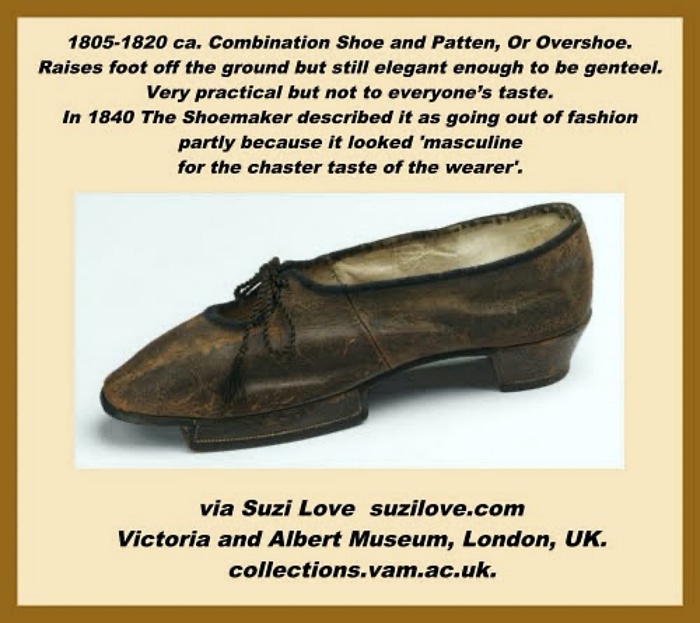
shoes_1805-1820 ca. Combination Shoe and Patten, Or Overshoe. Suitable for both genders. Raises the foot off the ground but is still elegant enough to be genteel. Very practical but not to everyone’s taste. In 1840 The Shoemaker described it as going out of fashion partly because it looked 'masculine for the chaster taste of the wearer'. via Victoria and Albert Museum, London, UK. collections.vam.ac.uk.
1805-1820 ca. Combination Shoe and Patten, Or Overshoe. Suitable for both genders. Raises the foot off the ground but is still elegant enough to be genteel. Very practical but not to everyone’s taste. In 1840 The Shoemaker described it as going out of fashion partly because it looked ‘masculine for the chaster taste of the wearer’. via Victoria and Albert Museum, London, UK. collections.vam.ac.uk.
HN_23_D2D_Fashion Men 1800-1819
https://books2read.com/SuziLoveFashionMen1800-1819
Posted in 1800s, 1800s Mens Fashions, 1800s women's fashion, England, Europe, fashion accessories, Jane Austen, Regency Era, Regency Fashion, shoes, Suzi Love Images | Tagged 1800s men fashion, 1800s women's fashion, Bridgerton, England, fashion accessories, Jane Austen, London, Regency Fashion, Shoes, Suzi Love Images, Victoria and Albert Museum

1800 ca. Jane Austen’s Era Man’s Bicorn, Or Two Cornered, Black Silk Hat. #janeaisten #Regencyfashion #HistoricalFashion #Hats

Suzi Love Posted on September 23, 2026 by Suzi LoveSeptember 14, 2026

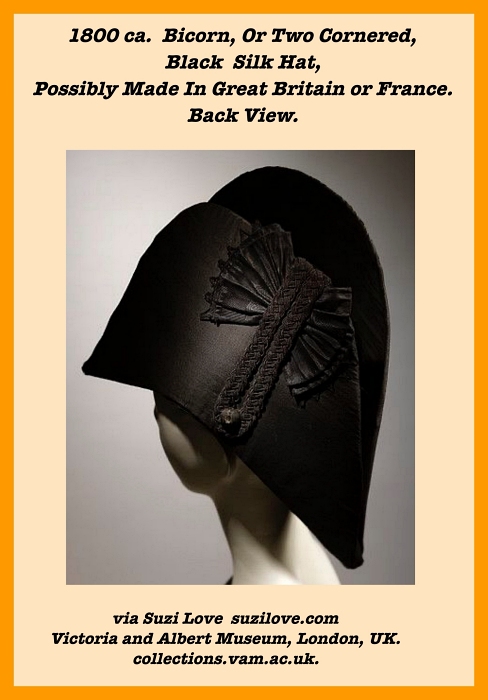
1800 ca. Bicorn, Or Two Cornered, Black Silk Hat, Possibly Made In Great Britain or France. via Victoria and Albert Museum, London, UK. collections.vam.ac.uk. The type of hats worn by the men in Jane Austen’s family around the turn of the century.

Definition: Bicorn Or Bicorne: Two cornered, or pointed, hats often worn by military men because the rain would drain off either side of the hat and  away from the body. They could also be easily flattened to carry under arm. 

1800 ca. Bicorn, Or Two Cornered, Black Silk Hat, Possibly Made In Great Britain or France. via Victoria and Albert Museum, London, UK. collections.vam.ac.uk.
HN_23_D2D_Fashion Men 1800-1819
https://books2read.com/SuziLoveFashionMen1800-1819
23_d2d_fashionmen1800-1819 https://books2read.com/SuziLoveFashionMen1800-1819
Posted in 1800s, 1800s Mens Fashions, England, Europe, fashion accessories, France, hats, Jane Austen, Regency Era, Regency Fashion, Suzi Love Images, U.S.A | Tagged 1800s men fashion, British history, England, fashion accessories, Hats And Hair, Jane Austen, Regency Fashion, Victoria and Albert Museum

1700-1800 ca. Women’s Pockets With Waist Ties as worn in Jane Austen’s years. #Georgianera #Regencyera #JaneAusten #Underclothing

Suzi Love Posted on September 5, 2026 by Suzi LoveSeptember 9, 2026

From 1700 until the early 1800s, pockets with waist ties were worn by women to keep essential items on their person. Generally of linen or some other cotton fabric, they were often quilted, or embroidered and gifted or handed down to others. In the 18th century, women’s pockets were not sewn into their gowns. Instead they were attached to a tape and tied around the waist as separate garments. Worn under the hoops and petticoats, they were accessed through openings in the gown and petticoat seams. By the early 1800s, round gowns were both flowing and almost transparent so pockets could no longer be worn under dresses, so ridicules, or bags, or reticules were carried instead. Jane Austen and her female friends and family would have worn pockets under their out layers.

From the Curator Victoria and Albert Museum, London: Quilting was a popular form of decoration for a variety of garments including pockets. However, hand-quilting was a time-consuming method of decoration. The increased demand for quilted petticoats, waistcoats and pockets led to the invention of woven quilting.

1700-1725 ca. Pair of Linen Twill Women’s Pockets With Crewel Embroidery and Waist Ties, British. Embroidered in yellow, green and pink worsted thread with chain and stem stitches, design of flower pot with flowering plant, bound with green worsted tape and sewn to linen tape tie. Designs are similar but not identical, suggesting both hand-drawn and possibly work of an amateur. Pockets may have been handed down to another person who found them too small as each pocket has been extended at top by 4 cms. via Victoria and Albert Museum, London, UK.
collections.vam.ac.uk.

1700-1725 ca. Pair of Linen Twill Women's Pockets With Crewel Embroidery and Waist Ties, British. Embroidered in yellow, green and pink worsted thread with chain and stem stitches, design of flower pot with flowering plant, bound with green worsted tape and sewn to linen tape tie. Designs are similar but not identical, suggesting both hand-drawn and possibly work of an amateur. Pockets may have been handed down to another person who found them too small as each pocket has been extended at top by 4 cms. via Victoria and Albert Museum, London, UK. collections.vam.ac.uk.
by 4 cms. via Victoria and Albert Museum, London, UK. collections.vam.ac.uk.

1750-1800 ca. Woman’s Pocket With Waist Ties, New England, America. Linen plain weave, cotton plain weave, wool embroidery. Dimensions 39.5 cm x 27.5 cm. Polychrome crewels on cotton and linen, vine with buds, flowers and leaves and initials M.W. in center. In 18th century, women’s pockets were tied around waist with tape as separate garments, worn under hoops and petticoats, accessed through openings in gown and petticoat seams. via Museum of Fine Arts, Boston, U.S.A. mfa.org

1750-1800 ca. Woman's Pocket With Waist Ties, New England, America. Linen plain weave, cotton plain weave, wool embroidery. Dimensions 39.5 cm x 27.5 cm. Polychrome crewels on cotton and linen, vine with buds, flowers and leaves and initials M.W. in center. In 18th century, women’s pockets were tied around waist with tape as separate garments, worn under hoops and petticoats, accessed through openings in gown and petticoat seams. via Museum of Fine Arts, Boston, U.S.A. mfa.org
1750-1800 ca. Woman’s 1750-1800 ca. Woman’s Pocket With Waist Ties, New England, America. Linen plain weave, cotton plain weave, seams. via Museum of Fine Arts, Boston, U.S.A. mfa.org
HN_1_D2D_Fashion Women 1700s
books2read.com/suziloveFashWomen1700s
HN_1 Fashion Women Late 1700s History Notes Book 1 by Suzi Love. What was fashionable for women in the late 1700s? Extravagant colors and fabrics and outrageous styles were all seen in these flamboyant fashions. books2read.com/suziloveFashWomen1700s
Posted in 1700s, 1700s Womens Fashion, 1800s, 1800s women's fashion, Australia, Canada, England, Europe, fashion accessories, Georgian Era, Georgian Fashion, Jane Austen, Regency Era, Regency Fashion, Suzi Love Images, U.S.A | Tagged 1700s Women's Fashion, 1800s women's fashion, fashion accessories, Georgian Fashion, Jane Austen, Museum Of Fine Arts, Regency Fashion, underclothing, Victoria and Albert Museum

Post navigation

← Previous Post

SUBSCRIBE TO SUZI LOVE'S NEWSLETTER.

Recent Posts

  • 19th Century Early Bridgerton and Jane Austen Era Men’s Brown Trousers With Front flap, or ‘Fall’. #Bridgerton #JaneAusten #RegencyEra #Men #HistoricalFashion
  • 1770-1790 ca. Pink Silk Damask Stays, Or Corset, English. #GeorgianFashion #Corset #BritishHistory
  • 1805 Regency Group of Fashionable Ladies and Gentlemen in Jane Austen years. #RegencyEra #RegencyFashion #JaneAusten
  • 1805 Red Velvet Coat, or Redingote, Or Pelisse In Jane Austen Style. #JaneAusten #RegencyFashion #Pelisse
  • 1700s Late Pair of Pattens, Or Strap On Undershoes, As Used On Rainy Days in Jane Austen and Bridgerton Times. #Bridgerton #JaneAusten #Shoes #BritishHistory #History

Recent Comments

  1. Suzi Love on Book Hooks: Petunia and the Pearl Diver. Petunia was too well spoken for a brothel worker. #Regencyromance #historicalromance #London #mfrw
  2. Bianca White on Book Hooks: Petunia and the Pearl Diver. Petunia was too well spoken for a brothel worker. #Regencyromance #historicalromance #London #mfrw
  3. Suzi Love on Book Hooks: Petunia and the Pearl Diver. Petunia was too well spoken for a brothel worker. #Regencyromance #historicalromance #London #mfrw
  4. Suzi Love on Book Hooks: Petunia and the Pearl Diver. Petunia was too well spoken for a brothel worker. #Regencyromance #historicalromance #London #mfrw
  5. Suzi Love on Book Hooks: Petunia and the Pearl Diver. Petunia was too well spoken for a brothel worker. #Regencyromance #historicalromance #London #mfrw

Login

  • Log in

Archives

  • November 2026
  • October 2026
  • September 2026
  • August 2026
  • July 2026
  • June 2026
  • May 2026
  • April 2026
  • March 2026
  • February 2026
  • January 2026
  • December 2025
  • November 2025
  • October 2025
  • September 2025
  • August 2025
  • July 2025
  • June 2025
  • May 2025
  • April 2025
  • March 2025
  • February 2025
  • January 2025
  • December 2024
  • November 2024
  • October 2024
  • September 2024
  • August 2024
  • July 2024
  • June 2024
  • May 2024
  • April 2024
  • March 2024
  • February 2024
  • January 2024
  • November 2023
  • October 2023
  • September 2023
  • August 2023
  • June 2022
  • April 2022

Categories

  • 1700s
  • 1700s Mens fashion
  • 1700s Womens Fashion
  • 1800s
  • 1800s Mens Fashions
  • 1800s women's fashion
  • 1900s
  • art
  • Australia
  • Bath
  • bedroom fashion
  • Book Hooks
  • Box Or Container
  • Bridgerton
  • Bus Trips
  • Canada
  • Carriage
  • cartoon
  • Celebrity
  • Chatelaine
  • children
  • Children
  • Christmas
  • Coat or Pelisse Or Redingote
  • Contemporary
  • Corset
  • Couple
  • Customs & Manners
  • dancing
  • December Scandal
  • Decorative Item
  • Dress Or Robe
  • Easter
  • Edwardian Era
  • Embracing Scandal
  • England
  • Ester In Images
  • Europe
  • Events
  • Fashion
  • fashion accessories
  • Food and Drink
  • Four Times A Virgin
  • France
  • furniture
  • Georgian Era
  • Georgian Fashion
  • Google Books
  • Grand Tour
  • Group
  • hats
  • History
  • History Events
  • History Notes
  • History Of Christmases Past
  • household
  • Hygiene
  • Irresistible Aristocrats
  • Jane Austen
  • Keanu Reeves
  • Kellys Justice
  • Legal
  • London
  • Love After Waterloo
  • Loving Lady Katharine
  • medical
  • military
  • money
  • mourning
  • Music
  • Outback Arrival
  • pants
  • Pastimes
  • peerage
  • People
  • Petunia and Pearl Diver
  • Places
  • Pleasure House Ball
  • postal
  • Queensland
  • Quotations
  • Regency Era
  • Regency Fashion
  • Regency Life Series
  • Reticule or Bag
  • riding
  • Romantic Era
  • Royalty
  • Russia
  • Scandalous Siblings Series
  • Scenting Scandal
  • Self Publishing
  • sewing
  • Shirt
  • shoes
  • Shopping
  • South Pacific
  • Spencer
  • sports
  • Suit
  • Sunday Snippet
  • Suzi Love
  • Suzi Love Books
  • Suzi Love Images
  • Suzi Love Writing
  • THe Viscount's Pleasure House
  • travel
  • U.S.A
  • underclothing
  • Vest or Waistcoat
  • Victorian Era
  • Victorian Fashion
  • weapons
  • weddings
  • Writing Tools

1800s men fashion 1800s women's fashion antiques Bridgerton British history Cartoons Corset cravat decorative Dress Or Gown England europe fashion accessories Fashion Plate France Georgian era Georgian Fashion gloves google books Hats And Hair historical romance History Notes household Jane Austen jewelry Journal des Dames et des Modes London Metropolitan Museum NYC pants Redingote Or Pelisse Or Coat Regency Era Regency Fashion Regency London reticule or bag riding Romantic Era sewing shawls Shoes Suzi Love Books Suzi Love Images Tailcoat The Repository Of Arts underclothing Vest or Waistcoat

©2026 - Suzi Love - Weaver Xtreme Theme Privacy Policy
↑