1795-1805 ca. Green Silk and Metal Vest, Or Waistcoat, Probably French. The style of waistcoat worn by men in Jane Austen’s times. Interesting cross-over front and tasteful embroidery, standing collar, back has ties to adjust the fit. via Metropolitan Museum, N.Y.C., U.S.A. metmuseum.org
1790-1800 ca. Men’s Riding Boots. Black leather with wide tan leather tops, small heel and slightly rounded toes. via Los Angeles County Museum of Art, California, USA. collections.lacma.org
Corsets originated in the beginning of the 16th century, when aristocratic Spanish women first adopted “whalebone bodies.” Stays (later known as corsets) rapidly became fashionable throughout Europe. In 1588, the French essayist Michel de Montaigne wrote, “To get a slim body, Spanish style, what torture do women not endure, so tightly tied and bound . . . ” Although doctors and moralists remonstrated, women continued to wear some form of corset until the middle of the 20th century, because corsetry was associated with feminine beauty, aristocratic display, and self-discipline.
1750-1770 ca. Back Lacing Linen Corset, European. Made of linen, lining of natural linen, chamois leather to strengthen, straps of linen, stiffening of whalebone. Corset: deep point, hip flaps, lacing at the back, Netherlands.
Description: Quilted linen corset with vertical tunnels and with ribs. Whalebone stiffening, point on front, hip flaps, front shoulder straps of fabric plus long narrow linen strips to tie. Lined and has chamois leather at armpits, front point and waist. Linen corset with a deep thickened point at the front, hip flaps, and lacing at the back. Fully quilted with vertical tunnels, with ribs. Thickened tip at the front is slightly triangular. Above for round shape due to wide horizontal rib. Flares from the waist into hip phlangers, or fingers. Lacing eyelets and criss-crossed lacing at the back. Front shoulder straps are of the fabric with very long linen straps with narrower linen strap, total 110 cm, and two horizontal linen loops on top of the backs. There is a narrow linen strip on all seams and along all edges. Armpits and the front point are reinforced with chamois leather and chamois leather is at the waist with straps attached. Via Mode Museum Province of Antwerp
Corsets 1700-1790 History Notes Book 15 This book shows how body wraps, stomachers and stays were worn during the 1700s. They created a variety of fashionable silhouettes to suit the elaborate fashions worn for court and daily life during the 18th Century. Wearing the correct underclothing was essential for keeping garments in place and giving the best fashion display.
1775-1825 ca. Bridgerton and Jane Austen Style Black Silk Breeches, American or European. #Bridgerton #JaneAusten #GeorgianEra #RegencyFashion books2read.com/SuziLoveFashionMen1800-1819
1798 Two ladies in Jane Austen style white walking dresses. Left: Dress has gold trim, white bonnet, green Parasol. Right: Stand up collar, short puffed sleeves, brown shawl and coiled head dresses, both with necklaces. via Rijks Museum, Amsterdam, Netherlands. rijksmuseum.nl
HN_1 Fashion Women Late 1700s History Notes Book 1 by Suzi Love.
What was fashionable for women in the late 1700s? Extravagant colors and fabrics and outrageous styles were all seen in these flamboyant fashions.
books2read.com/suziloveFashWomen1700s
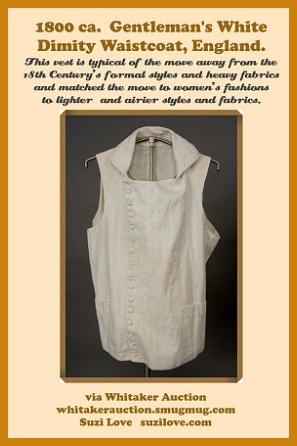
1800 ca. Gentleman’s White Dimity Waistcoat, England. This vest is typical of the move away from the 18th Century’s formal styles and fussy fabrics and matched the shift of women’s fashions towards lighter and airier styles and fabrics. via Whitaker Auction whitakerauction.smugmug.com
Waistcoats worn at the very beginning of the early 19th century generally had a straight bottom, double-breasted and with wide lapels. Not long after this, waistcoats began to be cut higher up to the waist in front so men during Jane Austen’s lifetime would have worn both styles.
1800 ca. Gentleman’s White Dimity Waistcoat, England. via suzilove.com and Whitaker Auctions.23_d2d_fashionmen1800-1819 https://books2read.com/SuziLoveFashionMen1800-1819
1715-1775 ca. Flat Drawstring Bag, French. Strung glass beads, or sablé, held together by looping stitches. Polychrome Rococo design on white ground, shepherd, shepherdess, four sheep around orange tree center, border with cornucopias and flowers. Ecru silk cord drawstrings with floral bead-covered wood tassels. Blue silk lining. via Museum of Fine Arts, Boston.
18th Century Wool, Leather And Linen Front Lacing Stays. via digitalmuseum.norway
In the early 18th century, stays were basically quilted waistcoats, laced in the front and un-boned and to be worn on informal occasions. Mid century, the role of stays changed. They were then supposed to create a V shaped form and support a woman’s back, so baleen from whales was inserted into the garments and backs became longer.
Eyelet holes were stitched and staggered in spacing, so stays could be spiral laced. Stays were strapless or had straps attached in the back and tied at the front sides. Eyelet holes were stitched and staggered in spacing, so stays could be spiral laced. Later, they began to support the bust, give a fashionable conical shape, and draw shoulders back.
It was around the 1790s that the term corset started to be used as a refined name for stays. The Times of 24 June 1795 stated that: ‘corsettes about six inches long…are now the only defensive paraphernalia of our fashionable belle’.
corset_18th Century Wool, Leather And Linen Front Lacing Stays. via digitalmuseum.norwaycorset_18th Century Wool, Leather And Linen Front Lacing Stays. via digitalmuseum.norwaycorset_18th Century Wool, Leather And Linen Front Lacing Stays. via digitalmuseum.norwaycorset_18th Century Wool, Leather And Linen Front Lacing Stays. via digitalmuseum.norwaycorset_18th Century Wool, Leather And Linen Front Lacing Stays. via digitalmuseum.norwaycorset_18th Century Wool, Leather And Linen Front Lacing Stays. via digitalmuseum.norway
What was fashionable for outer wear in past centuries? Different names in different countries: Pelisse, Redingote, Coat, Or Walking Dress. The Bridgertons and Jane Austen and her contemporaries wore long coats like these to keep warm when out and about, visiting, shopping etc. The thin muslin dresses worn in the early 1800s were little protection against European winters. http://books2read.com/suzilovePelisse
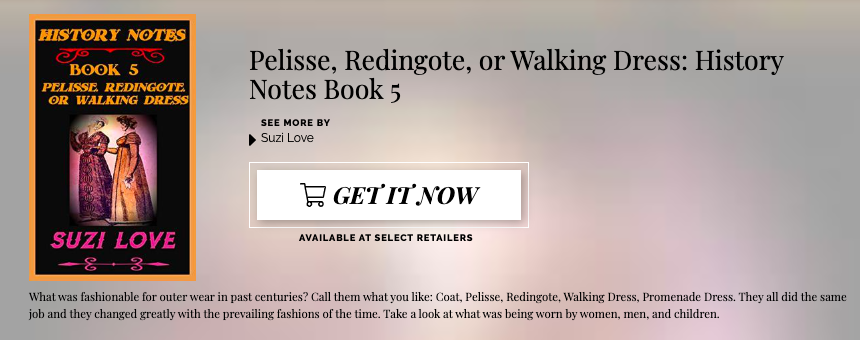
Pelisse, Redingote, Or Walking Dress. History Notes Book 5 By Suzi Love. What was fashionable for outer wear in past centuries? Call them what you like: Coat, Pelisse, Redingote, Walking Dress, Promenade Dress. Take a look at what was being worn by women, men, and children. books2read.com/suzilovePelisseD2D_RetailerBuyLink_HN_5_books2read.com/suzilovePelisse