1840 Group In An Outdoor Setting, French. Two men in top hats. Modes de Longchamps’. Men’s outfits, a woman’s riding habit and a small boy, all tailored by Robin of 21 Rue Saint Marc, Paris. via Le Bon Ton. via Victoria and Albert Museum, London, UK. collections.vam.ac.uk.
1810 Pale Blue Suit For Formal Court Wear, France. Suit with a frilled vest, or waistcoat, white stockings and a bicorn, or two-cornered, hat. Fashion Plate via Journal des Dames et des Modes, or Costume Parisien. The exception to the more relaxed style of early 19th century fashion for men was court dress, which was dictated by the royals in each European country and so retained elements of pomp and ceremony not seen in general dress by men. These outfits remained very formal and therefore little different to court dress of the 18th Century.
A court ensemble meant a coat, often of dark figured velvet although brighter colors could still be seen, breeches, a waistcoat with short skirts, a shirt and elaborately tied cravat, white stockings, and black evening shoes. These court outfits still featured a lot of decoration, such as gold braiding and elaborate embroidery. Court dress was accessorized with jewelry, such as expensive cravat pins and fobs and if the occasion was very formal, a sword was worn at the hip.
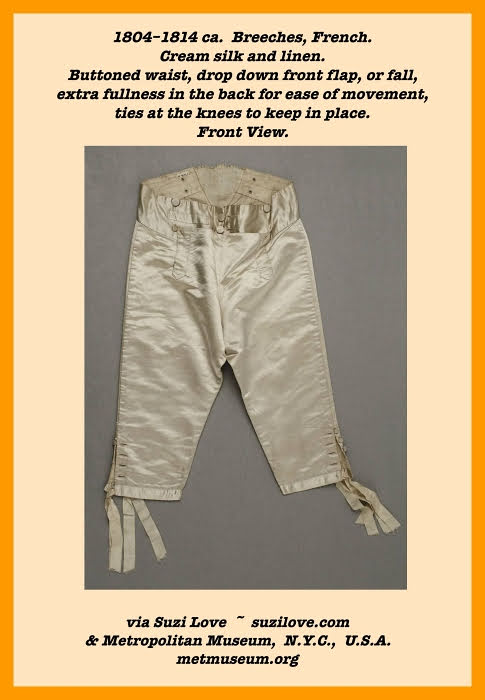
Typical of the type of outfit a gentleman in the Georgian Era would wear to a wedding or important event. The jacket flares from the waist into multiple folds to give easier movement and the front has a long line of matching buttons. The breeches have a buttoning front flap. Part of the costume collection at Ham House, Surrey, UK. Part of the National Trust, UK. nationaltrustimages.org.uk
1814 Gentleman’s Ensemble, French. Gentleman in brown tailcoat, white vest, high collared white shirt, knotted white cravat, white pants and white gaiters above black shoes. The style of outfit worn by the men in Jane Austen’s life. Fashion Plate via Journal des Dames et des Modes, or Costume Parisien.
1818 Gentleman’s Outfit, French. Cutaway coat with a fur collar and extra long tails, blue trousers finishing at his ankles, blue vest, high white cravat, black shoes, black top hat, walking stick and cured hairstyle with small sideburns. Fashion Plate via Journal des Dames et des Modes, or Costume Parisien.
Want To Know More About Georgian Era Men’s Fashions? Try History Notes Book 2: Fashion Men 1700s Late. What was fashionable for men in the late 1700s? Extravagant colors and fabrics and outrageous styles. Take a look at their suits, hats, accessories and bedroom fashions.
Strictly speaking, the Georgian Era might include all the years that a ‘King George’ ruled in England, but for the purposes of this book the ‘Georgian Era’ is primarily the late 1700s when mad King George III ruled. His son became Prince Regent in the early 1800s, therefore creating the years known as the Regency, and became George IV on the death of his father.
The Georgian years officially ended with the death of King George IV in 1830.
George I ruled 1714-1727
George II ruled 1727-1760
George III ruled 1760-1820
George IV ruled 1820-1830
HN_2_D2D_Fashion Men 1700s
books2read.com/suziloveFashMen1700
1810 Three Piece Gentleman’s Purple Court Suit, French. Worn by a rich and fashionable gentleman after Napoleon Bonaparte revived court traditions when he crowned himself Emperor of France in 1804. Gentlemen were expected to wear extravagant court dress, but the working class despised these luxurious fashions and royal overspending. Wastage of France’s money spurred French peasants to rise up in revolt and create the French Revolution. via Metropolitan Museum, N.Y.C., U.S.A.metmuseum.org
1810 Front Of Three Piece Court Suit, French. 1810 Back Of Gentleman’s Court Suit, French. 1810 Front and Back Of Gentleman’s Court Suit, French. 1810 Fabric Of Gentleman’s Court Suit, French. 1810 Gentleman’s Court Suit, French. 1810 Black and White View Of Gentleman’s Court Suit, French. https://books2read.com/SuziLoveFashionMen1800-1819
1801-1818 ca. ‘Diablo, or devil on two sticks’. Lessons In The Devil Series Plate 55: Man teaching a woman how to play diabolo, or devil on two sticks. via 1801-1818 Le Bon Genre, French. Gentleman in blue tailcoat, high white shirt and cravat, pants and black shoes. Lady in white dress with high frilled neckline, long sleeves and wearing green walking boots. Hand-colored etching. Published by: Pierre La Mésangère. Via British Museum, London, UK britishmuseum.org (PD-Art)
Jane Austen and Games: In Jane Austen’s times, games were a part of daily life. Families played all sorts of games, indoors and outside, to pass the time, especially at house parties or family gatherings.
Diablo, Or Devil On Two Sticks: Double cone type of yo-yo that is twirled, spun, tossed and caught on a string attached to two hand sticks. The toy, or Diablo, is kept spinning by manipulating it back and forth along the string and by tossing into the air. Numerous tricks can be performed e.g. toss, trapeze, cat’s tail and the umbrella.
Fashion Women 1815-1819 History Notes Book 28 https://books2read.com/SuziLoveFashionWomen1815-1819
1800 Gentleman and Son, French. Man in brown, double-breasted, cutaway coat with wide fur collar, ankle length loose trousers with a fob at his waist, black shoes. Son in high-waisted trousers, white shirt, red jacket, black hat and shoes and carrying a sword. Fashion Plate via Journal des Dames et des Modes, or Costume Parisien.
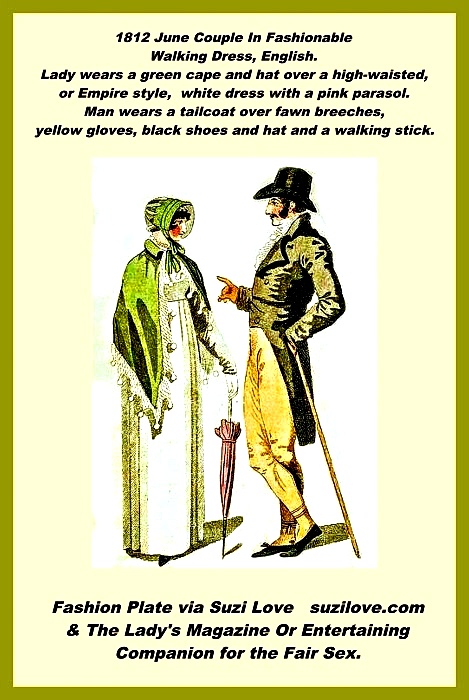
During the early 1800s skirted coats were replaced with short-fronted, or cutaway, tailcoats worn over fitted waistcoats and plain, white linen shirts. Knee breeches were gradually replaced by tight-fitting pantaloons and later trousers, decorative shoes were replaced with boot, such as the tan topped boots worn here, and fussy neckwear gave way to intricately tied, white linen neck cloths.
A Regency Era, or early 1800s, gentleman was outfitted in more practical fabrics, such as wool, cotton and buckskin rather than the fussy brocades and silks of the late 1700s. The men in Jane Austen’s life would have worn an elegant outdoor ensemble like this for everyday excursions around the countryside.
1808 April Trio of Two Men and a Woman in Full and Half Dress in the Directoire and Empire period, or the Regency Era, or the times of Jane Austen. Two varieties of men’s pants, one knee breeches and stockings and one long pants worn inside high boots. One wearing a Bicorn hat and the other holding a top hat and both with yellow gloves. Woman wearing a pink pelisse, or coat, over a white walking gown with a train and holding a parasol. via Le Beau Monde, or Literary and Fashionable Magazine, London, U.K.
Fashion Women 1805-1809 History Notes Book 26 What did Jane Austen and friends wear? https://books2read.com/SuziLoveFashionWomen1805-1809