Writing Regency Era Fiction Or Nonfiction? Need more information on Older Gentleman’s Day in early 1800s, or the Bridgerton family or Jane Austen’s Regency Era. A lighthearted overview of an older gentleman’s clothing, social life, and responsibilities in the early 1800s. Take a look at where an older man went, what he wore, and how he managed the family’s finances and his estates. Older Gentleman’s Day Regency Life Series Book 3 books2read.com/suziloveOGD
An overview of an older gentleman’s clothing, social life, and responsibilities in the early 1800s. books2read.com/suziloveYGD
1800 Young Dandy’s Morning Outfit, French. Brown, doublebreated, cutaway coat, striped trousers tucked into high black boots with tassels, gloves, small jaunty hat and a walking stick. Fashion Plate via Journal des Dames et des Modes, or Costume Parisien.
Dandy: The author of The Hermit in London, a series of sketches published in 1819—1820 observed: ‘A distinguished Exquisite is padded all over to-day; and all the other foplings are, on the morrow, mere walking pin-cushions. A fat prince, or a fat dandy, requires confinement in his limbs; and all his subjects are immediately restrained within the same limits. One day, the back is to be as broad as an Irish chairman’s, and the shoulders to be bolstered up to imitate a hod-man; and the next, the shoulders are to be flat, and a man is to be pinched in and laced up until he resembles an earwig. All these are Master Snip’s maneuvers, who continues to make his bill equally long, whether the spencer or the box-coat be in vogue.
1814 Long Dark Green Coat, Or Redingote, French. Horizontal front pockets, high white cravat, black top hat and high black boots. Fashion Plate via Journal des Dames et des Modes, or Costume Parisien.
Definition Redingote Or Coat: French word developed from English words, riding coat. Long fitted outdoor coat worn over other garments for warmth. Originally made with several capes and trimmed with large buttons. For women, the coat was often cut away in the front or left open to show off the dress underneath. French fashion plates call these coats Redingotes and they were worn by men, women, and children. English fashion plates call the coats a Pelisse, a walking dress, Promenade dress, or Carriage dress.
Reader or Writer of Regency Era Books? Love the Bridgertons and Jane Austen? Nonfiction book, Older Gentleman’s Day, gives an overview of his daily life by Award Winning researcher and author, Suzi Love. A sometimes comical look at an older gentleman’s clothing, social life, and responsibilities in the early 1800s. Take a look at where he went, what he wore, and how he managed the family’s finances. Older Gentleman’s Day, Regency Life Series Book 3 books2read.com/suziloveOGD
Regency is the time period in England that began in 1811 when King George III had increasing bouts of madness and was finally declared mad. The Prince of Wales was officially named Regent, often referred to as “Prinny”, and the Regency period ran until 1820 when King George III died and the prince was crowned King George IV. The long Regency era is from the time of Jane Austen and the Napoleonic Wars until the time Queen Victoria ascended the throne.
RL_3_OGD_Older Man’s Day Regency Life Series Book 3 by Suzi Love #Regency #History books2read.com_suziloveOGD
Reader or Writer of the Regency Era? Love the Bridgertons and Jane Austen? Try Older Gentleman’s Day for an overview of daily life. #Bridgerton #RegencyEra #JaneAusten #nonfiction http://books2read.com/suziloveOGD
1806 Waiting For the St. Cloud Coach, Place de la Concorde, Paris. Illustrations by Francis Courboin. via Les Modes de Paris. (PD-Art) This couple is depicted waiting for the coach, which was a passenger vehicle drawn by four horses. The woman is wearing a fashionable hat or “capote” that covers her face. Her dress maintains the empire waist and has very long sleeves that also have a ‘mancheron’ or a gathered sleeve at the shoulders. The man is wearing a ‘habit du gagé’ or a coat with tails, buttoned at the waist. His hat is a ‘haut-de-forme’ or what is commonly known in English as a top hat. He wears tight, short pants tucked into large, riding boots, as was the fashion for men. Illustrations by François Courboin from Octave Uzanne‘s Les Modes de Paris. Variations du goût et de l’esthétique de la femme, 1797-1897, L. Henry May, Paris, 1898, or from the English translation of the same work: Fashion in Paris : the various phases of feminine taste and aesthetics from 1797 to 1897, William Heinemann, London, 1898. Modes de Paris VIa Brown University Library .
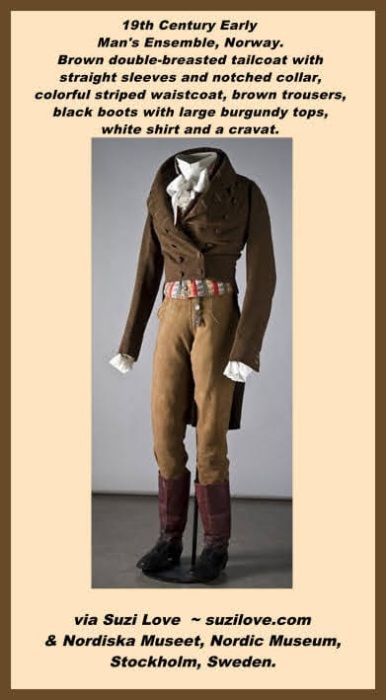
19th Century Early Man’s Ensemble, Norway. Brown double-breasted tailcoat with straight sleeves and notched collar, colorful striped waistcoat, brown trousers, black boots with large burgundy tops, white shirt and a cravat. via Nordiska Museet, Nordic Museum, Stockholm, Sweden.
19th Century Early Typical Man’s Ensemble: tailcoat, trousers, shirt, cravat etc. in Bridgerton and Jane Austen years. #Bridgerton #RegencyFashion #JaneAustenhttps://books2read.com/SuziLoveFashionMen1800-1819
Writing Regency Era Fiction Or Nonfiction? Need more information on Older Gentleman’s Day in early 1800s, or the Bridgerton family or Jane Austen’s Regency Era. A lighthearted overview of an older gentleman’s clothing, social life, and responsibilities in the early 1800s. Take a look at where an older man went, what he wore, and how he managed the family’s finances and his estates. Older Gentleman’s Day Regency Life Series Book 3 books2read.com/suziloveOGD
RL_3_OGD_Older Man’s Day Regency Life Series Book 3 by Suzi Love #Regency #History books2read.com_suziloveOGD
Writing Regency Era Fiction Or Nonfiction? Need information on Older Gentleman’s Day in Bridgerton And Jane Austen’s Years? #RegencyEra #Bridgerton #JaneAusten #BritishHistory http://books2read.com/suziloveOGD
Love the Bridgerton Series? Fan of Jane Austen? What did men wear in the early 1800s? Suits, hats, shoes, underclothing, military and bedroom fashions. #Bridgerton #RegencyFashion #JaneAusten #BritishHistory.
The Regency Era saw a wide variety of acceptable pants for men. Breeches were worn as part of a man’s daily outfit during the early 1800s and were necessary for formal occasions, such as court appearances, during the entire Regency Era. However, younger gentlemen moved away from breeches for daytime wear around 1807 and adopted a variety of long pants called trousers, pantaloons, buckskins or inexpressables. Knee-length breeches, worn with stockings, continued to be worn by older gentlemen through the entire Regency Era.
Around 1807, upper class gentlemen wore trousers held up by suspenders or pantaloons, which were closely fitted and worn with tall boots. Buckskins, made from deerskin, were comfortable to wear for riding. Inexpressibles were very tight leggings that left little to the imagination of young ladies. Every Regency man’s outfit included a hat, gloves, shoes or boots, and a selection of added accessories from a walking stick, watch on a chain, fobs, coin purse and a handkerchief.
1811 January Walking Dress, or Pelisse, English. Jane Austen and her contemporaries wore long coats like these to keep warm when out and about, visiting, shopping etc. Their thin muslin dresses worn in the early 1800s were little protection against European winters.
Round high morning robe of cambric with deep full-trimmed collar. Swedish coat of velvet, trimmed with swansdown or blue fox fur. Spanish pelerine of the same, fastened in front of the throat with a mother-of-pearl brooch, clasps to correspond for the bottom of the waist. Traveller’s, or slouch, hat of velvet turned up with shell ornament, half-boots of grey cloth, laced and bound with black velvet. Chinese ridicule, or reticule, or bag, of grey satin, embellished with black medallions and tassels. Gold chain and eye-glass, or quizzing glass.. Fashion Plate via Rudolph Ackermann’s ‘The Repository’ of Arts.
Definition Redingote Or Coat Or Pelisse Or Walking Dress: Long fitted outdoor coat worn over other garments for warmth. French word developed from English words, riding coat. French fashion plates call these coats a Redingote and English plates call them a Pelisse, Or Walking Dress, or Carriage Costume. For more of these, try my book on Pelisses, History Notes Book 5 . books2read.com/suzilovePelisse
Definition Swansdown: Fine down of a swan, used for trimmings on clothing and for making powder puffs.
Definition Velvet or Velour: Silk with short, dense and smooth pile produced by pile warp raised in loops above ground weave through introduction of rods during the weaving.
Definition Ridicule, Reticule, Indispensable, or Handbag: From the late 1700s, pockets could no longer be sewn into gowns nor could separate pockets be tied around their waists and accessed by slits in the gown and petticoats, as skirts fell from just under the bust and were full and flowing. Instead, women began carrying small bags, known at first as ridicules and later as reticules, to keep necessary items on their person e.g. handkerchiefs, coins, vinaigrettes, calling cards, glasses etc. For more on reticules, try my History Notes book 3 http://books2read.com/suziloveReticules
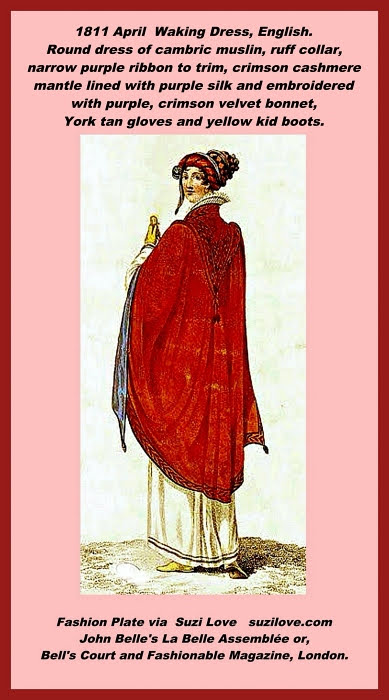
1811 April Waking Dress, English. Round dress of white cambric muslin with a ruff collar, trimmed round the bottom with narrow purple ribbon, cashmere crimson mantle confined close to the back and lined with purple silk, embroidered round the neck, cape, and sides with purple fancy border, deep cape falling from the shoulders, sloping to a narrow point, with tassels. Crimson velvet bonnet, turban front, and trimmed with purple to correspond. York tan gloves. Yellow kid boots. Fashion Plate via John Belle’s La Belle Assemblée or, Bell’s Court and Fashionable Magazine, London.