1757-1758 ca. Egg Shaped Toilet Case With Clock. By Master Francois Beeckaert, Paris, France. Gold, diamonds, silver, enamel. via Hermitage Museum, Russia.
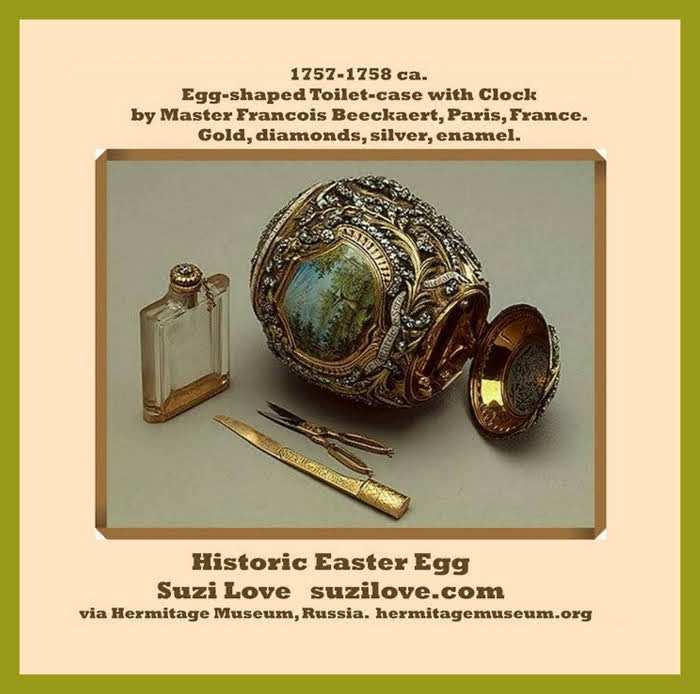


1757-1758 ca. Egg Shaped Toilet Case With Clock. By Master Francois Beeckaert, Paris, France. Gold, diamonds, silver, enamel. via Hermitage Museum, Russia.
1806 Silver and silver-gilt vinaigrette, Birmingham, England. Commemorating the Battle of Trafalgar in 1805. Rectangular with a hinged lid and a suspension loop. Gilded, pierced inner cover depicts HMS ‘Victory’ in relief inscribed ‘VICTORY’, ‘TRAFALGAR OCT 21 1805’. Via National Maritime Museum, Greenwich, London, U.K.
Vinaigrettes were used from the late 18th century through the 19th Century to revive a person who had fainted, having the vapors, or to mask unsanitary odors. Small containers, often a silver hinged box, held a tiny sponge dipped in an aromatic substance which had been dissolved in vinegar. The sponge was held beneath a grill or perforated cover so, by a flick of the fingers, the container was opened and the restorative substance held directly beneath a person’s nose. Jane Austen and her family and friends would have been very familiar with the use of vinaigrettes because Regency Era ladies were noted for having the vapors or fainting in hot ballrooms or dramatic situations. Ladies in the Romantic and Victorian Eras would have used them when tightly laced corsets became popular and ladies fainted because they were unable to draw in enough oxygen.
Both men and women used vinaigrettes in the late 1700s when people encountered foul aromas on a daily basis, but by the 1820s vinaigrettes were mainly used by women.These tiny containers were carried in a pocket, a reticule or bag, or suspended from the waist by chains as part of a chatelaine. Their sterling silver interiors were gilded to prevent discoloration from the acetic acid. Birmingham produced 90% of England’s silver vinaigrettes. As gold wasn’t affected by vinegar, craftsmen created some elaborate and decorative boxes on the container’s exteriors.


1820-1830 ca. Mother Of Pearl sewing casket with a painted view of Weilburg near Baden in Austria. Painting by Balthasar Wigand.
From The Curator: The mother-of-pearl industry in Vienna reached its apogee during the 1820s and 1830s, when numerous luxury items such as candle screens and desk sets were embellished with the iridescent material. Balthasar Wigand, responsible for the miniature on the lid of this box, specialized in views of the city and its surroundings, painted especially for use on small pieces of furniture and caskets. via Metropolitan Museum New York City, U.S.A. metmuseum.org


1750-155 ca. Writing Cabinet, Probably by Michael Kimmel, Germany. Veneered in kingwood, marquetry of mother-of-pearl, ivory and brass on pine, stained alder or birch. Mounted in gilt brass and with giltwood, carving of cypher of Augustus III. via suzilove.com Victoria and Albert Museum, London, UK. collections.vam.ac.uk.


19th Century Mid Dance Card or Aide de Memoire. Jeweled and enameled gold dance card with concealed timepiece. Lid with a blue enamel with rose-cut diamonds floral wreath, opening to compartment with watch dial, pencil, and notebook. via Sotheby’s Auctions. sothebys.com

1700 ca. Chess and Backgammon Box, Augsburg. Decorated in violet wood veneer, ebony and ivory. Ivory checkers and chess pieces, hinges and push button lock in gilded brass, two horn goblets, two ivory dice, thirty-none checkers’ pawns stamped both sides with effigies of cities, Munich, Vienna, Nuremberg, Prague, Danzig, of kings and queens, Prussia, England, Scotland, Poland, and various scenes. Via AnticStore.com

19th Century Tantalus, or Drink Holder, With Hand-Painted Glasses and Bottles, as would have been used in the homes of Jane Austen and the Bridgertons. via 1st Dibs Auctions 1stdibs.com
Tantalus: A small wooden cabinet containing drink decanters. The box has a lock and key to keep unauthorised people from drinking the contents e.g. servants and younger sons, yet still allowing the decanters of drinks to be on show. The word, Tantalus, is a reference to the unsatisfied temptations of the Greek mythological character Tantalus. Patented in the UK in 1881 by George Betjemann, a cabinet maker from the Netherlands, whose workshop was on Pentonville Road, London from the 1830s.This type of small drinks cabinet would have been used in most households during the Bridgerton family’s and Jane Austen’s times, unless the householders were teetotalers. via 1st Dibs Auctions 1stdibs.com

18th Century Late. Inkstand, Sheffield, England. Square, resting on four ball feet, the top pierced with four circular holes into which fit two inkwells, a pounce box and a box for wafers. Silver inkstands appeared in Britain in 17th century and included pot, or well, for ink, plus another pot with pierced cover held ‘pounce’ or sand, which writers scattered over paper to fix ink. Wafers to seal finished letter and tray to hold pens or quills. collections.vam.ac.uk

In Jane Austen’s times craftsmen created boxes and containers of precious metals, leather, silks, and decorated them with jewels. Boxes, Cases, Etui, Necessaire and everything else that was used to carry essential items for travel, sewing, medicine, writing, and toiletries. Containers were engraved to make exquisite and expensive items as well as practical carrying cases. books2read.com/suziloveBoxesCases

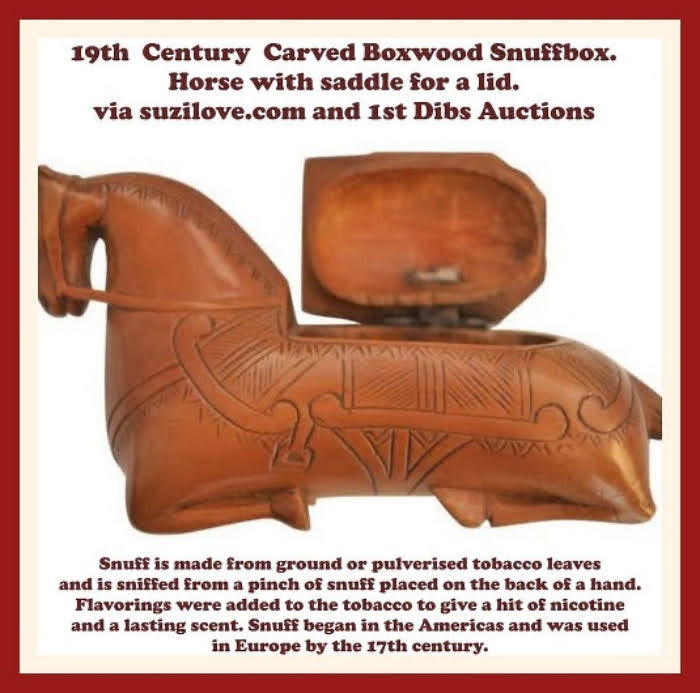
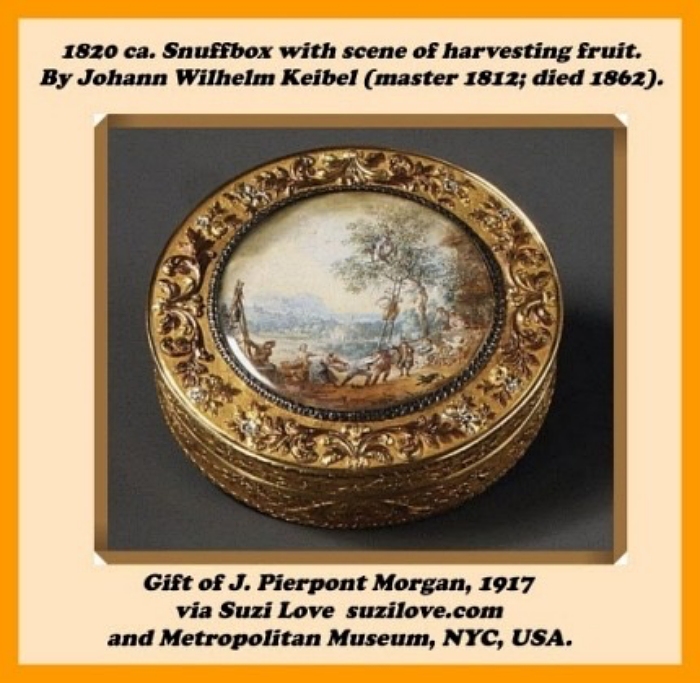
19th Century Snuff Boxes. Not only were boxes made to serve a purpose, but decorative boxes of all types were prized, especially in the 18th-19th Centuries when everything decorative and extravagant was in vogue and taking a pinch of snuff was fashionable. Snuff is made from ground or pulverized tobacco leaves and is sniffed from a pinch of snuff placed on the back of the hand.Flavorings were added to the tobacco to give a fast hit of nicotine and a lasting scent. Snuff began in the Americas and was used in Europe by the 17th Century.
Snuff became popular from the mid 1600s to the mid 1800s and was more popular than smoking. Inhaling snuff, or snuffing, was first seen by a European missionary in 1493 in Christopher Columbus’s new world within Haiti’s indigenous Taino. Until then, tobacco had been unknown to Europeans, but its use spread quickly throughout Europe during the 1500s. By the second half of the 17th century, ornate boxes started being produced to keep the precious powder dry and an entire industry making accessories blossomed around the fashion of taking snuff. Noblemen, and some women, carried extravagantly decorated snuff boxes with them at all times and would offer a pinch of their own particular blend to friends and family. Therefore, these boxes were always on display and so it became a competition to see who could have the most bejeweled or expensive box possible. By the mid 1800s, snuff taking was no longer popular so these exquisite and expensive snuff boxes became decorative, rather than functional.