↓
 

Suzi Love

Making history fun, one year at a time.

Header_
  • Home
  • Newsletter
  • Pre order form
  • Shop
    • Cart
    • Checkout
    • My account
    • Refund and Returns Policy
  • Blog
  • BOOKS
    • History Events
    • Kelly’s Justice
    • Irresistible Aristocrats
    • History Notes
    • Scandalous Siblings
    • Love After Waterloo
    • Regency Life Series
  • Privacy Policy
  • EVENTS
Home » Customs and Traditions » Page 4 << 1 2 3 4 5 >>

Tag Archives: Customs and Traditions

Post navigation

← Previous Post
Next Post→

Christmas: Early Religious Beliefs #Christmas #holidays #Traditions #Customs

Suzi Love Posted on December 5, 2025 by Suzi LoveDecember 5, 2025

Early Christians appropriated pagan customs and turned them into religious observances and, therefore, a victory over Paganism and a way to win more souls. By the end of the second century, numerous dates were being proposed as the correct date for the birth of Jesus. One popular method, allegorical theology, thought Christ must have born on the same day the sun was created, though our modern theorists estimate that the birth of Jesus was between 7 and 4 BC.

Unlike Easter, the earliest Christians didn’t celebrate the nativity or Christmas, which began in the late 3rd century AD as an alternative to pagan winter holidays. In the beginning, Christians only celebrated the baptism and resurrection of Christ and the death of the martyrs. The first evidence of Christmas being celebrated is in Rome in 336 AD and by the early fourth century, the 25th of December became the celebration day for the birth of Jesus Christ.

Origen of Alexandria, amongst others, opposed the celebration of Christ’s birth and pointed out that only Pharaoh and Herod celebrate their birthdays in the Bible, and that birthdays were for pagans, not Christians. Jehovah’s Witnesses follow this belief and reject the celebration of both Christmas and birthdays. Early religious Christmas customs began with special services held by candlelight and often at midnight. In Bethlehem, Midnight Mass is celebrated at the place of Jesus’ birth in the ancient Church of the Nativity. 

But as the years passed, going to church, especially at Christmas, was something done by villagers and landowners as a custom, an obligation, or to show respect to the local clergyman rather than for any great religious reasons. People attended Church services on Sunday and Holy Days and donated money to village or church causes but the religious fervor of early years had dimmed. If a person was particularly devoted, they would read the Bible, the Book of Common Prayer, or a book of sermons on a regular basis and probably attend the Church of England, which was the main church by the late Georgian and early Regency years.

Christmas: Early Religious Beliefs #Christmas #holidays #Traditions #Customs https://books2read.com/suziloveHOCP Share on X
Posted in Christmas, Customs & Manners, England, Europe, History, Suzi Love Images | Tagged British history, Christmas, Customs and Traditions, europe, Great Britain, religion

Christmas: Symbols and Their Meanings #Christmas #holidays #Traditions #Customs

Suzi Love Posted on December 3, 2025 by Suzi LoveDecember 1, 2025

Christmas Symbols and Their Meanings

Angels – Heralds for the news of the birth of a baby in a manger.

Bells – Bells have rung out for all important events for centuries, plus lost sheep are found by the sound of the bell.

Candy Cane  – Symbolizes the crook of the shepherds who visited Christ.  Red represents the blood that was spilled and white is for purity. The peppermint oil that flavors is known for its strong healing properties.

Cards – Produced in Britain in 1843 to be sent with love to family and friends around the world by the new Postal services.

Carols – Poems and stories of worship made into songs.

Carolers – Groups of people who strolled the streets singing Christmas songs

Feasting – To celebrate the joy of the baby’s arrival on the 25th December. 

Gift Giving – The Wise Men bowed before the baby and gave him gold, frankincense and myrrh.

Gold – Decorating using the color of one of the gifts of the wise men.

Green – Decorating using the color of evergreens which show everlasting love.

Holly – Represents Eternal Life and the crown of thorns worn by Jesus.

Mistletoe: In the 18th Century, men kissed a woman who stood under mistletoe to show love, friendship and goodwill. If a woman was un-kissed, she would (supposedly) never marry.

Nativity: The birth of Jesus Christ

Poinsettia –  Red flowers used in countries such as Mexico to symbolize Christmas time.

Stockings – Hung by children to receive gifts

Twelve Days of Christmas: Twelve days between the birth of Christ on December 25 and the coming of the Magi on January 6, the Epiphany.

Tree – Evergreen tree symbolizes eternal life and love

Wreath – Made of evergreens to symbolize never ending love

Christmas: Symbols and Their Meanings #Christmas #holidays #Traditions #Customs https://books2read.com/suziloveHOCP Share on X
Posted in 1700s, 1800s, 1900s, Bridgerton, Christmas, Customs & Manners, Edwardian Era, England, Europe, Food and Drink, Georgian Era, History Of Christmases Past, household, Jane Austen, Pastimes, Regency Era, Suzi Love Books, Victorian Era | Tagged Bridgerton, British history, Christmas, Customs and Traditions, europe, History Of Christmases Past, Jane Austen, Regency Era, Victorian Era

Christmas: European Traditions #Christmas #holidays #Traditions #Customs

Suzi Love Posted on December 2, 2025 by Suzi LoveDecember 1, 2025

Christmas European Traditions

From Harper’s Bazaar:- ‘Advent is the herald of Christmas. In Protestant as well as Catholic countries, choristers and school-boys during the “holy-nights” go from house to house singing songs or Christmas carols to usher in the auspicious day. In the south of Germany, they accompany the singing by knocking at the doors with a little hammer, or throwing pease, beans, or lentils at the windows. Hence the origin of the name of “knocking nights.”

In Bohemia, Styria, Carniola, and other German provinces, people group together and perform Christmas plays during Advent, with simple plots about the story of the Savior’s birth, his persecution by Herod, and the flight of the Holy Family into Egypt. The players usually consist of the Christ-child, St. Nicholas or St. Peter, St. Joseph and the Virgin, Herod, the varlet Ruprecht, several angels, together with shepherds and other less conspicuous personages.

The devil is the merriest character because he capers about through the village and furiously blows his horn, frightening or bantering with, the old and young, despite portraying the humble rôle of a messenger. A handsome youth of the strictest morals is usually selected to represent the Virgin Mary. The rehearsal is usually accompanied by a certain rhythmical movement, the players going four steps to and fro, so that a meter or foot corresponds to every step, and on the fourth, which includes the rhyme, the performer turns quickly around. The holy personages sing instead of rehearsing their parts, but accompany their singing with the same rhythmical movement.

On the first Sunday in Advent the play is inaugurated by a solemn procession, headed by the master singer bearing a gigantic star, followed by the others drawing a large fir-tree ornamented with ribbons and apples; and thus they go singing to the large hall where the play is to be performed. On arriving at the door they form a half circle, and sing the star-song; then, after saluting sun, moon, and stars, the emperor, the government, and the master singer, in the name of all the “herbs and roots that grow in the earth,” they enter the hall, and the performance begins.

The prologue and epilogue are sung by an angel. As the whole stage apparatus often consists of only a straw-bottomed chair and a wooden stool, every change of scene is indicated by a procession of the whole company singing an appropriate song; after which only those who take part in the next act remain standing, while the remainder go off singing.

These dramatic representations are often very simple, or only fragmentary, consisting, it may be, of a troop of boys and girls disguised as shepherds and shepherdesses, who go about singing shepherd songs, thus announcing the approaching advent of our Savior. At other times, they are performed from house to house and are associated with the distribution of Christmas presents.

In such cases, they are made the occasion of a solemn inquest into the conduct of the children, and constitute in Germany — which appears to be at once the paradise and purgatory of Christmas-loving juveniles — a potential auxiliary of pedagogic and parental discipline.

The archangel Gabriel, it may be, first appears upon the scene, and thus announces his advent: “May God give you a happy good-evening! I am his messenger, sent from angel-land. My name is Gabriel. In my hands I bear the scepter which the Son of God has given me. On my head I wear the crown with which the Son of God has crowned me.”

Thereupon the Christ-child, wearing a gilded paper crown, and carrying a basket full of apples and nuts, enters, singing the song commencing,

“Down from the high heaven I come,”

and greets the company with a similar salutation.

In the course of his song he informs the children that the object of his coming is to learn whether they have been good and obedient, and if they “pray and spin diligently.”

If so, they are to be rewarded with gifts from his golden chariot which stands at the door; if not, their backs are to be belabored with rods. St. Peter or St. Nicholas, as the case may be, is then called in to furnish a faithful account of the children’s deportment.

If it be St. Nicholas, he enters with a long staff or crozier in his hand, and a bishop’s miter of gilt paper upon his head. His report is not usually a flattering one. On their way from school the children loiter in the streets, they tear their books, neglect their tasks, and forget to say their prayers; and as a penance for all this evil-doing, he recommends a liberal application of the rod. The Christ-child interposes, almost supplicating,

“Ah, Nicholas, forbear.

Spare the little child.

Spare the young blood!”

The two then join with the angel in singing a song, when St. Peter is summoned, who promptly enters, jingling his keys. The saint, who rather plumes himself on his high office of heavenly janitor, carries matters with a high hand.

He examines the children’s copy-books, it may be, bids them kneel down and pray, and then, by virtue of his high prerogative, pronounces sentence upon the unfortunate delinquents, and calls upon the black Ruprecht, who stands waiting outside the door, to execute his orders.

“Ruperus, Ruperus, enter!

The children will not be obedient.”

The frightful bugbear, dressed in fur, and covered with chains, with blackened face and fiery eyes, and a long red tongue protruding out of his month, stumbles over the threshold, brandishing an enormous birch, and as he falls headlong into the room, roars out to the children, “Can you pray?” Whereupon they fall upon their knees and repeat their prayers at the top of their voices.

The five heavenly visitors, standing in a half circle, then sing another song or two descriptive of the heavenly joys, or freighted with wholesome advice to both children and parents. The latter give them in return a few farthings, while the Christ-child scatters apples and nuts here and there upon the floor for the further edification of the children, and then Christ-child, St. Nicholas, St. Peter, the archangel Gabriel, and devil exeunt.

St. Nicholas, as all the world knows, is the patron of children, with whom he is the most popular saint in the calendar. Bishop of Myra, in Lycia, in the time of Constantine the Great, if we are to credit the Roman breviary, he supplied three destitute maidens with dowries by secretly leaving a marriage-portion for each at their window. Hence the popular fiction that he is the purveyor of presents to children on Christmas-eve.

He usually makes his appearance as an old man with a venerable beard, and dressed as a bishop, either riding a white horse or an ass, and carrying a large basket on his arm, and a bundle of rods in his hand. In some parts of Bohemia he appear dressed up in a sheet instead of a surplice, with a crushed pillow on his head instead of a miter.

On his calling out, “Wilt thou pray?” all the children fall upon their knees, whereupon he lets fall some fruit upon the floor and disappears. In this manner he goes from house to house, sometimes ringing a bell to announce his arrival, visits the nurseries, inquiries into the conduct of the children, praises or admonishes them, as the case may be, distributing sweetmeats or rods accordingly.

St. Nicholas is the Santa Claus of Holland, and the Samiklaus of Switzerland, and the Sönner Klâs of Helgoland. In the Vorarlberg he is known as Zemmikias, who threatens to put naughty children into his hay-sack; in Nether Austria as Niklo, or Niglo, who is followed by a masked servant called Krampus. In the Tyrol he goes by the name of the “Holy Man,” and shares the patronage of his office with St. Lucy, who distributes gifts among the girls, as he among the boys. Sometimes he is accompanied by the Christ-child. In many parts of Switzerland, Germany, and the Netherlands St. Nicholas still distributes his presents on St. Nicholas’s Eve — the 5th of December — instead of on Christmas-eve.

In the Netherlands and adjoining provinces he is especially popular, and is perhaps the only saint who has maintained his full credit, even among the Protestants. For days previous to his expected advent busy housewives have been secretly conspiring with the bakers in gilding nuts, cakes, and gingerbread, and torturing pastry, prepared with flour, sugar, honey, spices, and sweetmeats, into the most fantastical forms, from which the good saint may from time to time replenish his supplies.

As to the children, St. Nicholas or Sünder Klaas is the burden of their prayers, the staple of their dreams, and the inspiration of their songs. As they importune him to let fall from the chimney-top some pretty gift into their little aprons, they go on singing with childish fervor,

“Sünder Klaas da gode Bloot!

Breng’ mi Nööt un Zuckerbrod,

Nicht to veel un nich to minn

Smiet in mine Schörten in!”

In Belgium, on the eve of the good bishop’s aerial voyage in his pastoral visitation of his bishopric of chimney-tops, the children polish their shoes, and after filling them with hay, oats, or carrots for the saint’s white horse, they put them on a table, or set them in the fireplace. The room is then carefully closed and the door locked. Next morning it is opened in the presence of the assembled household, when, mirabile dictu! the furniture is found to be turned topsy-turvy, while the little shoes, instead of horse’s forage, are filled with sweetmeats and toys for the good children, and with rods for the bad ones. In some places wooden or China shoes, stockings, baskets, cups and saucers, and even bundles of hay, are placed in the chimney, or by the side of the bed, or in a corner of the room, as the favorite receptacles of St. Nicholas’s presents.

In the Western world, where Christmas is characterized by the exchange of gifts among friends and family members, some of the gifts are attributed to a character called Santa Claus. He is also known as Father Christmas, Saint Nicholas, St. Nikolaus, Sinterklaas, Kris Kringle, Joulupukki, Weihnachtsmann, Saint Basil and Father Frost.

Father Christmas, who predates Santa Claus, was first recorded in the 15th century and then associated with holiday merrymaking and drunkenness. Today’s version of Santa Claus was created by the German-American cartoonist Thomas Nast (1840-1902), who drew a new image of the character annually, beginning in 1863.

By the 1880s, Nast’s Santa had become the one now know and in the 1920s, this image was used in most advertising. In Victorian Britain, his image was remade to match that of Santa and France’s Père Noël (Papa Noël) evolved the same way and eventually began using the same Santa image.

1873 January Christmas in Europe
Christmas: European Traditions #Christmas #holidays #Traditions #Customs https://books2read.com/suziloveHOCP Share on X
Posted in 1700s, 1800s, Christmas, Europe, Georgian Era, History Of Christmases Past, Regency Era, Victorian Era | Tagged Christmas, Customs and Traditions, europe, History Of Christmases Past, Suzi Love Research

Christmas: Tree History #Christmas #holidays #Traditions #RegencyEra

Suzi Love Posted on December 1, 2025 by Suzi LoveDecember 1, 2025

Christmas Trees and Their History

Our modern Christmas tree tradition probably began in Germany in the 18th century, though some argue that Martin Luther began the tradition in the 16th century. An  evergreen fir tree was used to celebrate winter festivals (pagan and Christian) for thousands of years. Nobody is really sure when Fir trees were first used as Christmas trees but it probably began 1000 years ago in Northern Europe. Many early Christmas Trees seem to have been hung upside down from the ceiling using chains.

The English phrase “Christmas tree”, first recorded in 1835, came from the German words Tannenbaum (fir tree) or Weinachtenbaum (Christmas tree). The Christmas tree is often explained as a Christianization of pagan tradition and ritual surrounding the Winter Solstice, which included the use of evergreen boughs, and an adaptation of pagan tree worship.   At first, a figure of the Baby Jesus was put on the top of the tree. Over time it changed to an angel or fairy that told the shepherds about Jesus, or a star like the Wisemen saw.

Christian tradition associates the holly tree with the crown of thorns, and says that its leaves were white until stained red by the blood of Christ. Along with a Christmas tree, the interior of homes were decorated with plants, garlands, and evergreen foliage and in Victorian times, Christmas trees were decorated with candles to represent stars.

The early Germans conceived of the world as a great tree whose roots were hidden deep under the earth, but whose top, flourishing in the midst of Walhalla, the old German paradise, nourished the she-goat upon whose milk fallen heroes restored themselves. Yggdnafil was the name of this tree, and its memory was still green long after Christianity had been introduced into Germany, when much of its symbolic character was transferred to the Christmas-tree. At first fitted up during the Twelve Nights in honor of Berchta, the goddess of spring, it was subsequently transferred to the birthday of Christ, who, as the God-man, is become the “resurrection and the life.”

Queen Victoria saw a Christmas tree as a girl in 1832. The little princess wrote excitedly in her diary that her Aunt Sophia had set up two “trees hung with lights and sugar ornaments. All the presents being placed around the tree.” In 1841, Prince Albert, Queen Victoria’s German husband, arranged for a fir tree to be brought from Germany and decorated. By 1850, Victoria and Albert had Christmas trees erected in the British Royal Palaces and their children started the tradition of gathering around the tree.

Xmas_Christmas Tree
Xmas_Christmas Tree
Xmas_Christmas Tree
Xmas_Christmas Tree
Xmas_Christmas Tree
Xmas_Christmas Tree
Xmas_Christmas Tree
Xmas_Christmas Tree
Xmas_Christmas Tree
Xmas_Christmas Tree
Xmas_Christmas Tree
Xmas_Christmas Tree

‘The Christmas-tree is doubtless of German origin. Though in its present form it is comparatively of recent date, yet its pagan prototype enjoyed a very high antiquity.’ From 1873 Harper’s Bazaar, America.

A print of the royal family gathered about the Christmas tree at Windsor Castle appeared in the Illustrated London News in 1848, then in Godey’s Lady’s Book in 1850, and was reprinted again ten years later. The six-foot fir sits on a table, each tier laden with a dozen or more lighted wax tapers. An angel with outstretched arms poses at the top. Gilt gingerbread ornaments and tiny baskets filled with sweets hang by ribbons from the branches. Clustered around the base of the tree are dolls and soldiers and toys.

Christmas trees did exist in America before Queen Victoria made them famous, but mainly only amongst migrant groups from Europe. The writer of an 1825 article in The Saturday Evening Post mentions seeing trees in the windows of many houses in Philadelphia, a city with a large German population. He wrote, Their “green boughs laden with fruit, richer than the golden apples of the Hesperides, or the sparkling diamonds that clustered on the branches in the wonderful cave of Aladdin.” Gilded apples and nuts hung from the branches as did marzipan ornaments, sugar cakes, miniature mince pies, spicy cookies cut from molds in the shape of stars, birds, fish, butterflies, and flowers. A woman visiting German friends in Boston in 1832 wrote about their unusual tree hung with gilded eggshell cups filled with candies.

Not until the mid-nineteenth century did Christmas trees start spreading to homes with no known German connection.  But once Queen Victoria approved of the custom of a Christmas tree,  the practice spread throughout England and America and, to a lesser extent, to other parts of the world, through magazine pictures and articles. Upper-class Victorian Englishmen loved to imitate the royal family, and other nations copied the custom. Late in the century, larger floor-to-ceiling trees replaced the tabletop size.  

Christmas: Tree History #Christmas #holidays #Traditions #RegencyEra https://books2read.com/suziloveHOCP Share on X
Posted in 1700s, 1800s, 1900s, Australia, Bridgerton, Canada, Christmas, Customs & Manners, Edwardian Era, Europe, Georgian Era, History Of Christmases Past, household, Jane Austen, Pastimes, Regency Era, Romantic Era, South Pacific, Suzi Love Images, U.S.A, Victorian Era | Tagged British history, Christmas, Customs and Traditions, europe, History Of Christmases Past, household, Regency Life, Regency Royalty, Suzi Love Research, Victorian Era

1826 Cartoon: An Affair Of Honor Decided With Pistols In Hyde Park From A Regency Gentleman’s Life. #RegencyEra #Cartoon #England

Suzi Love Posted on September 27, 2025 by Suzi LoveSeptember 27, 2025

1826 An Affair Of Honor Decided With Pistols In Hyde Park London, U.K. A Regency Gentleman’s Life. From The English Spy By Robert Cruikshank. By the Regency Era, dueling was outlawed, yet duels still happened because the courts were made up of peers who were reluctant to charge another peer with murder as a result of a duel. Gentlemen considered a duel a matter of honor and death was preferable to being labeled a coward.

Duels had a code of honor and were fought not so much to kill the opponent as to gain satisfaction and restore honor by demonstrating a willingness to risk your life. Originally dueling was only for the male members of nobility but then extended to all members of the upper classes. At first, duels were fought with swords but by the Regency Era, duels with pistols were more common. Some duels were also fought between women.

Favorite dueling grounds near London included Hampstead Heath, Chalk Farm and the common land that extended south of the Thames over modern Battersea, Putney and Wimbledon. The windmill there was a popular landmark beneath which duelists often agreed to meet. These locations were convenient for their proximity to the city, yet also sufficiently remote to avoid interruption and in the event of a fatality, attractively close to potential getaway routes on the roads out of London.

1826 An Affair Of Honor Decided With Pistols In Hyde Park London, U.K. A Regency Gentleman’s Life. From The English Spy By Robert Cruikshank.

1826 An Affair Of Honor Decided With Pistols In Hyde Park From A Regency Gentleman's Life. #RegencyEra #Cartoon #England https://books2read.com/suziloveYGD
1826 Cartoon: An Affair Of Honor Decided With Pistols In Hyde Park From A Regency Gentleman's Life. #RegencyEra #Cartoon #England https://books2read.com/suziloveYGD Share on X
RL_2_D2D_RetailerBuyLink_RL_2
RL_2_D2D_RetailerBuyLink_RL_2 https://books2read.com/suziloveYGD
Posted in 1800s, 1800s Mens Fashions, art, Bridgerton, cartoon, Customs & Manners, England, Google Books, Jane Austen, London, Regency Era, Regency Fashion, Suzi Love Images, weapons | Tagged art, Bridgerton, Cartoons, Customs and Traditions, duelling, England, google books, Jane Austen, Pistols, Regency Fashion, Regency London, Regency Men, weapons

1826 Cartoon: Bath Beau and His Lady. From Regency Life Around England. #RegencyEra #Cartoon #England

Suzi Love Posted on August 17, 2025 by Suzi LoveAugust 17, 2025

1826 Bath Beau and His Lady. Photo Editing By Suzi Love. ~ suzilove.com
From: 1826 The English Spy By Robert Cruikshank via Google Books (PD-150)

1826 The Dinner Party. A Regency Gentleman's Life. From The English Spy By Robert Cruikshank.
1826 Cartoon: Bath Beau and His Lady. From Regency Life Around England. #RegencyEra #Cartoon #England  books2read.com/suziloveYGD Share on X
RL_2_D2D_RetailerBuyLink_RL_2
RL_2_D2D_RetailerBuyLink_RL_2 https://books2read.com/suziloveYGD
Posted in 1800s, cartoon, Customs & Manners, England, household, London, Regency Era, Suzi Love Images | Tagged 1800s women's fashion, Bath, Cartoons, Customs and Traditions, Dress Or Gown, England, fashion accessories, google books, Jane Austen, Regency Era, Regency Fashion, Regency Life, Regency Life Series, Regency London, Regency Men, Regency Women

Cheltenham, Spa Town In Jane Austen and Bridgerton Years. #janeAusten #Bridgerton #RegencyEra #HistoricTravel #BritishHistory #England

Suzi Love Posted on July 22, 2025 by Suzi LoveJuly 19, 2025

Cheltenham Spa, England: Pittville Pump Room: Cheltenham is a famous spa town within easy reach of the Cotswolds in in the county of Gloucestershire, England, and was a popular Georgian and Regency spa town where one could rest and recuperate. It became famous as a Spa town following the discovery of mineral springs in 1716, and claims to be the most complete Regency town in Britain. The Pittville Pump Room is an elegant Grade 1 listed Regency building and perhaps the most famous example of Regency architecture in Cheltenham, despite the town being filled Regency buildings. The Pittville Pump Room was the last and largest of the spa buildings to be built in Cheltenham.

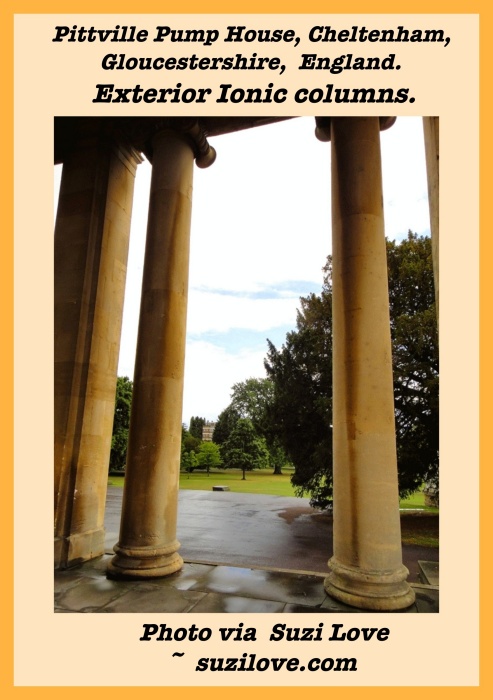
Location: The Pump Room stands at one end of Pittville Park,  about two miles from Cheltenham’s town centre, and is a monument to more than 100 years of fame which Cheltenham enjoyed as a Spa town. The building is set in beautiful parkland and is surrounded on three sides by a grand colonnade of ionic columns opening into the impressive hall with its domed ceiling and original crystal chandeliers. The park has extensive open lawns surrounded by trees and ornate bridges and pathways lead around the lakes where swans and ducks swim.

Cheltenham Tour Map. Pittville Pump House, Cheltenham, Gloucestershire, England.

History: The waters were first discovered in around 1715 on a site now occupied by Cheltenham Ladies’ College. In 1788 George III and Queen Charlotte came to take the waters and it was their visit that set the seal on Cheltenham’s future. After a visit to Cheltenham, a banker named Joseph Pitt commissioned the architect John Forbes to design a pump room that was to act as the centrepiece to his vision of a town to rival Cheltenham – a town he would call Pittville.

The foundation stone was laid on 4 May 1825 and the work completed in 1830. The laying of the foundation was celebrated by the ringing of the bells, firing of cannons, as well as a Masonic Procession which set out from the Masonic Hall in Portland Street. In the evening banquets were held at two of the town’s hotels and grand fireworks display was to be seen at Pittville. The building took five years to complete. Following disagreements between Forbes and the builder, a second architect, John Clement Mead from London, was employed to finish the interior. He designed the elaborate stoves which heated the building. The original official opening on 6th July, 1830 was postponed until 20th July, 1830 because of the death of George IV. A grand public breakfast and ball marked the occasion.

1830 Pittville Park. Pittville Pump House, Cheltenham, Gloucestershire, England.
1831 Pittville Park. Pittville Pump House, Cheltenham, Gloucestershire, England.
1834 View Of Pump House Outside Cheltenham. Pittville Pump House, Cheltenham, Gloucestershire, England.
Pittville Pump House, Cheltenham, Gloucestershire, England.
Poster: Pittville Pump Room latest and grandest water spas built in Cheltenham.
1820s Early Joseph Pitt, Banker. Commissioned architect John Forbes to design a pump room as centrepiece to his vision of a town to rival Cheltenham, a town he would call Pittville.
1825 May Foundation Stone laid for Pittville. 1830 Pittville completed.Pittville Pump House, Cheltenham, Gloucestershire, England.

Building the Pump Room: The total cost of the project was over £40,000, and incredible price for that time. Like many bankers of his time, Pitt ran into financial difficulties, the building went out of favour and was sold in 1890 to the Borough of Cheltenham for £5,400, a fraction of the original cost. The building is decorated in Ionic style and the great hail reflects the genius of John Forbes with the spa opening on the north side and the gallery and dome surmounting the hall.

The grand building is 92 feet long by 43 feet, surrounded by a colonnade 13 feet wide the roof of which are supported by fluted Ionic columns 22 feet high. Along the facade stand three figures representing Aesculapius, Hygeia and Hippocrates, originally made by Lucius Gahagan of Bath. In its design, the building combines elements of both Greek and Roman architecture. It was modelled on the temple on Illisus in Athens, the engravings of which appeared in Stuart and Revett’s Antiquities of Athens (1762).

The inspiration for the dome probably came from the Panthenon in Rome. A large ballroom was situated on the ground floor where even today visitors can attend music concerts, dances and other events. With a capacity of 400 and remarkable acoustics, it is Cheltenham’s finest concert venue. The spa with an oval pump room to the rear of the building are still there for the visitors to enjoy, available from a marbled pump and counter. A reading room, library and billiard room occupied the first floor.

Third well pumped surface water and housed the many pipes running the other wells. Pittville Pump House, Cheltenham, Gloucestershire, England.
Pump, Or Tabernacle, Opened in 1830. Dispensed unique salty mineral rich water. Pittville Pump House, Cheltenham, Gloucestershire, England.
Looking down the well. Pittville Pump House, Cheltenham, Gloucestershire, England.
Two wells with side tunnels supplied spa water. Pittville Pump House, Cheltenham, Gloucestershire, England.
Diagram of the pump.Pittville Pump House, Cheltenham, Gloucestershire, England.
View from pump house upper level.
Side View. Pittville Pump House, Cheltenham, Gloucestershire, England.
Rotunda. Pittville Pump House, Cheltenham, Gloucestershire, England.
Rotunda and exterior of building. Rotunda. Pittville Pump House, Cheltenham, Gloucestershire, England.
Ionic columns surrounding the Pump House. Pittville Pump House, Cheltenham, Gloucestershire, England.
Exterior with Ionic columns. Pittville Pump House, Cheltenham, Gloucestershire, England.
Exterior Brick and Windows. Pittville Pump House, Cheltenham, Gloucestershire, England.

Fashion History: “Cheltenham will be the summer village of all that is fashionable and all that is dignified; the residence of the royal ” family being a thing quite new so far from the metropolis . Already we hear of nothing but Cheltenham modes — the Cheltenham cap — the Cheltenham bonnets — the Cheltenham buttons — the Cheltenham buckles , in short all the fashions are completely Cheltenhamized throughout Great Britain.” via 1826 Griffith’s New Historical Description of Cheltenham and Its Vicinity.

Second World War: The Pump Room housed British and American army personnel, when dry rot was allowed to creep through the structure unchecked, and only after the war was the full extent of the damage revealed. Plaster, brickwork, timber: nearly everything had been affected. The dome was only held in position by a shell of plaster; the timber had been eaten away by the fungus.

The Duke of Wellington: Public subscriptions carne to the rescue, which were accompanied by Public Works grants and Historic Building Council contributions. A total of £43,250 was raised and by 1960 the building was partially restored to its former glory and reopened in 1960 by the Duke of Wellington. The old card room had been replaced by a new foyer, cloakrooms and second staircase, and heating and new lighting were in stalled.

Recent History: In 2003, the old Victorian wells were leaking and allowing ground water to dilute the natural mineral water so Pittville Pump Room no longer qualified as a spa and the well was shut down. The spa was then repaired and reopened so visitors can taste the only alkaline spa water in the country. The Pump Room’s old maple-strip floor was replaced with a stunning English oak floor, better flooring found for the ball room, and old pipes replaced. Nowadays the Pittville Pump Room is in use most days of the year for private and public functions and is one of Cheltenham’s most popular wedding venues. The venue is also used frequently by orchestras, choirs and chamber groups because it has stunning acoustics.

Cheltenham Spa, England: Pittville Pump Room. #England #Cotswolds #BritishHistory #HistoricTravel https://books2read.com/suziloveROver Share on X
RL_1_D2D_Regency Overview RetailerLinks
https://books2read.com/suziloveROver
RL_1_D2D_Regency Overview RetailerLinks https://books2read.com/suziloveROver
Posted in 1700s, 1800s, Bridgerton, Customs & Manners, England, Georgian Era, Google Books, Grand Tour, History, Jane Austen, Regency Era, Suzi Love Images, travel | Tagged Bridgerton, British history, cheltenham, Customs and Traditions, England, Jane Austen, Regency Era, Regency Life, Regency Royalty, travel

1800s “Admiration”. By Vittorio Reggianini. Jane Austen Era oil on canvas. #RegencyEra #JaneAusten #Arthistory

Suzi Love Posted on June 8, 2025 by Suzi LoveJune 8, 2025

1800s “Admiration”. By Vittorio Reggianini. Oil on canvas. This looks like a typical drawing room scene from Jane Austen’s lifetime, or the early 1800s, or the Regency Era. Via Wikimedia Commons commons.wikimedia.org

1800s "Admiration". By Vittorio Reggianini. Oil on canvas. #Regency #Art
1800s "Admiration". By Vittorio Reggianini. Jane Austen Era oil on canvas. #RegencyEra #JaneAusten #Arthistory https://books2read.com/SuziLoveFashionWomen1801-1804 Share on X
HN_25_D2D_fashwomen1801-1804
https://books2read.com/SuziLoveFashionWomen1801-1804
HN_25_D2D_fashwomen1801-1804 https://books2read.com/SuziLoveFashionWomen1801-1804

Posted in 1800s, 1800s Mens Fashions, 1800s women's fashion, art, Customs & Manners, Dress Or Robe, fashion accessories, household, Regency Era, Regency Fashion, Suzi Love Images | Tagged 1800s women's fashion, art, Customs and Traditions, Dress Or Gown, fashion accessories, household, Jane Austen, Regency Fashion, WikiMedia Commons | Leave a reply

Auld Lang Syne Traditionally Sung To Farewell the Old Year. #NewYear. #2025 #Scotland #BritishHistory

Suzi Love Posted on December 31, 2024 by Suzi LoveDecember 30, 2024

Auld Lang Syne is traditionally sung to farewell the old year at the stroke of midnight on New Year’s Eve. It’s a poem written by Robert Burns in 1788 in Scotland, but based on an older Scottish folk song. In 1799, it was set to the traditional tune.

The song begins by posing a rhetorical question: Is it right that old times be forgotten? The answer is generally interpreted as a call to remember long-standing friendships.[9] Alternatively, “Should” may be understood to mean “if” (expressing the conditional mood) referring to a possible event or situation.

George Thomson‘s Select Songs of Scotland was published in 1799 in which the second verse about greeting and toasting was moved to its present position at the end.[9]

Most common usage of the song involves only the first verse and the chorus. The last lines of both of these are often sung with the extra words “For the sake of” or “And days of”, rather than Burns’s simpler lines. This makes these lines strictly syllabic, with just one note per syllable.

Should auld acquaintance be forgot,
And never brought to mind?
Should auld acquaintance be forgot,
And auld lang syne?


(Chorus)
For auld lang syne, my jo,
For auld lang syne,
We’ll tak a cup o’ kindness yet,
For auld lang syne.


And surely ye’ll be your pint-stowp!
And surely I’ll be mine!
And we’ll tak a cup o’ kindness yet,
For auld lang syne.


We twa hae run about the braes
And pu’d the gowans fine;
But we’ve wander’d mony a weary foot
Sin auld lang syne.


We twa hae paidl’d i’ the burn,
Frae mornin’ sun till dine;
But seas between us braid hae roar’d
Sin auld lang syne.


And there’s a hand, my trusty fiere!
And gie’s a hand o’ thine!
And we’ll tak a right guid willy waught,
For auld lang syne.

English version

Should old acquaintance be forgot,
And never brought to mind?
Should old acquaintance be forgot,
And old lang syne?


(Chorus)
For auld lang syne, my dear,
For auld lang syne,
We’ll take a cup of kindness yet,
For auld lang syne.


And surely you’ll buy your pint cup!
And surely I’ll buy mine!
And we’ll take a cup o’ kindness yet,
For auld lang syne.


We two have run about the slopes,
And picked the daisies fine;
But we’ve wandered many a weary foot,
Since auld lang syne.


We two have paddled in the stream,
From morning sun till dine;
But seas between us broad have roared
Since auld lang syne.


And there’s a hand my trusty friend!
And give me a hand o’ thine!
And we’ll take a right good-will draught,
For auld lang syne.

Robert Burns
Robert Burns Robert Burns, engraving from A Biographical Dictionary of Eminent Scotsmen, 1870.

Xmas_NewYear_AuldLangSyne_Sml
Auld Lang Syne Traditionally Sung To Farewell the Old Year. #NewYear. #2025 #Scotland #BritishHistory books2read.com/suziloveHOCP Share on X

Posted in Christmas, Georgian Era, History Of Christmases Past, Music, Regency Era, Suzi Love Images | Tagged British history, Christmas, Customs and Traditions, music, New Year, Scotland

1826 Almack’s Revisited by Charles White.: ‘It was what most correct persons called ‘horrid bad Almack’s’. #RegencyEra #London #BritishHistory

Suzi Love Posted on September 12, 2024 by Suzi LoveAugust 31, 2024

1826 Almack’s Revisited by Charles White. The ball of this evening passed off as all other balls at the same place, creating envy, jealousy, and hatred in the minds of many of those who have been unsuccessful in procuring tickets; affording real amusement to few, and disappointing a greater portion of those who, by dint of manoeuvring, petitioning, parliamentary interest, or presents, have been enabled to obtain the desired vouchers; and as this was one of the last balls of the season, and a general election already talked of, the mixture of company and the number was much greater than usual; and, consequently, it was what the most correct persons called, “horrid bad Almack’s!”

Almack’s or Willis’s Rooms, King Street, St James, London, UK. Almack’s Assembly Rooms, founded by William Almack at No. 26-28, were on the site of the present Almack House. The club was originally a gaming establishment but moved from Pall Mall. The Assembly rooms were on the South side of King Street in St James’s and were opened on February 12, 1765. At the time the subscription was ten guineas for which there was a ball and supper each week for the twelve weeks of the season.

1826 Almack's Revisited by Charles White.: 'It was what most correct persons called 'horrid bad Almack's'. #RegencyEra #London #BritishHistory
1826 Almack’s Revisited by Charles White.: ‘It was what most correct persons called ‘horrid bad Almack’s’. #RegencyEra #London #BritishHistory
1826 Almack's Revisited by Charles White.: 'It was what most correct persons called 'horrid bad Almack's'. #RegencyEra #London #BritishHistory  books2read.com/suziloveOLD  Share on X
RL_5_D2D_RetailerBuyLink_RL_5_2
https://books2read.com/suziloveOLD
Posted in 1800s, 1800s Mens Fashions, 1800s women's fashion, dancing, England, Google Books, History, London, Pastimes, Regency Era, Regency Fashion, Suzi Love Images | Tagged Almack's Assembly Rooms, Customs and Traditions, dancing, google books, Jane Austen, London, Regency Era, Regency London, Regency People | Leave a reply

Post navigation

← Previous Post
Next Post→

SUBSCRIBE TO SUZI LOVE'S NEWSLETTER.

Recent Posts

  • 1800s Early Three Empire Style Dresses As Worn by Jane Austen. #RegencyEra #Germany #JaneAusten
  • Pleasure House Ball: Why shouldn’t Lady Lillian take the chance of a night’s fun at a scandalous ball? #RegencyRomance #HistRom #ReadARegency #EroticRomance
  • 1814 Jane Austen, Mansfield Park. “Give a girl an education and introduce her properly into the world, and ten to one but she has the means of settling well, without further expense to anybody.”#JaneAusten #RegencyEra #Quote
  • What shoes did the Bridgertons and Jane Austen wear? Gray Slippers, American, with long ankle ties. #JaneAusten #Bridgerton #shoes #regencyfashion
  • Book Hooks: Lady Laura Jamison believes her extraordinary olfactory senses will sniff out her perfect match, but will the Earl prove her wrong? #HistoricalRomance #RomCom #RegencyRomance

Recent Comments

  1. Jana Richards on Book Hooks: Lady Laura Jamison believes her extraordinary olfactory senses will sniff out her perfect match, but will the Earl prove her wrong? #HistoricalRomance #RomCom #RegencyRomance
  2. Kayelle Allen on Book Hooks: Lady Laura Jamison believes her extraordinary olfactory senses will sniff out her perfect match, but will the Earl prove her wrong? #HistoricalRomance #RomCom #RegencyRomance
  3. Tina Donahue on Book Hooks: Lady Laura Jamison believes her extraordinary olfactory senses will sniff out her perfect match, but will the Earl prove her wrong? #HistoricalRomance #RomCom #RegencyRomance
  4. Maggie Blackbird on Book Hooks: Lady Laura Jamison believes her extraordinary olfactory senses will sniff out her perfect match, but will the Earl prove her wrong? #HistoricalRomance #RomCom #RegencyRomance
  5. James DiBenedetto on Book Hooks: Lady Laura Jamison believes her extraordinary olfactory senses will sniff out her perfect match, but will the Earl prove her wrong? #HistoricalRomance #RomCom #RegencyRomance

Login

  • Log in

Archives

  • May 2026
  • April 2026
  • March 2026
  • February 2026
  • January 2026
  • December 2025
  • November 2025
  • October 2025
  • September 2025
  • August 2025
  • July 2025
  • June 2025
  • May 2025
  • April 2025
  • March 2025
  • February 2025
  • January 2025
  • December 2024
  • November 2024
  • October 2024
  • September 2024
  • August 2024
  • July 2024
  • June 2024
  • May 2024
  • April 2024
  • March 2024
  • February 2024
  • January 2024
  • November 2023
  • October 2023
  • September 2023
  • August 2023
  • July 2023
  • June 2023
  • April 2023
  • March 2023
  • February 2023
  • June 2022
  • April 2022
  • March 2022

Categories

  • 1700s
  • 1700s Mens fashion
  • 1700s Womens Fashion
  • 1800s
  • 1800s Mens Fashions
  • 1800s women's fashion
  • 1900s
  • art
  • Australia
  • Bath
  • bedroom fashion
  • Book Hooks
  • Box Or Container
  • Bridgerton
  • Bus Trips
  • Canada
  • Carriage
  • cartoon
  • Celebrity
  • Chatelaine
  • children
  • Children
  • Christmas
  • Coat or Pelisse Or Redingote
  • Contemporary
  • Corset
  • Couple
  • Customs & Manners
  • dancing
  • December Scandal
  • Decorative Item
  • Dress Or Robe
  • Easter
  • Edwardian Era
  • Embracing Scandal
  • England
  • Ester In Images
  • Europe
  • Events
  • Fashion
  • fashion accessories
  • Food and Drink
  • Four Times A Virgin
  • France
  • furniture
  • Georgian Era
  • Georgian Fashion
  • Google Books
  • Grand Tour
  • Group
  • hats
  • History
  • History Events
  • History Notes
  • History Of Christmases Past
  • household
  • Hygiene
  • Irresistible Aristocrats
  • Jane Austen
  • Keanu Reeves
  • Kellys Justice
  • Legal
  • London
  • Love After Waterloo
  • Loving Lady Katharine
  • medical
  • military
  • money
  • mourning
  • Music
  • Outback Arrival
  • pants
  • Pastimes
  • peerage
  • People
  • Petunia and Pearl Diver
  • Places
  • Pleasure House Ball
  • postal
  • Queensland
  • Quotations
  • Regency Era
  • Regency Fashion
  • Regency Life Series
  • Reticule or Bag
  • riding
  • Romantic Era
  • Royalty
  • Russia
  • Scandalous Siblings Series
  • Scenting Scandal
  • Self Publishing
  • sewing
  • Shirt
  • shoes
  • South Pacific
  • Spencer
  • sports
  • Suit
  • Sunday Snippet
  • Suzi Love
  • Suzi Love Books
  • Suzi Love Images
  • Suzi Love Writing
  • Swain Cove
  • THe Viscount's Pleasure House
  • travel
  • U.S.A
  • underclothing
  • Vest or Waistcoat
  • Victorian Era
  • Victorian Fashion
  • weapons
  • weddings
  • Writing Tools

1800s men fashion 1800s women's fashion antiques Bridgerton British history Cartoons Corset cravat decorative Dress Or Gown England europe fashion accessories Fashion Plate France Georgian era Georgian Fashion gloves google books Hats And Hair historical romance History Notes household Jane Austen jewelry Journal des Dames et des Modes London Metropolitan Museum NYC pants Redingote Or Pelisse Or Coat Regency Era Regency Fashion Regency London Regency Men reticule or bag riding sewing shawls Shoes Suzi Love Books Suzi Love Images Tailcoat The Repository Of Arts underclothing Vest or Waistcoat

©2026 - Suzi Love - Weaver Xtreme Theme Privacy Policy
↑