1850–1859 ca. Silk Whalebone and Steel Corset, French. Pale green watered silk corset with black flossing and contrast stitching. via Fine Arts Museums Of San Francisco https://art.famsf.org


1850–1859 ca. Silk Whalebone and Steel Corset, French. Pale green watered silk corset with black flossing and contrast stitching. via Fine Arts Museums Of San Francisco https://art.famsf.org


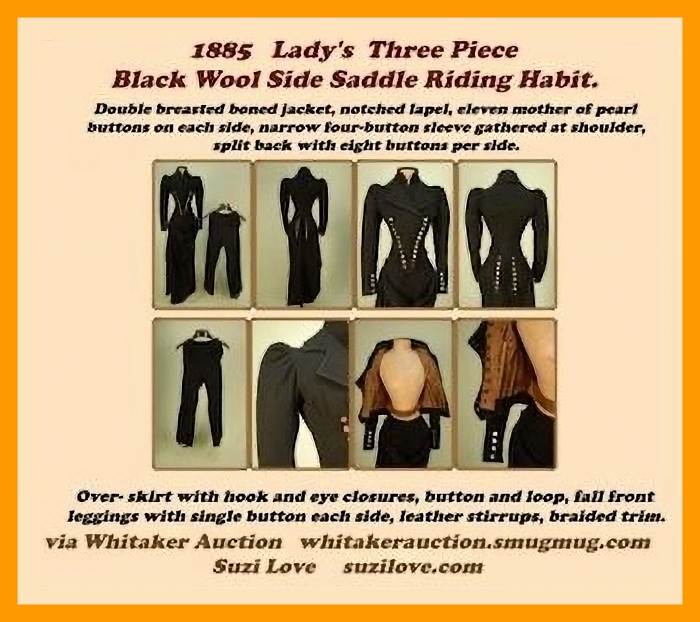
1885 Three Piece Side Saddle Riding Habit. Double breasted boned jacket with notched lapel, mother of pearl buttons, sleeve gathered at shoulder, over- skirt with side hook & eye closures, button and loop, fall front leggings, leather stirrups, braided trim. via suzilove.com Whitaker Auction whitakerauction.smugmug.com


1860 Corset, American. Cotton, metal, and bone. Manufacturer: Langdon Batcheller and Company, American, founded 1865. Stamped Thompson’s Patent Glove Fitting Corset. via Metropolitan Museum NYC, U.S.A. metmuseum.org


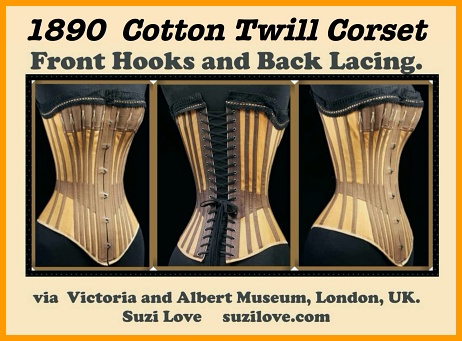
1890 Cotton Twill Corset, England or Germany. Machine stitched with front hooks and back lacing and made in two parts. Brown corset with the bones covered with a darker cotton twill, black fabric covered busks and a trimming of black machine-made cotton lace. Lined with white cotton twill and the top and bottom are bound with reddish brown tape.
The front fastens with a busk and the backs are provided with metal eyelets for a lace. The corset is hip length, curving to a rounded point in the front and less deeply at the back. The bones are close-set and splayed out at the bust and hips, and at the tops are trimmed with fancy stitching in cream. There is a band of dark brown cording at the top, covering the breasts. At the waist there is a V-shaped band in darker brown stitching. With metal fastenings. via http://collections.vam.ac.uk/item/O351699/corset-unknown/
Corsets 1880-1900 History Notes Book 20 This book shows how a fashionable silhouette became of paramount importance and how a well-fitted corset became a fashion essential. As well as a decorative fashion item, tight lacing gave a narrow waist and the desired feminine form under clothing. https://books2read.com/SuziLoveCorsetBook20


Cartoons For Riders At The Hunt. Typical comical scenes from The Bridgertons and Jane Austen’s Daily Lives. From: 1860 Mr. Sponge’s Sporting Tour by Robert Smith Surtees. via Google Books (PD-100)


Top Hat Styles Chart during the 1800s, from the Regency Era through to the Victorian years. Most popular style was cone shaped and tall in height. Originally made of beaver and very short but later from silk and taller. Tall crown, widens at top, narrow brim turns up slightly at sides. https://books2read.com/SuziLoveFashionMen1800-1819


1836-1840 ca. Floral Print Cotton Dress With Silk Satin Piping, English. Cotton printed in soft pink, red, white, and green floral motif on light brown, edged with green silk satin piping and lined with linen and cotton. Sleeves tightly gathered, loose at elbow, skirt gathered from tight fitting bodice edged with green satin piping. via Victoria and Albert Museum, London, UK. collections.vam.ac.uk.From the Museum: Soft colours and floral patterns are a distinctive feature of many 1830s day dresses. Here, pink, red and white flowers harmonise with the brown ground and green piping. The construction of the sleeves is also interesting as they are tightly gathered at the top and loose around the elbow. This accentuates the slope of the shoulder and the tightness of the wrist.


What was fashionable for outer wear in past centuries? Different names in different countries: Pelisse, Redingote, Coat, Or Walking Dress. The Bridgertons and Jane Austen and her contemporaries wore long coats like these to keep warm when out and about, visiting, shopping etc. The thin muslin dresses worn in the early 1800s were little protection against European winters. http://books2read.com/suzilovePelisse


1851-1860 ca. Queen Victoria’s Ivory Silk Satin Dancing Slippers, English. Made by Richard Gundry, Gundry and Co., Soho Square, London, U.K.


1800-1850 ca. Reticule, Or Bag. Brown bag with monogram and drawstring, British. The Bridgerton family and Jane Austen and their female contemporaries would have sewn, gifted and used a bag similar to this. via Snowshill Manor, National Trust, U.K. nationaltrustimages.org.uk
Definition Reticule: Bag or purse, often with a drawstring to pull closed and usually made of cloth or covered cardboard and often decorated with beading or embroidery. A reticule, or purse, or handbag, was usually carried by a woman during the Regency period to carry all their daily necessities. Earlier, women used pockets that tied at the waistline and were hidden in the folds of their skirts. Empire style, or early 1800s, high-waisted dresses made it impossible to either sewn in a pocket or to tie on a pocket. So women began carrying small, decorated bags called Reticules, or ridicules, which generally pulled close at the top with a drawstring.