1808 April Trio of Two Men and a Woman in Full and Half Dress in the Directoire and Empire period, or the Regency Era, or the times of Jane Austen. Two varieties of men’s pants, one knee breeches and stockings and one long pants worn inside high boots. One wearing a Bicorn hat and the other holding a top hat and both with yellow gloves. Woman wearing a pink pelisse, or coat, over a white walking gown with a train and holding a parasol. via Le Beau Monde, or Literary and Fashionable Magazine, London, U.K.
1808 Walk in the Tuileries Gardens. A dandy of the Year VIII. According to Baudelaire, a dandy was, “no profession other than elegance…no other status but that of cultivating the idea of beauty in their own persons….The dandy must aspire to be sublime without interruption; he must live and sleep before a mirror.” Dandies tried to imitate the aristocracy in manner and appearance. This man wears short breeches, usually worn by the aristocracy, that were out of fashion and had been replaced by the ‘more-democratic’ ankle-length pants. His outfit and manners are a throwback to a pre-Revolutionary era. llustrations by François Courboin from Octave Uzanne’s Les Modes de Paris. Fashion in Paris : the various phases of feminine taste and aesthetics from 1797 to 1897, William Heinemann, London, 1898. (PD-Art) via Brown University Library.
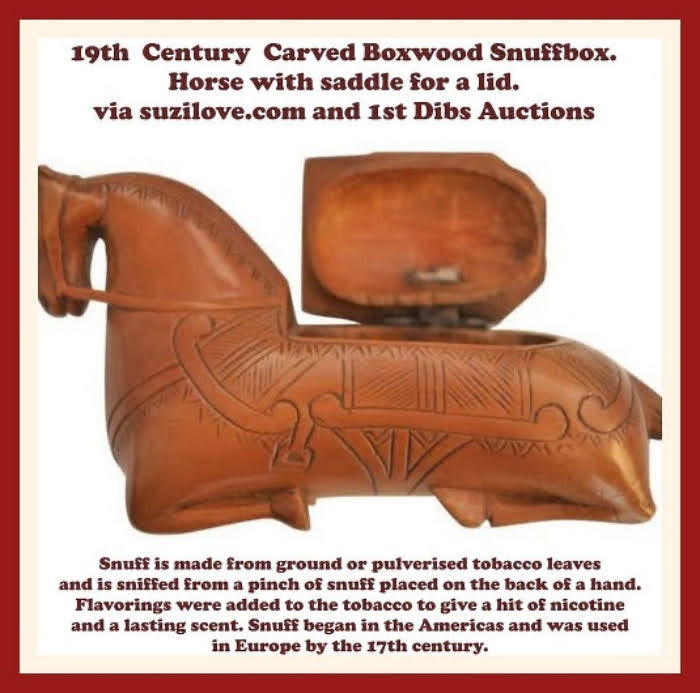
19th Century Snuff Boxes. Not only were boxes made to serve a purpose, but decorative boxes of all types were prized, especially in the 18th-19th Centuries when everything decorative and extravagant was in vogue and taking a pinch of snuff was fashionable. Snuff is made from ground or pulverized tobacco leaves and is sniffed from a pinch of snuff placed on the back of the hand.Flavorings were added to the tobacco to give a fast hit of nicotine and a lasting scent. Snuff began in the Americas and was used in Europe by the 17th Century.
Snuff became popular from the mid 1600s to the mid 1800s and was more popular than smoking. Inhaling snuff, or snuffing, was first seen by a European missionary in 1493 in Christopher Columbus’s new world within Haiti’s indigenous Taino. Until then, tobacco had been unknown to Europeans, but its use spread quickly throughout Europe during the 1500s. By the second half of the 17th century, ornate boxes started being produced to keep the precious powder dry and an entire industry making accessories blossomed around the fashion of taking snuff. Noblemen, and some women, carried extravagantly decorated snuff boxes with them at all times and would offer a pinch of their own particular blend to friends and family. Therefore, these boxes were always on display and so it became a competition to see who could have the most bejeweled or expensive box possible. By the mid 1800s, snuff taking was no longer popular so these exquisite and expensive snuff boxes became decorative, rather than functional.
19th Century Shoe Snuffbox. via 1st Dibs Auctions 1stdibs.com19th Century Engraved Horn Snuffbox. Heart surrounded by flowers and leaves, sides with dove, symbol of purity and peace, brass hinge and setting. via 1st Dibs Auctions19th Century Carved Boxwood Snuffbox. Horse with saddle for a lid. via 1st Dibs Auctions
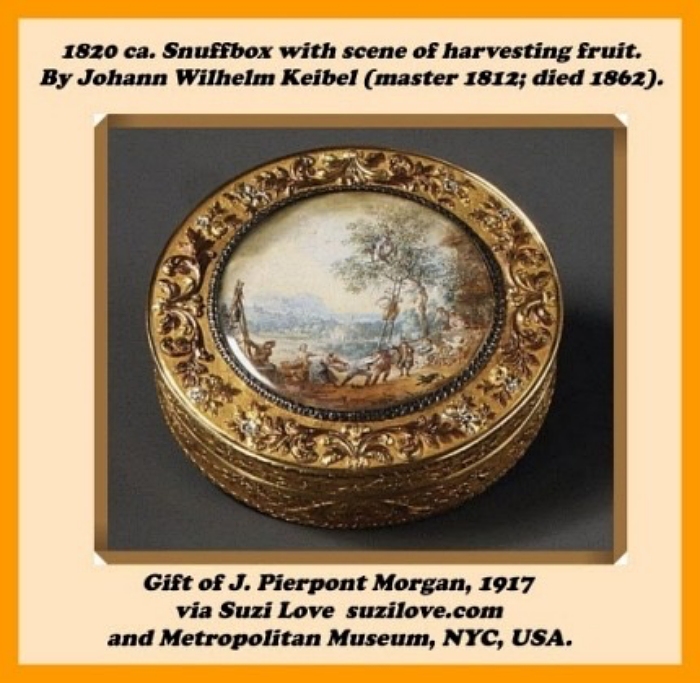
1804-1809 ca. Snuffbox in the Shape of A Lion, Moulinie, Bautte and Cie, Geneva, Switzerland.via Victoria and Albert Museum.1820 Snuffbox with scene of harvesting fruit. By Johann Wilhelm Keibel (master 1812; died 1862). via Metropolitan Museum New York City, U.S.A. metmuseum.org1810 ca. Jeweled Gold Snuff Box, Switzerland. Maker’s Mark Geneva. via Christie’s Auction Rooms. christies.com 19th Century Taking Snuff and Pretty Snuff Boxes In Bridgerton and Jane Austen Years. #bridgerton #RegencyEra #JaneAusten #Antiques https://www.books2read.com/suziloveBoxesCases Share on X
1818 November 6th A Dandy Cock in stays or- A new thing for the ladies.By Isaac Robert Cruikshank A dandy, much burlesqued, stands full-face, his head, which has a bird-like profile, turned to the left; his hair is brushed up at the back behind his hat to resemble the tail-feathers of a cock. He wears puffed-out breeches and top-boots with enormous spurs, and holds an umbrella. Via British Museum, London, UK. britishmuseum.org (PD-Art)
1807-1817 ca. Man’s Leather Breeches, American. These are the sort of pants that the men Jane Austen knew would have worn for riding or in the country. Drop front buttoned flap at the waist, a drawstring at the back waist to adjust waist size, and drawstrings and buttons at the calves to keep the breeches secure when worn with high boots. via Metropolitan Museum New York City, U.S.A. metmuseum.org
Do you need more factual and visual information for your historical fiction? Try History Notes Books 1-28. Non-fiction Series: Fashion, corsets, Regency Era, music and social manners in the 18th and 19th centuries e.g.
1810-1820 ca. Double Breasted Red Hunting Coat, English.
1810-1820 ca. Red Hunting Coat, English. Hunting was both a popular sport and an essential part of social success. Double-breasted tailcoat of woolen superfine, lined with sateen and cotton, M-notch lapels, nine gold buttons with heraldic crest, cuffs with three smaller matching buttons. via Collection from Castle Howard, Yorkshire, U.K. Victoria and Albert Museum, London, UK. Hunting coats, or colors, often red coats called pinks, were worn by hunt masters and hunters. In Bridgerton and Jane Austen times, or the early 1800s, gentlemen wore red coats like this while riding to the hounds.
Historically, hunt members wore ‘colors’ to distinguish between types of hunters and their level of experience. Traditional red coats were worn by huntsmen, masters, former masters, whippers-in, regardless of sex, while other hunt staff members and male members invited by masters wore colors and hunt buttons as a mark of appreciation for their involvement in the organization and running of the hunt. After the Hunting Act in England and Wales, only Masters and Hunt Servants wore red coats or hunt livery. Gentleman subscribers usually wore black coats, with or without hunt buttons and in some countries, women wore colored collars on their black or navy coats to help them stand out from the rest of the field. Some hunts, including most harrier and beagle packs, wear green rather than red jackets, and some hunts wear other colors such as mustard.
Are you a Bridgerton fan? Love Jane Austen? Love history? Take a look at a Young Gentleman’s Day in early 1800s. Young Gentleman’s Day Regency Life Series Books 2 by Suzi Love. Easy to read books on what a young gentleman did, wore, and lived during the early 1800s, or the Regency Era when King George 3rd was mad and his son, Prince George, was the Regent in Britain. #Regency #JaneAusten #amwriting books2read.com/suziloveYGD
Do you need more factual and visual information for your historical fiction? History of fashion, music, peerage and customs in 18th and 19th centuries. Non-fiction series full of gorgeous pictures and engraved fashion plates. A visual history of fashion, music, peerage, social manners and customs from late 1700s to late 1800s, or 18th and 19th centuries.