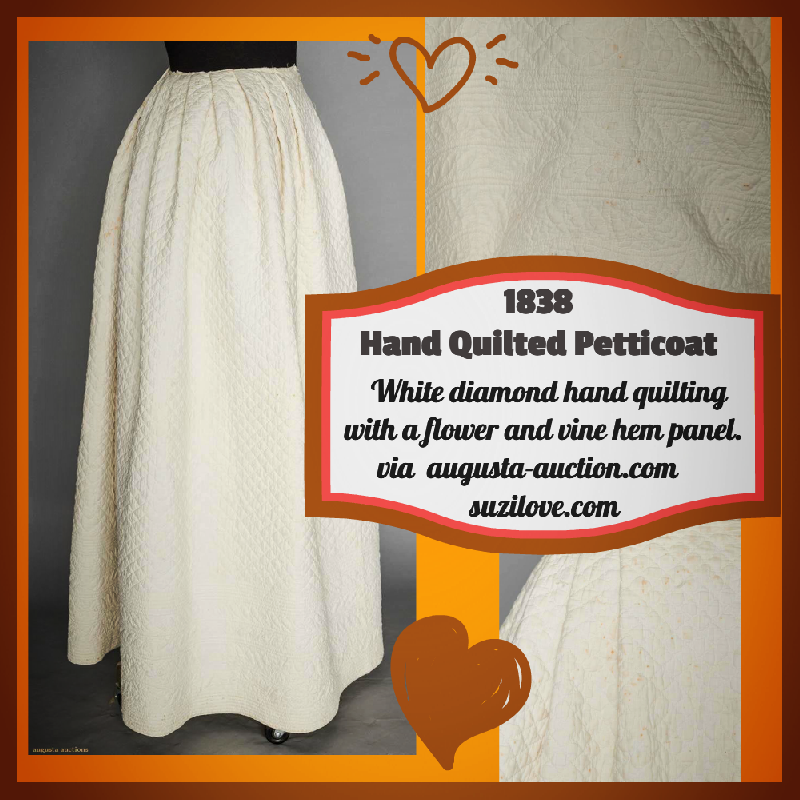
1838 White Cotton Hand Quilted Petticoat. Diamond pattern with flower and vine quilted hem band. via August Auction.



I'm an Australian author of contemporary and historical romances, plus history non-fiction. My books range from sexy to erotic, late 1700s to the mid 1800s, and with a dash of Australia thrown into the mix. My heroes and heroines challenge tradition and my stories often expose the seamier levels of life. I now live in a sunny part of Australia after spending many years in developing countries in the South Pacific. My greatest loves are traveling, anywhere and everywhere, meeting crazy characters, and visiting the Australian outback. I hope my books bring history alive and you have fun adventuring with my roguish heroes and feisty heroines.
1838 White Cotton Hand Quilted Petticoat. Diamond pattern with flower and vine quilted hem band. via August Auction.
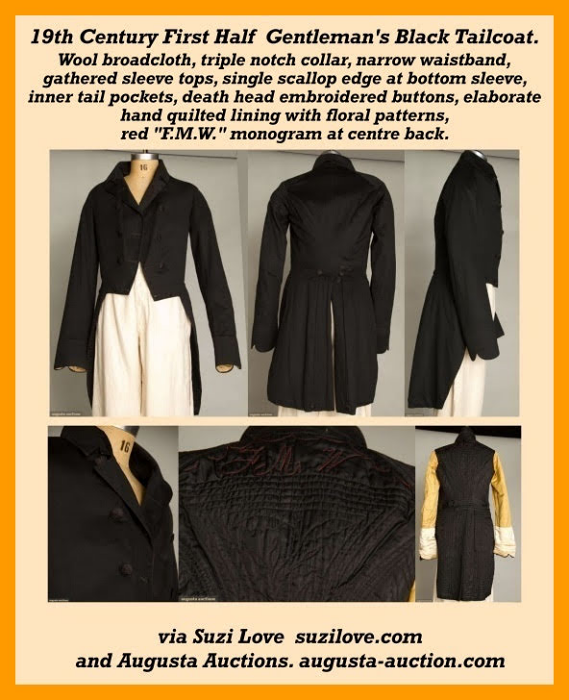
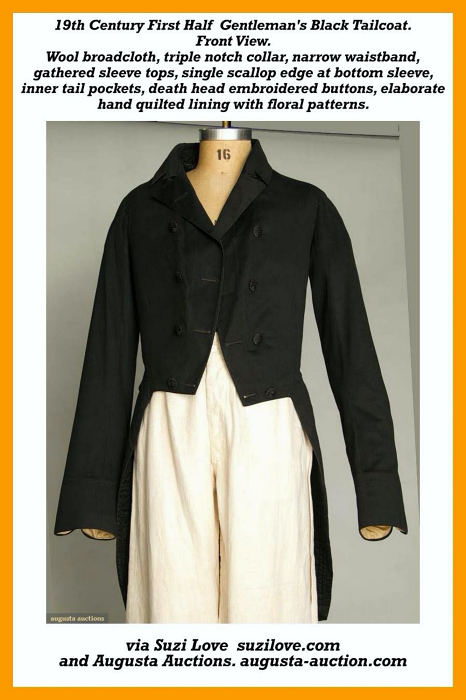
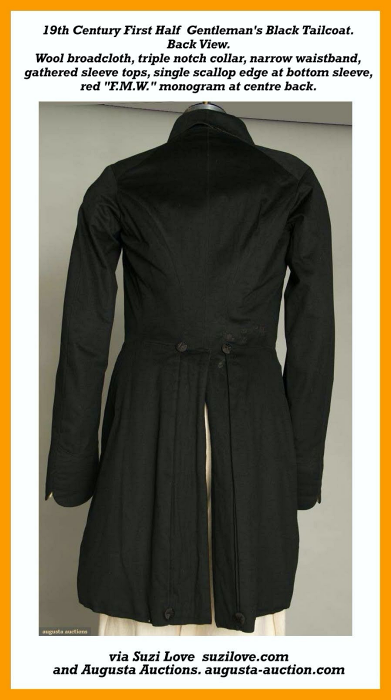
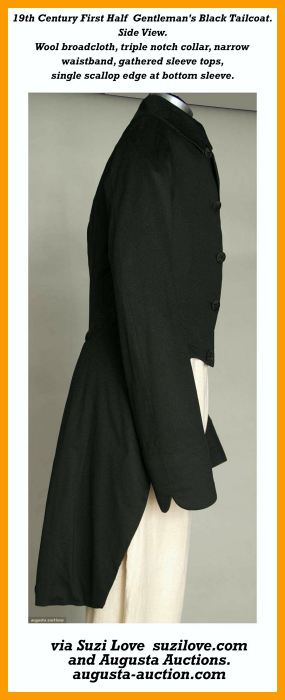
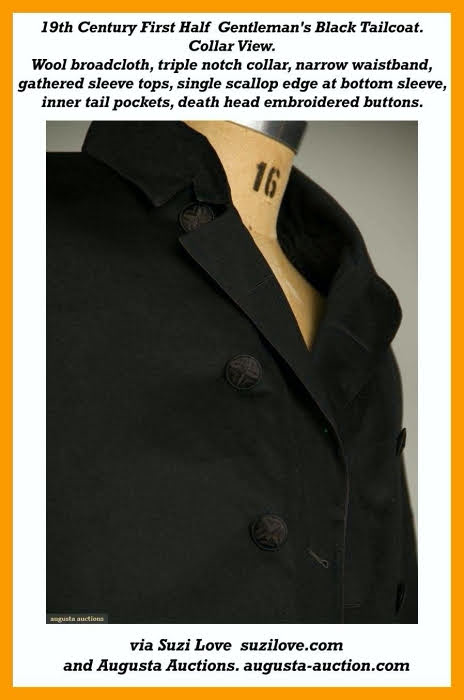
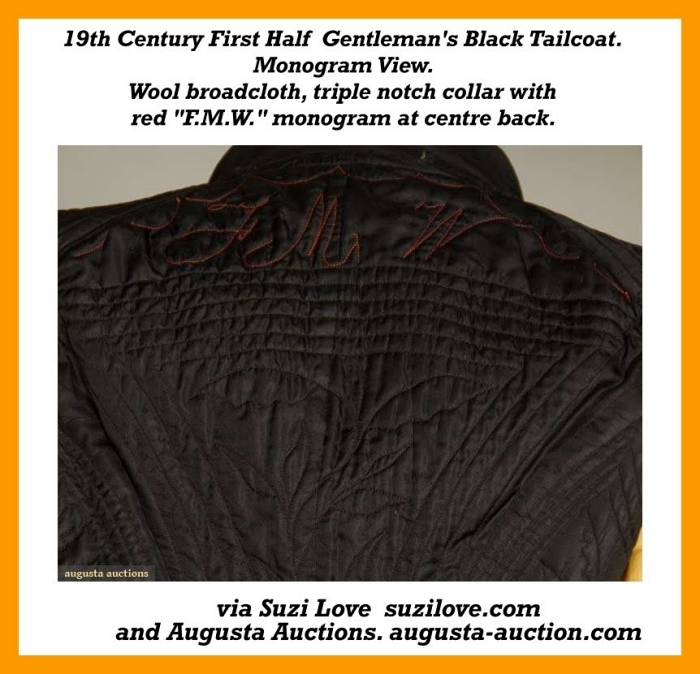
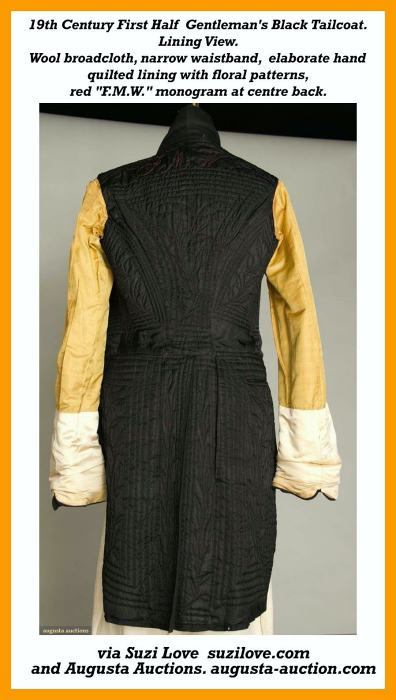
19th Century First Half Gentleman’s Black Tailcoat. Wool broadcloth, triple notch collar, narrow waistband, sleeve tops gathered and uniformly wide to single scallop edge at bottom sleeve, inner tail pockets, death head embroidered buttons, elaborate hand quilted lining with floral patterns in concentric square frames and a “F.M.W.” monogram embroidered at the centre back top in red. Via Augusta Auctions – augusta-auction.com
Tailcoat: A Regency Era, or early 1800s, gentleman was outfitted in more practical fabrics, such as wool, cotton and buckskin rather than the fussy brocades and silks of the late 1700s. The men in Jane Austen’s life would have worn a black tailcoat like this for everyday wear. https://books2read.com/SuziLoveFashionMen1800-1819

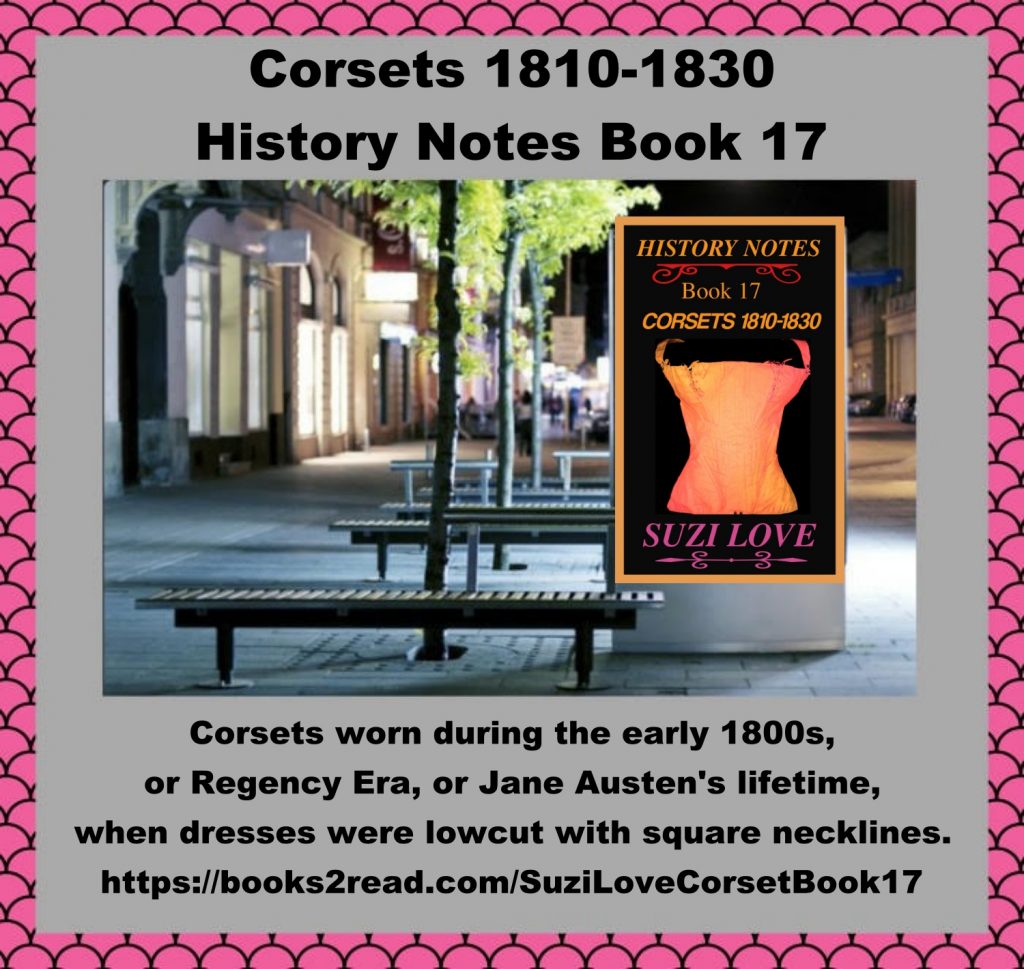
This book shows how corsets changed to fit well under clothing, give maximum support and comfort. Corsets pushed up breasts and showed off the bust line beneath a square-cut and low-cut neckline as in the early 1800s, or Regency years. Jane Austen and her female and friends wore these corsets. Corsets or stays worn during the early 1800s, or Jane Austen’s lifetime. https://books2read.com/SuziLoveCorsetBook17
The main purpose of corsets was to support and shape the breasts. Though they still slimmed the midriff, this was not the prime purpose of a corset between 1810 and 1830. The waistlines of dresses were lowering to below the bust line but nearer to the true waist, so corsets were longer and were given added shaping by stitching and cording and by shaping the breasts with pleated or gathered cups.

And for another tradition we all love, how about a few facts about the beginning of Birthday Parties,
Suzi

The tradition started in Europe a long time ago when it was feared evil spirits were particularly attracted to people on their birthdays. To protect them from harm, friends and family would to come be with the birthday person and bring good thoughts and wishes.
Giving gifts brought even more good cheer to ward off the evil spirits. At first it was only kings who were recognized as important enough to have a birthday celebration (maybe this is how the tradition of birthday crowns began?).
As time went by, children became included in birthday celebrations. The first children’s birthday parties occurred in Germany and were called Kinderfeste.
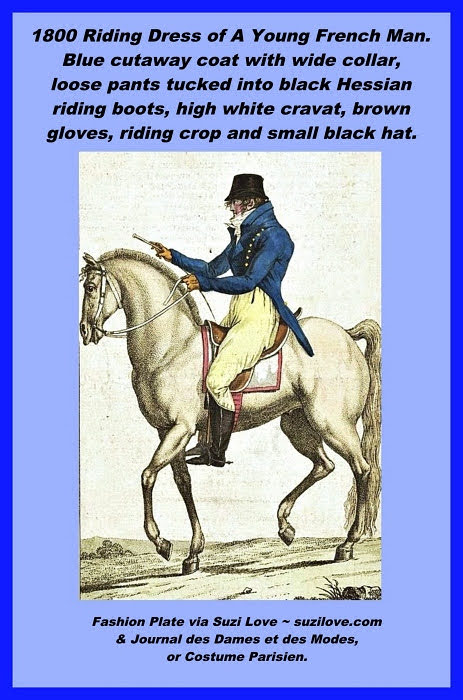
1800 Riding Dress of A Young French Man. Blue cutaway coat with wide collar, loose pants tucked into high black riding boots, high white cravat, brown gloves, riding crop and a very small black hat. Fashion Plate via Journal des Dames et des Modes, or Costume Parisien.
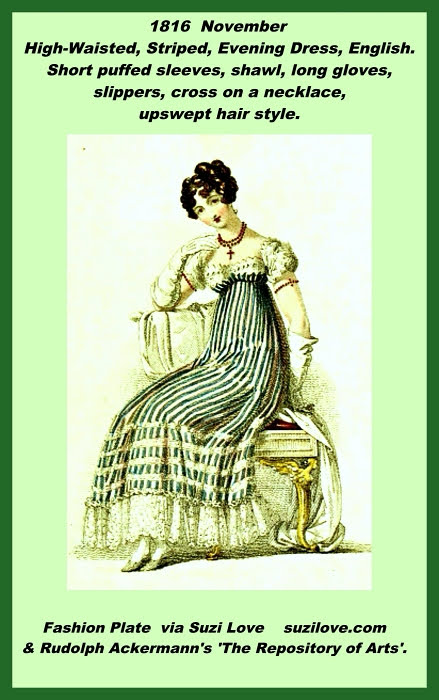
1816 November. A lilac and white striped gauze dress over a white satin slip; the bottom of the skirt is ornamented with five rows of white silk trimming, of a very light and elegant description: it has just been introduced, and the patterns has more novelty than any thing we have seen for some time; a single flounce of deep blond lace completes the trimming. The body is also very novel; the upper part is formed of lace, and the lower of gauze, to correspond with the dress; the latter is quite tight to the shape, but the former has an easy fullness, which forms the shape in a manner extremely advantageous to the figure. The sleeve is short and very full; it is composed of lace, looped high, and finished by a trimming to correspond with that of the skirt. The hair is full dressed, without any ornament. Necklace, cross, armlets, and bracelets of rubies. White satin slippers, and white kid gloves.Fashion Plate via Rudolph Ackermann’s ‘The Repository of Arts’.
Gorgeous Regency Era clothing came in a wide range of styles to suit every season and occasion. Ladies in Jane Austen’s times wore Empire style dresses which were usually of light fabric and floaty in style. By the later 1810s, stripes were very popular and lace and frills were added to make the dress more individual.
1770 ca. Corset, Europe. Back lacing, blue and cream silk with cream silk bows.

Corsets 1700-1790 History Notes Book 15 This book shows how body wraps, stomachers and stays were worn during the 1700s. They created a variety of fashionable silhouettes to suit the elaborate fashions worn for court and daily life during the 18th Century. Wearing the correct underclothing was essential for keeping garments in place and giving the best fashion display. Corsets, stays, body wraps, and stomachers worn during the 1700s, or the Georgian Era. https://books2read.com/SuziLoveCorsetBook15

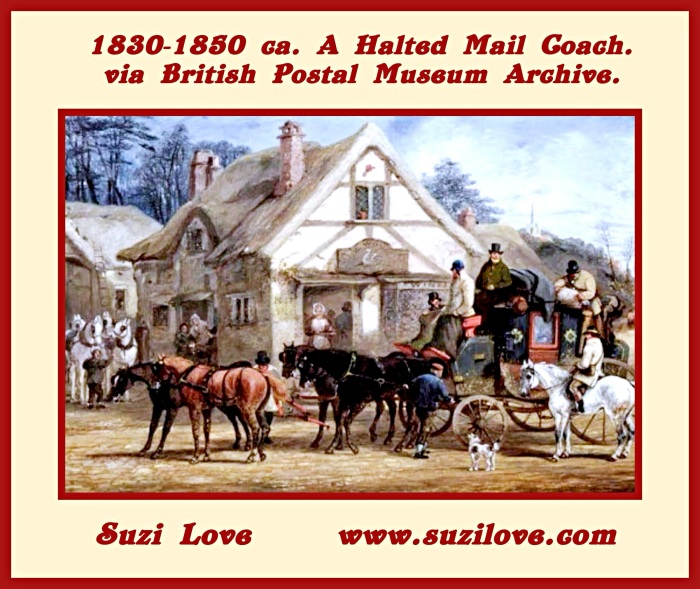
1830-1850 A Halted Mail Coach via British Postal Museum.
For many years in England, mounted carriers rode between posts and carried letters to and from local postmasters who delivered them to people in his area. The system was inefficient and post riders often robbed. John Palmer, a theatre owner, transported actors and materials and wanted to improve mail delivery so the Chancellor of the Exchequer, William Pitt, let Palmer try. He beat the old delivery time by 22 hours and brought the mail from Bristol to London in 16 hours. A year later, in 1785, the mail coach, sometimes called a post coach, was delivering mail from London to Norwich, Liverpool, Leeds, Dover, Portsmouth, Poole, Exeter, Gloucester, Worcester, Holyhead and Carlisle.
Palmer’s mail service improved after turnpike roads were introduced in the late 1780s, allowing faster travel and encouraged business between the proprietors of stage coaches.” The first mail coaches were supplied by contractors who received on average “one penny-halfpenny per mile.”, despite these contracted coaches being poorly built.. By the 1800s, the Post Office owned their own fleets of coaches with black and scarlet livery.
Mail coaches were usually drawn by four horses and took four passengers inside and three outside. The mail box was locked and secured at the rear of the coach and guarded by an armed Royal mail post office guard who followed strict rules.
Travel and Luggage By Suzi Love History Notes Book 10. How did people travel in Jane Austen’s times. In past centuries? What did they take with them to make their long journeys easier? Travel by road, ship, canal, or railway all took a long time and had dangers so people learned to prepare. And then, in the nineteenth century, road improvements, inventions, and scientific developments made travel more pleasurable. books2read.com/SuziLoveTravel

1808 Orange Redingote, or Pelisse, French. Walking dress with white vertical front trim and wearing a blue hat with three rows of lace trim hanging down to cover the face. Fashion Plate via Journal des Dames et des Modes, Costume Parisien. Jane Austen and her female contemporaries wore coats like these when outdoors because they needed the warmth over the fashionable light muslin dresses that all women wore. Redingotes could be both comfortable and decorative. They often had military elements in support of the thousands of men involved in ongoing wars.
Definition Redingote Or Pelisse Or Walking Dress Or Coat: Long fitted outdoor coat worn over other garments for warmth. Often left open at the front to show off the dress underneath. French word developed from English words, riding coat.


1820-1835 ca. Woman’s Underwear Combination, English. This style of underwear was worn during the Jabe Austen and Bridgerton years. Petticoat: 1820-1829 ca. Cotton with double row of piping round hem. Frontless with looped shoulder pieces. Corset: 1835: Cotton reinforced with whalebone and cording, hand-sewn. Shift Or Chemise:1830s Worn under corset. Drawers: Sheer clinging fabrics needed drawers underneath for modesty. via Victoria and Albert Museum, London, UK.
collections.vam.ac.uk.
