I'm an Australian author of contemporary and historical romances, plus history non-fiction.
My books range from sexy to erotic, late 1700s to the mid 1800s, and with a dash of Australia thrown into the mix. My heroes and heroines challenge tradition and my stories often expose the seamier levels of life.
I now live in a sunny part of Australia after spending many years in developing countries in the South Pacific. My greatest loves are traveling, anywhere and everywhere, meeting crazy characters, and visiting the Australian outback.
I hope my books bring history alive and you have fun adventuring with my roguish heroes and feisty heroines.
Pleasure House Ball Book 3 Irresistible Aristocrats. Love revealed at a courtesan’s ball. Brenton, Lord Mallory, attends his first courtesan’s ball in ten years to appease his concerned friends, though he’d rather stay home and read to his motherless daughters. books2read.com/suzilovePHB
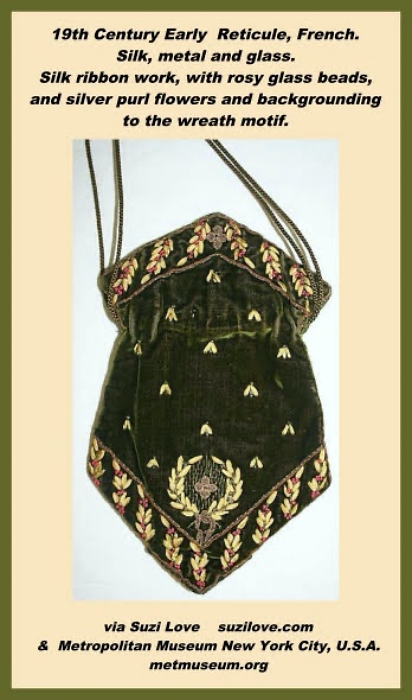
19th cent. Early. Reticule, or Bag, of silk, metal and glass, French, as carried in Jane Austen’s times. Silk ribbon work, with rosy glass beads, and silver purl flowers and backgrounding to the wreath motif. via Metropolitan Museum, N.Y.C., U.S.A. metmuseum.org
Definition Reticule: Bag or purse, often with a drawstring to pull closed and usually made of cloth or covered cardboard and often decorated with beading or embroidery. A reticule, or purse, or handbag, was usually carried by a woman during the Regency period to carry all their daily necessities. Earlier, women used pockets that tied at the waistline and were hidden in the folds of their skirts. Empire style, or early 1800s, high-waisted dresses made it impossible to either sewn in a pocket or to tie on a pocket. So women began carrying small, decorated bags called Reticules, or ridicules, which generally pulled close at the top with a drawstring.
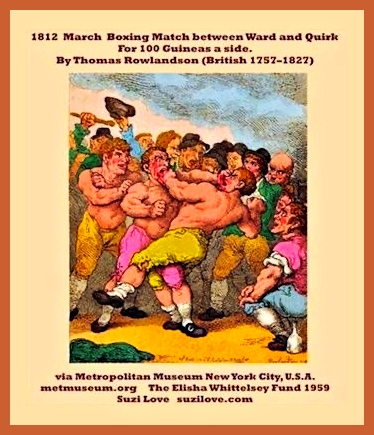
1812 March 1st Boxing Match between Ward and Quirk for 100 Guineas a side. By Thomas Rowlandson, British. via The Metropolitan Museum, New York City, U.S.A. metmuseum.org
1802 Full Dress of Blue Court Suit, French. Man’s grand parure, or full dress, with white lace on the tailcoat and ruffles on the shirt, jewels, white stockings, black dress shoes, sword and a bicorn hat under his arm. Fashion Plate via Journal des Dames et des Modes, Costume Parisien. Typical menswear for court in most parts of Europe in the early 1800s, or Regency Era, or Jane Austen’s times, included a tailcoat, a vest or waistcoat, breeches, stockings, dress shoes, and hat.
1819 February Pink Ball Dress, English. Underskirt with white lace hem, pink layer with intricate decoration, short puffed sleeves, low décolletage, or neckline, white shawl and white hat with pink feather. Fashion Plate via John Belle’s La Belle Assemblée or, Bell’s Court and Fashionable Magazine, London. Women’s clothing came in the late 1810s came in a wide range of styles to suit every season and occasion. When attending assemblies or balls, ladies in Jane Austen’s times women wore Empire style dresses which were usually made of light fabric and floaty in style and often of a shorter length suitable for dancing. https://books2read.com/SuziLoveFashionWomen1815-1819
Definition Ball Dress: At the end of the 1810s, ball or dancing dresses had higher hemlines that rose several inches above the ankle so ladies wouldn’t trip on their hens or flounces and make a spectacle of themselves.
Definition Aigret, aigrette, egret: Plume of feathers or jeweled ornament in shape of feathers worn on head or hats. During the early 19th century, or Jane Austen’s lifetime, or during the years of the Bridgerton series, the favorite feathers were osprey and heron.
1806 White Bodice and Red Scarf. Various Hats, Bonnets and an evening headdress. Fashion Plate via Journal des Dames et des Modes, or Costume Parisien.
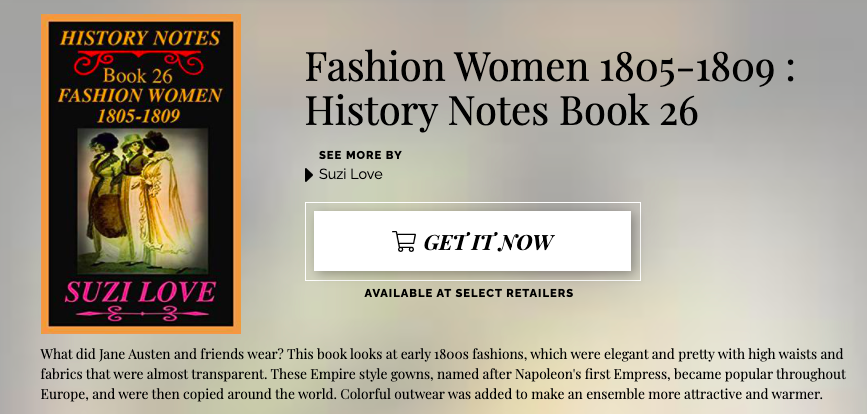
French fashions like this were copied by English magazines so these styles of hats would have been worn by Jane Austen and her contemporaries. https://books2read.com/SuziLoveFashionWomen1805-1809
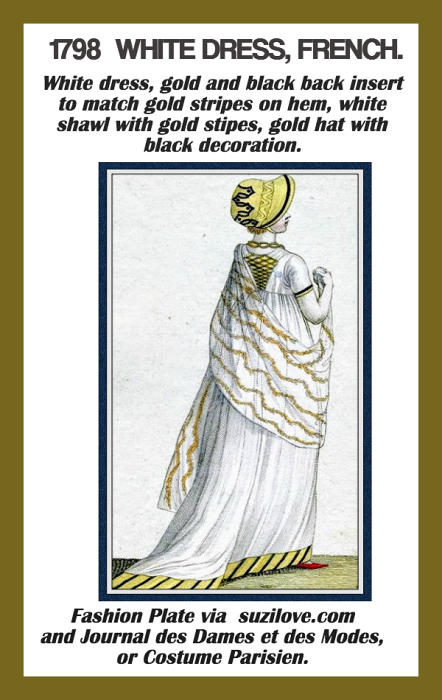
1798 White Dress, French. Gold and black back insert to match gold stripes on the hem, white shawl with gold stripes, gold hat with black decoration. Via Journal des Dames et des Modes or Costume Parisien.
Definition: 18th Century Late Women’s Fashions: A conical body shape was still fashionable while the shape of the skirts changed. The wide panniers which held the skirts out at the sides mostly disappeared by 1780 for all but the most formal court functions and false rumps, or bum-pads or hip-pads were worn for a time. A low-necked gown, usually called in French a robe, was worn over a petticoat and most gowns had skirts that opened in front to show the petticoat worn beneath. As part of the general simplification of dress, the open bodice with a separate stomacher was replaced by a bodice with edges that met center front. Strapless stays which still were cut high at the armpit, to encourage a woman to stand with her shoulders slightly back, a fashionable posture. The fashionable shape was a rather conical torso, with large hips. The waist was not particularly small. Stays were usually laced snugly, but comfortably. Shoes had high, curved heels (the origin of modern “louis heels”) and were made of fabric or leather. Shoe buckles remained fashionable until they were abandoned along with high-heeled footwear and other aristocratic fashions in the years after the French Revolution.
Fashion Women Late 1700s History Notes Book 1. What was fashionable for women in the late 1700s? Extravagant colors and fabrics and outrageous styles were all seen in these flamboyant fashions. Take a look at their dresses, suits, hats, shoes and bedroom fashions. books2read.com/suziloveFashWomen1700s
What was fashionable for women in the late 1700s? Extravagant colors and fabrics and outrageous styles were all seen in these flamboyant fashions. #Georgian #nonfiction #amwriting books2read.com/suziloveFashWomen1700s
1805-1808 ca. Man’s three-part court suit of coat, waistcoat, and breeches, French. Wool broadcloth embroidered with silk and metallic threads, spangles, and glass. Plum colored broadcloth embroidered with plum colored and white silk and chenille, silver thread, spangles and brilliants. Supposed to have been worn by the Hon. James Bowdoin, U.S. Minister to Spain, 1805-1808, at a ball given by Napoleon at the Tuileries. Worn with 01.110 and 01.111. Said to have been worn by the Hon. James Bowdoin, U.S. Minister to Spain from 1805-1808; to his grand-nephew, James Bowdoin Winthrop by inheritance; to James Bowdoin Winthrop’s nephew, Robert C. Winthrop, Jr. by inheritance; gift of Robert C. Winthrop, Jr. to MFA, February 1, 1901.
DIMENSIONS Coat: center back (collar to bottom of coat): 106 cm (41 3/4 in.) Waistcoat: center front: 55.2 cm (21.75 in.) Breeches: center front: 67.9 cm (26.75 in.)
1815 Pink Dress, French. Cashmere dress with white underdress showing the sleeves, decorated hem, turban of tulle and satin, diamond pointed hem, slippers and shawl. Fashion Plate via Journal des Dames et des Modes, or Costume Parisien. https://books2read.com/SuziLoveFashionWomen1815-1819
Definition Aigret, aigrette, egret: Plume of feathers or jeweled ornament in shape of feathers worn on head or hats. During the early 19th century., or Jane Austen’s lifetime, the favorite feathers were osprey and heron.
Definition Empire Style: Named after the First Empire in France, by 1800 Empire dresses had a very low décolleté, or neckline and a short narrow backed bodice attached to a separate skirt. Skirts started directly under the bust and flowed into the classical relaxed wide styles of Greece and Rome. This style of dress is associated with Jane Austen and her contemporaries as a simple cotton high-waisted dress was worn most days and accessorized according to the importance of the occasion.
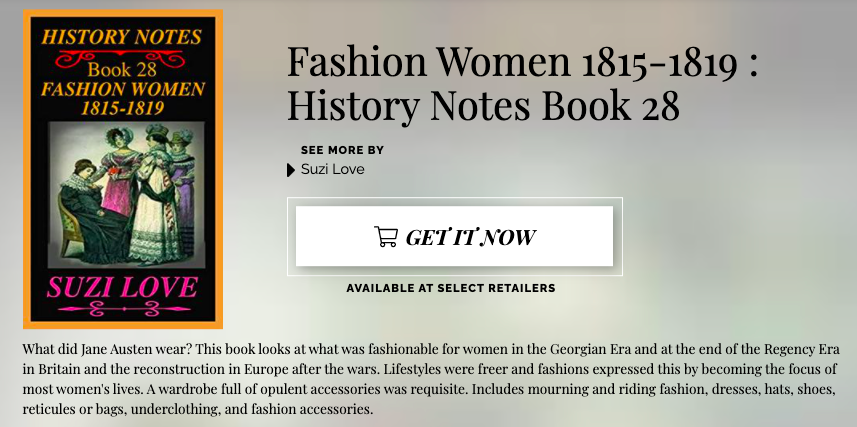
Fashion Women 1815-1819 History Notes Book 28 What did Jane Austen wear? . D2D_HN_28_https://books2read.com/SuziLoveFashionWomen1815-1819
1700s Late Gentlemen’s Coats. A fitted coat was an essential part of a gentleman’s wardrobe in the late 1800s and were generally tailored and cut to fit tightly. Therefore, gentlemen needed a valet, or some other helper, to extricate himself and his shoulders from his glove-like coat. Breeches and a waistcoat in the same fabric usually completed the 18th century’s gentleman ensemble. Coats were generally worn long at the back and had elaborate decoration down the front openings, collars, and sleeve cuffs.
HN_2_D2D_Fashion Men 1700s
books2read.com/suziloveFashMen1700