I'm an Australian author of contemporary and historical romances, plus history non-fiction.
My books range from sexy to erotic, late 1700s to the mid 1800s, and with a dash of Australia thrown into the mix. My heroes and heroines challenge tradition and my stories often expose the seamier levels of life.
I now live in a sunny part of Australia after spending many years in developing countries in the South Pacific. My greatest loves are traveling, anywhere and everywhere, meeting crazy characters, and visiting the Australian outback.
I hope my books bring history alive and you have fun adventuring with my roguish heroes and feisty heroines.
1815 Pink Dress, French. Cashmere dress with white underdress showing the sleeves, decorated hem, turban of tulle and satin, diamond pointed hem, slippers and shawl. Fashion Plate via Journal des Dames et des Modes, or Costume Parisien. https://books2read.com/SuziLoveFashionWomen1815-1819
Definition Aigret, aigrette, egret: Plume of feathers or jeweled ornament in shape of feathers worn on head or hats. During the early 19th century., or Jane Austen’s lifetime, the favorite feathers were osprey and heron.
Definition Empire Style: Named after the First Empire in France, by 1800 Empire dresses had a very low décolleté, or neckline and a short narrow backed bodice attached to a separate skirt. Skirts started directly under the bust and flowed into the classical relaxed wide styles of Greece and Rome. This style of dress is associated with Jane Austen and her contemporaries as a simple cotton high-waisted dress was worn most days and accessorized according to the importance of the occasion.
Fashion Women 1815-1819 History Notes Book 28 What did Jane Austen wear? . D2D_HN_28_https://books2read.com/SuziLoveFashionWomen1815-1819
1700s Late Gentlemen’s Coats. A fitted coat was an essential part of a gentleman’s wardrobe in the late 1800s and were generally tailored and cut to fit tightly. Therefore, gentlemen needed a valet, or some other helper, to extricate himself and his shoulders from his glove-like coat. Breeches and a waistcoat in the same fabric usually completed the 18th century’s gentleman ensemble. Coats were generally worn long at the back and had elaborate decoration down the front openings, collars, and sleeve cuffs.
HN_2_D2D_Fashion Men 1700s
books2read.com/suziloveFashMen1700
19th Century Embroidered Silk Bag, Japan. Metal clasp and chain, embroidered with a beautiful bird and flowers. via Ruby Lane Antiques. rubylane.com
Definition Reticule: Bag or purse, often with a drawstring to pull closed and usually made of cloth or covered cardboard and often decorated with beading or embroidery. A reticule, or purse, or handbag, was usually carried by a woman during the Regency period to carry all their daily necessities. Earlier, women used pockets that tied at the waistline and were hidden in the folds of their skirts. Empire style, or early 1800s, high-waisted dresses made it impossible to either sewn in a pocket or to tie on a pocket. So women began carrying small, decorated bags called Reticules, or ridicules, which generally pulled close at the top with a drawstring.
1816 August Walking Costume, or Pelisse, or Coat, English. Round dress, composed of cambric and trimmed with lace. The body is let in with a profusion of lace. Plain long sleeves, very full, except at the wrist where the fulness is confined by small plaits, sleeve finished by double frill of lace. Over the dress is a Pelisse of blue and white shot sarcenet, lined with white sarcenet and trimmed with white satin. Pelisse sleeve is very full and finished at the wrist by a cuff and bows of ribbon. Pelisse is made half high and finished at neck with a triple fall of rich lace but the neck is bare. White satin hat is turned up in front and ornamented with flowers. Kid gloves, blue kid shoes and a parasol. We are indebted for this tasteful dress to Mrs. Gill of Cork Street, Burlington Garden, London. Fashion Plate via Rudolph Ackermann’s ‘The Repository of Arts’.
Definition: Pelisse Or Redingote: Woman’s long, fitted coat often worn open in front to show off the dress underneath. Sometimes cut away in front. Originally made with several capes and trimmed with large buttons. French word developed from English words, riding coat. reefer. Single- or double-breasted, fitted, tailored, over-all coat usually made from sturdy fabric. Jane Austen and her contemporaries wore long coats like these to keep warm when out and about, visiting, shopping etc. The thin muslin dresses worn in the early 1800s were little protection against European winters. #Regency #Fashion #History
Fashion Women 1815-1819 History Notes Book 28 What did Jane Austen wear? . D2D_HN_28_https://books2read.com/SuziLoveFashionWomen1815-1819
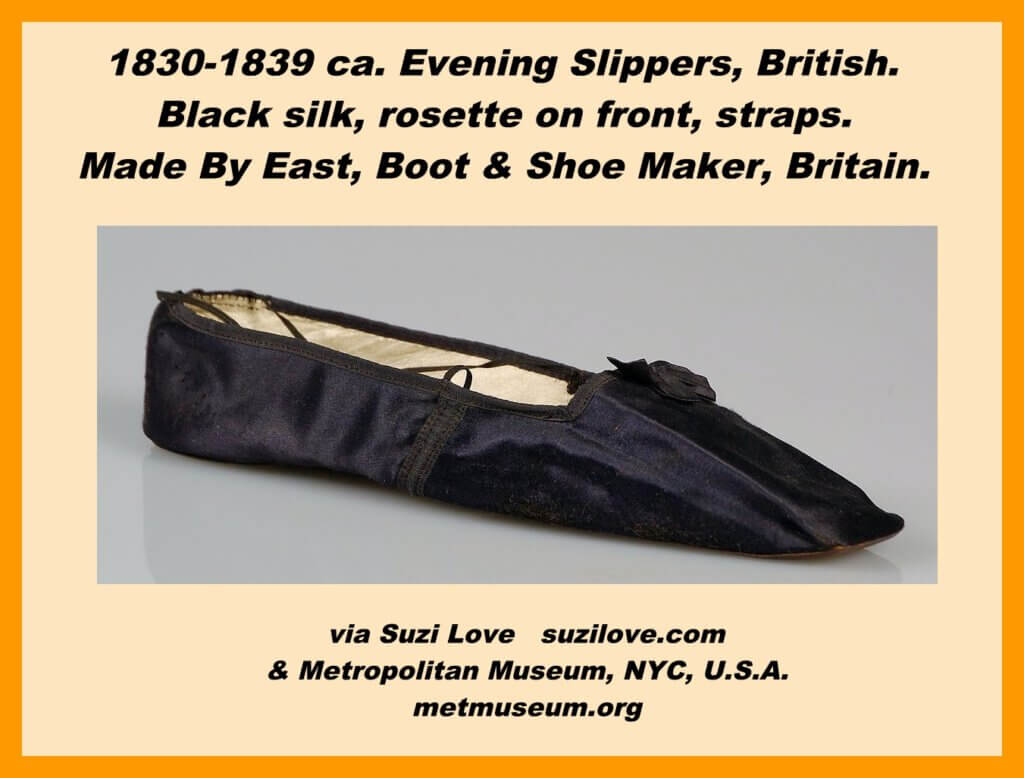
1830-1839 ca. Black Evening Slippers, British. Black silk, rosette on front, straps. Made By East, Boot & Shoe Maker, Britain. via Metropolitan Museum, NYC, U.S.A.
1830s Shoes: Producing different shoes for right and left feet started around 1830 in France. In these first attempts, little paper labels on the insoles of the shoes indicated left and right. However, the shoes were still made on straight lasts with no differentiation between the left and right foot. By the end of the 19th century, producing left and right shoes had become common as shoemakers then worked with combinations of sole and vamp cuts tailored to fit either the right or the left foot. The first steps towards the mechanisation of shoemaking were taken during the Napoleonic Wars. In 1810, engineer Marc Brunel developed a machinery that could mass-produce nailed boots for the soldiers of the British Army. But after the end of the war in 1815, manual labour became cheap, and the demand for military shoes declined. The industrialization of shoemaking began around 1830.
1816 May Full Evening Dress, English. The type of evening dress the Bridgerton family and Jane Austen and her contemporaries would have worn to a formal evening event, such as a ball. A white satin slip, over which is a white lace dress, ornamented with three quillings of white lace on the skirt, intermixed with bows of white satin ribbon. The body and sleeve, both of which are richly ornamented with colored stones, are formed, as our readers will see by the print, in a very novel style. Head-dress, a cap composed of white satin, finished with a band edged with pearls, and a superb plume of white feathers. Necklace, ear-rings, and bracelets,’ colored stones intermixed with pearls. White satin slippers, and white kid gloves. We are indebted to the elegant invention Of Mrs. Gill, of Cork-street, Burlington-Gardens, for our dress this month. Fashion Plate via Rudolph Ackermann’s ‘The Repository of Arts’.
Definition Full Dress: Most formal of outfits, day or night, with all possible accessories added.
Fashion Women 1815-1819 History Notes Book 28 What did Jane Austen wear? . D2D_HN_28_https://books2read.com/SuziLoveFashionWomen1815-1819
Lady Laura Jamison believes her extraordinary olfactory senses will sniff out her perfect match, but will Richard St. Martin, the Earl of Winchester, prove her theory wrong? Scenting Scandal By Suzi Love Book 2 Scandalous Siblings Series. books2read.com/suziloveSS
EXCERPT
Laura concentrated on restful images. Brooks babbled, birds sang, white fluffy clouds floated. Colorful rainbows arced and…. Nothing, dammit. Her frazzled nerves refused to be soothed. Trying not to alert her aunt, whose over-emotional farewells had already delayed proceedings, Laura tugged on Winchester’s arm. His leather-gloved hand held fast. The Devil take the blasted Earl and his oversized anatomy, his overwhelming maleness and his…
She shivered. Everything overpowering about this man, including his unwanted invasion of her senses, ought to be declared illegal. A ticket tied to each limb reading: Danger. Avoid at all cost.
His cologne’s citrus tang, bergamot with an after-note of lemon, flooded her nose and made her sneeze. Another confirmation that the theory of natural selection being developed by scientists at the Royal Academe was correct. And an extra incentive to elude her keeper, ergot the enigmatic Earl, and pay another visit to her friends, Mr. Charles Darwin and his cousin, both men grandsons of Mr. Erasmus Darwin, famed researcher and theorist.
While she listed to herself the scientific reasons for avoiding the Earl, her herbalist and caring side, or more likely her feminine one, overruled. She reminded herself a few more drops of lemon should be added to the next batch of cologne she blended for Richard. Even as she mentally cursed her siblings for insisting she work closely with Winchester, Laura’s traitorous body responded in a physical way to his presence.
Imagining him, an expert financier, being granted full authority over not merely her ‘Change transactions, but also her daily household accounts, horrified her. Mortification would nail closed her coffin if he compared her scientific skills with those of her extraordinarily talented four siblings and found her wanting. Or, heaven save her, exposed her failures to the world.
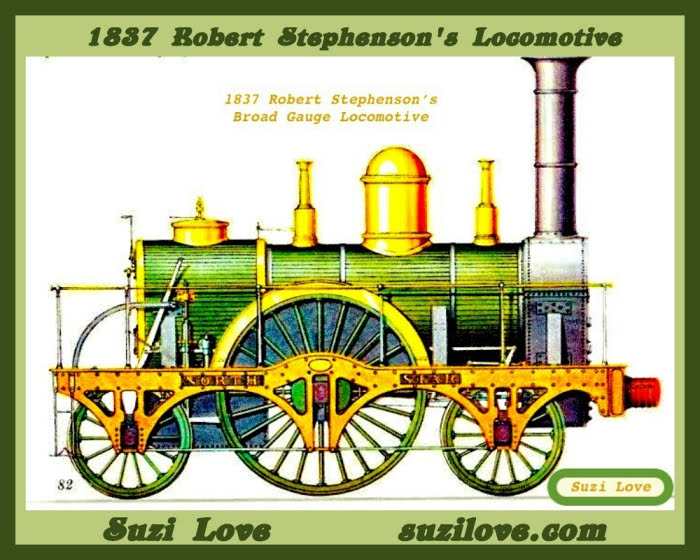
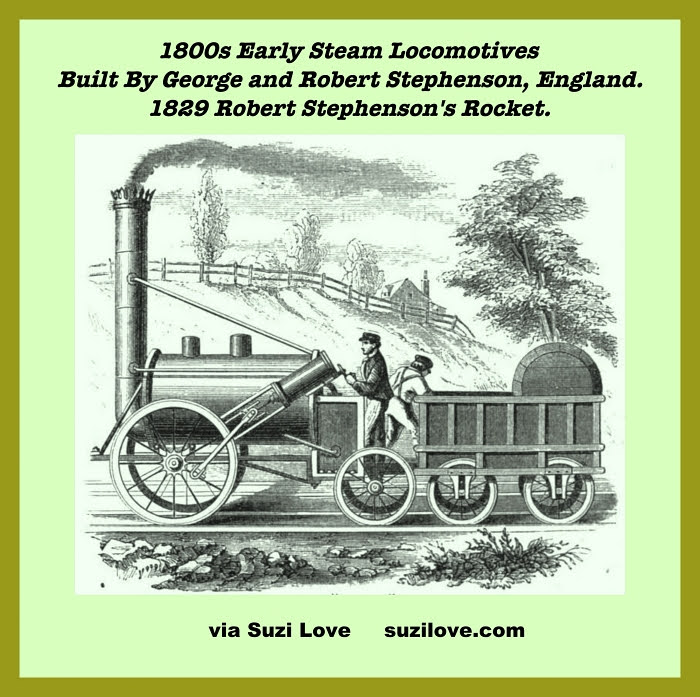
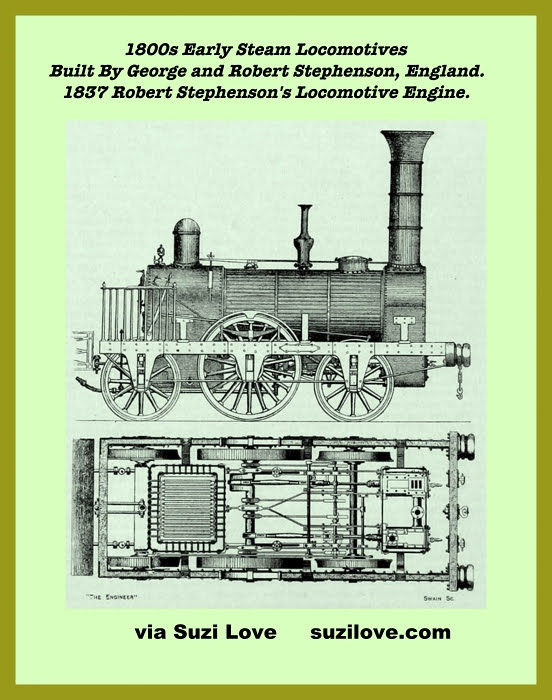
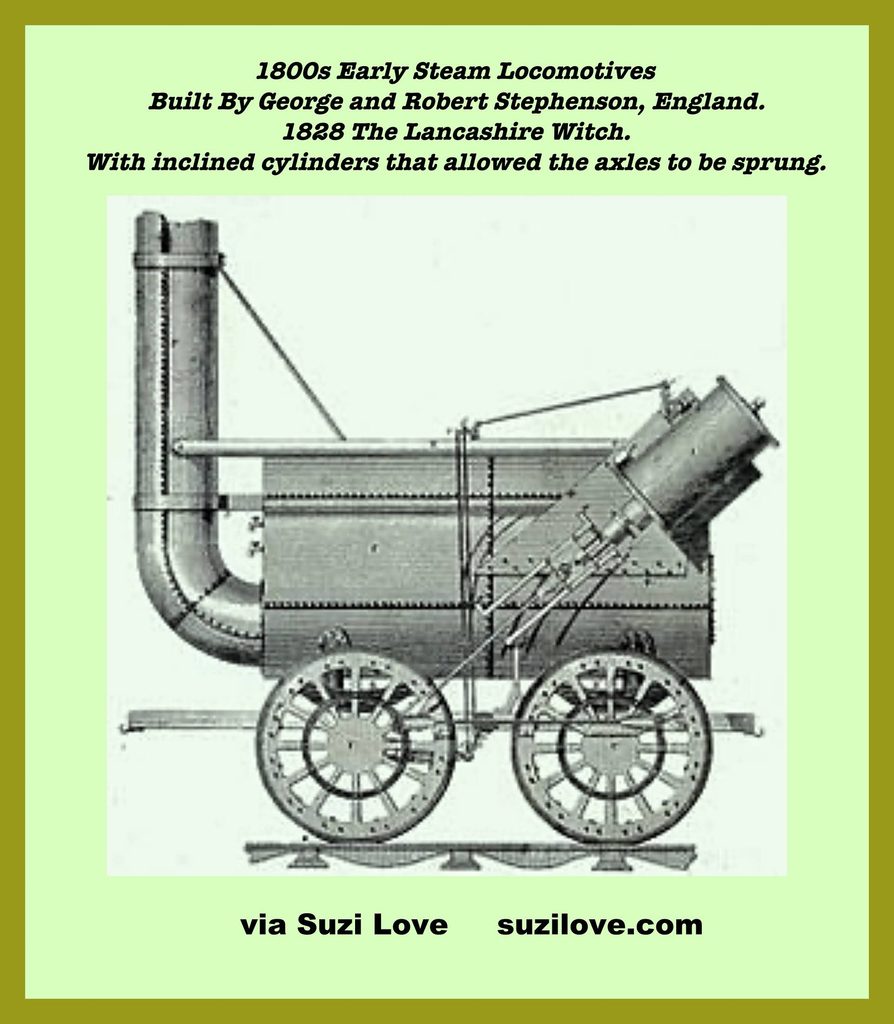
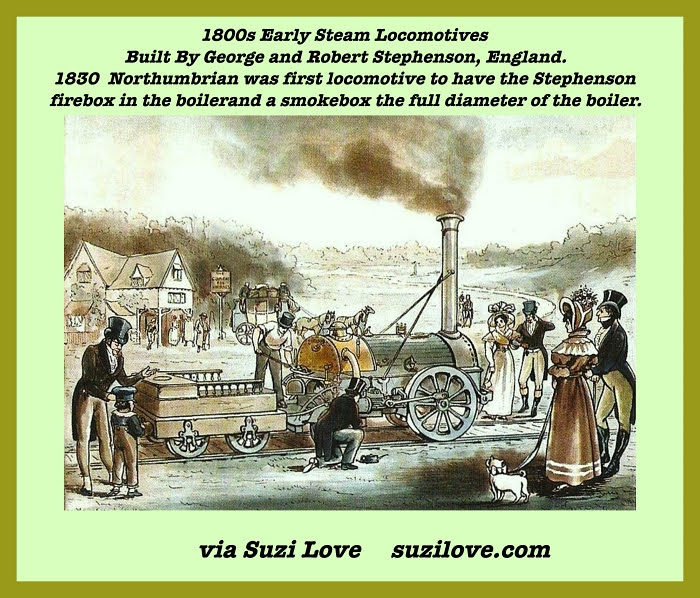
1800s Early Robert Stephenson’s Innovative Steam Locomotives.
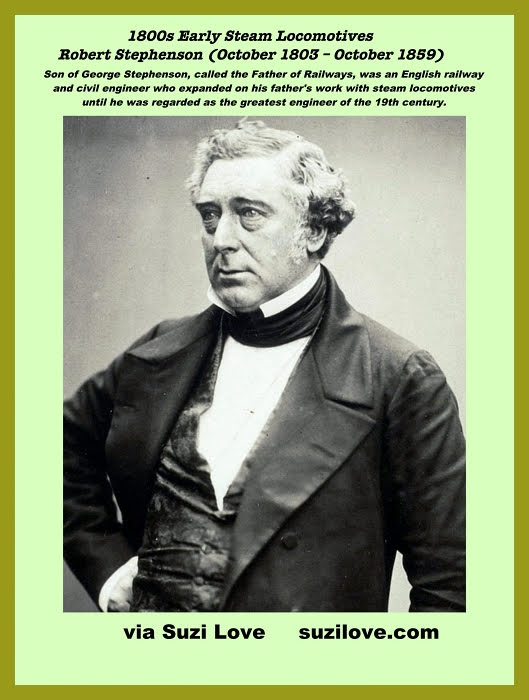
Robert Stephenson (16 October 1803 – 12 October 1859), son of George Stephenson, called the Father of Railways, was an English railway and civil engineer who expanded on his father’s work with locomotives until he was regarded as the greatest engineer of the 19th century. He helped his father survey the Stockton and Darlington Railway line and later assisted in the first surveys of the Liverpool & Manchester Railway.
How did people travel in Bridgerton’s and Jane Austen’s times? Treat yourself to a nonfiction book. History Notes Book 10. Travel and Luggage. books2read.com/SuziLoveTravel
Stephenson’s Rocket was built for and won the Rainhill Trials of the Liverpool and Manchester Railway in October 1829 to show that improved locomotives would be more efficient than stationary steam engines. It was built at the Forth Street Works of Robert Stephenson’s company in Newcastle upon Tyne and was the most advanced locomotive of its day. The Rocket was based on earlier designs by George and Robert Stephenson, including the Killingworth locomotive Blücher in 1814, the Locomotion in 1825 and the LancashireWitch in 1828.
Timeline for Robert Stephenson and his steam locomotives.
1821: Robert Stephenson assists his father George on surveying the Stockton and Darlington Railway.
1822: Robert assists with the first survey of the Liverpool & Manchester Railway.
1823: Robert becomes managing partner of locomotive builders Robert Stephenson & Co in Newcastle, the first locomotive company in the world.
1825: September – Stockton & Darlington Railway opens using locomotives from Robert Stephenson & Co.
1827: Robert assists his father George with construction of the Liverpool & Manchester Railway.
1829: Robert Stephenson & Co’s locomotive Rocket wins the Rainhill Trials.
1830: Robert appointed to survey a line between London and Birmingham.
1833: Robert appointed chief engineer of The London & Birmingham Railway.
1838: The London & Birmingham Railway is opened with Robert’s tunnels at Kilsby and Primrose Hill being major civil engineering works.
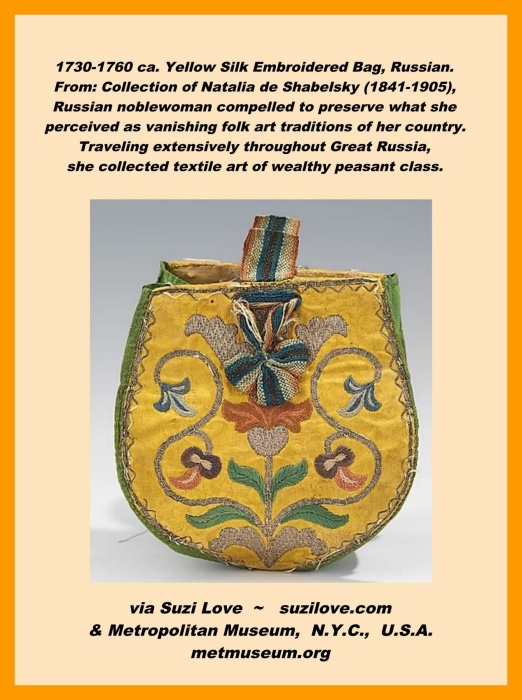
1730-1760 ca. Yellow Silk Embroidered Bag, Russian. From: Collection of Natalia de Shabelsky (1841-1905), Russian noblewoman preserving vanishing folk art traditions of her country. Traveling extensively throughout Great Russia, she collected textile art of wealthy peasant class. via Metropolitan Museum, NYC.
18th Century bags, or purses, were usually designed to hang from the waist or wrist to carry essential daily items on the person rather than making the long walk back through a castle or grand house to fetch things like coins, personal seals, toiletries or medicines.
1815 French Couple. Lady in evening dress with scooped neckline on low-cut pink bodice, floral headpiece and long white gloves. Gentleman in brown tailcoat and stirrup trousers, vest, and casual necktie. Fashion Plate via Journal des Dames et des Modes, or Costume Parisien.
The sort of fashionable outfits and items worn or carried by Jane Austen and her contemporaries when out in public. Ladies outfits for evening were accessorized with gloves, headdresses and jewelry and often dresses were of this shorter length for dancing. Gentlemen were always heavily accessorized as well with the essential of gloves, coats, waistcoats and neatly tied cravats. For more about the fashions of 1815, take a look at History Notes Books 23 and 28 men’s and women’s regency Era fashions.
Fashion Women 1815-1819 History Notes Book 28 What did Jane Austen wear? What was fashionable for women at the end of the Regency Era in Britain and the reconstruction in Europe after the wars. Book 28 for 1815-1819 in History Notes Includes fashions for mourning, riding, dresses, hats, shoes, reticules or bags, underclothing, accessories.
Fashion Men 1800-1819 History Notes Book 23 What was fashionable for men in early 1800s, or Jane Austen’s time, or Regency Era? Suits, hats, shoes, underclothing, fashion accessories, military and bedroom fashions. French fashions and Georgian and Regency Era fashions from Great Britain were copied around the world.
. Fashion Women 1815-1819 History Notes Book 28 https://books2read.com/SuziLoveFashionWomen1815-1819