I'm an Australian author of contemporary and historical romances, plus history non-fiction.
My books range from sexy to erotic, late 1700s to the mid 1800s, and with a dash of Australia thrown into the mix. My heroes and heroines challenge tradition and my stories often expose the seamier levels of life.
I now live in a sunny part of Australia after spending many years in developing countries in the South Pacific. My greatest loves are traveling, anywhere and everywhere, meeting crazy characters, and visiting the Australian outback.
I hope my books bring history alive and you have fun adventuring with my roguish heroes and feisty heroines.
1815 White Walking Dress, English. Lady reading outside. Aqua pelisse, or coat, open to reveal a yellow lining, yellow gloves, high bonnet with feathers and blue shoes. Jane Austen and her family and friends would have worn this style of walking ensemble and as Jane Austen was very fond of reading, it’s easy to picture her looking like this. Fashion Plate via Rudolph Ackermann’s ‘The Repository of Arts’.
Fashion Women 1815-1819 History Notes Book 28 https://books2read.com/SuziLoveFashionWomen1815-1819
‘How dare you.’ Lady Lillian spat the words at the Earl of Mallory and gave him her fiercest glare. ‘You shouldn’t have interfered like that. If those gentlemen recognize you, they might work out who I am, which is exactly what you wanted to avoid.’ She huffed. ‘Besides, I instigated that kiss.’
‘Why would you do such a brazen thing? Risk your good name and your life in such an impulsive manner.’
She sighed, all her anger deflating. ‘My good name evaporated when Geoffrey’s sexual preferences became known after his death. The men he mixed with kept his secrets when he was alive, and possibly even liked whips and ropes as much as Geoffrey, but dead men can’t reveal their secrets so they felt safe to expose him, while distancing themselves from those activities.’
‘But why would they risk incriminating themselves?’
‘I learned later that two girls had died, a day apart and in different areas of London, but both had been physically tormented and their bodies were left in parks in Mayfair. Government officials were sent to investigate after a minister’s wife and children stumbled upon one of them, and there was a push to find the culprit and to close down any houses of ill repute in respectable neighborhoods.’
‘I read about the murders, but surely they don’t think Geoffrey had anything to do with that. He wasn’t the most respected man and nor was he a decent husband, but I cannot imagine him killing women.’
‘The enquiry cleared Geoffrey, but as those houses were places that Geoffrey and his cohorts visited, his so-called friends decided to toss out Geoffrey’s name and draw the scrutiny away from them.’
Brent took her hands and shook them lightly. ‘Why didn’t you tell me?’
She shrugged. ‘Geoffrey was dead and I simply wanted to forget all the sordidness and start afresh.’ She waved a hand at the guests, whose conversations had become bawdier and louder the more punch was consumed and, as inhibitions were drowned in liquor, both women and men had stripped away clothing and were well on their way to public sex. ‘Here, I can reclaim myself, because everyone indulges in excesses and they don’t judge each other badly because they’ve let down their guards for an evening.
Nothing had prepared Lady Katharine Montgomery for the jumble of feelings overwhelming her when Alex worshipped her body, first with words and later with his hands and mouth. For years around this house, she’d been forced to appear dowdy, unintelligent, and totally self-effacing to never anger her father, or draw his wrath. Now, though, every degrading restriction was lifted from her mind, body, and life.
Her father was dead. Yesterday, she’d buried her hatred for the despicable man who’d given her life during the quarter hour it took to stand at his grave and, along with all the other hypocrites present, pretend to mourn as they buried his mortal remains. He’d cheated traders, beaten plantation workers, and horse-whipped her within an inch of her life. She and all the other mourners hoped he’d rot in hell.
Last night, she’d felt free to liberate the passionate nature she’d kept buried for six and twenty years for fear of her father’s explosive wrath. But one night with Lord Alexander St. John had changed everything. One night with a lover who was gentle and caring had her aching for more, more of Alex and more of life with him.
1815 March Brown Promenade Dress, English. High-waisted dress with decorative hem, white sleeves, white fichu, blue scarf, brown hat decorated with flowers. Jane Austen and her contemporaries would have worn this style of outdoor walking outfit and flowered hat. Fashion Plate via The Lady’s Magazine Or Entertaining Companion for the Fair Sex.
Definition Redingote: Woman’s long, fitted coat often worn open in front to show off the dress underneath. Sometimes cut away in front. Originally made with several capes and trimmed with large buttons. French word developed from English words, riding coat. reefer. Single- or double-breasted, fitted, tailored, over-all coat usually made from sturdy fabric.
Definition Fichu: A piece of lace, muslin, or other cloth worn about the neck and cleavage to preserve a lady’s modesty. From French word meaning neckerchief.
Fashion Women 1815-1819 History Notes Book 28 https://books2read.com/SuziLoveFashionWomen1815-1819
19th Century Late Mechanical Tantalus, French. Ormolu, Bronze, Crystal, and Gilt with a lock and key to open. Earlier versions of this type of small drinks cabinet would have been used in most households during Jane Austen’s times, unless the householders were teetotalers. via 1st Dibs Auctions 1stdibs.com
Tantalus: A small wooden cabinet containing drink decanters. The box has a lock and key to keep unauthorised people from drinking the contents e.g. servants and younger sons, yet still allowing the decanters of drinks to be on show. The word, Tantalus, is a reference to the unsatisfied temptations of the Greek mythological character Tantalus. Patented in the UK in 1881 by George Betjemann, a cabinet maker from the Netherlands, whose workshop was on Pentonville Road, London from the 1830s.
1845 Woman’s Dress, Probably Made In England. Silk Taffeta and glazed linen plain weave. via Los Angeles County Museum of Art, California, USA. collections.lacma.org
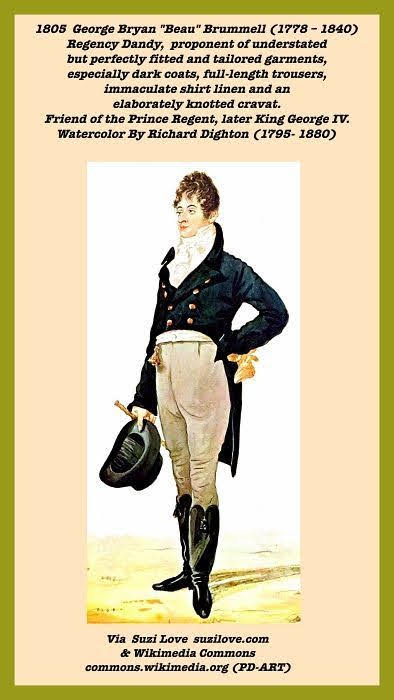
George Bryan “Beau” Brummell (June 7th 1778 – March 30th 1840) Arbiter of men’s fashion and friend of the Prince Regent, the future King George IV. Established mode of dress for men that rejected overly ornate fashions for understated but perfectly fitted and tailored clothing. Look based on dark coats, full-length trousers rather than knee breeches and stockings, with immaculate shirt linen and an elaborately knotted cravat. 1855 Engraving of Beau Brummell from an article in Harper’s New Monthly Magazine.
1805 Beau Brummell (1778-1840) Regency Dandy, proponent of understated but perfectly fitted and tailored garments, especially dark coats, full-length trousers, immaculate shirt linen and an elaborately knotted cravat. Friend of the Prince Regent, later King George IV. Watercolor By Richard Dighton (1795- 1880) Via Wikimedia Commons commons.wikimedia.org (PD-ART) https://books2read.com/SuziLoveFashionMen1800-1819
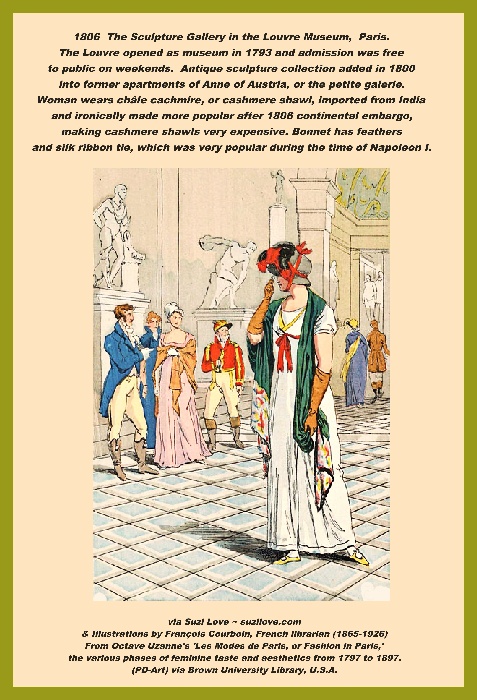
1806 The Sculpture Gallery In The Louvre Museum, Paris, France. Illustrations by Francis Courboin. via Les Modes de Paris. (PD-Art) Although this is in Paris, there were similar places in England where Jane Austen and her contemporaries would meet to admire art such as paintings and sculptures.
The Louvre was opened as a museum in 1793 and admission was free to the public on weekends. The antique sculpture collection was added in 1800 into the former apartments of Anne of Austria or the petite galerie. The woman wears a cashmere shawl. These shawls, imported from India, were ironically made more popular after the 1806 continental embargo, making cashmere shawls very expensive. Her bonnet has feathers and is held in place with a silk ribbon, a style very popular during the time of Napoleon I. (PD-Art) Illustrations by François Courboin from Octave Uzanne’s Les Modes de Paris. Variations du goût et de l’esthétique de la femme, 1797-1897, L. Henry May, Paris, 1898, or from the English translation of the same work: Fashion in Paris : the various phases of feminine taste and aesthetics from 1797 to 1897, William Heinemann, London, 1898. Modes De Paris via Brown University Library.
Fashion Women 1805-1809 History Notes Book 26 What did Jane Austen and friends wear? https://books2read.com/SuziLoveFashionWomen1805-1809
1807 Game of Billiards By Louis Leopold Boilly, French. Ladies playing billiards as they did in Jane Austen’s time. via Heritage Museum, Russia ~ heritagemuseum.org
Fashion Women 1805-1809 History Notes Book 26 What did Jane Austen and friends wear? https://books2read.com/SuziLoveFashionWomen1805-1809
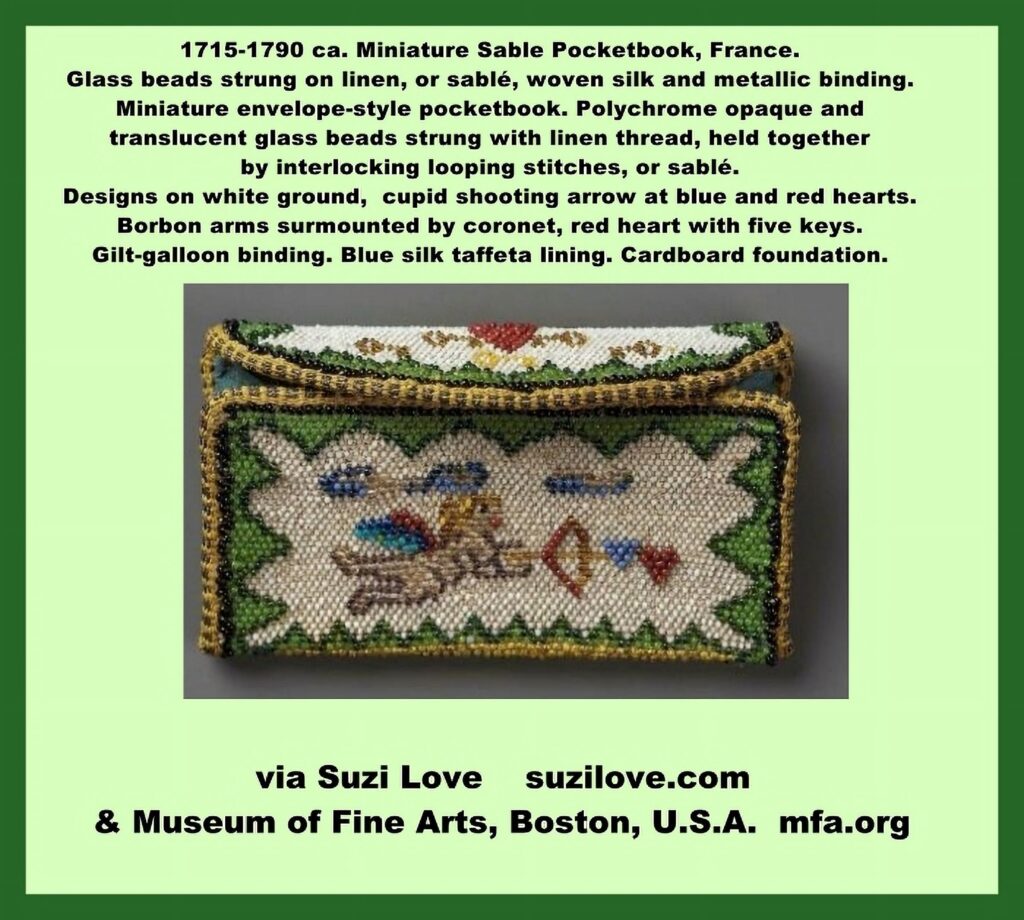
1715-1790 ca. Miniature Sable Pocketbook, France. Glass beads strung on linen, or sablé, woven silk and metallic binding. Miniature envelope-style pocketbook. Polychrome opaque and translucent glass beads strung with linen thread, held together by interlocking looping stitches, or sablé. Designs on white ground, cupid shooting arrow at blue and red hearts. Borbon arms surmounted by coronet, red heart with five keys. Gilt-galloon binding. Blue silk taffeta lining. Cardboard foundation. via Museum of Fine Arts, Boston. mfa.org