I'm an Australian author of contemporary and historical romances, plus history non-fiction.
My books range from sexy to erotic, late 1700s to the mid 1800s, and with a dash of Australia thrown into the mix. My heroes and heroines challenge tradition and my stories often expose the seamier levels of life.
I now live in a sunny part of Australia after spending many years in developing countries in the South Pacific. My greatest loves are traveling, anywhere and everywhere, meeting crazy characters, and visiting the Australian outback.
I hope my books bring history alive and you have fun adventuring with my roguish heroes and feisty heroines.
1815 Arundel Fete Dress and Baronial Helmet, English. White dress with purple bodice and hem with matching shawl and plumed headdress. Skirt of white crape over white satin, a double row of novel and elegant trimmings on the bottom, two falls of the crape, set on full, are edged with silk. Body comes high on each side of the bosom and is shaped so as to display the neck and shoulders, and both body and sleeves are formed and trimmed in the most exquisitely tasteful manner. A superb cord and tassels confines the waist and ties in front. The Baronial Helmet is striking and made of white sarsnet or satin and white lace and superbly ornamented with feathers. Jewelry set, or Grand Parure, of necklace, bracelets. ear-rings, and small French locket of pearl. White kid slippers and gloves. Full Dress for evening would most likely be a dress of silk or satin, perhaps with a transparent overlay of netting, tulle etc., embellished with taffeta, ruffles and ribbons, and with a full range of accessories including a Grand Parure of tiara and other matching jewelry. https://books2read.com/SuziLoveFashionWomen1815-1819
La Belle Assemblee: Fashion Plate via John Belle’s La Belle Assemblée or, Bell’s Court and Fashionable Magazine, London. Many of the fashion plates seen in La Belle Assemblée and The Repository of Arts were designed by Mrs. Bell who had her dressmaking showroom in Bedford Square, London, and was related to John Bell who published La Belle Assemblée. It seems that she designed for at least two fashion magazines and so there is a cross-over of designs in different magazines.
Grand Parure: A Parure is a matched set of jewelry, including a necklace, bracelet, earrings, pin etc. and a Grand Parure often includes a tiara or other headdress.
Fashion Women 1815-1819 History Notes Book 28 https://books2read.com/SuziLoveFashionWomen1815-1819
Weird Historical Pants for Men. No wonder men needed valets! It wasn’t just women struggling into tight fitting clothing!
And no wonder it took both sexes so long to dress every day, often changing clothes four or five times a day!
Early on were Breeches – Short, close-fitting trousers that fastened just below the knees or above the ankles, with a horizontal front flap called the ‘fall’ and were worn with stockings. Boys of 3 – 6 years stopped wearing loose dress-type children’s garments and went into short pants instead, and were considered ‘breeched. In Regency times, breeches were worn tighter to show off a manly physique.
Then of course we had Pantaloons
By the late 1810s and beyond, these became popular and eventually they evolved into full length trousers. Originally pantaloons were made to suit shorter Hessian boots that fell below the typical knee-breech level and they were worn very form-fitting.
Buckskins – Fashionable trousers made from deer skin also showed off every curve of the man’s figure. How could ladies not want to peek? Oooh, what a display of fine, manly figure!! Swoon!
And so to more modern Trousers – The word Trouser came into usage in the late 1600?s, so we’ve had trousers around for a long time. But at first, they were mostly for lower classes. Revolutionary France started a trend for sans-culottes, which meant trousers or pantaloons instead of culottes, or knee breeches, which were associated with the aristocracy.
The styles of the revolution moved across to England and were taken up by those who either sided with revolutionary ideals or who took them up as part of a protest against the establishment set.
Early trousers looked strange because they were generally a bit looser than pantaloons or breeches, and ended at the ankles with slits on the side for foot access. They often needed under-the-foot straps to fix them in place.
Now here’s a couple of insider tips from a gentleman’s valet for you to remember –
– False calves can be created by padding so that a master’s calves fill out his stockings and make him look more muscular, especially when he is wearing knee-breeches. Every woman’s dream!
– For rotund gentlemen, tightly pulled corsets help keep the paunch to a minimum and enhance his figure.
– To keep trousers in place and prevent disgrace, braces( suspenders) can be worn under vests.
Even in cases of his master’s over-imbibing, or just plain clumsiness, a valet can ensure his lordship remains correctly clothes at all times when representing the household in public by taking a few early precautions.
Imagine the poor valet’s work if – a gentleman rode before breakfast – changed to join the family– spent the morning boxing with friends in looser attire – changed for lunch at his club with peers – changed for afternoon calls or a drive in the park with the women- changed for dinner with friends – changed into evening dress for a formal ball- arrived home just before daylight to change into his banyan( robe) to smoke his cheroot before bed – then rose 3 hours later expecting his clothes laid out so he could do it all over again.!!
No, I seriously do not want to go back in time and become either a lady’s maid or a gentleman’s valet
– although, if I had the choice…
Hmmmm….being in a gentleman’s bedroom…. does hold a certain appeal.
Suzi Love
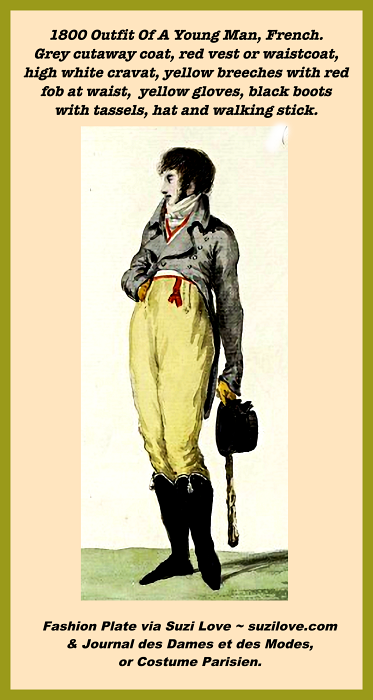
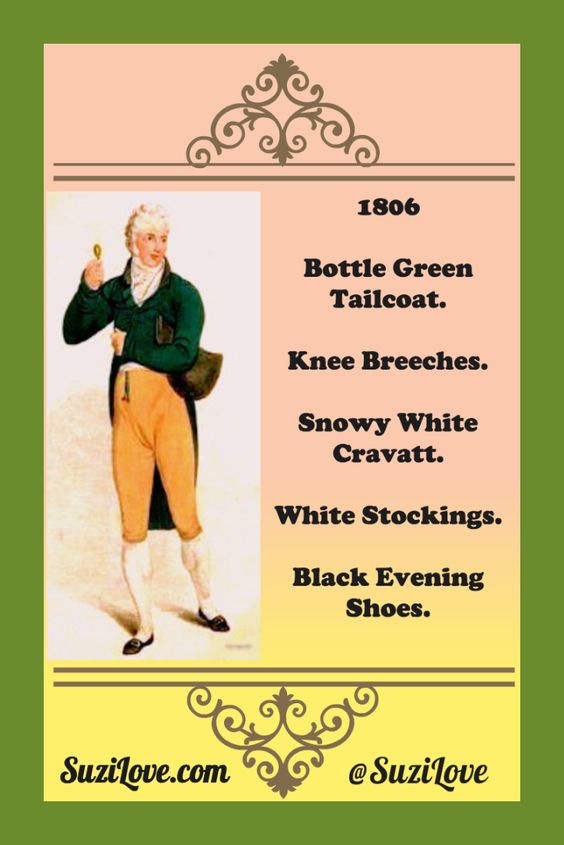
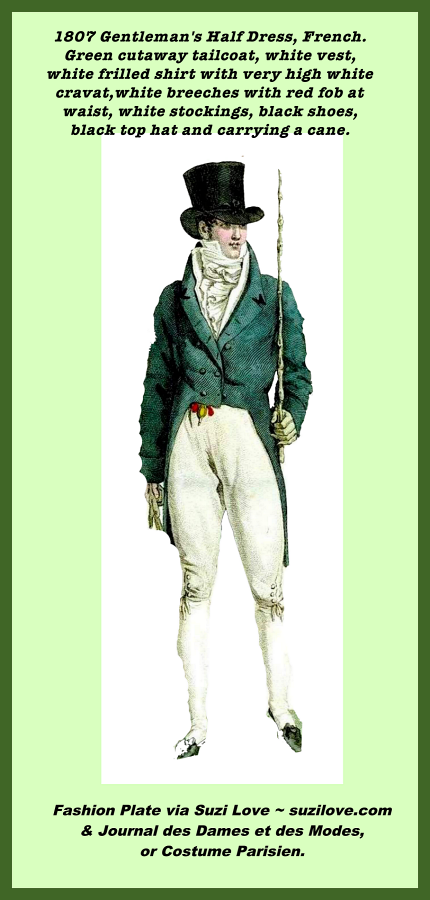
1775-1825 ca. Black Silk Breeches, American or European. via Metropolitan Museum, N.Y.C., U.S.A. metmuseum.org1806 Young French Gentleman. Short Brown Castorine Coat Over Blue Tailcoat, White Cashmere breeches, yellow gloves, black top Hat. Fashion Plate via Journal des Dames et des Modes, or Costume Parisien.1804-1814 ca. Collage View. Breeches, French. Cream silk and linen. Buttoned waist, drop down front flap, or fall, extra fullness in the back for ease of movement, ties at the knees to keep in place. via Suzi Love ~ suzilove.com & Metropolitan Museum, N.Y.C., U.S.A. metmuseum.org1812-1813 ca. A man with a hat shaped as a balloon, green coat, white breeches, colored cravat. Hand-colored etching. 1812-1813 Le Chapeau en Ballon Series: Le Bon Genre Plate 51. Via British Museum, London, UK. 1807-1817 ca. Man’s Leather Breeches, American. Drop front buttoned flap at the waist, a drawstring at the back waist to adjust waist size, and drawstrings and buttons at the calves to keep the breeches secure when worn with high boots. via Metropolitan Museum New York City, U.S.A. metmuseum.org 1807 Pale Blue Tailcoat, French. White frilled shirt with extra high collar and cravat, vest, white knee breeches, white stockings, black shoes, gloves, bicorn hat and a curly hairstyle. Fashion Plate via Journal des Dames et des Modes, or Costume Parisien. 1800 Outfit Of A Young Man, French. Grey cutaway coat, red vest or waistcoat, high white cravat, yellow breeches with red fob at waist, yellow gloves, black boots with tassels, hat and walking stick. Fashion Plate via Journal des Dames et des Modes, or Costume Parisien.1805 ca. Collage Leather Breeches, French. Buttoned and adjustable waist, back waist gusset for ease of movement, front fall flap, two tone fitted cuffs on legs with many buttons to fasten and hold in place on the legs. via Metropolitan Museum New York City, U.S.A. metmuseum.org 1790 British Consul’s Tan Leather Pants, Boston. Tan buckskin, fall front, brass and self covered buttons, breeches have leather ties at waist and at leg hems. via Augusta Auction 1806 Gentleman’s Daily Outfit, French. Bottle green tailcoat, knee breeches, snowy white cravat, white stockings, flat black shoes. Fashion Plate via Journal des Dames et des Modes, or Costume Parisien.1807 Gentleman’s Half Dress, French. Green cutaway tailcoat, white vest, white frilled shirt with very high white cravat, white breeches with red fob at waist, white stockings, black shoes, black top hat and carrying a cane. Fashion Plate via Journal des Dames et des Modes, or Costume Parisien. https://books2read.com/SuziLoveFashionMen1800-1819
How many dukes were there in England in 1804? The number varied from year to year, depending on which titles became extinct etc. From: 1804 Kearsley’s Complete Peerage via Google Books (PD-200)
1804 Nine Princes of the Royal Blood, some of whom are Dukes.
Prince of Wales, Duke of York, Duke of Clarence, Duke of Kent, Duke of Cumberland,
Duke of Sussex, Duke of Cambridge, Duke of Gloucester, Prince William.
1804 Eighteen English Dukes, excluding the Prince Royals holding the title of ‘Duke’.
Norfolk, Somerset, Richmond, Grafton, Beaufort, St. Albans, Leeds,
Regency Life Series: Images, information, funny anecdotes give overview of Jane Austen’s and Bridgerton times. #bridgerton #RegencyEra #JaneAusten #BritishHistory https://books2read.com/suziloveROver
Disgust suddenly flooded Viscount Hawkesbury’s body and the heart Justin had assumed was frozen in his chest clenched, hard. Despite being forced into unseemly money-making ventures, the three of them had vowed to remain, at heart at least, gentlemen. They all needed to take their places in society, which was why Justin never usually entertained this sort of female at his house. Too many watching neighbors and too many wagging tongues in this respectable neighborhood.
Had he now passed the point of no return? Had the indecent acts he’d committed, all to either survive or earn his some of the ready, tainted his thinking to this extent? It terrified him that his morals were as lost as those idiots who assumed a title and riches gave a man leeway to be rude, arrogant, and even to inflict pain on those they considered inferior. He’d picked out this woman and had intended using her as an example, encouraging her to pass along his message to the long line of societal whores who would continue to plague him. He wanted to stand in the street and scream and yell, “The Virile Viscount is finished!”
Behavior such as his here showed the arrogance he’d always deplored. Rude attacks on a woman were despicable, and it was especially ill-bred of him to tease and taunt what he now suspected was a well-bred lady. But he’d underestimated the woman’s pluck, or perhaps her determination to make herself heard.
“Be warned, my lord, I shall return. Tomorrow. Early. Very early. And if you refuse to speak with me, I’ll haunt your house until you are prepared to listen to me.” Her ferocious expression made him burst out laughing again.
Bart wiggled his eyebrows in a suggestive manner and held out his hand to encourage the woman to take a seat on the thigh of the woman he still held.
“I like her, Justin. Can I have her?”
“Feel free, Bart. If you dare! Though I suspect Thomas is correct. I’ve come to the unwilling, and unfortunate, conclusion that she’s not here to audition for the Harem.”
“Certainly not.” Her tone was icy. “I’m offering you an exchange. Your skill in tutoring my friends in return for information.”
“Regrettably, my services are no longer for hire.”
She inhaled so sharply he swore her ribs vibrated. Then she made her announcement.
“If I leave this room, I’ll take with me what may be your last chance to see your mother. Alive, at any rate.”
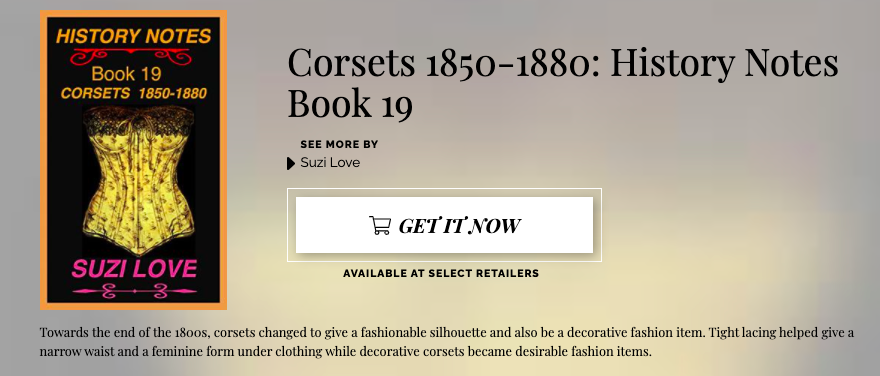
1879-1885 ca. Linen Riding Corset, English. https://books2read.com/SuziLoveCorsetBook19 Woven linen corset, weighs 0.14kg, and worn for riding. Made on a loom with pockets for bones and busk, woven corsets were lightweight, flexible, washable and patented in France in 1832 by Jean Werly. Stitched corsets made from seamed pattern pieces provided more support when on horseback. Manufacturer: Charles Bayer. via Victoria and Albert Museum, London, UK.
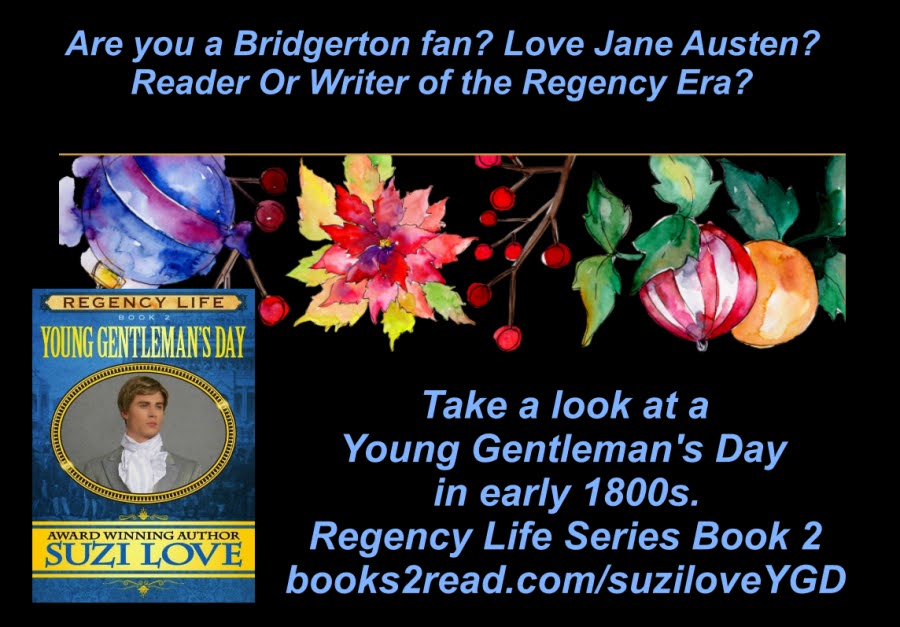
Are you a Bridgerton fan? Love Jane Austen? Love history? Take a look at a Young Gentleman’s Day in early 1800s. Young Gentleman’s Day Regency Life Series Books 2 by Suzi Love. Easy to read books on what a young gentleman did, wore, and lived during the early 1800s, or the Regency Era when King George 3rd was mad and his son, Prince George, was the Regent in Britain. #Regency #JaneAusten #amwriting books2read.com/suziloveYGD
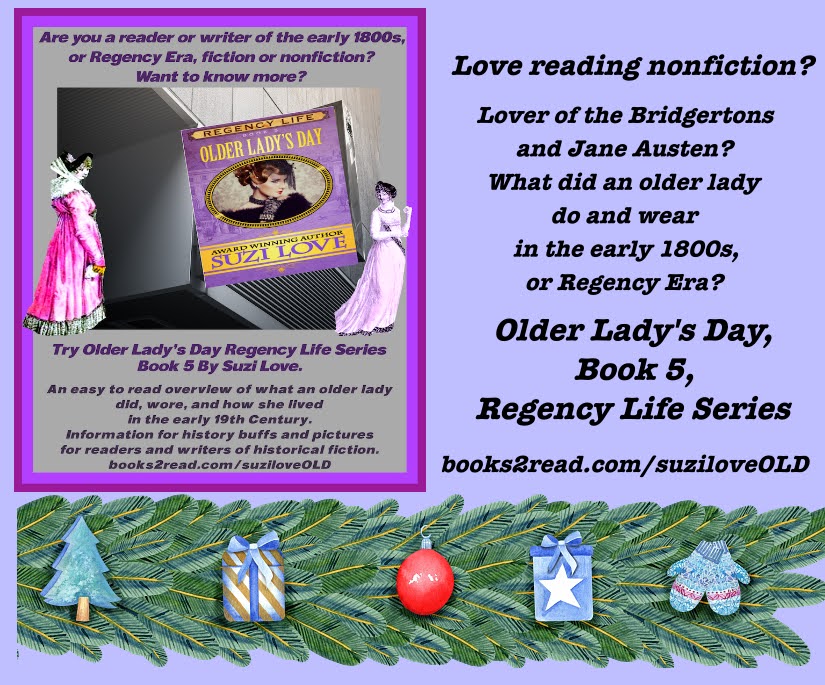
What did an older lady do and wear in the Regency Era? Information & pictures for readers and writers of early 1800s history, nonfiction and fiction. books2read.com/suziloveOLD
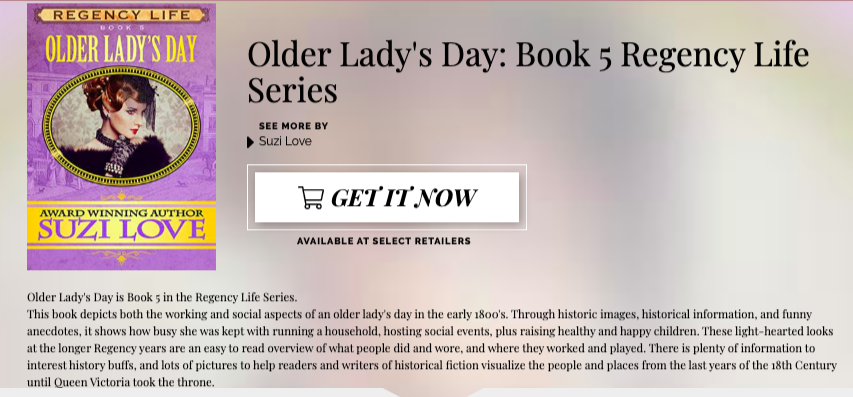
The older lady’s day usually started with her toilette in her bedroom, where her maid helped her dress for the day and styled her hair. After that, she would join her family downstairs for breakfast unless she preferred a tray with either tea or hot chocolate in her bedroom as she prepared for her busy day. Her day would be made up of speaking with the housekeeper and the cook about the week’s menus, assuring that the servants were all available that day and no one was ill, and checking the list of foods needed. She would also enquire if the laundry was up to date and that they had enough good linen to make up all the beds before extended family members and guests arrived. If she was in the country and hosting a weekend house party, she would assign rooms to the guests on her lists and query that all was in readiness for their arrival.
Have you read Suzi Love’s Books? Romance, Mystery, Military and History. Regency, historical and contemporary romance. Plus non-fiction history and writing.
The Viscount’s Pleasure House Book 1 Irresistible Aristocrats Disenchanted Viscount tutoring three Regency Ladies. What could go wrong? #Regency Erotic https://books2read.com/suziloveTVPH
Four Times A Virgin Book 2 Irresistible Aristocrats: The countess will do anything to prevent her younger sisters being forced into sordid marriages like hers, even if it means joining forces with the Duke of Stirkton and revealing the horrors of their intertwined pasts. books2read.com/suziloveFTAV
Pleasure House Ball Book 3 Irresistible Aristocrats: Lord Mallory attends his first courtesan’s ball in ten years to appease his concerned friends, though he’d rather stay home and read to his motherless daughters. Though mortified that Brenton unmasks her at a scandalous ball, Lady Lillian Armstrong doesn’t regret their night together. books2read.com/suzilovePHB
Petunia and the Pearl Diver Book 4 Irresistible Aristocrats Series: The pearl diver needs a working girl to rouse his body. Petunia needs money to save her family. A night at a London brothel could be the solution to both problems. But walking away is impossible when one night leaves them craving more…and more. https://books2read.com/suzilovePetPD
Loving Lady Katharine Book 5 Irresistible Atistocrats: When Lady Katharine Montgomery flees London after her scandalous husband was murdered, the Pacific islands of the New Hebrides (Vanuatu) become her haven. Her life changes when Lord Alexander St. John, British ship’s captain and trader, sails into Port Vila. https://books2read.com/suzi
Embracing Scandal Book 1 Scandalous Siblings: Lady Rebecca Jamison saves her family from financial ruin by investing in railways, but when a greedy syndicate murders her friend, Becca is forced to beg assistance from Cayle St. Martin, the new Duke of Sherwyn. https://books2read.com/suziloveES
Scenting Scandal Book 2 Scandalous Siblings Series: Richard, Earl of Winchester, may not know it yet, but he’s Lady Laura Jamison’s perfect match. Lady Laura Jamison believes her extraordinary olfactory senses will sniff out her perfect match, but will Richard prove her theory wrong? https://books2read.com/suziloveSS
December Scandal Book 3 Scandalous Siblings: The Jamison family joins the Duke of Sherwyn and the St. Martin clan at the duke’s country estate, but guest numbers double when early December snowfalls make roads impassable. #HistoricalRomance https://books2read.com/suziloveDS
Love After Waterloo: When Lady Melton and son join antagonistic Captain Belling and the last group of wounded British soldiers evacuating Waterloo, she anticipates hardship and trouble with deserters. Not her relationship with a belligerent Captain. #RegencyRomance #military books2read.com/suziloveLAW
Self Publishing: Absolute Beginner’s Guide. Information, contacts, and checklists steer you towards professionally produced books. Helps both fiction and non-fiction authors and available in digital and paperback. Co-Authored by two Australians: multi-published Imogene Nix and best-selling and award winning Suzi Love. http://books2read.com/selfpublishing
History Notes Books 1-28: Do you need more factual and visual information for your historical fiction? Non-fiction Series: Fashion, music and social manners in the 18th and 19th centuries books2read.com/suziloveFashWomen1700s