1813 October White Empire style, or high-waisted, Carriage Dress, English. Brown shawl, brown boots, and a lace cap tied under the chin. Typical of the carriage fashions that would have been worn by Jane Austen and her contemporaries. Fashion Plate via The Lady’s Magazine Or Entertaining Companion for the Fair Sex.
Definition Empire Style Dress: High-waisted white gown defined women’s fashion during the Regency Era. ‘Empire’ is the name given to the period when Napoleon Bonaparte built his French Empire. High-waisted, loose gowns were adopted by the aristocracy as a symbol of turning away from the fussy, elaborate and expensive clothing worn in the 1700s. https://books2read.com/SuziLoveFashion1810-1814
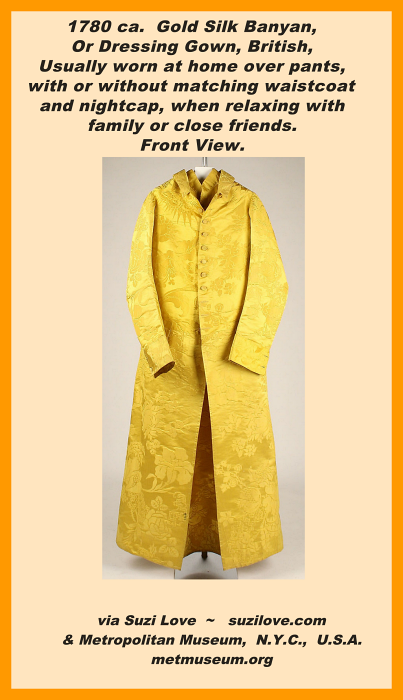
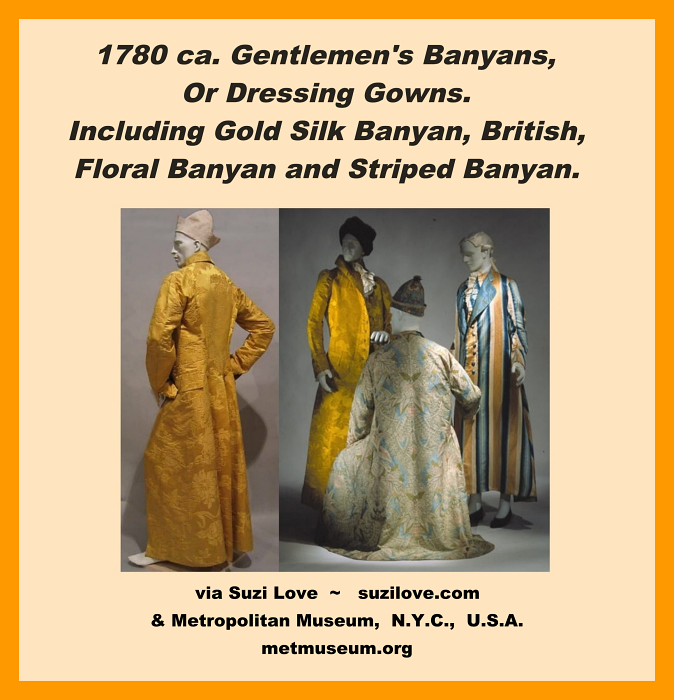
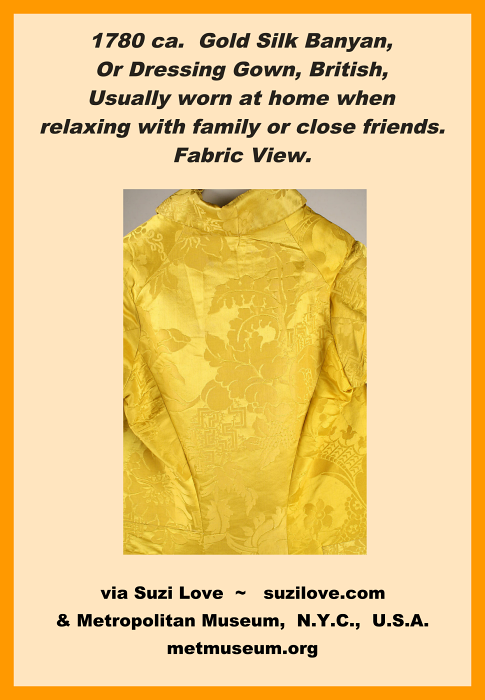
1780 ca. Gold Silk Banyan, British. For at-home wear, a gentleman had a dressing gown, often with a matching waistcoat, and an undress cap or turban. “This yellow damask banyan with its bold Chinese Chippendale – inspired pattern would have been an imposing sight on the streets or in the drawing rooms of London.” via Metropolitan Museum New York City, U.S.A. metmuseum.org Credit: Catharine Breyer Van Bomel Foundation Fund, 1978 Accession Number:1978.135.1
From the Curator: ‘For at-home wear, a gentleman had a dressing gown, often with a matching waistcoat, and an undress cap or turban.As for breeches, they were not designed especially for this casual ensemble, but rather borrowed from other suits.The dressing gown was cut like a man’s loose coat and usually hung to the floor, though there were also versions that stopped below the knees. Since there were no fastenings, the wearer overlapped the dressing gown in front when he walked so that the sides did not billow out behind him.The sleeves were originally rolled back to form cuffs, but later dressing gowns display the fashionable cuff of their period.In England these dressing gowns were called “banyans” or “Indian nightgowns” because of their kimono-like form and Eastern origin. Banyans were made in a variety of fabrics, including silk brocades, damasks, and printed cottons. By the 1780s, gentlemen ventured out of doors in this comfortable and stylish costume. According to Town and Country Magazine in 1785: “Banyans are worn in every part of the town from Wapping to Westminster, and if a sword is occasionally put on it sticks out of the middle of the slit behind. This however is the fashion, the ton, and what can a man do? He must wear a banyan.”This yellow damask banyan with its bold Chinese Chippendale – inspired pattern would have been an imposing sight on the streets or in the drawing rooms of London.’ via Metropolitan Museum New York City, U.S.A. metmuseum.org
1780 ca. Front View. 1780 ca. Back View.1780 ca. Back View. 1780 ca. Fabric View. RL_2_D2D_RetailerBuyLink_RL_2
https://books2read.com/suziloveYGD
1826 The Cyprian’s Ball At the Argyll Rooms. A Regency Gentleman’s Life. From The English Spy By Robert Cruikshank.
1826 The Cyprian’s Ball At the Argyll Rooms. A Regency Gentleman’s Life. From The English Spy By Robert Cruikshank. RL_2_D2D_RetailerBuyLink_RL_2
https://books2read.com/suziloveYGD
19th Century Early Chemise or Shift, American. White linen and embroidery. via Metropolitan Museum New York City, U.S.A. metmuseum.org
Chemise Or Shift: Sleeveless, mid-calf length garment of white cotton or muslin was worn next to the skin under stays or corset. Called ‘Shift’ from early Georgian (1700-1750) until Late Georgian (1750-1790) to replace ‘Smock’. By 1800, name replaced by ‘Chemise’. The sort of undergarment that Jane Austen would have worn next to her skin and under her stays, or corset.
1810-1815 ca. Salmon Pink Empire Style Dress, Norway. Typical Regency high-waisted dress. Long sleeves with puckered sleeve cap. Deep neckline with short shirred bodice. Long full skirt. via Digital Museum, Norway. digitalmuseum.no Regency fashion at its prettiest. The style of Empire style, or high-waisted, dress worn by Jane Austen and her contemporaries and the ladies in the Bridgerton family.
The Empire waist gown defined women’s fashion during the Regency Era. ‘Empire’ is the name given in France to the period when Napoleon built his French Empire. High-waisted, loose gowns were adopted by the aristocracy as a symbol of turning away from the fussy, elaborate and expensive clothing worn in the 1700s. Jean-Jaques Rousseau advocated copying peasants and returning to a simpler life and more natural fashions. Unrestricting clothing was part of the new Democracy in France and these simpler and flowing fashions were adopted all over Europe, including Britain and despite the continual wars being fought against France during the early 1800s. Not even war stopped fashions from being copied everywhere.
This book looks at what was fashionable for women in Jane Austen’s or the Bridgerton family’s times, or the early 1800s, or the Regency Era in Britain. Wars were being fought around the globe so women’s fashion adopted a military look in support of soldiers. Fashions, like the lifestyle, became progressively more extravagant and accessories went from colorful to over-the-top.
1803 Jane Austen Style Dress Bodice and Five Trimmed Hats. Low cut bodice, puffed sleeves, scarf, four variations of trimmed hats. Fashion Plate via Journal des Dames et des Modes, or Costume Parisien. https://books2read.com/SuziLoveFashionWomen1801-1804
Hats: Early 1800s: Lightweight caps or muslin, linen, lace or net were worn as morning caps, night caps, or under other hats. Jane Austen and her family and female friends would have worn caps like these, sometimes during the morning at home, to bed to keep their long hair from becoming knotted, or under a bonnet to hold a hairstyle in place. But for outdoor ventures, hats were more substantial and for the evening a lot more individual and elaborate. The ties of a bonnet that were secured under the chin vary from the very simple to the quite fanciful.
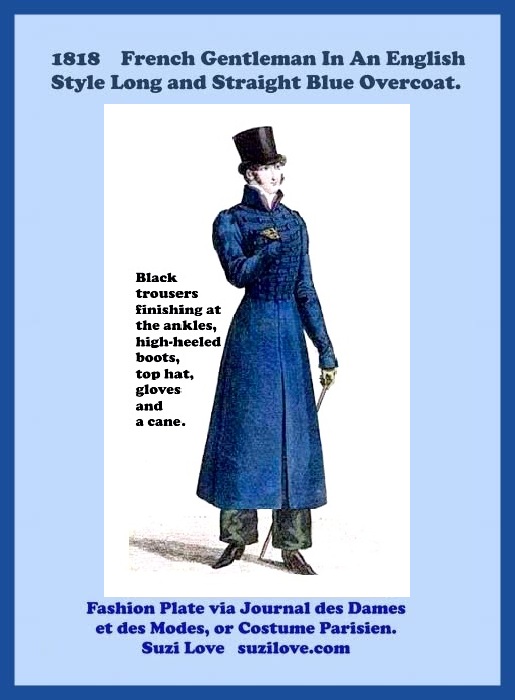
1818 French Gentleman In An English Style Long Blue Coat, Or Redingote. Black top hat, cane, black boots, black pants ending at his ankles, and gloves. Fashion Plate via Journal des Dames et des Modes, or Costume Parisien.
Definition Redingote Or Pelisse Or Walking Dress Or Coat: French word developed from English words, riding coat. Long fitted outdoor coat worn over other garments for warmth. Often left open at the front to show off the dress underneath. Sometimes cut away in front. Originally made with several capes and trimmed with large buttons. French fashion plates call these coats Redingotes and they are designed for women, men and children. English fashion plates call them a Pelisse, a walking dress, Promenade dress, or Carriage dress.
1818 Long Blue Coat, French. Gentleman In An English Style Long Blue Coat, Or Redingote. Black top hat, cane, black boots, black pants ending at his ankles, and gloves. Fashion Plate via Journal des Dames et des Modes, or Costume Parisien. https://books2read.com/SuziLoveFashionMen1800-1819
1800 ca. Tan Corduroy Breeches. Drop down front flap, or ‘fall’, with two buttons, three silver metal buttons at the waistband, watch pocket, corner pockets with buttons, pieced back with waist tie, saggy back with extra fabric to allow for easier movement when riding or sitting, four buttons and silk ties at knee. via Whitaker Auction whitakerauction.smugmug.com
These are the sort of breeches that Jane Austen’s male contemporaries would have worn.
1800 ca. Tan Corduroy Breeches. Drop down front flap, or ‘fall’, with two buttons, three silver metal buttons at the waistband, watch pocket.1800 ca. Tan Corduroy Breeches. saggy back with extra fabric to allow for easier movement when riding or sitting.1800 ca. Tan Corduroy Breeches. Drop down front flap, or ‘fall’1800 ca. Tan Corduroy Breeches. four buttons and silk ties at knee. 1800 ca. Tan Corduroy Breeches. four buttons and silk ties at knee. 23_d2d_fashionmen1800-1819
https://books2read.com/SuziLoveFashionMen1800-1819
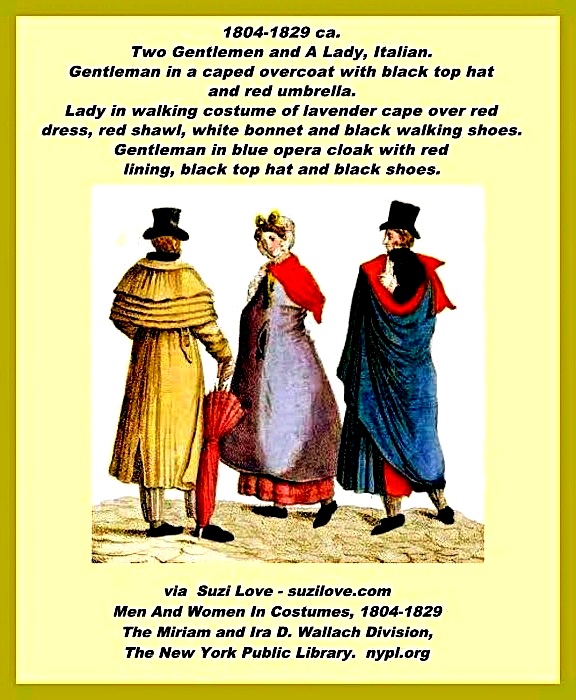
1804-1829 ca. Two Gentlemen and A Lady, Italian. Dressed as ladies and gentlemen would be in the times of the Bridgerton family and Jane Austen and friends. Gentleman in a caped overcoat with black top hat and red umbrella. Lady in walking costume of lavender cape over red dress, red shawl, white bonnet and black walking shoes. Gentleman in blue opera cloak with red lining, black top hat and black shoes. Men And Women In Costumes, 1804-1829 The Miriam and Ira D. Wallach Division, The New York Public Library. nypl.org The sort of fashionable outfit and items worn or carried by Jane Austen and her contemporaries when out walking. Outfits were always heavily accessorized with coats, shawls, hats and parasols.