Young Lady’s Day is Book 4 in the Regency Life Series. This book depicts the often-frivolous life and fashions of a young lady in the early 1800’s, but also gives a glimpse into the more serious occupations a young lady may undertake. Through historic images, historical information, and funny anecdotes, it shows how a young lady fills her day, where she is permitted to go, and who she is allowed spend time with. These light-hearted looks at the longer Regency years are an easy to read overview of what people did and wore, and where they worked and played. There is plenty of information to interest history buffs, and lots of pictures to help readers and writers of historical fiction visualize the people and places from the last years of the 18th Century until Queen Victoria took the throne.
Love the Bridgertons? Jane Austen fan? Early 1800’s glimpse into frivolous and serious occupations filling a young lady’s day. #Bridgerton #JaneAusten #RegencyEra #Nonfiction #AmWriting https://books2read.com/suziloveYLD
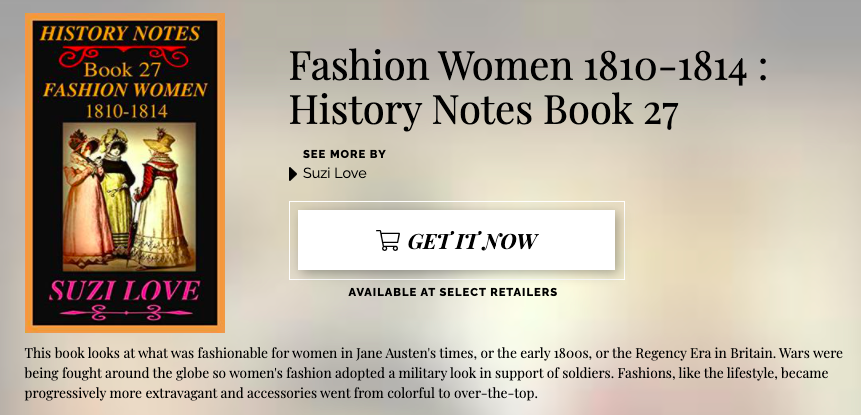
1811 White Dress, French. Worn under a white spotted tunic with yellow over dress with long sleeves. White gloves, shoes and hat with plume, or feathers, or aigrette. Fashion Plate via Journal des Dames et des Modes, or Costume Parisien. Even though this is a French fashion plate, Jane Austen and her contemporaries would have worn long coats like these to keep warm when out and about, visiting, shopping etc. The thin muslin dresses worn in the early 1800s were little protection against European winters so warmth and color was added by tunics and coats in a huge variety of styles.
Definition Aigret, aigrette, egret: Plume of feathers or jeweled ornament in shape of feathers worn on head or hats. During the early 19th century., or Jane Austen’s lifetime, the favorite feathers were osprey and heron.
1811 White Dress, French. Worn under a white spotted tunic with yellow over skirt. White gloves, shoes and hat. Fashion Plate via Journal des Dames et des Modes, or Costume Parisien.
Suzi Love Author avatar link
Suzi Love Author
1811 Jane Austen Style White Dress With Spotted Tunic And Yellow Overdress. #JaneAusten #RegencyFashion #19thcenturydress https://books2read.com/SuziLoveFashion1810-1814
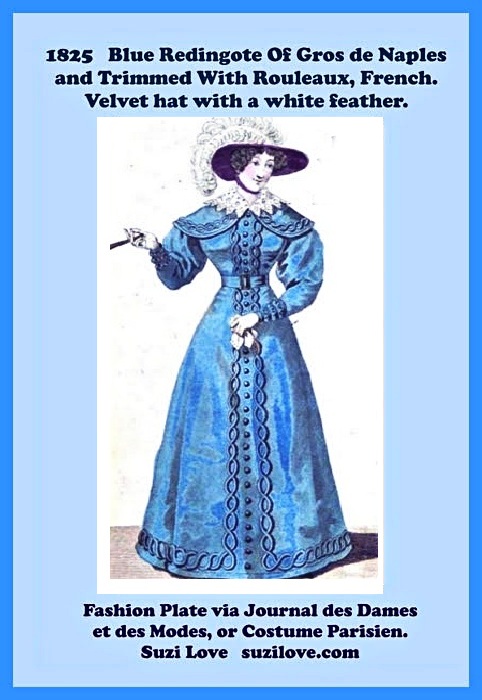
1825 Blue Redingote of Gros de Naples and Trimmed With Rouleaux, French. Wide shawl collar, Gigot sleeves are full at the top and narrow below the elbows, velvet hat with a white feather. Fashion Plate via Journal des Dames et des Modes, or Costume Parisien.
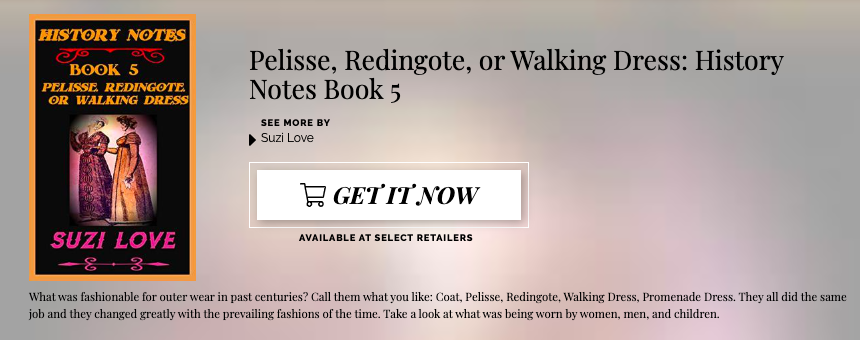
Definition Redingote Or Pelisse Or Walking Dress Or Coat: French word developed from English words, riding coat. Long fitted outdoor coat worn over other garments for warmth. Often left open at the front to show off the dress underneath. Sometimes cut away in front. Originally made with several capes and trimmed with large buttons. French fashion plates call these coats Redingotes and they are designed for women, men and children. English fashion plates call them a Pelisse, a walking dress, Promenade dress, or Carriage dress. books2read.com/suzilovePelisse
Definition Gros de Naples: ‘Gros’ is French for thick. Well-woven, plain weave, thick Napes silk, both plain and figured, various qualities, and colored.
1825 Blue Redingote of Gros de Naples and Trimmed With Rouleaux, French. #RegencyFashion #RomanticEraFashion #Pelisse. books2read.com/suzilovePelisse
Music history from the 17th, 18th, and 19th Centuries. Pianos, pianofortes, harps, viols, violins played during Jane Austen’s times. Musical Instruments were so important in most of the more affluent households in history that large industries grew all around the world to manufacture instruments, musical accessories, and to print sheet music. Musical instruction and encouragement could be found everywhere and both young ladies and gentlemen were encouraged to have musical appreciation. And of course, playing music was on the list of social requirements for all young ladies desirous of becoming a wife and homemaker.
London became Europe’s leading centre for the manufacture of scientific instruments and this led to the manufacture of more musical instruments as well as factories developed and rail transport helped the faster distribution of goods to regional areas. One of the first places that music was used to tell stories and to share enjoyment was in Christmas music. Because music was such an integral part of households, music was always a feature in Magazines. There were advertisements everywhere for musical instruments for sale, for sheet music, and for music lessons. And of course, of most interest to the ladies were the hundreds of fashion plates included in magazines where people were depicted with their musical instruments.
HN_6-7-8 Music General History NotesHN_6 Music General History Notes, books2read.com/suziloveMusicGeneral
Love music? Love Jane Austen and the Bridgerton family? Treat yourself to a nonfiction book on music history. #Bridgerton #Music #History #JaneAusten https://books2read.com/suziloveMusicGeneral
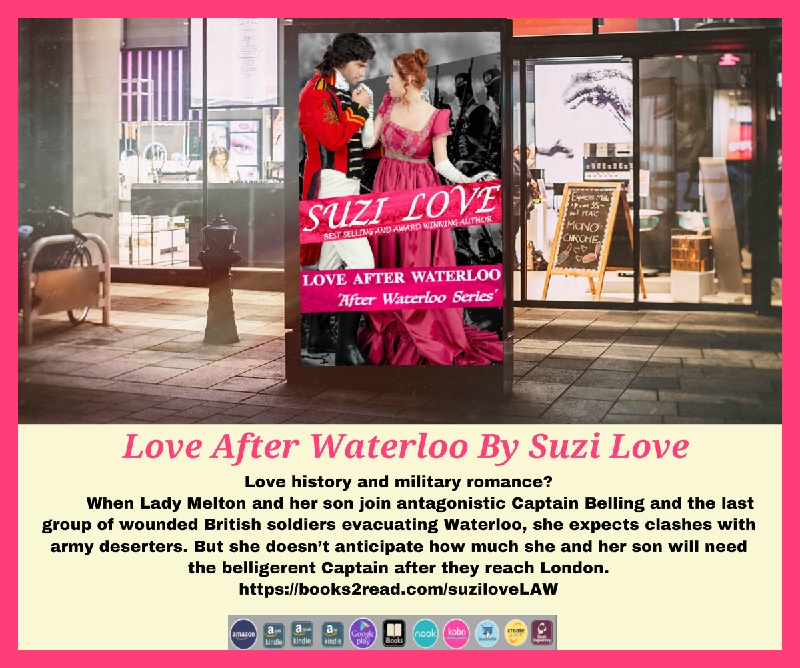
Love After. Waterloo: Blurb: When Lady Melton and her son, Daniel, are forced to join antagonistic Captain Belling and the last group of wounded British soldiers evacuating Waterloo and traveling back to London, she expects clashes with army deserters. What she doesn’t anticipate is how much she and her son will need the belligerent Captain after they reach London. https://books2read.com/suziloveLAW
Book Hook: “I remember who you are, Lady Melton,” Captain Belling said in a cold voice, barely glancing over his shoulder at them. “The only thing I don’t know is why the hell you and that child are still anywhere near Waterloo, when all women were ordered to evacuate a week ago.”
“That child has a name, Captain. His name is Daniel, or if you are a stickler for formality, Viscount Melton.”The captain turned and frowned down at her son, who stared back at him with blatant curiosity and a small amount of animosity, as forthright as any young and intelligent child. Even at his young age, Daniel was a shrewd judge of character, and had been instructed by his uncles to be careful about trusting strangers. When the Captain turned back to the tattered maps spread over his makeshift desk, Anne ignored his unspoken dismissal and used the time to observe the infuriating man without having his condemning gaze fixed on her, as it had been a week earlier at the Duke and Duchess of Richmond’s extravagant Brussels ball. If she and Daniel were to travel with his group of wounded soldiers, Anne wanted to learn as much as possible about their leader. Her son’s survival depended on her being well informed and prepared for any eventuality.
Dust filtered down through a gaping hole in the high roof and settled in the Captain’s hair, turning it a darker brown than his normal golden yellow, though a bucketful of dust wouldn’t make any difference to the state of his stained uniform. His left pants’ leg had been sliced open to the knee, the two sides pinned clear of the large bandage winding down most of his leg, while a spindly wooden crutch was propped against the table.
His large physique had attracted her even before their dance at the ball, though his striking physical attributes didn’t compensate for his belligerent attitude, or for his obvious displeasure at encountering her both in Brussels and near the battlefield. Still, the Captain had undoubtedly scowled in a similar fashion at many women he’d met either in Brussels or at Waterloo, as she’d heard him spout his narrow-minded view at the ball to his fellow officers. The Captain believed that in the vicinity of battles only men should be allowed. Not women, and especially not ladies.
Book Hooks: Captain Belling said in a cold voice, “The only thing I don’t know is why the hell you and that child are still near Waterloo.” #MilitaryRomance #RegencyRomance #BattleofWaterloo books2read.com/suziloveLAW
Craftsmen created containers of precious metals, leather, and silks and decorated them with jewels and engraving. Jane Austen and her contemporaries would have used writing boxes, linen boxes when travelling, boxes to hold their food and drink supplies while traveling by carriage, and decorative boxes to keep letters, ribbons, gloves, hairpins etc. Boxes, Cases, and Necessaires By Suzi Love, History Notes Book 11. books2read.com/suziloveBoxesCases.
Jane Austen, the Bridgerton family, and contemporaries used jeweled boxes of metal, leather, or silks. #Bridgerton #Travel #JaneAusten #RegencyEra #Antiques books2read.com/suziloveBoxesCases
1807 Two Ladies In Morning Dress, French. Left: Morning dress with short puffed sleeves over long straight sleeves ruffles around collar sleeves and hem white cap carrying blue parasol. Right: Blue Fichu or neck Shawl, blue Bonnet. Fashion Plate via Journal des Dames et des Modes, or Costume Parisien.
These are the types of outfits worn by Jane Austen and contemporaries in English magazines, where French fashions were obsessively copied despite the two countries being at war for many years.
Definition Fichu: Piece of lace, muslin, or other cloth worn about the neck and cleavage to preserve a lady’s modesty. From French word meaning neckerchief.
Fashion Women 1805-1809 History Notes Book 26
What did Jane Austen and friends wear? This book looks at early 1800s fashions, which were elegant and pretty with high waists and fabrics that were almost transparent. These Empire style gowns, named after Napoleon’s first Empress, became popular throughout Europe, and were then copied around the world. Colorful outwear was added to make an ensemble more attractive and warmer.
https://books2read.com/SuziLoveFashionWomen1805-1809
How did people travel in Jane Austen and Bridgerton years? What did they take with them to make their long journeys easier? Travel by road, ship, canal, or railway all took a long time and had dangers so people learned to prepare. And then, in the nineteenth century, road improvements, inventions, and scientific developments made travel more pleasurable. Travel and Luggage By Suzi Love History Notes Book 10 books2read.com/SuziLoveTravel
Horse Power To Steam. Various alternatives to horse power were tested in London’s streets during the 19th century. Steam powered road engines and trams proved too heavy and damaged the roads. Stationary steam engines were used to haul trams attached to a cable but these were only really effective on hills that we too steep for horses. There were also experiments with trams driven gas engines and battery electric power. but was successfully developed. Petrol engines were still primitive and unreliable in the 1890s. In 1900 the reliable horse still dominated the streets of London but new technology was to revolutionize road transport.
Travel and Luggage By Suzi Love History Notes Book 10. How did people travel in Jane Austen’s times. In past centuries? What did they take with them to make their long journeys easier? Travel by road, ship, canal, or railway all took a long time and had dangers so people learned to prepare. And then, in the nineteenth century, road improvements, inventions, and scientific developments made travel more pleasurable. books2read.com/SuziLoveTravel HN_10_D2D_RetailerBuyLink_Travel and Luggage By Suzi Love History Notes Book 10 #History #travel How did people travel in past centuries? What did they take with them to make their long journeys easier? books2read.com/SuziLoveTravel
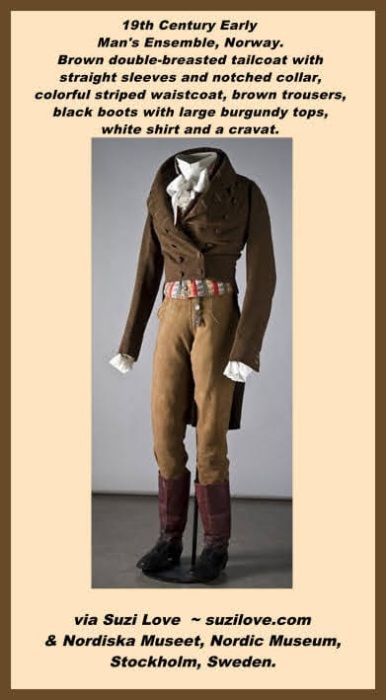
19th Century Early Man’s Ensemble, Norway. Brown double-breasted tailcoat with straight sleeves and notched collar, colorful striped waistcoat, brown trousers, black boots with large burgundy tops, white shirt and a cravat. via Nordiska Museet, Nordic Museum, Stockholm, Sweden.
19th Century Early Typical Man’s Ensemble: tailcoat, trousers, shirt, cravat etc. in Bridgerton and Jane Austen years. #Bridgerton #RegencyFashion #JaneAustenhttps://books2read.com/SuziLoveFashionMen1800-1819
Fashion Women 1800 By Suzi Love History Notes Book 12 #Regency #Fashion Love gorgeous historical women’s fashions? Take a look at what women wore and carried in 1800 in Europe and around the world. books2read.com/SuziLoveFashionWomen1800
Women’s dress changed dramatically after 1785. The rich fabrics and complicated, formal shapes of the late 18th century gave way to simple, light fabrics that draped easily. These new gowns achieved something of the effect of the simple tunics shown on classical Greek and Roman statues and vases. Inspired in part by the statuary of ancient Greece and Rome, the new fashion was epitomised by light cotton gowns falling around the body in an unstructured way, held around the high waist with a simple sash and accompanied by a soft shawl draped around exposed shoulders. This style was ideal for the Indian imports like Kashmiri shawls and Bengali muslin, as used in this embroidered gown. Championed by such influential figures as Emma Hamilton in England and Madame Récamier in France, the so-called ‘Empire’ style catapulted Indian muslin into the forefront of fashion.
Empire Dress: Owes its name, physical emancipation, popularity, and even its sexiness to France. In this English example, French style is slavishly followed in the gown’s high waist and modish stripes.
Empire style, or early 1800s, high-waisted dresses made it impossible to either sewn in a pocket or to tie on a pocket. So women began carrying small, decorated bags called Reticules, or ridicules, which generally pulled close at the top with a drawstring.
Inspired in part by the statuary of ancient Greece and Rome, the new fashion was epitomised by light cotton gowns falling around the body in an unstructured way, held around the high waist with a simple sash and accompanied by a soft shawl draped around exposed shoulders. This style was ideal for the Indian imports like Kashmiri shawls and Bengali muslin, as used in this embroidered gown. Championed by such influential figures as Emma Hamilton in England and Madame Récamier in France, the so-called ‘Empire’ style catapulted Indian muslin into the forefront of fashion.