↓
 

Suzi Love

Making history fun, one year at a time.

Header_
  • Home
  • Newsletter
  • Pre order form
  • Shop
    • Cart
    • Checkout
    • My account
    • Refund and Returns Policy
  • Blog
  • BOOKS
    • History Events
    • Kelly’s Justice
    • Outback Arrival
    • Irresistible Aristocrats
    • History Notes
    • Scandalous Siblings
    • Love After Waterloo
    • Regency Life Series
  • Privacy Policy
  • EVENTS
Home » Suzi Love Images » Page 31 << 1 2 … 29 30 31 32 33 … 73 74 >>

Category Archives: Suzi Love Images

Post navigation

← Previous Post
Next Post→

Christmas: Lord Of Misrule #Christmas #holidays #Traditions #Customs

Suzi Love Posted on December 16, 2025 by Suzi LoveDecember 15, 2025

The Lord of Misrule was generally a peasant, or sub-deacon, and the revelries followed the Pagan tradition of Saturnalia and was a time of drunkenness and wild partying. The Church’s festival with a Boy Bishop, the leader of children’s festivities in choir schools, was similar, but was abolished by Henry VIII in 1541, restored by the Catholic Queen Mary, but again abolished by Protestant Elizabeth I. On the Continent, the Council of Basle suppressed it in 1431 but the custom was revived in some places from time to time, even as late as the eighteenth century. After the death of Edward VI in 1553, the English court stopped appointing a Lord of Misrule.

From A Survey of London by John Stow: Reprinted from the text of 1603.

‘…in the feaste of Christmas, there was in the kings house, wheresoeuer he was lodged, a Lord of Misrule, or Maister of merry disports, and the like had yee in the house of euery noble man, of honor, or good worshippe, were he spirituall or temporall.’

During the late medieval and early Tudor periods in England, Lord of Misrule, also called Abbot Of Misrule, or King Of Misrule, was appointed to manage the Christmas festivities held at court, in the houses of great noblemen, in the law schools of the Inns of Court, and in many of the colleges at the universities of Cambridge and Oxford.

His reign lasted anywhere from 12 days to 3 months and his role was to direct the masques, processions, plays, and feasts. Although this was mostly a British custom, in ancient Rome from the 17th to 23rd of December, a Lord of Misrule took on the guise of Saturn for the feast of Saturnalia and the ordinary rules were changed so that masters became slaves and the offices of state were held by slaves. The Lord of Misrule presided and could command anyone to do anything. Our contemporary Christmas holidays seem to have originated from this idea of festive holidays.

The custom began in December 1551 when the Duke of Somerset, Edward VI’s uncle Edward Seymour, was in the Tower of London awaiting execution. He sent a note to the Master of Revels to appoint George Ferrers as Lord of Misrule. Ferrers was a courtier and poet who later contributed to A Mirror for Magistrates, described by Scott Lucas as a “compendium of tragic monologues” by a series of historical personages.

Scotland had the Abbot of Unreason (suppressed in 1555) as their equivalent to the Lord of Misrule and scholars believe both ideas came from the “king” or “bishop” who presided over the earlier Feast of Fools.

Xmas_Lord Of Misrule
Christmas: Lord Of Misrule Custom #Christmas #holidays #Traditions #Customs. books2read.com/suziloveHOCP Share on X
Posted in Australia, Canada, Christmas, Customs & Manners, England, Europe, History Of Christmases Past, Suzi Love Images, U.S.A | Tagged Christmas, Customs and Traditions, History Of Christmases Past, pastimes

Christmas: Bring In The Boar’s Head. #Christmas #holidays #customs #BritishHistory #RegencyEra

Suzi Love Posted on December 15, 2025 by Suzi LoveDecember 15, 2025

The Boar’s head At Christmas.

Christmas in the Olden Time by Walter Scott. 

Then was brought in the lusty brawn

By old blue-coated serving man;

Then the grim boar’s head frowned on high,

Crested with bays and rosemary.

Well can the green-garbed ranger tell

How, when and where the monster fell;

What dogs before his death he tore,

And all the baitings of the boar.

The wassal round, in good brown bowls,

Garnished with ribbons, blithely trowls.

There the huge sirloin reeked: hard by

Plum-porridge stood, and Christmas pye;

Nor failed old Scotland to produce,

At such high-tide, her savory goose.

Because wild boar was the most feared animal, serving it at a meal represented the victory of good over evil. During the 17th century, wild boar became extinct in Britain so a pig’s head was used instead. The head was often presented on a decorated platter with an apple in its mouth and carried in by bearers in a dramatic manner. The tradition of serving ham for Christmas lunch or dinner probably came from the idea of serving boar’s head or roasted boar joints to guests at Christmas.

To say nothing of the roast beef and plum-pudding, Christmas pies, furmity, and snap-dragons, the Yule-log and the mistletoe have not finally abdicated, while the boar’s head, decorated with rosemary or prickly holly, maintains its place at the English Christmas dinner, and is still served up in great state at the royal Christmas table. At Oxford, U.K., the boar’s head was carried in by the strongest of the guardsmen, singing a Christmas carol, and preceded by a forester, a huntsman, and a couple of pages dressed in silk and carrying the mustard which was regarded as a great luxury and  an infallible digester.

Xmas_Boar's Head
Xmas_Boar's Head
Xmas_Boar's Head

The following celebrated carol of the Boar’s Head is found in the book of  ‘Christmasse Carolles’ published in 1521 by Wynkyn de Warde: 

The boar’s head in bande bring I,     

With garlandes gay and rosemary,

I pray you all synge merely,

Qui estis in convivio.

“The bore’s head, I understande,

Is the chefe servyce in this lande.

Loke wherever it be fande,

Servite cum cantico.

“Be gladde, lordes, both more and lasse,

For this bath ordayned our stewarde,

To chere you all this Christmasse,

The bore’s head with mustarde.”

At Oxford, U.K., the boar’s head was carried in by the strongest of the guardsmen, singing a Christmas carol, and preceded by a forester, a huntsman, and a couple of pages dressed in silk and carrying the mustard which was regarded as a great luxury and  an infallible digester. A similar custom appears to have prevailed in Genoa in the times of the Dorias when a boar decorated with branches of laurel and accompanied by trumpeters was annually presented to the Doria family by the Abbot of San Antonio at Pré at midday on the 24th of December.

Christmas: Bring In The Boar's Head. #Christmas #holidays #customs #BritishHistory #RegencyEra https://books2read.com/suziloveHOCP Share on X

Posted in 1700s, 1800s, Christmas, Customs & Manners, England, Europe, Food and Drink, Georgian Era, Regency Era, Romantic Era, Suzi Love Images, Victorian Era | Tagged Christmas, Customs and Traditions, europe, Food, Great Britain, household, Suzi Love Images

Christmas: Mistletoe and its long history. #Christmas #Holidays #Customs #BritishHistory

Suzi Love Posted on December 14, 2025 by Suzi LoveDecember 14, 2025

Another Christmas Tradition is kisisng under the Mistletoe. So have fun this Christmas and find someone to kiss. The problem in hotter climates is to find the Mistletoe, of course. Darn!

Mistletoe was used by Druid priests 200 years before the birth of Christ in their winter celebrations. They revered the plant since it had no roots yet remained green during the cold months of winter. The ancient Celtics believed mistletoe to have magical healing powers and used it as an antidote for poison, infertility, and to ward of evil spirits. The plant was also seen as a symbol of peace, and it is said that among Romans, enemies who met under mistletoe would lay down their weapons and embrace.

Scandanavians associated the plant with Frigga, their goddess of love, and it may be from this that we derive the custom of kissing under the mistletoe. Those who kissed under the mistletoe had the promise of happiness and good luck in the following year. Mistletoe was associated with Christmas as both a decoration under which lovers kiss, as well as a protection from witches and demons. Sounds romantic, although mistletoe is actually a parasitic plant that grows on other trees or plants and comes in many varieties.  

In Britain, mistletoe was mainly found in the western and southwestern parts, so the custom wasn’t even followed in all parts of England. But where the mistletoe custom was followed, it was hung in doorways and the greenery was watched by young gentlemen in hopes of catching a pretty girl to kiss, usually on the cheek.      

Traditionally, a man was allowed to kiss a woman who was standing underneath mistletoe and bad luck would befall any woman who refused. In some places, it was the custom to pick a berry for each kiss and when all the berries were gone, no more kisses could be taken.

Xmas_Mistletoe
Xmas_Mistletoe
Xmas_Mistletoe
cropped to image, recto, unframed
Xmas_Mistletoe
Xmas_Mistletoe
Christmas: Mistletoe and its long history. #Christmas #Holidays #Customs #BritishHistory https://books2read.com/suziloveHOCP Share on X
Posted in 1700s, 1800s, Australia, Christmas, Customs & Manners, dancing, England, Europe, Georgian Era, History Of Christmases Past, household, Regency Era, Romantic Era, Suzi Love Images, U.S.A, Victorian Era | Tagged British history, Christmas, Customs and Traditions, dancing, europe, Georgian era, History Of Christmases Past, Regency Era

Christmas: Twelve Days Of Christmas and Twelfth Night.

Suzi Love Posted on December 13, 2025 by Suzi LoveDecember 11, 2025

Twelve Days of Christmas

Days and nights used to be counted separately, so the important night was often the night before rather than the night of, which is why some parts of the world celebrate Christmas on Christmas Eve. Therefore, the twelve days of Christmas actually begin on the eve of December 25th, the first night, and end on January 6th, which is Epiphany. The day of December 26 is the first day and the eve of December 26 the second night.

The famous Twelfth Night is the eve of Epiphany and the twelfth day is Epiphany itself. During these twelve days, traditional roles were relaxed or turned upside down so that masters waited on their servants, men were allowed to dress as women and women as men. These crazy antics can also be seen in modern Christmas pantomimes in which authority is mocked, women play male leads and the leading older female character is played by a man.

Twelfth Night

The Twelfth Night festival marked the onset of the winter solstice, the point in late December when the sun, whose daily arc had reached its lowest and darkest. 

Twelfth Night is the eve before the twelfth day of Christmas or the Epiphany celebration, which commemorates the adoration of the Magi before the infant Jesus and marks the final night of the Christmas season. Twelve Nights,” which extended from the 25th of December to the 6th of January. The Twelve Nights were religiously observed by numerous feasts, and were regarded by the ancient Germans as among the holiest and most solemn of their festivals.

In Tudor England, the Twelfth Night marked the end of a winter festival that started on All Hallows Eve. A King or Lord of Misrule would be appointed to run the Christmas festivities, and the Twelfth Night was the end of his period of rule. Shakespeare’s play, Twelfth Night, or What You Will, was originally written to be performed as a Twelfth Night entertainment. After Twelfth Night, the Carnival season starts and lasts until Mardi Gras. In some places, Twelfth Night celebrations include food traditions such as the king cake or tortell.

In the Bavarian and Styrian Alps the Twelve Nights are called “Rumor Nights,” on account of their visions of ghosts and hobgoblins, when priests and prudent housewives, with prayer and invocation, holy-water and burning incense, fumigate dwelling and outhouse, and sprinkle their cattle with salt. Hence these nights were also called “Fumigating Nights.” As an additional protection against “witches’ feet” and “devils’ paws,” the initials of the holy magicians were formerly inscribed upon the door-posts. On the dreaded Twelfth-night, when Frau Holle, or Berchta, issues with her fearful train from her wild mountain home, where she dwells among the dead, she is generally preceded by the faithful Eckhart, an old man with a long beard and a white wand, who warns every one of her terrible approach.

Xmas_Twelth Night
Xmas_Twelth Night
Xmas_Twelth Night
Christmas: Twelve Days Of Christmas and Twelfth Night. https://books2read.com/suziloveHOCP Share on X
Posted in Christmas, Customs & Manners, England, Europe, Food and Drink, History, household, Suzi Love Images | Tagged British history, Christmas, Customs and Traditions, drinks, Food, household, Suzi Love Images

Christmas Greenery: Holly, Ivy and Evergreen Boughs. #Christmas #Holidays #customs #Europe

Suzi Love avatarPosted on December 12, 2025 by Suzi LoveDecember 11, 2025

Christmas Greenery: Holly, Ivy and Evergreen Boughs. #Christmas #Holidays #customs #Europe https://books2read.com/suziloveHOCP

Continue reading →
Posted in Australia, Canada, Christmas, Customs & Manners, Edwardian Era, England, Europe, Georgian Era, History, household, Regency Era, Romantic Era, South Pacific, Suzi Love Images, U.S.A, Victorian Era | Tagged Christmas, Customs and Traditions, History Events, History Of Christmases Past, household

Christmas: Christmas Card History #Christmas #holidays #Traditions #Customs #VictorianEra

Suzi Love Posted on December 11, 2025 by Suzi LoveDecember 11, 2025

Sending Christmas Cards.

At the end of the winter term, schoolmasters would set their pupils to work on Christmas Pieces, samplers of writing on superior paper with engraved borders, to show parents how they had progressed during the year. By about 1820, the engraved borders were enhanced with color and the children’s pieces became more decorative.

However, the custom of sending cards at Christmas was started in the United Kingdom in 1843 by Sir Henry Cole. Postage had been standardized three years earlier and Cole was a civil servant who had played a key role in initiating Uniform Penny Post. He wanted ordinary people to become more interested in the new ‘Public Post Office’. With his artist friend John Horsley, they designed the first card which was issued from a periodical, Felix Summerley’s Home Treasury, and were sold for 1 shilling each.

The card was lithographed, hand-colored, had three panels and was in a rustic frame of carved wood and ivy. The outer two panels showed people caring for the hungry and the naked. The centre panel showed a family of three generations having Christmas dinner, although the temperate classes strongly objected to the idea of a child being given a glass of wine with dinner.

Xmas_Christmas Card

New railways carried more post, and a lot faster, than a horse and carriage so the Post Office offered a Penny stamp. Cards became even more popular when they could be posted in an unsealed envelope for one halfpenny. Christmas cards became truly popular when printing improved and cards could be produced in large numbers, around 1860. By the early 1900s, the custom had spread over Europe and especially in Germany.

Early cards usually pictured Nativity scenes, but in the late Victorian times, robins and snow-scenes became popular because the postmen wore red uniforms and were nicknamed ‘Robin Postmen’. Snow-scenes were also popular because they were a reminder of the very bad winter of 1836.

Snow scenes reflected the snowy and often harsh northern hemisphere winters when opening and reading Christmas cards was an enjoyable family experience.  In 1860, Charles Goodall & Son, a British publisher of visiting cards, began mass producing cards to be used for visits during the Christmas period. These Christmas and New Year’s visiting cards were decorated with simple designs such as a twig of holly or flowers.

Sales of cards grew and designs and sizes changed. The first cards were meant to appeal to the masses and encourage them to send large numbers by post, so rather than focus on religious images, they showed sentimental or humorous images of family and children, fanciful designs of flowers, fairies, or reminders of the approach of spring. Religious themes of nativity scenes, children looking at the manger, or angels and candles remain popular to the modern day.

Cards could be shaped like bells, a fan, a crescent, a circle, or a diamond and were folding, decorated with jewels, iridescent, embossed, and carried either simple Christmas and New Year greetings or had verses and carols written in them. The next year, Mr W.C.T. Dobson produced a sketch symbolizing the ‘Spirit of Christmas’ which sold many more than the previous thousand and the novelty caught on.

Many artists became famous for their annual illustrations that became postcards and cards.  Printing technology became more advanced in the age of industrialisation and the price of card production dropped. With the introduction of the halfpenny postage rate, the Christmas card industry industry increased until in 1880 11.5 million cards were produced.

Xmas_Christmas Card
Xmas_Christmas Card
Xmas_Christmas Card
Xmas_Christmas Card
Xmas_Christmas Card
Xmas_Christmas Card
Xmas_Christmas Card
Xmas_Christmas Card
Xmas_Christmas Card
Christmas Card History #Christmas #holidays #Traditions #Customs #VictorianEra https://books2read.com/suziloveHOCP Share on X
Posted in 1800s, Australia, Canada, Christmas, Customs & Manners, England, Europe, household, Pastimes, Suzi Love Images, U.S.A, Victorian Era | Tagged British history, British Postal Museum, Christmas, Customs and Traditions, europe, History Of Christmases Past, postal, Victoria and Albert Museum, Victorian Era

Christmas: 1803 December The Bellman #Christmas #holidays #RegencyEra #Customs

Suzi Love Posted on December 11, 2025 by Suzi LoveDecember 10, 2025

Christmas Bells.

“Bells are musics laughter.” By Thomas Hood (1799-1845), British poet and humorist.

Bells hold a  long time association with Christmas. In Victorian times, carol singers used small handbells to play the tune of the carol. Sometimes there were bells without singing – Church bells are rung after sunset to signal the start of the Christmas Eve service, the first of Christmas. In England, the bellman goes round at midnight ringing his bell, and rattling off a stanza or two, for the gratuity which he confidently anticipates; while watchmen, firemen, rate-collectors, postmen, chimney-sweeps, street scavengers, the errand-boys of your baker, butcher, poultry merchant, and green-grocer, even to the hired singers in the churches all expect their Christmas-box. In Victorian times, carol singers used small hand bells to play the tune of the carol and sometimes there were bells without singing. Church bells are rung after sunset to signal the start of the Christmas Eve service, the first of Christmas.

The Bellman

The Bellman stands full face, shouting with wide-open mouth and ringing his hand-bell.

In his left hand he holds out his verses headed by a little figure of Napoleon wearing a huge tricorne and holding a gigantic sword:

 ‘This little Boney-says he’ll come At merry Christmas time,

But that I say is all a hum Or I no more will rhyme

Some say in Wooden house he’ll glide, Some say in air Balloon,

E’en those who airy schemes deride. Agree his coming soon.

Now honest people list to me, Though Income is but small, I’ll bet my Wig, to one Penney, He does not come at all.’ Hand-colored etching and aquatint.

Via British Museum

Christmas: 1803 December The Bellman #Christmas #holidays #RegencyEra #Customs books2read.com/suziloveHOCP Share on X
Posted in 1800s, Bridgerton, Christmas, Customs & Manners, England, History Of Christmases Past, Jane Austen, Music, Regency Era, Suzi Love Books, Suzi Love Images | Tagged Bridgerton, British history, Christmas, Customs and Traditions, England, History Of Christmases Past, Jane Austen, music, Regency Era, Suzi Love Books

Christmas: How did they celebrate Christmas in Bridgerton and Jane Austen times? #Christmas #Christianity #Bridgerton #JaneAusten #holidays

Suzi Love Posted on December 10, 2025 by Suzi LoveDecember 9, 2025

How did they celebrate Christmas in Bridgerton and Jane Austen times? Historical information about the traditions of Christmas through the centuries, including the religious aspects, decorations, games, food and plays. History Of Christmases Past has lots of information and images about Christmas through the centuries, including religious aspects, decorations, games, food and plays. Historic images show how some traditions have changed while many have remained the same through the centuries. books2read.com/suziloveHOCP

How did they celebrate Christmas in Bridgerton and Jane Austen times? Historical information about the traditions of Christmas through the centuries, including the religious aspects, decorations, games, food and plays. #holidays #Christmas #Christianity #Bridgerton #JaneAusten http://books2read.com/suziloveHOCP
How did they celebrate Christmas in Bridgerton and Jane Austen times? Historical information about the traditions of Christmas. #holidays #Christmas #Christianity #Bridgerton #JaneAusten http://books2read.com/suziloveHOCP Share on X


Posted in 1700s, 1800s, 1900s, Australia, Bridgerton, Canada, Christmas, Customs & Manners, Edwardian Era, England, Europe, Events, Food and Drink, Georgian Era, History Of Christmases Past, household, Jane Austen, Music, Regency Era, Romantic Era, Royalty, South Pacific, Suzi Love Books, Suzi Love Images, U.S.A, Victorian Era | Tagged Book 1, Bridgerton, British history, Christmas, Customs and Traditions, drinks, Edwardian Era, Food, Georgian era, History Events, History Of Christmases Past, household, Jane Austen, music, Queen Victoria, Regency Era, Regency Royalty, Suzi Love Books, Victorian Era

Christmas: Typical Christmas Food Eaten By the Bridgerton and Jane Austen Families. #Christmas #Food #JaneAusten #Bridgerton

Suzi Love Posted on December 9, 2025 by Suzi LoveDecember 9, 2025

Christmas: Typical Christmas Food Eaten By the Bridgerton and Jane Austen Families. #Christmas #Food #JaneAusten #Bridgerton

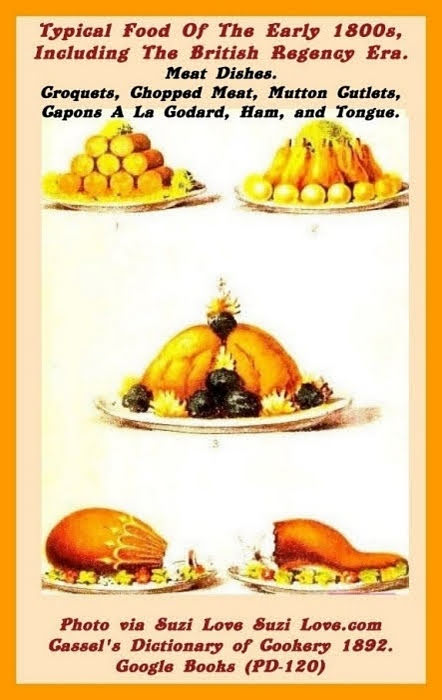
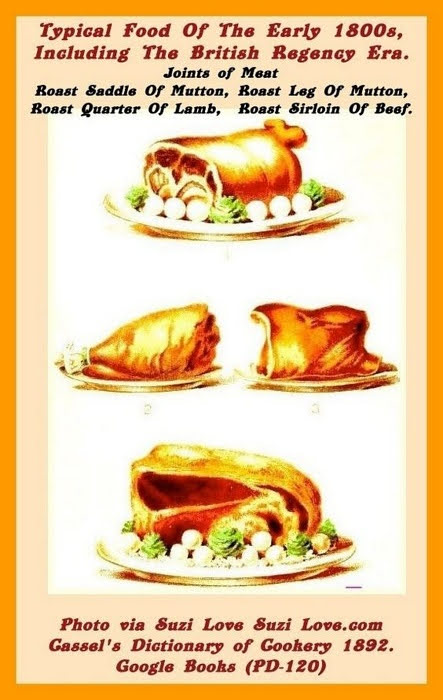
On the Christmas menu was generally mince pies and perhaps a goose or a piece of beef, depending on the family’s wealth and status. Mince pies were not made of fruit mince as we do now, but of offal or meat such as bullock’s tongue cooked with spices, orange peel, and wine and then used to fill pastry cases.

Another Christmas specialty was a Yorkshire Christmas pie which would be filled with turkey, goose, a hen, or perhaps woodcocks, partridge, or pigeons. And after the main courses, came the Plum Pudding, mixed on Stir-Up Sunday according to each family’s recipe and then boiled in a cloth.

Xmas_food_1800s_Typicalchristmasdesserts_1892cassells
Xmas_food_1800s_TypicalPies-and-Puddings_MrsBeeton
Food_1800s_Typical Food of the Early 1800s Including the British Regency Era. Meat Dishes- Croquettes, chopped meat, mutton cutlets, capons A la Godard, Ham and Tongue. 1892 Cassell_Sml
Food_1800s_Typical Food of the Early 1800s. Including the Regency Era. Joints Of Meat_Sml
food_1800s_Typical Historical Christmas Meal. Boars Head, Wassail Bowl, Punch Bowl, Roast Swan, Punch Jelly, Lamb_s Wool, and Truffles. Plate via Cassell_s Dictionary of Cookery_Sml
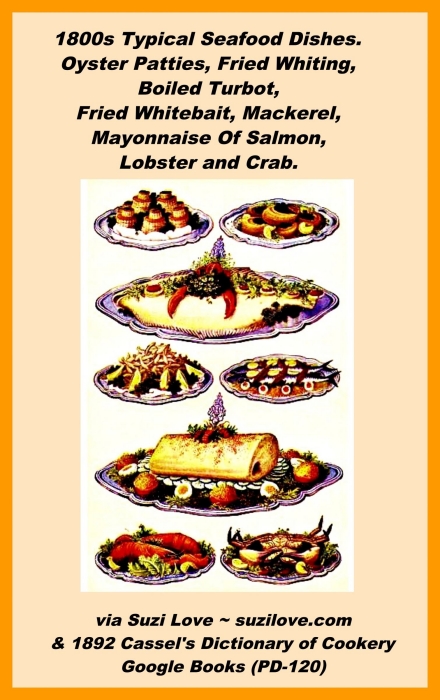
Food_1800s_TypicalFishDishes_OysterPattties_FriedWhiting_BoiledTurbot_friedWhitebait_Mackera=el_MayonaiseOfsalmon_Lobster_Crab_From1892Cassells
food_1800s_TypicalGame and Poultry (1). Snipe On Toast, Larks On Toast, Roast Pheasant, Roast Pigeons, Roast Fowl, Roast Goose, Roast Duck, Boiled Fowl, Roast Turkey_1860s_Mrs. Beeton_Sml
Food_1800s_TypicalJoints_SirloinofBeef, Boiled Beef, Leg Of Mutton, Roast Ribs Of Beef. From- 1861 Mrs. Beeton_Sml
Christmas: Typical Christmas Food Eaten By the Bridgerton and Jane Austen Families. #Christmas #Food #JaneAusten #Bridgerton https://books2read.com/suziloveHOCP Share on X
Posted in 1700s, 1800s, Australia, Bridgerton, Canada, Christmas, Customs & Manners, England, Europe, Food and Drink, Georgian Era, History, History Of Christmases Past, household, Jane Austen, Regency Era, Romantic Era, Suzi Love Images, U.S.A, Victorian Era | Tagged Bridgerton, British history, Christmas, europe, Food, google books, History Of Christmases Past, household, Jane Austen, Suzi Love Images

Christmas: Games and Snap Dragon played at a Bridgerton and Jane Austen Christmas. #Christmas #Holidays #JaneAusten #Bridgerton #RegencyEra

Suzi Love Posted on December 9, 2025 by Suzi LoveDecember 8, 2025

Games

At Christmas time, households had guests to stay and games were played to either fill in the time inside when the weather was too bad to venture out with sleds or skates, or to keep tradition. Blind man’s bluff, forfeits, and snap dragon were all played.

A list of some entertainments for Christmas…From The book Of Christmas by Thomas kibble Hervey. “jugglers, and jack-puddings, scrambling for nuts and apples, dancing the hobby-horse, hunting owls and squirrels, the fool-plough, hot-cockles, a stick moving on a pivot, with an apple at one end and a candle at the other, so that he who missed his bite burned his nose, blindman’s buffs, forfeits, interludes and mock plays :” — also of ” thread my needle, Nan,” ” he can do little that can’t do this,” feed the dove, hunt the slipper, shoeing the wild mare, post and pair, snap dragon, the gathering of omens….

Snap Dragon A favorite game was Snap Dragon, often played on Christmas Eve. Raisins were put into a large, shallow bowl and brandy was poured over them and then ignited.  Lights were extinguished to increase the eerie effect of the blue flames playing across the liquor. The object of the game was to reach through the blue flames and grab as many raisins as possible from the flaming brandy and pop them into your mouth. The risk of burning yourself increased the excitement.

Samuel Johnson’s Dictionary of the English Language in 1755 describes the. game as “a play in which they catch raisins out of burning brandy and, extinguishing them by closing the mouth, eat them”. According to an eighteenth-century article in Richard Steele’s Tatler magazine, “the wantonness of the thing was to see each other look like a demon, as we burnt ourselves, and snatched out the fruit.”

Snap-dragon was played in England, Canada, U/S.A, and probably other countries with British backgrounds. The words snap-dragon and flap-dragon can refer to the game, the raisins used in the game, or the bowl with brandy and raisins.

The first reference to Snap-dragon as a game is in Francis Grose’s Dictionary of the Vulgar Tongue  in 1811. “Christmas gambol: raisins and almonds being put into a bowl of brandy, and the candles extinguished, the spirit is set on fire, and the company scramble for the raisins.” Snap-dragon as a Christmas parlour game was mentioned in 1836 in Charles Dickens’ The Pickwick Papers and in 1861, in Anthony Trollope’s novel Orley Farm.  Lewis Carroll, in Through the Looking-Glass, and What Alice Found There in 1871 describes “A snap-dragon-fly. Its body is made of plum pudding, its wings of holly-leaves, and its head is a raisin burning in brandy.”

Agatha Christie’s book Hallowe’en Party describes a children’s party during which a child’s murder causes Hercule Poirot to be brought in to solve the case and at which Snap-dragon is played at the end of the evening.

A song went with the game….

“Here he comes with flaming bowl,

Don’t be mean to take his toll.

Snip! Snap! Dragon!

Take care you don’t take too much

Be not greedy in your clutch.

Snip! Snap! Dragon!

With his blue and lapping tongue

Many of you will be stung.

Snip! Snap! Dragon!

For he snaps at all that comes

Snatching at his feast of plums.

Snip! Snap! Dragon!

But Old Christmas makes him come

Though he looks so fee! Fa! Fum!

Snip! Snap! Dragon!

Don’t `ee fear him, be but bold.

Out he goes, his flames are cold.

Snip! Snap! Dragon!

Xmas_Christmas: Games and Snap Dragon
Christmas: Games and Snap Dragon played at a Bridgerton and Jane Austen Christmas. #Christmas #Holidays #JaneAusten #Bridgerton #RegencyEra https://books2read.com/suziloveHOCP Share on X
Posted in Christmas, Customs & Manners, England, Europe, History, household, Pastimes, Suzi Love Images, U.S.A | Tagged Christmas, Customs and Traditions, games, History Of Christmases Past, household, pastimes, Suzi Love Images, Suzi Love Research

Post navigation

← Previous Post
Next Post→

SUBSCRIBE TO SUZI LOVE'S NEWSLETTER.

Recent Posts

  • Reader or Writer of the Regency Era? Love the Bridgertons and Jane Austen? Try Older Gentleman’s Day for an overview of daily life. #Bridgerton #RegencyEra #JaneAusten #nonfiction
  • 19th Century Early Type of Linen Chemise, or Shift, Worn By the Bridgerton Ladies and Jane Austen. #Bridgerton #Underclothing #JaneAusten #RegencyFashion
  • 1800 ca. Heptagonal Bag Of Old Rose Moiré Silk Panels With A Steel Turn-Key Closure. #JaneAusten #France #Reticule
  • 1780 ca. English Guitar, Lisbon Made by Jaco Vieira da Silva. #Music #Guitar #Portugal #GeorgianEra
  • 1715-1775 ca. Flat Drawstring Bag, French. Strung glass beads held together by looping stitches. #Reticule #GeorgianFashion #GeorgianEra

Recent Comments

  1. Suzi Love on Book Hooks: “Oh, dear. I’ve taken your bed. I’ve forced you to use a mattress on the floor.” #Waterloo #regencyromance #historicalromance #BookHook #MFRW
  2. Suzi Love on Book Hooks: “Oh, dear. I’ve taken your bed. I’ve forced you to use a mattress on the floor.” #Waterloo #regencyromance #historicalromance #BookHook #MFRW
  3. Suzi Love on Book Hooks: “Oh, dear. I’ve taken your bed. I’ve forced you to use a mattress on the floor.” #Waterloo #regencyromance #historicalromance #BookHook #MFRW
  4. Suzi Love on Book Hooks: “Oh, dear. I’ve taken your bed. I’ve forced you to use a mattress on the floor.” #Waterloo #regencyromance #historicalromance #BookHook #MFRW
  5. Lisa Demers on Book Hooks: “Oh, dear. I’ve taken your bed. I’ve forced you to use a mattress on the floor.” #Waterloo #regencyromance #historicalromance #BookHook #MFRW

Login

  • Log in

Archives

  • August 2026
  • July 2026
  • June 2026
  • May 2026
  • April 2026
  • March 2026
  • February 2026
  • January 2026
  • December 2025
  • November 2025
  • October 2025
  • September 2025
  • August 2025
  • July 2025
  • June 2025
  • May 2025
  • April 2025
  • March 2025
  • February 2025
  • January 2025
  • December 2024
  • November 2024
  • October 2024
  • September 2024
  • August 2024
  • July 2024
  • June 2024
  • May 2024
  • April 2024
  • March 2024
  • February 2024
  • January 2024
  • November 2023
  • October 2023
  • September 2023
  • August 2023
  • July 2023
  • April 2023
  • March 2023
  • June 2022
  • April 2022

Categories

  • 1700s
  • 1700s Mens fashion
  • 1700s Womens Fashion
  • 1800s
  • 1800s Mens Fashions
  • 1800s women's fashion
  • 1900s
  • art
  • Australia
  • Bath
  • bedroom fashion
  • Book Hooks
  • Box Or Container
  • Bridgerton
  • Bus Trips
  • Canada
  • Carriage
  • cartoon
  • Celebrity
  • Chatelaine
  • children
  • Children
  • Christmas
  • Coat or Pelisse Or Redingote
  • Contemporary
  • Corset
  • Couple
  • Customs & Manners
  • dancing
  • December Scandal
  • Decorative Item
  • Dress Or Robe
  • Easter
  • Edwardian Era
  • Embracing Scandal
  • England
  • Ester In Images
  • Europe
  • Events
  • Fashion
  • fashion accessories
  • Food and Drink
  • Four Times A Virgin
  • France
  • furniture
  • Georgian Era
  • Georgian Fashion
  • Google Books
  • Grand Tour
  • Group
  • hats
  • History
  • History Events
  • History Notes
  • History Of Christmases Past
  • household
  • Hygiene
  • Irresistible Aristocrats
  • Jane Austen
  • Keanu Reeves
  • Kellys Justice
  • Legal
  • London
  • Love After Waterloo
  • Loving Lady Katharine
  • medical
  • military
  • money
  • mourning
  • Music
  • Outback Arrival
  • pants
  • Pastimes
  • peerage
  • People
  • Places
  • Pleasure House Ball
  • postal
  • Queensland
  • Quotations
  • Regency Era
  • Regency Fashion
  • Regency Life Series
  • Reticule or Bag
  • riding
  • Romantic Era
  • Royalty
  • Russia
  • Scandalous Siblings Series
  • Scenting Scandal
  • Self Publishing
  • sewing
  • Shirt
  • shoes
  • Shopping
  • South Pacific
  • Spencer
  • sports
  • Suit
  • Sunday Snippet
  • Suzi Love
  • Suzi Love Books
  • Suzi Love Images
  • Suzi Love Writing
  • Swain Cove
  • THe Viscount's Pleasure House
  • travel
  • U.S.A
  • underclothing
  • Vest or Waistcoat
  • Victorian Era
  • Victorian Fashion
  • weapons
  • weddings
  • Writing Tools

1800s men fashion 1800s women's fashion antiques Bridgerton British history Cartoons Corset cravat decorative Dress Or Gown England europe fashion accessories Fashion Plate France Georgian era Georgian Fashion gloves google books Hats And Hair historical romance History Notes household Jane Austen jewelry Journal des Dames et des Modes London Metropolitan Museum NYC pants Redingote Or Pelisse Or Coat Regency Era Regency Fashion Regency London reticule or bag riding Romantic Era sewing shawls Shoes Suzi Love Books Suzi Love Images Tailcoat The Repository Of Arts underclothing Vest or Waistcoat

©2026 - Suzi Love - Weaver Xtreme Theme Privacy Policy
↑