1800 White Walking Dress, English. Worn with a full length bronze wrap and matching turban. Engraved Plate via Rudolph Ackermann’s ‘The Repository’ of Arts.
The Empire dress which evolved in the late 1790s began as a chemise shift gathered under the breasts and at the neck. Named after the First Empire in France, by 1800 Empire dresses had a very low décolleté, or neckline and a short narrow backed bodice attached to a separate skirt. Skirts started directly under the bust and flowed into the classical relaxed wide styles of Greece and Rome. This style of dress is associated with Jane Austen and her contemporaries as a simple cotton high-waisted dress was worn most days and accessorized according to the importance of the occasion.
1800 White Walking Dress, English. Worn with a full length bronze wrap and matching turban. Engraved Plate via Rudolph Ackermann’s ‘The Repository’ of Arts.
1800 Jane Austen style White Walking Dress, English. Worn with a full length bronze wrap and matching turban. #RegencyEra #JaneAusten #HistoricalFashion books2read.com/SuziLoveFashionWomen1800
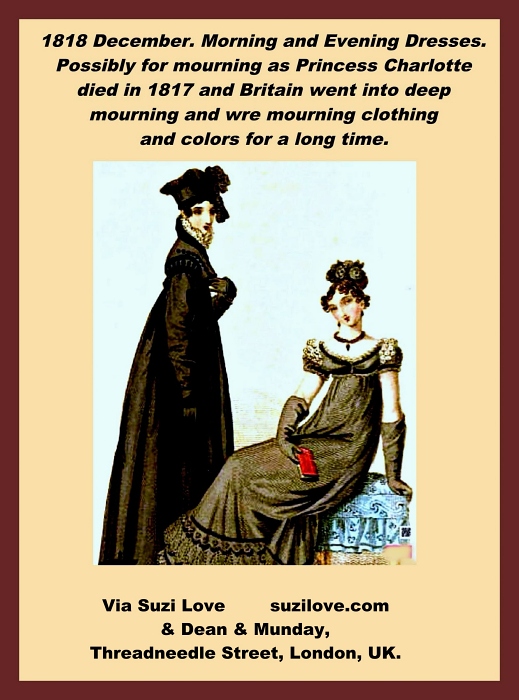
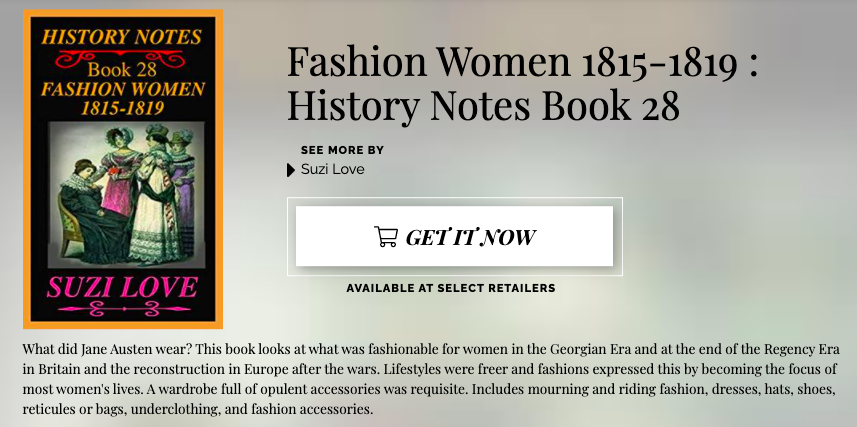
1818 December Morning and Evening Dresses, possibly for mourning as Princess Charlotte died in 1817. Published by Dean and Munday, Threadneedle Street, London, U.K.
Walking Dress is a plain high dress of black bombazine with long sleeves. Skirt trimmed on hem with a broad bias piece of black crape with narrow puffing of black crape. Sleeve hem has three narrow puffings of black crape. Fastens in front and ornamented on the bust with black crape, no collar but a very full mourning ruff of clear muslin. Over this dress is a Spanish coat of fine black Merino, cut tight to the body, short in the waist and trimmed with a row of black buttons on each side of the bust. Black velvet collar is finished round the edge with black crape, long sleeves of an easy fullness and trimmed at the wrist the same as the collar. Very tasteful epaulette is a mixture of black velvet and crape. Skirt is slightly full, trimmed up the fronts and round the hem with a broad band of black velvet, edged on each side by narrow rouleaux of black crape.
Dinner Dress is of black crape over a black sarsnet slip with a gored skirt, trimmed on the hem with black crape flounces, lower very narrow and higher considerably broader and surmounted by another narrow one. They are scalloped and finished at the edge by black satin, narrow rouleau of the same material heads top and bottom flounce. Corsage of black satin cut very low round the bust and waist and bust finished French style with points of black crape. Short full sleeve of black satin with three falls of black crape on the shoulder. Via Lady’s Monthly Museum ~ Dean & Mundy, Threadneedle Street, London, UK.
1818 December Morning and Evening Dresses, possibly for mourning as Princess Charlotte died in 1817. Published by Dean and Munday, Threadneedle Street, London, U.K.
1818 December Morning and Evening Dresses, Possibly For Mourning As Worn In Bridgerton and Jane Austen Times. #Bridgerton #JaneAusten #RegencyFashion #HistoricalFashion #Mourning https://books2read.com/SuziLoveFashionWomen1815-1819
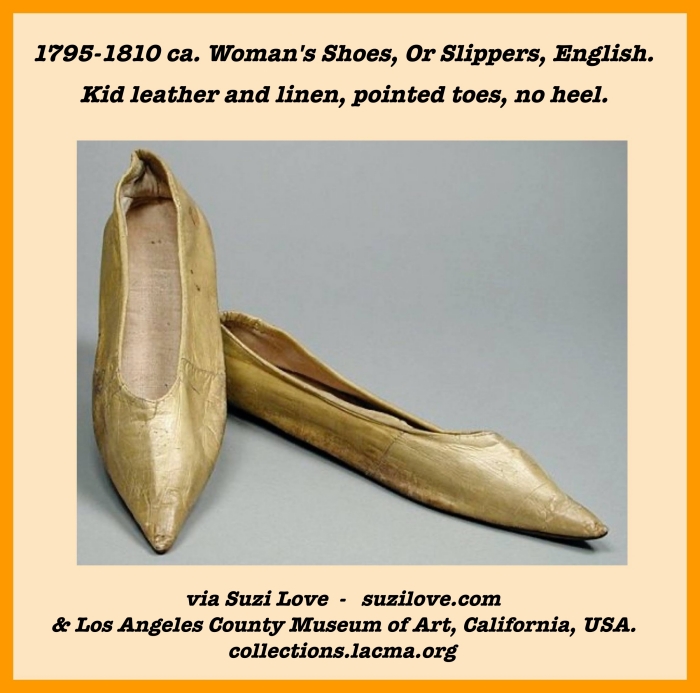
1795-1810 ca. Woman’s Shoes, Or Slippers, English. Kid leather and linen, pointed toes, no heel. via Los Angeles County Museum of Art, California, USA.
Digital Capture
1795-1810 ca. Jane Austen Style Woman’s Kid Leather Shoes, Or Slippers, English. #janeausten #shoes #regencyfashion https://books2read.com/SuziLoveFashionWomen1801-1804
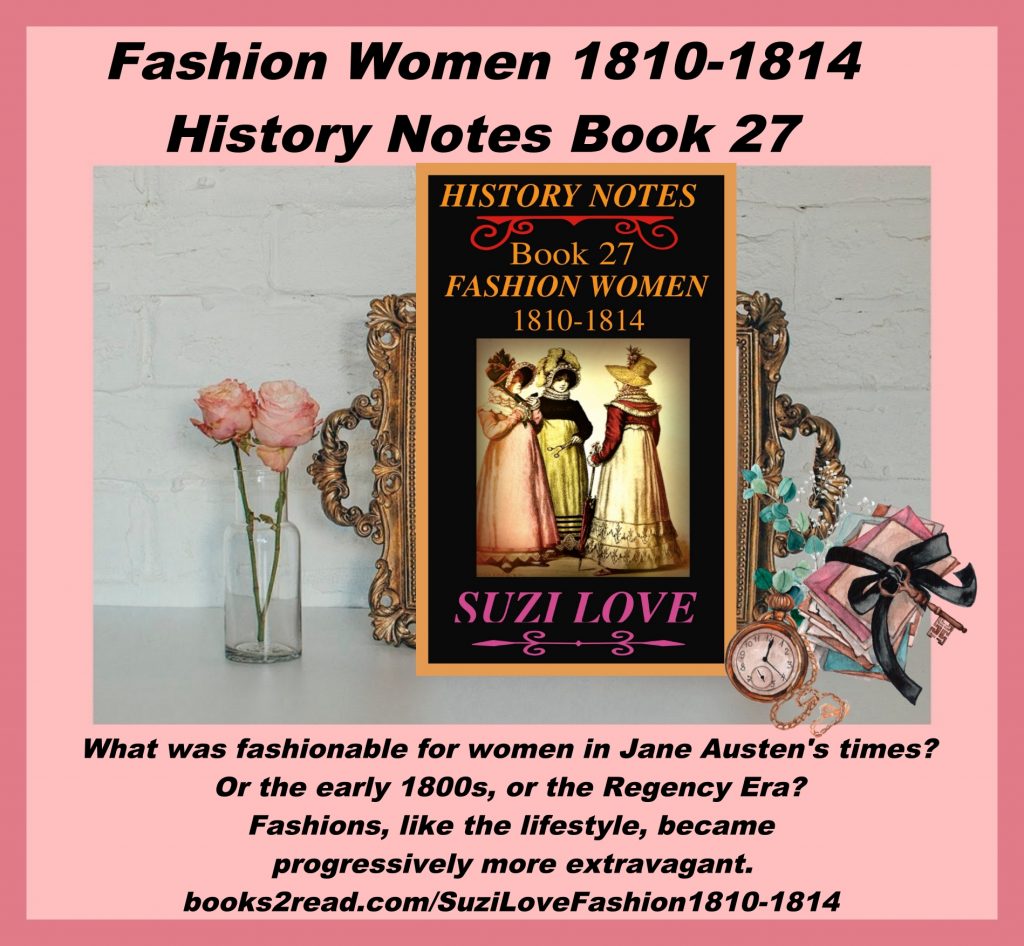
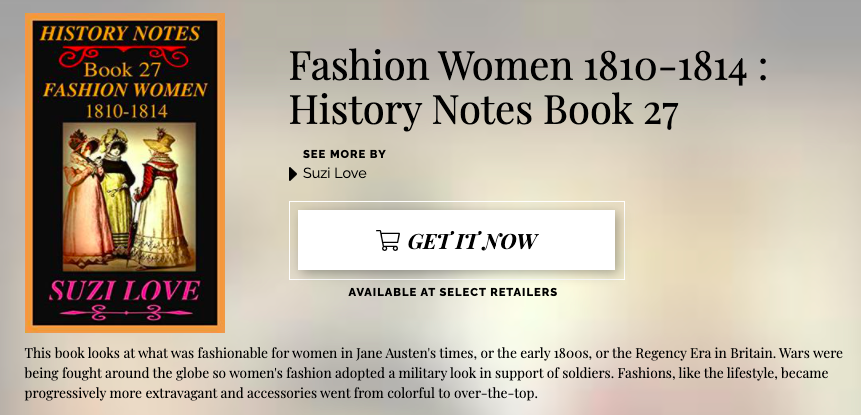
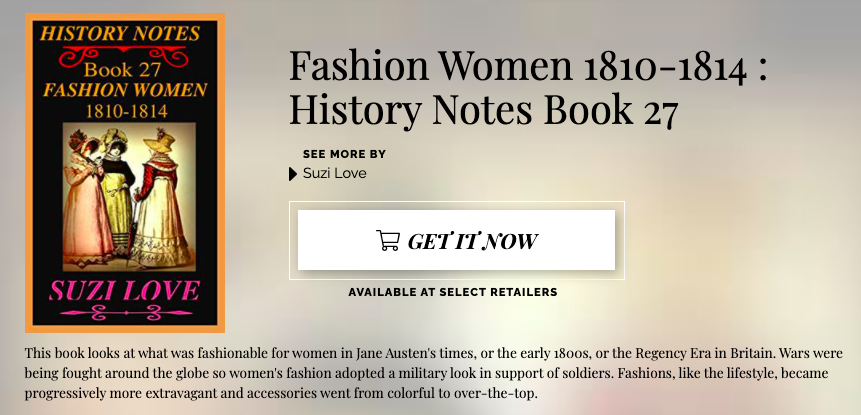
What was fashionable for women in Jane Austen’s times? Mourning, riding, daytime, evening clothing, plus underclothing, corsets and accessories. Fashion Women 1810-1814 History Notes Book 27 This book looks at what was fashionable for women in Jane Austen’s times, or the early 1800s, or the Regency Era in Britain. Wars were being fought around the globe so women’s fashion adopted a military look in support of soldiers. Fashions, like the lifestyle, became progressively more extravagant and accessories went from colorful to over-the-top. https://books2read.com/SuziLoveFashion1810-1814
The Lady’s Magazine said of the basis of women’s fashion that was popular for the first twenty years of the 1800s, ‘White is still the prevailing color for robes. For morning dresses, linen gowns, in large diamonds or squares, are fashionable. Indian muslins, plain or embroidered, are preferred to Florence and satins. The designs of embroidery for shawls are of infinite variety. Long gloves, which reach above the elbow, are not yet laid aside. Medallions are hung around the neck from crossed chains and some of these medallions are shaped like the bags, called ridicules. These reticules are of the lozenge or hexagon shape, with a small tassel at each angle. Reticules, or ridicules, are in lozenge or hexagon shapes with a small tassel at each angle. In capotes, or hats, and ribbands, the violet and dark green prevail over jonquil. Bracelets in hair, pear-shaped ear-rings, medallions on square plates, saltiers of colored stones, are still in fashion.’
What was fashionable in Bridgerton and Jane Austen times? Mourning, riding, daytime, evening fashion plus corsets and underclothing. #Bridgerton #RegencyFashion #JaneAusten https://books2read.com/SuziLoveFashion1810-1814
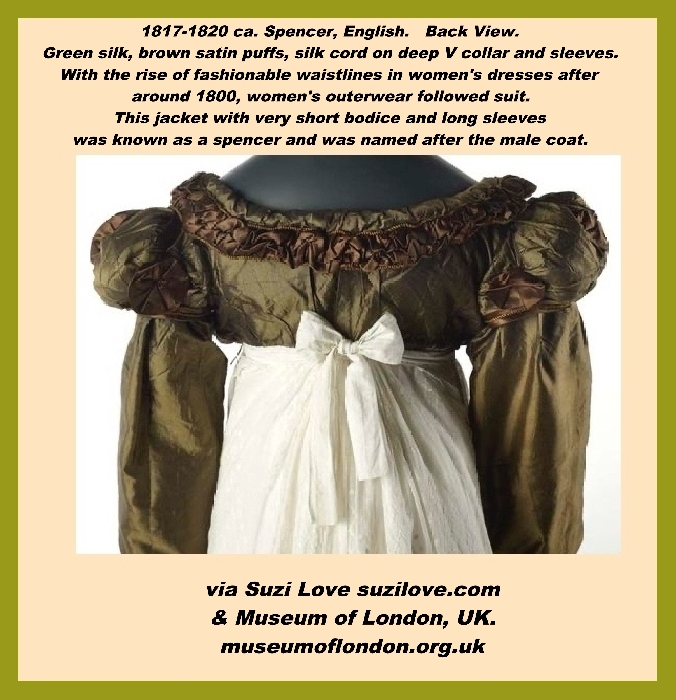
1817-1820 ca. Spencer, or Jacket, English. The sort of jacket worn by Jane Austen and friends over their loose Empire style dresses. Green silk Spencer, brown satin puffs, silk cord on deep V collar and sleeves. With the rise of fashionable waistlines in women’s dresses after around 1800, women’s outerwear followed suit. This jacket with very short bodice and long sleeves was known as a Spencer and was named after the male coat. via Museum of London, UK. museumoflondon.org.uk
Description Spencer: Short jackets worn for warmth over the high-waisted Empire style gowns that were popular after the French Revolution, where there was a shift away from opulence and decadence to simpler fashion. This jacket with very short bodice and long sleeves was known as a Spencer and was named after the male coat made famous by the Earl Spencer and said to have originated in accident to Lord Spencer in hunting when coat tails torn off and a cropped jacket was invented. The dresses in the early 1800s therefore became looser, lighter, and flowing and women became cold due to their very low cut and short bodices. Short fitted jackets that went easily over the dresses and provided extra modesty and some warmth. As Europe and many other parts of the world were deep in wars in the late 1700s and early 1800s, men in uniform were found everywhere. In support of these military men, fashions leaned towards military style shoulder paddings, shoulder embellishments, loops, buttons, and braids.
1817-1820 ca. Spencer, English. With the rise of fashionable waistlines in women’s dresses after around 1800, women’s outerwear followed suit. This jacket with very short bodice and long sleeves was known as a spencer. via Museum Of London.
1817-1820 ca. Jane Austen and Bridgerton Style Green Silk Spencer, Or Jacket, English. #Bridgerton #RegencyFashion #BritishFashion #JaneAusten https://books2read.com/SuziLoveFashionWomen1815-1819
1800-1820 ca. Small Pieces Of Drawing Room Furniture as would have been used in houses where Jane Austen lived. Side tables, book tables, chest and foot stool. Collage by Suzi Love.
1800-1820 ca. Small Pieces Of Drawing Room Furniture as Jane Austen and the Bridgertons would have used. #bridgerton #janeausten #RegencyEra #Furniture https://books2read.com/suziloveOLD
1810 ca. Cotton Dress Ensemble With Train, French. Cut out in back, lace shawl with sequins can be added to cover shoulders, small low cut bodice, all over embroidery and very short decorative sleeves. Front, Back and Side Views. via Metropolitan Museum New York City, U.S.A. metmuseum.org
1810 ca. Cotton Dress Ensemble With Train in Jane Austen style. #RegencyFashion #JaneAusten #historicalfashion https://books2read.com/SuziLoveFashion1810-1814
1820 ca. Typical Regency Wrap Corset.. Worn over a chemise. Cross-over fabric and lacing at the back. Tied around at the front. via Roger-Viollet Palais Galliera, Musée de la Mode de la Ville de Paris.
Corsets changed at the end of the Regency Era to fit well under clothing, give maximum support and comfort. Corsets pushed up breasts and showed off the bust line beneath a square-cut and low-cut neckline as in the early 1800s, or Regency years. The Bridgerton ladies, Jane Austen and their female friends would have worn this type of soft wrap corset. https://books2read.com/SuziLoveCorsetBook17.
1817 March. Opera Dress, English. The sort of outfit Jane Austen and her contemporaries or the Bridgerton women would wear for an evening at the opera or theatre. Fashion Plate via Rudolph Ackermann’s ‘The Repository of Arts’.
A blue crape dress over a white satin slip; the dress trimmed round the skirt with a deep blond lace, which is headed with a light and novel trimming, composed of white floss silk and small pearl beads: this trimming is surmounted with a beautiful deep embroidery of lilies, surrounded by leaves. The body and sleeves of this dress, as our readers will perceive by our print, are extremely novel. Head-dress, toque à la Berri; it is a crown of a novel form, tastefully ornamented round the top with lilies to correspond with the trimming of the skirt, and a plume of white feathers, which droop over the face. Ear-rings, necklace, and bracelets, sapphire mixed with pearl. The hair dressed in loose light ringlets on the forehead, and disposed in full curls in the back of the neck. White kid gloves, and white satin slippers.