1897 The Imperial Coronation Egg With A Surprise.Made By Mikhail Pushkin. Presented by Emperor Nicholas II to his wife Empress Alexandra Feodorovna as memento of entry to Moscow on May 26th, the day of the Coronation, in Uspensky Cathedral. Gold embellished with translucent yellow guilloché enamel.
Many Russian Easters were celebrated with Imperial monogramed eggs as the royals were very involved with both the religious celebrations of Easter and the family traditions. Fabergé eggs were jeweled eggs created by Peter Carl Fabergé and his company in Russia from 1885 to 1917. The most famous of the eggs are the ones made for the Russian Tsars, Alexander III and Nicholas II, as Easter gifts for their wives and mothers, often called the ‘Imperial’ Fabergé eggs. The House of Fabergé made about 50 eggs and 43 have survived. Another two were planned for Easter 1918, but because of the Russian Revolution were not delivered. After the Revolution, the Fabergé family left Russia and the Fabergé trademark has been sold several times since then. Several companies have sold Easter egg merchandise using the Fabergé name. The trademark is now owned by Fabergé Limited, which makes egg-themed jewelry.
1806 Silver and silver-gilt vinaigrette, Birmingham, England. Commemorating the Battle of Trafalgar in 1805. Rectangular with a hinged lid and a suspension loop. Gilded, pierced inner cover depicts HMS ‘Victory’ in relief inscribed ‘VICTORY’, ‘TRAFALGAR OCT 21 1805’. Via National Maritime Museum, Greenwich, London, U.K.
Vinaigrettes were used from the late 18th century through the 19th Century to revive a person who had fainted, having the vapors, or to mask unsanitary odors. Small containers, often a silver hinged box, held a tiny sponge dipped in an aromatic substance which had been dissolved in vinegar. The sponge was held beneath a grill or perforated cover so, by a flick of the fingers, the container was opened and the restorative substance held directly beneath a person’s nose. Jane Austen and her family and friends would have been very familiar with the use of vinaigrettes because Regency Era ladies were noted for having the vapors or fainting in hot ballrooms or dramatic situations. Ladies in the Romantic and Victorian Eras would have used them when tightly laced corsets became popular and ladies fainted because they were unable to draw in enough oxygen.
Both men and women used vinaigrettes in the late 1700s when people encountered foul aromas on a daily basis, but by the 1820s vinaigrettes were mainly used by women.These tiny containers were carried in a pocket, a reticule or bag, or suspended from the waist by chains as part of a chatelaine. Their sterling silver interiors were gilded to prevent discoloration from the acetic acid. Birmingham produced 90% of England’s silver vinaigrettes. As gold wasn’t affected by vinegar, craftsmen created some elaborate and decorative boxes on the container’s exteriors.
HN_11_D2D_Craftsmen created containers of precious metals, leather, silks, and decorated them with jewels to make exquisite and expensive items as well as practical carrying cases. books2read.com/suziloveBoxesCases
For many centuries, road travel was the main way of getting from place to place, but roads were notoriously rutted and badly maintained, especially in Britain. The Romans laid down the roads but they very poorly maintained through the 17th and 18th Centuries. It wasn’t until the 19th Century that improvements were made and rose travel opened up.
Roman Road Construction. Roman roads were constructed in layers. Rubble, slabs of stone, pebbles and gravel, smooth paving stones. Average width of road was 15 to 18 feet.
Roman Road Construction. Roman roads were constructed in layers. Rubble, slabs of stone, pebbles and gravel, smooth paving stones. Average width of road was 15 to 18 feet.
The dreadful condition of British roads caused great apprehension to all classes of travelers. Making a journey anywhere in the country was a big undertaking and often a gentleman composed his last will and testament before his departure. Traveling in vehicles was only possible during the day or on the nights with very bright moonlight with few vehicles attempting road travel in winter and any travel on a Sunday was frowned upon.
From: 1815 Journal of Tour of Great Britain by a French Tourist via Google Books (PD-180) ‘The roads very narrow, crooked, and dirty, continually up and down. The horses we get are by no means good, and draw us with difficulty at the rate of five miles an hour. We change carriages as well as horses at every post house. They are on four wheels, light and easy, and large enough for three persons. The post boy sits on a cross bar of wood between the front springs, or rather rests against it. This is safer, and more convenient both for men and horse, but does not look well and, as far as we have seen, English post horses and postillions do not seem to deserve their reputation.’
If you’ve read Jane Austen you’ll know that it was improper for a woman to travel alone, which meant that well-bred women were dependent on male relations to accompany them or else they had to take a maid in the carriage with her and be accompanied by a driver and footmen, which of course added to the cost of carriage travel. Any woman traveling by herself on a mail coach would be subject to speculation and probably malicious gossip.
Mail coaches raced across these roads trying to stick to a time table but there were numerous accidents on roads that were often flooded, covered in snow, or up such steep hills that passengers had to alight and either push the coach or walk ups the hill.
1790 Turnpike Gates In The Vicinity Of London, U.K.
Tolls were collected on many roads in Britain but, because the turnpikes were mainly on land belonging to the nobility, money collected went into their personal coffers and very little went to road maintenance. This caused a continual push in parliament to make those who owned the land and collected the money responsible for repairing their roads, but these pleas fell on deaf ears as the lords in who sat in parliament had no interest in spending money to better travel for the common people.
Description of Stage Coach Travel in England. via 1815 Journal Tour of Great Britain.
“The gentlemen-coachmen, with half-a dozen great coats about them,—immense capes,—a large nosegay at the button-hole,—high mounted on an elevated seat,—with squared elbows,—a prodigious whip, beautiful horses, four in hand, drive in a file to Salthill, a place about twenty miles from London, and return, stopping in the way at the several public-houses and gin-shops where stage-coachmen are in the habit of stopping for a dram, and for parcels and passengers on the top of the others as many as seventeen persons. These carriages are not suspended, but rest on steel springs, of a flattened oval shape, less easy than the old mode of leathern braces on springs. Some of these stage coaches carry their baggage below the level of the axletree.”
1825 Observations on the Management of Turnpikes by John Loudon Mc Adam. Via Google Books (PD-150)
1825 Observations on the Management of Turnpikes by John Loudon Mc Adam. Via Google Books (PD-150)
John Loudon McAdam, born Ayr, Scotland. (1756 -1836) He acted as a magistrate and assumed other civic roles including one as as trustee of the Ayrshire Turnpike in 1783, where he developed an interest in road construction and engineering, eventually becoming general surveyor for the Bristol Corporation in 1804. He wrote papers on the benefits of raising roads, making them from layers of stone and gravel, and giving priority to drainage. However, no roads were made this way until McAdam was put in charge of remaking the Bristol Turnpike in 1816, when he put his theories into practice and demonstrated macadamization, known as macadam. He made him numerous enemies on the Turnpike Trusts, who preferred to keep the money made from tolls rather than ploughing it back into road improvements but Macadam was soon in widespread use.
John Loudon McAdam (1756 – 1836), Scottish engineer and road-builder who started a new way of raising roads called ‘macadamization’. Via Wikimedia Commons.
John Loudon McAdam (1756 – 1836), Scottish engineer and road-builder who started a new way of raising roads called ‘macadamization’. Via Wikimedia Commons.
1825 John McAdam Observation of English Roads. “In a Country like England, inhabited by an ‘ intelligent people, well educated, active, and enterprising, where every hint at improvement is eagerly caught at and prosecuted with spirit, it is only possible to account for the apathy respecting Roads, and the want of exertion in prosecuting the means given for improvement, by showing that a strong counteracting principle exists in the defects of the Road Laws, and that although much want of encouragement has arisen from the prejudices of old practitioners— the great obstacle to success remains in the zealous opposition of those who profit by mismanagement in various ways.”
McAdam Report on Bristol District Roads, March, 1815.
Expenditure and Debt.
• 1802 – 1812 only two roads maintained themselves.
• Neither able to pay £100 of the debt they owed.
• No other roads supported themselves at all.
McAdam’s List of Reasons for Bad Roads.
• Ignorance and incapacity of Surveyors
• Lack of any control over the lavish spending of Road Trusts
• Trust accounts being in an inexplicable mess
• No system or scientific mode of constructing roads
• Every part of a road being differently formed
• Each road managed by a different person
• Each area managed by a different Turnpike Trust
• Winford Road Trust produced no account books
McAdam informed the Road Trusts that smooth roads were the most useful and lasted longer because carriages do little damage to a smooth road because the horses exert themselves less and the carriages do not rock and roll.
Unfortunately for travelers in the late 1700s and early 1800s, the smoothness of a road surface depended on the preparation and distribution of the road building materials used and was therefore entirely in the hands of each individual road-maker. In 1816, Mc Adam reported to the Bristol District the difference in revenue if roads were built of good material, regularly maintained, and if the finances of Turnpike Trusts were under someone’s control.
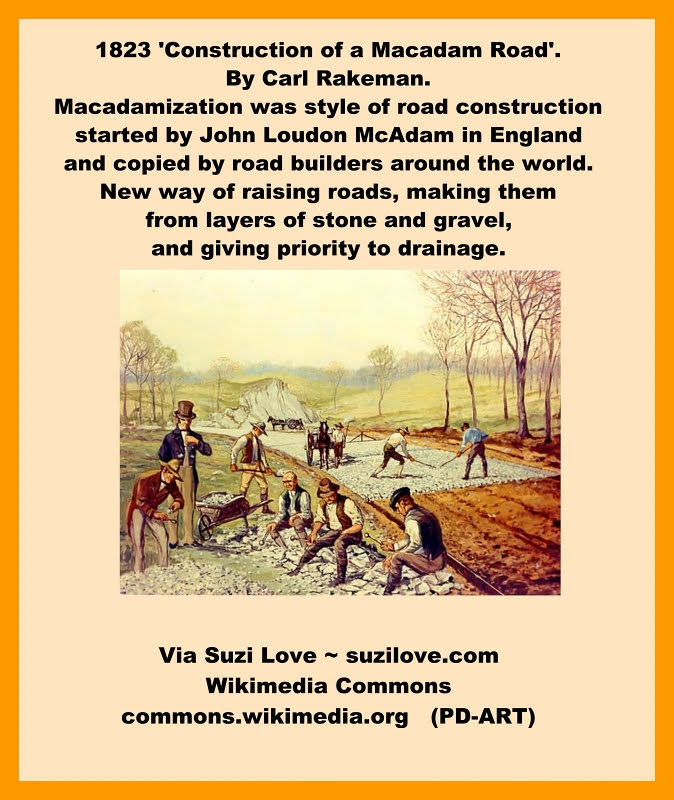
1823 ‘Construction of a Macadam Road’ by Carl Rakeman. Via Wikimedia Commons.
1823 ‘Construction of a Macadam Road’ by Carl Rakeman. Via Wikimedia Commons.
Travel on these roads was also dangerous as highwaymen stopped and robbed anyone who came along. Male or female made no difference to highwaymen in Britain, nor to the bushrangers in Australia or the gangs on American roads, as they robbed indiscriminately and often with violence.
By the end of the 18th Century, however, travel as a pleasurable pursuit came into vogue and numerous guides were written for traveling all over the British Isles as well as on the continent.
The 1812 ‘Tour Of Dr. Syntax’ was an ironic look at the new obsession of travel and travel guides. Before he set off for the Lake District, Dr. Syntax said to his wife, “You well know what my pen can do, and I’ll employ my pencil too: I’ll ride and write, and sketch and print and thus create a real mint: I’ll prose it here, I’ll verse it there and picturesque it everywhere. I’ll do what all have done before; I think I shall and somewhat more.”
Georgian and Regency travelers were envious of aristocrats, even if they were of the nobility themselves, and loved to view all the British Great Houses.
A gentleman and his wife would even drive up to the front door of a mansion house and demand to be given a tour of the house. If they weren’t admitted, they would write in their journals of the inhospitable nature of the people on a particular estate. Thomas Pennant, William Mavor, and others, loved to write about these bad experiences and have them published. Paterson’s British Itinerary, a travel guide had 17 editions between 1785-1832 – it outlined the roads used by the stage and mail coaches, the tolls, the bridges, etc.
This new touring craze created an industry of hospitality that encompassed more than simple mail coach trips from place to place, and more than a noble family traveling from their country seat to the Metropolis of London for parliamentary sittings. Inns had to improve the quality of the linens and meals if they wanted to attract the wealthier traveling class. Before that, many travelers carried their own linen, crockery, glasses, and utensils, as they didn’t trust the hygiene or standards of country inns.
Travel became something written about by poets with many sonnets written to the beauty of places like the Lake District in England, or the pyramids in Egypt. Inns became cleaner and more respectable so they could welcome travelers of the upper classes. This also meant that women could travel more as roads were slowly improved from rutted tracks that were only suitable for horse riding to roads that family coaches could travel along, though these roads were still narrow and subject to extremes of weather, such as flooding. The race was on to travel from places like London to Edinburgh in the fastest possible time.
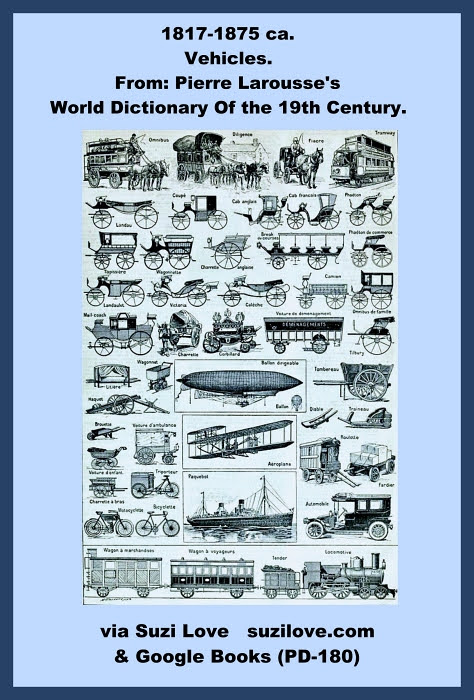
1817-1875 ca. Vehicles. From: Pierre Larousse’s World Dictionary Of the 19th Century.
1920-1922 ca. Automobiles.
HN_10_D2D_RetailerBuyLink_ History Notes Book 10 books2read.com/SuziLoveTravel
1820-1830 ca. Mother Of Pearl sewing casket with a painted view of Weilburg near Baden in Austria. Painting by Balthasar Wigand.
From The Curator: The mother-of-pearl industry in Vienna reached its apogee during the 1820s and 1830s, when numerous luxury items such as candle screens and desk sets were embellished with the iridescent material. Balthasar Wigand, responsible for the miniature on the lid of this box, specialized in views of the city and its surroundings, painted especially for use on small pieces of furniture and caskets. via Metropolitan Museum New York City, U.S.A. metmuseum.org
1820-1830 ca. Sewing casket with view of Weilburg near Baden in Austria. Painting by Balthasar Wigand. via Metropolitan Museum New York City, U.S.A. metmuseum.org
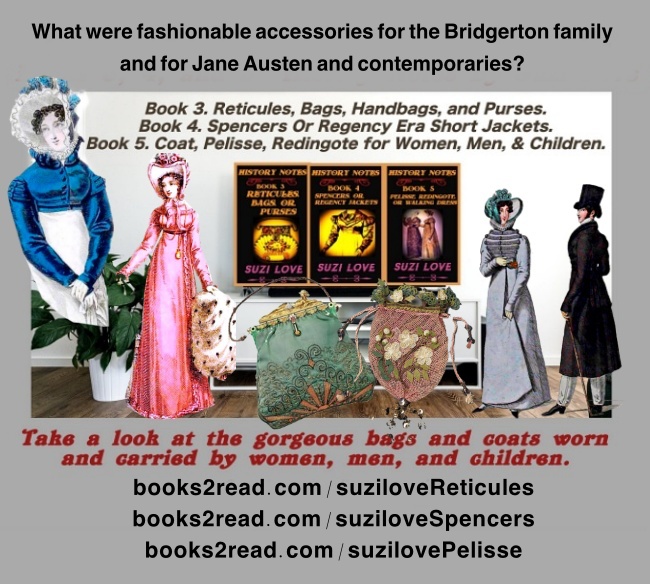
Fashion Must Haves In Jane Austen’s Times: Reticules, Spencers, Redingotes. History Notes Series Books 3, 4, and 5.
Reticule Or Bag: Purse, often with a drawstring to pull closed and usually made of cloth or covered cardboard and often decorated with beading or embroidery. Carried by a woman during the Regency period to carry all their daily necessities. in the place of pockets.
Spencer: Short jacket, cropped at the waist, worn over a dress, or gown. Delicate and regency dresses provided so little protection from the cold, so over garments were essential for warmth, modesty and good health.
Pelisse Or redingote Or Walking Dress: Coat worn over clothing of both sexes for warmth and protection from the elements.
Do you need more factual and visual information for your historical fiction? Try History Notes Books 1-13. Non-fiction Series: Fashion, music and social manners in the 18th and 19th centuries e.g.
Want a glimpse into the life of a young lady in Jane Austen and the Bridgerton years? #bridgerton #RegencyEra #JaneAusten
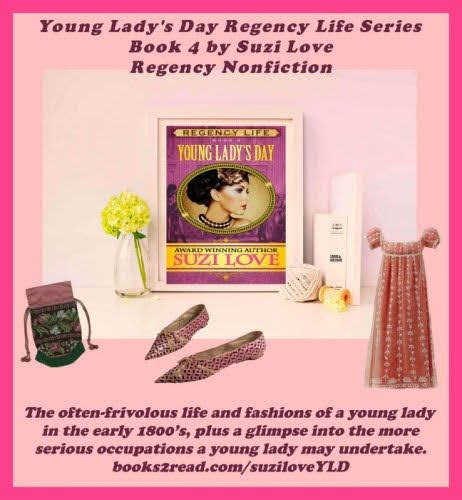
Young Lady’s Day is Book 4 in the Regency Life Series. This book depicts the often-frivolous life and fashions of a young lady in the early 1800’s, but also gives a glimpse into the more serious occupations a young lady may undertake. Through historic images, historical information, and funny anecdotes, it shows how a young lady fills her day, where she is permitted to go, and who she is allowed spend time with. These light-hearted looks at the longer Regency years are an easy to read overview of what people did and wore, and where they worked and played. There is plenty of information to interest history buffs, and lots of pictures to help readers and writers of historical fiction visualize the people and places from the last years of the 18th Century until Queen Victoria took the throne. https://books2read.com/suziloveYLD
1750-155 ca. Writing Cabinet, Probably by Michael Kimmel, Germany. Veneered in kingwood, marquetry of mother-of-pearl, ivory and brass on pine, stained alder or birch. Mounted in gilt brass and with giltwood, carving of cypher of Augustus III. via suzilove.com Victoria and Albert Museum, London, UK. collections.vam.ac.uk.
HN_13_D2D_WritingTools Book 13 What did the lady of the house use to pen notes? What sat on the desk of the man of the house when managing his accounts? #History #Nonfiction #travel books2read.com/SuziLoveWritingTools
1700 ca. Chess and Backgammon Box, Augsburg. Decorated in violet wood veneer, ebony and ivory. Ivory checkers and chess pieces, hinges and push button lock in gilded brass, two horn goblets, two ivory dice, thirty-none checkers’ pawns stamped both sides with effigies of cities, Munich, Vienna, Nuremberg, Prague, Danzig, of kings and queens, Prussia, England, Scotland, Poland, and various scenes. Via AnticStore.com
This book depicts the often-frivolous life and fashions of a young lady in the early 1800’s, but also gives a glimpse into the more serious occupations a young lady may undertake. Through historic images, historical information, and funny anecdotes, it shows how a young lady fills her day, where she is permitted to go, and who she is allowed spend time with. These light-hearted looks at the longer Regency years are an easy to read overview of what people did and wore, and where they worked and played. There is plenty of information to interest history buffs, and lots of pictures to help readers and writers of historical fiction visualize the people and places from the last years of the 18th Century until Queen Victoria took the throne. Young Lady’s Day Regency Life Series Book 4 by Suzi Love. https://books2read.com/suziloveYLD
Young Lady’s Day Regency Life Series Book 4 by Suzi Love. #regency #nonfiction
An early 1800’s glimpse into both the frivolous and more serious occupations filling a young lady’s day. Historic images and historical information show her fashions and frolics.
https://books2read.com/suziloveYLD