1829 July 4th George Shillibeer’s Omnibus, London, U.K. First Omnibus between Paddington and Bank of England via the New Road, now Marylebone Rd., Somers Town and City Rd. Via Wikimedia Commons. books2read.com/SuziLoveTravel



1829 July 4th George Shillibeer’s Omnibus, London, U.K. First Omnibus between Paddington and Bank of England via the New Road, now Marylebone Rd., Somers Town and City Rd. Via Wikimedia Commons. books2read.com/SuziLoveTravel
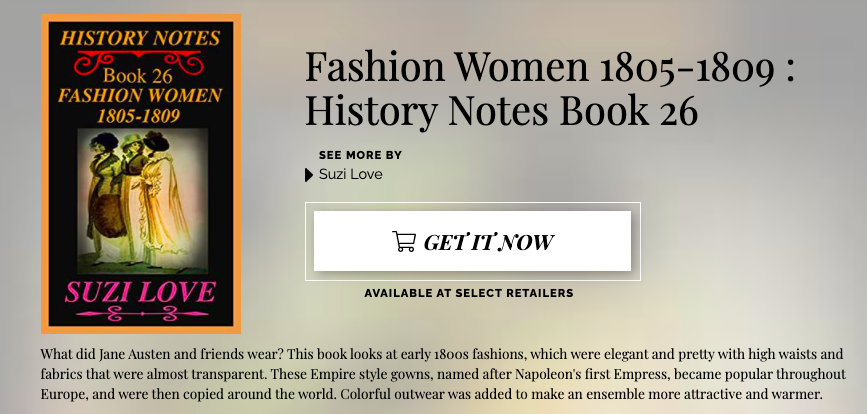
What did Jane Austen and friends wear? Early 1800s fashions were elegant and pretty with high waists and fabrics that were almost transparent. These Empire style gowns, named after Napoleon’s first Empress, became popular throughout Europe, and were then copied around the world. Colorful outwear was added to make an ensemble more attractive and warmer. History Notes Book 26 Fashion Women 1805-1809.
https://books2read.com/SuziLoveFashionWomen1805-1809
The Empire waist gown defined women’s fashion during the Regency Era. ‘Empire’ is the name given in France to the period when Napoleon built his French Empire. High-waisted, loose gowns were adopted by the aristocracy as a symbol of turning away from the fussy, elaborate and expensive clothing worn in the 1700s. Jean-Jaques Rousseau advocated copying peasants and returning to a simpler life and more natural fashions. Unrestricting clothing was part of the new Democracy in France and these simpler and flowing fashions were adopted all over Europe, including Britain and despite the continual wars being fought against France during the early 1800s. Not even war stopped fashions from being copied everywhere.

1815 The First Quadrille at Almack’s Assembly Rooms, London. Left to Right: Marquis of Worcester, Lady Jersey, Clanronald MacDonald and Lady Worcester. “It was not until 1815 that Lady Jersey introduced from Paris the favourite quadrille, which has so long remained popular. I recollect the persons who formed the very first quadrille that was ever danced at Almack’s: they were Lady Jersey, Lady Harriett Butler, Lady Susan Ryde, and Miss Montgomery; the men being the Count St Aldegonde, Mr Montgomery, Mr Montague, and Charles Standish.” From The Reminiscences of Captain Gronow 1810-1860.
The patronesses of Almack’s controlled a lot of a young lady’s acceptance into English society in Jane Austen’s times. To be given a voucher and admitted to an assembly, there was an introduction into London’s polite society.


1800-1830 ca. Reticule, or Bag, American. Bottom of bag shaped like basket and made of stiff deep cream colored mohair with minute blue figure, two panels of light blue painted silk moiré, upper part of bag of deep cream colored figured silk, blue silk ribbon, drawstring and bows trimming lower part of bag. via Museum of Fine Arts, Boston, U.S.A. mfa.org
Definition Reticule Or Ridicule Or Bag or Purse: Often with a drawstring to pull closed and usually made of cloth or covered cardboard and often decorated with beading or embroidery. A reticule, or purse, or handbag, was usually carried by a woman during the Regency period to carry all their daily necessities. Earlier, women used pockets that tied at the waistline and were hidden in the folds of their skirts. Empire style, or early 1800s, high-waisted dresses made it impossible to either sewn in a pocket or to tie on a pocket. So women began carrying small, decorated bags called Reticules, or ridicules, which generally pulled close at the top with a drawstring.


1817 Evening Mourning Dress, English. Black short length dress, layers of feathers on the skirt, long lace headdress falling from an upswept hairstyle and black shoes. Fashion Plate via John Belle’s La Belle Assemblée or, Bell’s Court and Fashionable Magazine, London.
Mourning – Full Or Deep Mourning: Entire ensemble and accessories must be black. Shiny fabrics were not allowed so bombazine became the fabric of choice for many. Hats had veils added and jet was the preferred jewelry.
Mourning – Half or Slight Mourning: allowed touches of grey and white to be added to full, or deep, mourning ensembles. Some lustre, or shine, was allowed in fabrics and accessories. After a time, mauve or deep purple could also be worn.

What did Jane Austen and friends wear? Early 1800s fashions were elegant and pretty with high waists and fabrics that were almost transparent. These Empire style gowns, named after Napoleon’s first Empress, became popular throughout Europe, and were then copied around the world. Colorful outwear was added to make an ensemble more attractive and warmer. History Notes Book 26 Fashion Women 1805-1809.
https://books2read.com/SuziLoveFashionWomen1805-1809
The Empire waist gown defined women’s fashion during the Regency Era. ‘Empire’ is the name given in France to the period when Napoleon built his French Empire. High-waisted, loose gowns were adopted by the aristocracy as a symbol of turning away from the fussy, elaborate and expensive clothing worn in the 1700s. Jean-Jaques Rousseau advocated copying peasants and returning to a simpler life and more natural fashions. Unrestricting clothing was part of the new Democracy in France and these simpler and flowing fashions were adopted all over Europe, including Britain and despite the continual wars being fought against France during the early 1800s. Not even war stopped fashions from being copied everywhere.
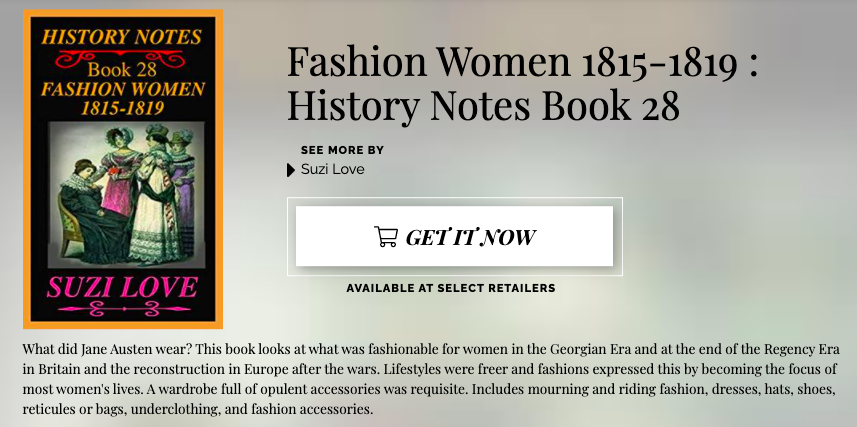
What was fashionable for women in Jane Austen’s times? Mourning, riding, daytime, evening clothing, plus underclothing, corsets and accessories. Wars were being fought so women adopted military looks in support of soldiers. https://books2read.com/SuziLoveFashion1810-1814

1812 Woman wearing an extraordinary hat, flounced dress and a cashmere shawl. 1801-1818 Le Bon Genre Fashion Series Plate 50. Published by: Pierre La Mésangère. Via British Museum, London, UK. britishmuseum.org (PD-Art)

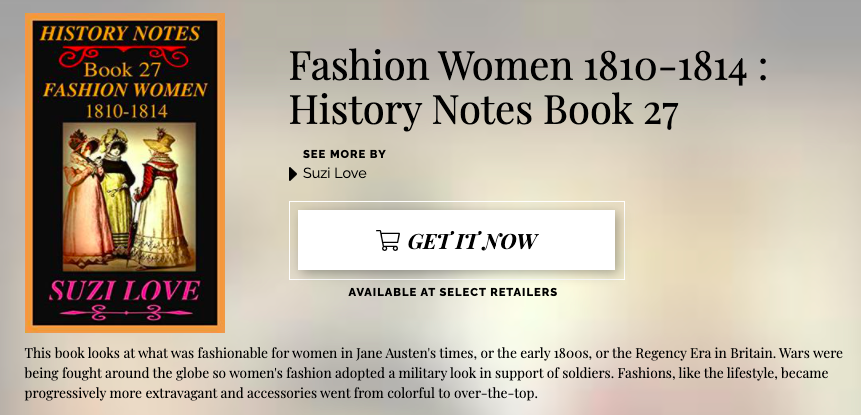
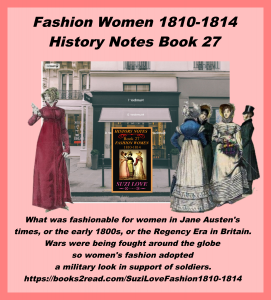
Fashion Women 1810-1814 History Notes Book 27 This book looks at what was fashionable for women in Jane Austen’s times, or the early 1800s, or the Regency Era in Britain. Wars were being fought around the globe so women’s fashion adopted a military look in support of soldiers. Fashions, like the lifestyle, became progressively more extravagant and accessories went from colorful to over-the-top. https://books2read.com/SuziLoveFashion1810-1814
1787 St. George’s Church, Hanover Square, London, U.K. By T. Malton. A favorite place to be married for the Regency aristocracy during Bridgerton and Jane Austen times, but also a haunt of pickpockets.
From the Edinburgh Annual Register 1810: Complaints have been made of numerous robberies, by daring gangs of pickpockets in the daytime, in the public streets, also at churches, chapels, and meetings, particularly at St. George’s church, Hanover-square. The Countess of Aylesford, and several other ladies of distinction, having been robbed there, mentioned the circumstances to Townsend, the officer. The Countess of Aylesford said, she had no doubt but she was robbed by a short fat woman. Townsend went to the church and observed Mary Blakeman, alias Hills, a well-known female pickpocket, genteelly dressed in a black velvet pelisse and a cottage straw bonnet. When he called her outside, no stolen property was found on her person, despite him knowing her to be a thief for 25 years.

